
20+ Joyful STEM Toddler Activities for Early Learning
 By Speech Blubs Team•Mar 18, 2026•13 min.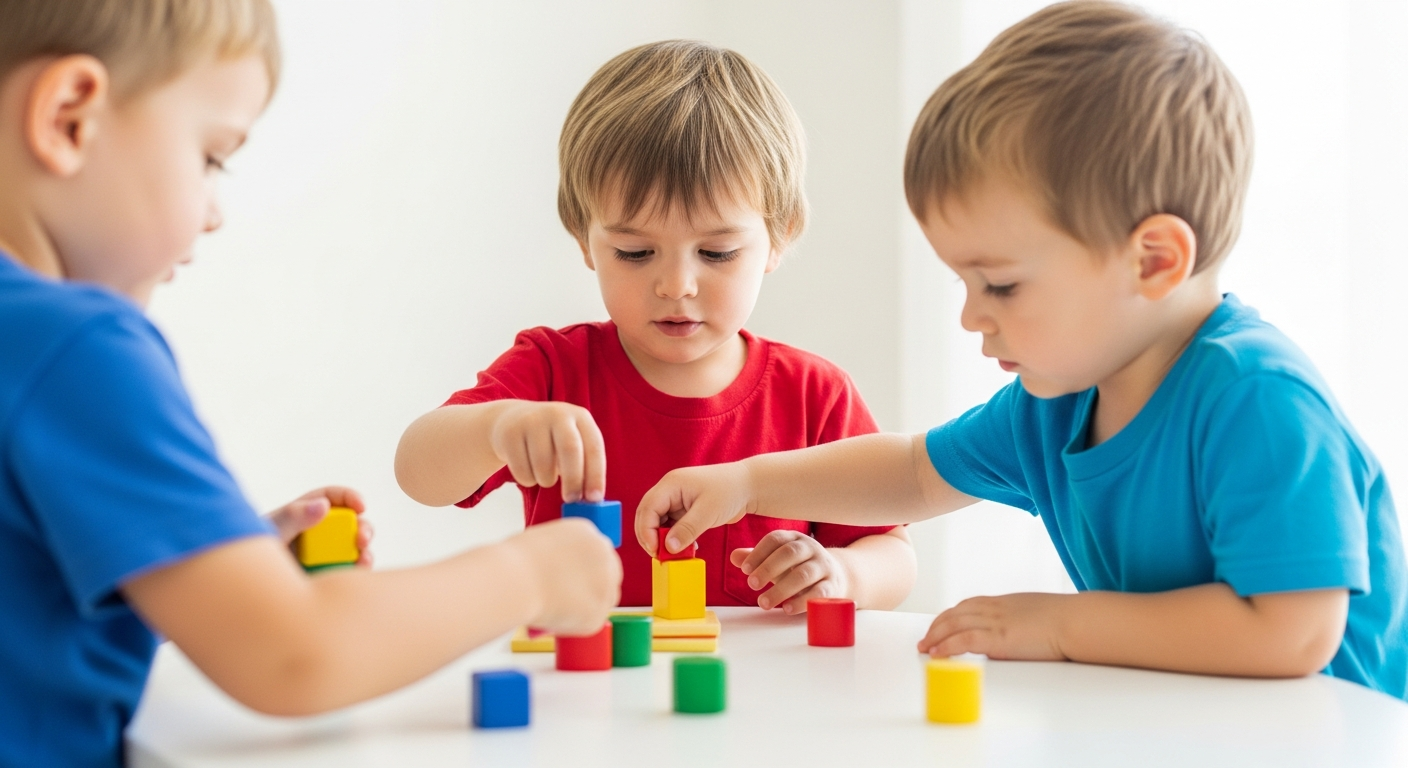
Table of Contents
- Introduction
- What Does STEM Really Mean for a Toddler?
- The Connection Between STEM and Speech Development
- 20+ Creative STEM Toddler Activities
- Fostering a Growth Mindset Through STEM
- Practical Scenarios: Connecting Play to Speech Blubs
- Why Choose Speech Blubs for Your Toddler’s STEM Journey?
- Setting Realistic Expectations
- Frequently Asked Questions
- Conclusion
Introduction
Did you know that a toddler dropping their spoon from a high chair over and over again isn't just trying to test your patience? They are actually performing their very first physics experiment! They are observing gravity, cause and effect, and the trajectory of an object in motion. At this age, every "clunk," "splash," and "crash" is a data point in their growing understanding of the world. Research shows that early exposure to math and science concepts isn't just about preparing for school; it actually predicts future academic success in both literacy and numeracy.
In this post, we are going to explore a wide variety of stem toddler activities that you can do right at home. We will cover why these activities matter, how they connect to speech development, and how you can use everyday items to spark a lifelong love for discovery. Our goal at Speech Blubs is to empower children to speak their minds and hearts, and we believe that curiosity is the loudest voice a child has. By the end of this article, you will have a full toolkit of play-based ideas that turn your living room into a laboratory of joy.

What Does STEM Really Mean for a Toddler?
When we hear the word STEM (Science, Technology, Engineering, and Math), we often think of high-tech laboratories or complex equations. However, for a two or three-year-old, STEM is much simpler. It is about the "How" and "Why" of their daily lives.
- Science is about observing the natural world—watching a bug crawl or seeing ice melt.
- Technology is about using tools to solve problems—using a stool to reach the sink or a spoon to stir.
- Engineering is about building—stacking blocks to see how high they can go before they topple.
- Math is about patterns, shapes, and counting—sorting socks by color or noticing the roundness of an orange.
At Speech Blubs, we understand that these foundational skills are deeply intertwined with communication. To ask "Why?" or to describe a "big, blue ball," a child needs both the observation skills of a scientist and the language skills of a communicator. Our company was born from the personal experiences of our founders, who all grew up with speech challenges and created the tool they wished they had. We believe in "smart screen time" that encourages children to interact with the world around them rather than passively consuming it.
The Connection Between STEM and Speech Development
Many parents are surprised to learn that STEM toddler activities are incredible for language growth. When a child engages in a hands-on experiment, they are naturally motivated to use new vocabulary. They aren't just learning "words"; they are learning "concepts."
For example, for a parent whose 3-year-old "late talker" loves animals, the "Animal Kingdom" section of our app offers a fun, motivating way to practice "moo" and "baa" sounds. When you take that interest outside for a "nature scavenger hunt" (a classic STEM activity), the child connects the digital peer they saw in the app with the real-life cow or sheep they see in a field. This is the power of our unique "video modeling" methodology, where children learn by watching and imitating their peers. You can download Speech Blubs on the App Store to see this science in action.

20+ Creative STEM Toddler Activities
Science: Exploring the Wonders of Nature
1. The "Sink or Float" Experiment Fill a large plastic bin or your bathtub with water. Gather various household items: a metal spoon, a plastic toy, an apple, a rock, and a sponge. Before dropping each item, ask your toddler, "What do you think? Sink or float?"
- STEM Concept: Buoyancy and density.
- Speech Tip: Use descriptive pairs like "heavy/light" and "up/down."
2. Ice Age Dinosaur Rescue Freeze small toy dinosaurs or animals in a large container of water overnight. Give your toddler "tools" like a spray bottle of warm water, a small mallet (supervised), and some salt. Their mission is to rescue the animals from the ice.
- STEM Concept: States of matter (solid to liquid).
- Speech Tip: Practice words like "cold," "frozen," "melt," and "help!"
3. Color Mixing Magic Fill three clear cups with water and add a few drops of primary food coloring (red, blue, yellow) to each. Let your toddler use a dropper or a small spoon to mix the colors in a separate empty cup.
- STEM Concept: Chemistry and color theory.
- Speech Tip: "Red and blue make purple!" Focus on the transition words "then" and "now."
4. The Sensory Nature Walk Go outside with a simple egg carton. Paint each slot a different color and ask your toddler to find something in nature that matches that color (a yellow leaf, a gray rock, a green blade of grass).
- STEM Concept: Classification and biology.
- Speech Tip: Use the 5 senses. "How does the leaf feel? Is it crunchy?"
5. Shadow Dancers On a sunny day or using a bright flashlight in a dark room, show your toddler how to make shadows. Move your hands closer and further from the light to see the shadow grow and shrink.
- STEM Concept: Light and optics.
- Speech Tip: "Look, the shadow is BIG!" or "Now it's small."
Technology: Understanding How the World Works
6. "Smart Screen Time" with Peer Modeling In a world of passive cartoons, we offer a screen-free alternative to mindless viewing. Using Speech Blubs, your child watches other children perform tasks, make sounds, and solve puzzles. This activates "mirror neurons," which are essential for learning new skills. Our method is backed by science and designed to be a joyful family connection tool.
- STEM Concept: Observation and digital literacy.
- Speech Tip: Sit with your child and imitate the kids on the screen together.
7. Flashlight Investigations Give your child a toddler-safe flashlight and let them explore a "dark" room (like a closet or a room with curtains drawn). Encourage them to find specific objects.
- STEM Concept: How tools (technology) help us see in different environments.
- Speech Tip: Use directional words like "on," "off," "up," and "under."
8. Magnet Fishing Tie a strong magnet to a string and attach the string to a stick. Fill a box with various items—some magnetic (paperclips, metal spoons) and some not (plastic blocks, fabric). Let them "fish" for the magnetic items.
- STEM Concept: Magnetism and physics.
- Speech Tip: "It stuck!" vs "It fell."
9. The "How It Works" Station Collect old (safe) items like a manual egg beater, a large calculator, or an old telephone. Let your child push buttons and turn cranks to see what happens.
- STEM Concept: Mechanical engineering and cause/effect.
- Speech Tip: Use verbs: "push," "turn," "spin," "click."
Engineering: Building and Problem Solving
10. Cardboard Box Forts Never underestimate a large delivery box. Encourage your child to help you figure out how to make a door or a window.
- STEM Concept: Structural engineering and spatial awareness.
- Speech Tip: "In" and "out." "Is the door big enough for me?"
11. The Great Block Tower Challenge your child to build the tallest tower possible. When it falls (and it will!), talk about why it fell. "Was the bottom too small?"
- STEM Concept: Balance and stability.
- Speech Tip: Count the blocks as you stack them. "One... two... three... CRASH!"
12. Toy Car Ramps Use books, cardboard, or even an ironing board to create ramps of different heights. Roll cars down and see which one goes the farthest.
- STEM Concept: Gravity, friction, and slope.
- Speech Tip: "Fast" and "slow." "Ready, set, go!"
13. Magnetic Tile Mazes If you have magnetic tiles, build a simple maze on the floor and try to guide a marble or a small ball through it.
- STEM Concept: Spatial planning and design.
- Speech Tip: "Go left," "go right," "stop!"
14. Bridge Building for Animals Using two stacks of blocks as "land" and a piece of cardboard as the "bridge," help your child create a way for their toy animals to cross the "river" (a blue towel).
- STEM Concept: Engineering and load-bearing.
- Speech Tip: "Cross the bridge." "Is it strong?"
Math: Patterns, Shapes, and Numbers
15. Muffin Tin Sorting Give your toddler a muffin tin and a bowl of colorful pom-poms or large pasta shapes. Ask them to sort the items by color or size into the different holes.
- STEM Concept: Sorting, classifying, and set theory.
- Speech Tip: Color names and size adjectives (big, medium, tiny).
16. Shape Hunter Walk Take a walk around the neighborhood specifically looking for one shape, like a circle. Point out tires, manhole covers, and the sun.
- STEM Concept: Geometry.
- Speech Tip: "I see a round tire!"
17. Kitchen Calculations While you are cooking, involve your toddler. "I need three carrots. Can you help me count them?" Or, "Is this cup full or empty?"
- STEM Concept: Volume, measurement, and counting.
- Speech Tip: "Full," "empty," "more," "all gone."
18. Pattern Making with Snacks Using crackers and grapes, create a pattern (cracker, grape, cracker, grape) and see if your child can "predict" what comes next.
- STEM Concept: Algebraic thinking (patterns).
- Speech Tip: Say the pattern out loud together to build rhythm and sequencing.
19. Measuring with Feet Instead of a ruler, use your toddler's feet to measure things. "How many 'toddler feet' long is the rug?"
- STEM Concept: Measurement and units.
- Speech Tip: "Long," "short," "many," "few."
20. The "Which One is Different?" Game Place three blue blocks and one red block on the floor. Ask your child to point to the one that doesn't belong.
- STEM Concept: Logic and discrimination.
- Speech Tip: "This one is red. These are blue."
Fostering a Growth Mindset Through STEM
The most important part of any STEM toddler activity isn't the final result—it’s the process. When a tower falls or a "sink or float" prediction is wrong, that is a golden opportunity for learning. Instead of saying "That's wrong," we can say, "Oh! Look what happened! Why do you think it did that?"
This approach builds confidence and reduces the frustration that often comes with speech delays. When children feel like "scientists," they are more willing to take risks with their words. See what other parents are saying about how this confidence-building approach has helped their families by visiting our testimonials page.
Practical Scenarios: Connecting Play to Speech Blubs
Let’s look at how we can bridge these physical activities with our digital tools for a comprehensive learning experience:
- The Busy Builder: If your child spends all afternoon building with blocks (Engineering), they will love the "Big Wheels" or "Building Blocks" sections in Speech Blubs. They can watch other children name the tools and parts, reinforcing the vocabulary they just used while playing.
- The Nature Lover: If your child is obsessed with your "Nature Scavenger Hunt," use the "Animal Kingdom" or "Living World" sections. After seeing a bird outside, they can practice the "Tweet tweet" sound with a peer on the screen.
- The Late Talker: If your child is struggling to find words, STEM activities provide a low-pressure environment. If you’re unsure where your child stands, we recommend taking our quick 3-minute preliminary screener. It involves 9 simple questions and provides an assessment and a next-steps plan to support your child’s development.
Why Choose Speech Blubs for Your Toddler’s STEM Journey?
We know that parents are looking for the best value and the most effective tools. While there are many apps out there, we pride ourselves on being a "smart" solution that blends scientific principles with pure play.
We offer two main ways to join our community:
- Monthly Plan: $14.99 per month. This is a great way to test the waters.
- Yearly Plan: $59.99 per year. This is our best value option, breaking down to just $4.99 per month—a 66% savings compared to the monthly plan.
When you choose the Yearly Plan, you don't just get the Speech Blubs app; you get a comprehensive educational suite. This includes:
- A 7-day free trial to explore everything risk-free.
- The Reading Blubs app, which helps transition those early speech skills into literacy.
- Early access to all new updates and features.
- Priority 24-hour support response time from our dedicated team.
Ready to get started? Create your account and begin your 7-day free trial today.
Setting Realistic Expectations
As a child development expert, it’s important to remember that every child moves at their own pace. STEM toddler activities are not about creating a mini-engineer in a month; they are about fostering a love for communication and building foundational skills.
Using Speech Blubs as a supplement to your overall development plan—and, when applicable, professional therapy—can create joyful family learning moments. We don't promise overnight "public speaking" skills; we promise a tool that makes the journey toward those milestones more engaging and less frustrating for both you and your child.
Frequently Asked Questions
1. Is my toddler too young for STEM activities? Absolutely not! STEM for toddlers is simply about exploration. If your child is curious about why a ball rolls or how water feels, they are already doing STEM. The activities we've listed are designed for children as young as 18 months, focusing on sensory play and basic observation.
2. How much screen time is healthy for a 2-year-old? The American Academy of Pediatrics suggests limiting screen time and focusing on "high-quality programming" when it is used. At Speech Blubs, we focus on "active" rather than "passive" screen time. Our app is designed for co-play, meaning you and your child use it together to spark real-world imitation and conversation.
3. What if my child gets frustrated when their "engineering" projects fail? Frustration is a natural part of the learning process. Use these moments to model "emotional intelligence." Say things like, "It's okay to be sad the tower fell. Let's try a bigger block on the bottom this time!" This teaches problem-solving and resilience, two core STEM traits.
4. How do I know if these activities are actually helping my child's speech? The best indicator is your child’s engagement and attempt to use new sounds or words. If you want a more formal way to track progress, you can use our preliminary screener every few months to see how their communication skills are evolving.
Conclusion
Incorporating stem toddler activities into your daily routine doesn't require a Ph.D. or a closet full of expensive toys. It just requires a little bit of curiosity and a lot of play. Whether you are counting carrots in the kitchen, rescuing dinosaurs from ice, or exploring "Animal Kingdom" in the Speech Blubs app, you are building the neural pathways that your child will use for the rest of their life.
By focusing on the process—the "Why" and the "How"—you are giving your child the gift of confidence. You are teaching them that their voice matters and that the world is a wonderful place to explore. We invite you to join our mission to help every child speak their mind and heart.
Take the first step today! Download Speech Blubs on Google Play or the App Store and start your 7-day free trial. For the best value and access to our full suite of tools, including Reading Blubs and 24-hour support, make sure to select our Yearly Plan. Let’s turn screen time into "smart time" and play time into "discovery time" together!
About the author