
Best Delayed Speech Toys to Help Your Child Start Talking
 By Speech Blubs Team•Mar 12, 2026•12 min.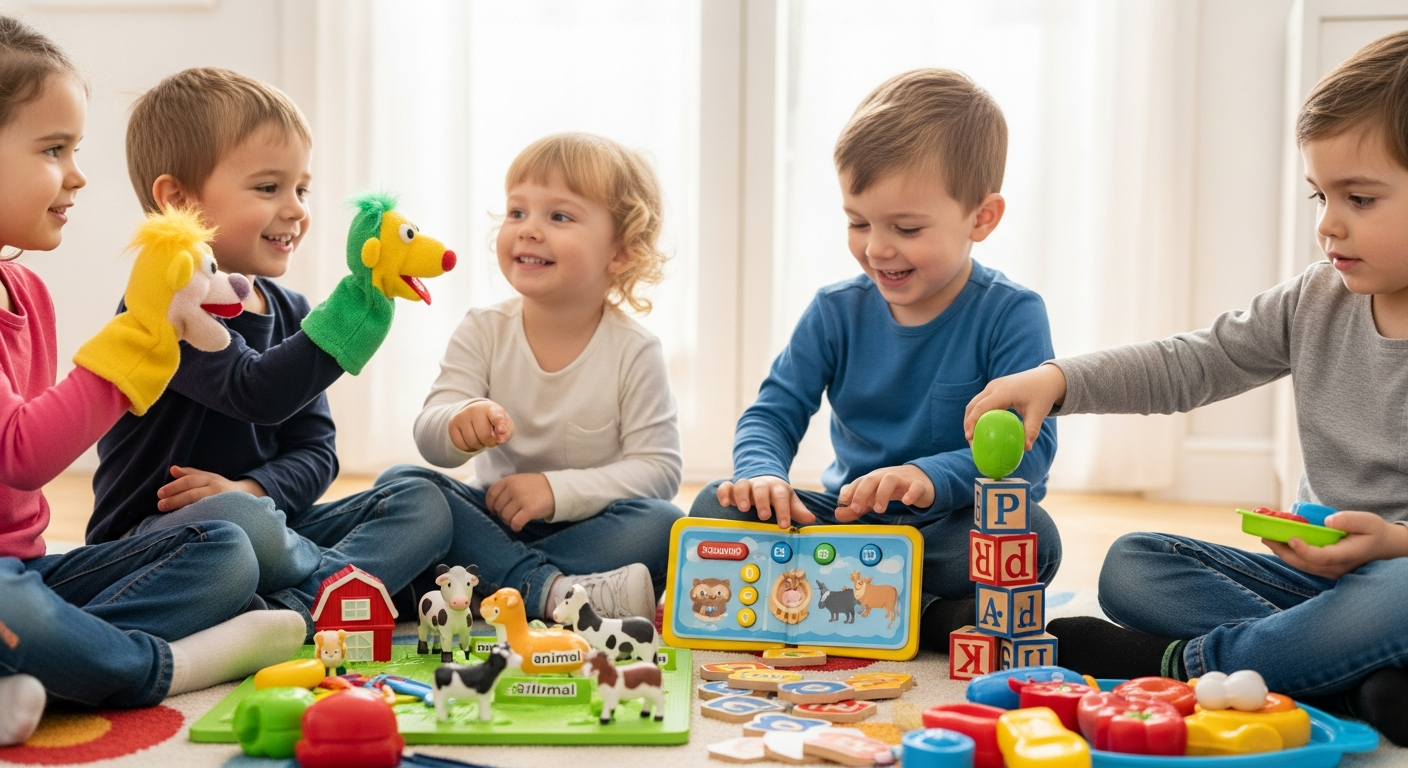
Table of Contents
- Introduction
- Understanding How Toys Support Speech Development
- Best Toys for Early Communication (9-12 Months Developmental Range)
- Interactive Play for Toddlers (12-24 Months Developmental Range)
- Movement and Sensory Toys to Spark Language
- Beyond Physical Toys: The Role of "Smart Screen Time"
- Practical Tips for Playing with Your Late Talker
- Choosing the Right Plan for Your Child's Journey
- Conclusion
- FAQ
Introduction
Have you ever sat at a park, watching other toddlers chatter away, while your own little one remains a quiet observer? If you’ve felt that pang of worry or wondered if you’re doing enough to help your child find their voice, you are certainly not alone. Statistics show that roughly 1 in 4 children will face some form of speech or language delay. It is a journey that can feel isolating, but at Speech Blubs, we believe it should be a journey filled with hope, play, and connection. Our mission is to empower every child to speak their minds and hearts, turning the frustration of a "late talker" into the joy of a "first word."
The toys you choose for your home are more than just items to keep your child occupied; they are the building blocks of communication. In this post, we will explore the best delayed speech toys that encourage interaction, imitation, and cognitive development. We’ll dive into why specific toys work, how to use them effectively, and how you can bridge the gap between physical play and "smart screen time" using our unique methodology. By the end of this guide, you’ll have a clear roadmap for choosing toys that don’t just sit in a bin, but actually spark conversation. Our goal is to show you that with the right tools and a playful approach, you can foster a deep love for communication in your child.

Understanding How Toys Support Speech Development
Before we look at specific toys, it is essential to understand the "why" behind them. Speech doesn't happen in a vacuum. It is the result of several foundational skills coming together: joint attention (looking at the same thing together), imitation (doing what you do), and cause-and-effect (understanding that an action leads to a result).
When we talk about delayed speech toys, we aren't necessarily talking about "talking toys" that have batteries and loud electronic voices. In fact, some of the most effective tools for speech development are silent. When a toy is "quiet," it leaves room for the child—and you—to provide the soundtrack. At Speech Blubs, we emphasize this active participation. Our founders, who all grew up with speech challenges themselves, created our tool to be the interactive experience they wished they had—a way to move from passive observation to active communication.
Best Toys for Early Communication (9-12 Months Developmental Range)
In the earliest stages of language development, children aren't just learning words; they are learning how the world works. If your child is functioning in this range, they are developing the cognitive "hooks" that language will eventually hang on.
Cause and Effect Toys
Cause-and-effect toys teach a child: "If I do something, something else happens." This is the core of communication. When a child cries, a parent comes. When a child says "Up," they get picked up.
- Pop-Up Pal Toys: These classic toys require a child to push, flip, or turn a switch to make a character appear. This builds fine motor skills and teaches the concept of "doing to get."
- Spinning Drums: A simple tap makes the drum spin and creates a visual and auditory reward.
- Light-up Press Toys: While we often prefer non-electronic toys, simple press-and-glow spinners can be highly motivating for children with significant delays or sensory needs, helping them learn to attend to an object.
Object Permanence and Problem Solving
A child must understand that things exist even when they can’t see them before they can name them. This is called object permanence.

- Montessori Ball Boxes: Dropping a ball into a hole and watching it disappear and then reappear is a foundational cognitive exercise.
- Simple Shape Sorters: These teach trial and error. As you play, you can model simple words like "in," "out," "uh-oh," and "more."
- Soft Tissue Boxes: Pulling "tissues" (often colorful scarves) out of a box is an endless source of fun that encourages repetitive movements and joint attention.
If you’re unsure where your child stands in these developmental milestones, we recommend taking our quick 3-minute preliminary screener. It consists of 9 simple questions and provides an assessment and a next-steps plan to help you understand your child’s current needs.
Interactive Play for Toddlers (12-24 Months Developmental Range)
As your child moves into the toddler phase, play becomes more functional. They start to understand what objects are for—a brush is for hair, a cup is for drinking, and a car goes "vroom."
Symbolic and Pretend Play Sets
This is the "golden era" for delayed speech toys. Pretend play allows children to practice real-life scenarios in a safe, controlled way.
- Farm Sets: The classic barn with animals is a staple for a reason. It is perfect for practicing animal sounds. For a parent whose 3-year-old "late talker" loves animals, the "Animal Kingdom" section in our app offers a fun, motivating way to practice "moo" and "baa" sounds alongside these physical toys.
- Baby Dolls and Accessories: Feeding, bathing, and putting a doll to sleep allows you to model functional verbs like "eat," "wash," "sleep," and "boo-boo."
- Play Kitchens and Food: Using Velcro-connected "cutting" fruit is excellent for fine motor skills and provides a perfect opportunity to use the word "cut" over and over again.
Constructive Play
- Nesting Blocks: These are versatile for teaching prepositions. You can put animals "in" the blocks, stack them "up," or knock them "down."
- Cars and Ramps: Cars are high-motivation toys. You can use a simple cardboard box as a ramp to practice "ready, set, go!" and "fast/slow."
To see how these play routines translate into real-world success, you can read testimonials from other parents who have used our methods to supplement their child’s physical play.
Movement and Sensory Toys to Spark Language
Sometimes, the best way to get a child talking is to get them moving. Gross motor play often "unlocks" expressive language because it engages the whole brain.
- Bubbles: Bubbles are perhaps the most effective low-cost "toy" for speech. They encourage eye contact, pointing, and requesting ("more," "pop," "please").
- Stomp Rockets: These are incredible for practicing the "Ready, set, go!" routine, which is a powerful verbal script for late talkers.
- Ball Poppers: Squeezing a toy to make a ball fly out provides an immediate, joyful reward that kids want to repeat.
When we combine these physical activities with "smart screen time," the results can be even more impactful. You can download Speech Blubs on the App Store or find us on the Google Play Store to see how we turn screen time into an active, vocal experience.
Beyond Physical Toys: The Role of "Smart Screen Time"
While physical toys are vital, we live in a digital world. Many parents feel guilty about screen time, but at Speech Blubs, we’ve created a "smart" alternative to passive viewing. Unlike cartoons that a child simply watches, our app requires them to participate.
The Power of Video Modeling
Our unique approach is based on video modeling. Scientific research shows that children are most motivated to learn from their peers. In our app, children see videos of other kids—not adults or cartoons—making sounds and saying words. This triggers "mirror neurons" in the brain, making the child much more likely to imitate what they see.
We use this methodology to teach complex communication skills in a joyful, play-based way. It’s not about drills; it’s about a peer saying "Aaaah" or "Ooooh" and your child feeling the spark to join in. This is a powerful supplement to professional therapy and physical play with delayed speech toys.
Speech Blubs: A Joyful Learning Companion
Our app is designed to be a tool for family connection. We encourage "co-play," where you sit with your child, watch the videos together, and celebrate every sound they make. It’s about building confidence and reducing the frustration that often comes with a speech delay. Our mission is to provide an immediate, effective, and joyful solution for the millions of children who need a little extra support.
Practical Tips for Playing with Your Late Talker
Choosing the right delayed speech toys is only half the battle; how you use them matters even more. Here are some strategies we recommend to our community:
- Follow Their Lead: If your child wants to use the toy car as a phone, let them! Join their play first to build a connection, then gently model the "correct" use later.
- The Power of the Pause: This is the most difficult but effective strategy. When playing with bubbles, blow some, then wait. Look at your child expectantly. Give them 5 to 10 seconds to make a sound or a gesture before you blow more.
- Narrate, Don't Interrogate: Instead of asking "What is this?" (which can feel like a test), simply narrate what you see. "Oh, the blue car is fast! Vroom vroom!"
- Simplify Your Language: If your child isn't speaking yet, use single words or short phrases. If they are using single words, move to two-word phrases.
- Use Repetitive Routines: Toys like the "Piggy Bank" or "Ball Drop" are great because they have a clear beginning, middle, and end. Use the same words every time ("In," "Put in," "Done") to help the child map the word to the action.
For more information on our approach and how we support families, you can visit our main homepage.
Choosing the Right Plan for Your Child's Journey
We want to make speech support accessible and transparent for every family. To get the most out of our "smart screen time" and peer-led modeling, we offer two main subscription plans:
- Monthly Plan: $14.99 per month. This is a great way to test the waters and see how your child responds to the video modeling.
- Yearly Plan: $59.99 per year. This is our clear best-value choice, breaking down to just $4.99 per month—a savings of 66% compared to the monthly rate.
The Yearly Plan is designed to provide a comprehensive, long-term support system for your child's development. When you choose the Yearly Plan, you receive:
- A 7-day free trial to explore everything we offer risk-free.
- Access to the Reading Blubs app, which focuses on early literacy and phonics.
- Early access to all new content updates.
- Priority 24-hour support response time.
Please note that the Monthly plan does not include the free trial, Reading Blubs, or priority support. We highly recommend the Yearly plan to ensure your child has all the tools they need to thrive. You can create your account and start your 7-day free trial today to see the difference for yourself.
Conclusion
Choosing the right delayed speech toys is a wonderful first step in supporting your child’s communication journey. From simple cause-and-effect toys to elaborate pretend play sets, each item in your playroom can become a catalyst for a "first word." However, remember that the most important "toy" in the room is you. Your voice, your engagement, and your encouragement are what truly make these tools effective.
At Speech Blubs, we are here to walk this path with you. We don't promise overnight miracles or public speeches in a month; instead, we promise a process that fosters a love for communication, builds foundational skills, and creates joyful family moments. We want to help your child find the confidence to speak their mind and heart.
Ready to take the next step? We invite you to join our community. Download Speech Blubs on the App Store or Google Play today. For the best experience and the full suite of features—including the Reading Blubs app and our 7-day free trial—be sure to select the Yearly plan. Let’s start this journey of discovery together, one joyful sound at a time.
FAQ
1. Can toys alone fix a speech delay? While the right delayed speech toys are powerful tools for encouraging communication, they are most effective when used as part of a broader strategy. This includes adult interaction, consistent modeling, and, in many cases, professional speech therapy. Our app is designed to be a powerful supplement to these efforts, providing a "smart" way to engage your child's natural desire to imitate their peers.
2. Why does my child prefer the box the toy came in? This is actually a great sign! A box is an "open-ended" toy. It can be a house, a car, a drum, or a hat. This type of play shows that your child is developing symbolic thinking, which is a precursor to using words as symbols for objects. Follow their lead and use the box to practice prepositions like "in," "out," and "under."
3. Is screen time bad for children with speech delays? Not all screen time is created equal. Passive viewing (like watching cartoons) doesn't require a child to interact or speak. "Smart screen time," like what we provide at Speech Blubs, is different. It uses peer-led video modeling to encourage the child to vocalize, imitate, and engage. When used alongside physical play, it can be a very effective developmental tool.
4. How do I know if a toy is "educational" for speech? An educational speech toy is any toy that encourages joint attention and interaction. If a toy does all the work (it talks, sings, and moves on its own), the child often becomes a passive observer. Look for toys that require the child to do something to get a result. This creates opportunities for you to model language and for the child to practice requesting and commenting.
About the author