
Best Toys for Speech Delay 4 Year Old: Play to Speak
 By Speech Blubs Team•Mar 5, 2026•15 min.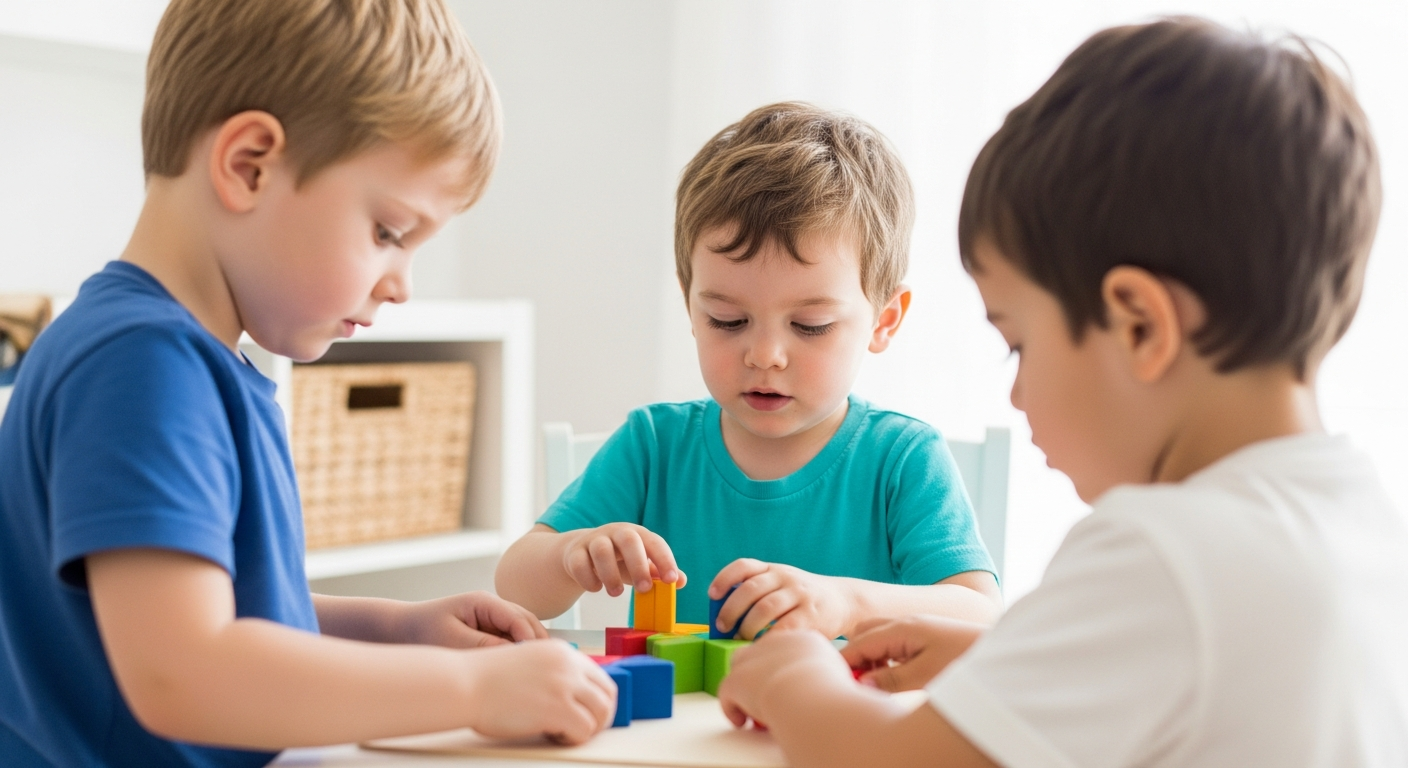
Table of Contents
- Introduction
- The Power of Play: Why Toys Matter for a 4-Year-Old’s Speech
- Choosing the Right Toys for Speech Delay (Criteria)
- Top Categories of Toys for Speech Delay in 4-Year-Olds
- Practical Strategies: How to Play with Your Child
- Speech Blubs: A Joyful Supplement to Traditional Play
- Why the Yearly Plan is Your Best Investment
- Practical Scenario: Putting It All Together
- Conclusion
- FAQ
Introduction
Have you ever sat on the floor, surrounded by a mountain of brightly colored plastic, wondering which of these items might finally help your child find their voice? For parents of a 4-year-old with a speech delay, a toy box isn’t just a collection of playthings; it is a potential toolkit for communication. It can be overwhelming to navigate the aisles of a toy store when your primary goal isn't just entertainment, but helping your little one express their thoughts, feelings, and needs.
At Speech Blubs, we understand this journey intimately. Our mission is to empower children to "speak their minds and hearts." This mission is personal for us because our founders all grew up with speech challenges themselves. They created the very tool they wished they had as children—a way to turn the frustration of a speech delay into a joyful, play-based learning experience. We believe that for the 1 in 4 children who need speech support, the right combination of physical play and "smart screen time" can make all the difference.

In this post, we will explore the most effective toys for speech delay in 4-year-olds, categorized by how they stimulate language. We will move beyond a simple shopping list to provide you with actionable strategies to transform playtime into a powerful learning opportunity. Whether you are working with a professional speech-language pathologist or looking for ways to support your child at home, this guide will help you choose toys that foster confidence, reduce frustration, and create those precious moments of family connection. By the end of this article, you will have a clear plan for using play to build the foundational skills your child needs to thrive.
The Power of Play: Why Toys Matter for a 4-Year-Old’s Speech
By the age of four, most children are moving from simple words to complex sentences and imaginative storytelling. However, for a child with a speech delay, this transition can feel like climbing a mountain without a map. Toys act as the "bridge" in this process. They provide a concrete focal point for language. It is much easier for a child to say "blue car" when they are holding a physical blue car than it is to produce those words in a vacuum.
Play is the natural language of childhood. When a child is engaged in play, their brain is in an optimal state for learning. They are motivated, curious, and less pressured than they might feel during formal "drills." This is why we focus on blending scientific principles with play to create our unique "smart screen time" experiences. We see our app not as a replacement for physical toys, but as a powerful supplement that uses video modeling to show children how their peers use language during play.
When choosing toys for speech delay for a 4-year-old, we aren't just looking for "educational" labels. We are looking for toys that encourage:
- Joint Attention: Both you and your child focusing on the same object.
- Imitation: The child copying your actions or sounds.
- Requesting: Giving the child a reason to ask for "more," "help," or a specific item.
- Symbolic Play: Using one object to represent another (e.g., a block becomes a phone).
Choosing the Right Toys for Speech Delay (Criteria)
Before we dive into specific recommendations, it’s helpful to understand what makes a toy "speech-friendly." Not all toys are created equal. In fact, some highly "automated" toys that talk, sing, and light up at the push of a button can actually hinder language development because the toy is doing all the talking!

For a 4-year-old, we want to look for toys that are:
- Open-Ended: These are toys that can be used in multiple ways. A set of blocks can be a castle today and a garage tomorrow. Open-ended toys require the child to use their imagination and, eventually, their words to describe what they are doing.
- Highly Motivating: If your child loves dinosaurs, a dinosaur-themed toy will elicit more speech than a generic puzzle. Follow your child's lead.
- Social in Nature: Look for toys that naturally involve a partner. Toys that require "taking turns" or "working together" are goldmines for social communication.
- Sensory-Rich: Toys with different textures, weights, or sounds (that the child creates, not a battery) can help ground a child and keep them engaged.
If you are unsure where your child currently stands in their development, you can take our quick 3-minute preliminary screener. It involves 9 simple questions and provides an assessment and a next-steps plan to help you tailor your play strategies.
Top Categories of Toys for Speech Delay in 4-Year-Olds
Social & Pretend Play Toys
At four years old, children are beginning to experiment with "role play." This is a massive milestone for language because it requires them to take on different perspectives and use language in a social context.
- Dolls and Action Figures: These allow children to act out daily routines. For example, if your child is working on verbs, you can have the "baby" eat, sleep, or jump.
- Play Kitchens and Food: This is a classic for a reason. You can practice "ordering" food, naming colors (the red apple, the green grape), and using sequence words like "first" we cook, "then" we eat.
- Puppets: Sometimes a child who is shy about speaking directly to an adult will talk to a puppet. Puppets can "ask" the child questions or make silly mistakes that the child has to "correct."
Real-World Scenario: For a parent whose 4-year-old loves playing "house," the "Everyday Activities" section of Speech Blubs offers a fun way to reinforce these concepts. You can watch a peer brush their teeth in the app, then go to the bathroom and practice the same words together. You can download Speech Blubs on the App Store to start exploring these interactive modules.
Cause-and-Effect & Problem-Solving Toys
Cause-and-effect toys are essential for teaching the "if/then" logic of communication. "If I push this button, then the lion pops up." This mirrors communication: "If I say 'milk,' then Mom gives me a drink."
- Animal Pop-Up Toys: These are favorites among speech therapists. They are perfect for targeting animal names and sounds. You can model phrases like "Lion, where are you?" or "Ready, set... pop!"
- Marble Runs or Car Ramps: These toys are incredibly motivating. The child wants to see the marble or car go down, which creates a perfect opportunity to practice "Ready, set, go!" or to request "more" marbles.
- Air Toobz: This is a more modern take on cause-and-effect. It uses air to move balls through tubes. It’s excellent for 4-year-olds because it requires some teamwork to build the tracks, encouraging phrases like "tube here" or "next ball."
Building and Construction Toys
Building toys are fantastic for practicing spatial language (up, down, under, on top) and descriptive words.
- Blocks and Magnetic Tiles: These are the gold standard of open-ended play. You can work on colors, shapes, and sizes while building. If the tower falls, it’s a perfect "Uh-oh!" moment—a foundational functional phrase.
- Squigz: These little suction-cup builders are wonderful for fine motor skills and speech. They make a satisfying "pop" sound when pulled apart, which can be paired with the word "pop" or "pull" every single time.
- SpinAgain: This toy involves stacking spinning discs on a pole. It provides great visual stimulation and is an easy way to practice the word "more" or "turn."
Musical and Sound-Based Toys
Speech is, at its core, about making and manipulating sounds. Musical toys help children become more aware of rhythm, pitch, and volume.
- Echo Microphones: These simple, battery-free toys are magic for late talkers. They provide immediate auditory feedback, making the child’s own voice sound different and exciting. It encourages them to experiment with sounds like "ba-ba-ba" or "shhh."
- First Drums or Bongos: Use these to practice "loud" and "quiet" or to tap out the syllables in words. "Ba-na-na" (three taps).
- Rock 'n Roller Piano: For children with motor challenges, toys like this that respond to simple movements can be very empowering, helping them realize they can control their environment through action.
Active & Sensory Play Toys
Sometimes, children need to move their bodies to get their brains ready to speak. Active play can reduce the "pressure" of communication.
- Bilibo: This shell-like toy can be sat in, stood on, or hidden under. It’s great for core strength and for practicing "in" and "out."
- Teeter Popper: This provides sensory input and a fun "popping" sound as the child rocks. It’s a great "waiting" toy—the child rocks, and then you stop them and wait for them to say "go" or "more" before they can rock again.
- Bubbles: Never underestimate the power of bubbles! They are the ultimate tool for requesting. You blow a bubble, wait, and see if the child makes a sound or gesture to ask for more.
Practical Strategies: How to Play with Your Child
Having the right toys is only half the battle. The real magic happens in how you play. Here are some research-backed strategies that we advocate for at Speech Blubs to make playtime more productive.
1. Narrate the Action (Sportscasting)
Instead of asking your child questions (e.g., "What is that? What color is the car?"), try narrating what you are doing. "I have the blue car. Vroom! The car is going fast. Up, up, up the ramp!" This provides a rich language model without putting the child on the spot.
2. Use the "One-Word-Up" Rule
If your child is currently not speaking, model single words ("Ball," "Go," "Blue"). If your child is using single words, model two-word phrases ("Big ball," "Go car," "Blue hat"). By staying just one step ahead of them, you make the language feel attainable rather than overwhelming.
3. Create a Need for Communication
Don't give your child everything they need at once. If you are playing with a car ramp, hold the cars in your lap. Wait for your child to look at you, gesture, or make a sound before giving them one. This teaches them that their communication has power.
4. Verbal Routines
Use the same phrases over and over during specific activities. "Ready... set... GO!" is a classic. Eventually, you can pause—"Ready... set..."—and wait for your child to fill in the "GO!" This builds confidence and predictability.
5. Incorporate "Smart Screen Time"
We know that parents are often worried about screen time. However, there is a big difference between passive viewing (like watching cartoons) and active, educational engagement. Our app is designed as a screen-free alternative to passive viewing in the sense that it requires active participation.
Our "video modeling" method is based on the scientific principle of mirror neurons. When a child watches another child (not a cartoon) make a sound or say a word, their brain reacts as if they are making that sound themselves. It’s a powerful way to bridge the gap between watching and doing. Ready to see it in action? Create your account and begin your 7-day free trial today.
Speech Blubs: A Joyful Supplement to Traditional Play
While physical toys are essential, Speech Blubs provides a unique layer to your child's development. Our app was born from the personal experiences of our founders who knew exactly how it felt to struggle with speech. We didn't want to create another "game"; we wanted to create a tool that fosters a love for communication.
Our approach is rooted in:
- Scientific Methodology: We use peer-led video modeling, which is highly effective for children with speech delays, autism, and Down syndrome.
- Empathetic Expertise: We don't promise overnight miracles. We promise a journey of joyful learning, reduced frustration, and foundational skill-building.
- Family Connection: We encourage "co-play." The app is most effective when you sit with your child, mimic the kids on the screen together, and then transition that learning into your "real world" play with toys.
Don't just take our word for it—see what other parents are saying about their child's success and the confidence they've gained through our platform.
Why the Yearly Plan is Your Best Investment
When you decide to join the Speech Blubs family, we want to ensure you get the absolute best value for your child’s progress. While we offer a Monthly plan for $14.99 per month, our Yearly plan is the clear best choice for families committed to seeing long-term growth.
The Yearly plan is priced at $59.99 per year, which breaks down to just $4.99/month—a 66% savings compared to the monthly option. But it’s not just about the cost. The Yearly plan includes exclusive, high-value features that are not available in the Monthly plan:
- A 7-Day Free Trial: You can explore the entire app with your child before committing.
- Reading Blubs App: You get full access to our companion app designed to boost early literacy and reading skills.
- Early Access: You’ll be the first to receive our latest updates and new content modules.
- Priority Support: Enjoy a 24-hour response time from our dedicated support team.
We encourage you to choose the Yearly plan to get the full suite of features and provide your child with a comprehensive, long-term learning environment. You can download Speech Blubs on Google Play or the App Store to get started.
Practical Scenario: Putting It All Together
Imagine your 4-year-old, Leo, loves the "Animal Kingdom." He has a speech delay and mostly uses gestures to get what he wants.
- Morning Play: You sit on the floor with a farm set (a physical toy). You hold the cow and say, "Moo! The cow says moo." Leo watches but doesn't repeat.
- Smart Screen Time: You open Speech Blubs to the "Animal Kingdom" section. Leo sees a young girl his age making the "Moo" sound. She is wearing a fun cow filter. Leo giggles. You do the "Moo" sound together with the girl on the screen.
- Reinforcement: You go back to the physical farm toy. You pick up the cow and wait. Leo looks at the cow, then at you, and says a quiet "Moo."
- Celebration: You give him a high-five and let the cow "jump" into the barn. "Yes! Moo! The cow goes in!"
This cycle—Physical Play -> Video Modeling -> Reinforcement—is the core of our methodology. It turns a "task" into a "game" and builds the confidence Leo needs to try more words.
Conclusion
Finding the right toys for speech delay for a 4-year-old doesn't have to be a source of stress. By focusing on open-ended, motivating, and social toys, you are providing the "raw materials" for language. Whether it's a simple echo microphone, a complex marble run, or a classic dollhouse, the goal is the same: to create a reason and a space for your child to speak their mind and heart.
Remember, you are your child's first and most important teacher. Your involvement, your patience, and your playfulness are more valuable than the toys themselves. Speech Blubs is here to support you every step of the way, providing a "smart" supplement to your daily routines that is backed by science and filled with joy.
We invite you to start this journey today. Don't wait for frustration to grow—foster a love for communication right now. Start your 7-day free trial by downloading Speech Blubs on the App Store or Google Play. For the best value and access to Reading Blubs and priority support, be sure to select our Yearly plan. Together, we can help your child find their voice.
FAQ
1. Can toys really help with a speech delay, or do I need a professional? Toys are excellent tools for home-based support and are used by almost all speech-language pathologists (SLPs). While toys and apps like Speech Blubs are powerful supplements that can foster confidence and foundational skills, they should ideally be used in conjunction with professional therapy if your child has a significant delay.
2. My 4-year-old only wants to play with cars. Is that okay? Yes! It is best to follow your child's lead. You can teach almost any language concept (colors, prepositions, verbs, turn-taking) using cars. If they are motivated by cars, they will be much more likely to attempt the words you are modeling.
3. Is Speech Blubs just another cartoon for my child to watch? Not at all. Speech Blubs is designed as "smart screen time." Unlike passive cartoons, our app uses video modeling of real children to encourage active imitation. It is an interactive experience that requires the child to listen, watch, and vocalize, rather than just sit and watch.
4. Why is the Yearly plan better than the Monthly plan? The Yearly plan offers the best value at $59.99/year (only $4.99/month), saving you 66%. More importantly, it includes a 7-day free trial, access to the Reading Blubs app for literacy, early updates, and faster support response times, providing a more comprehensive tool for your child's development.
About the author