
Core Words List Speech Therapy: Help Your Child Speak
Unlock your child's voice with an essential core words list speech therapy guide. Learn why these 200 words are key to communication and how to teach them
 By Speech Blubs Team•Apr 14, 2026•15 min.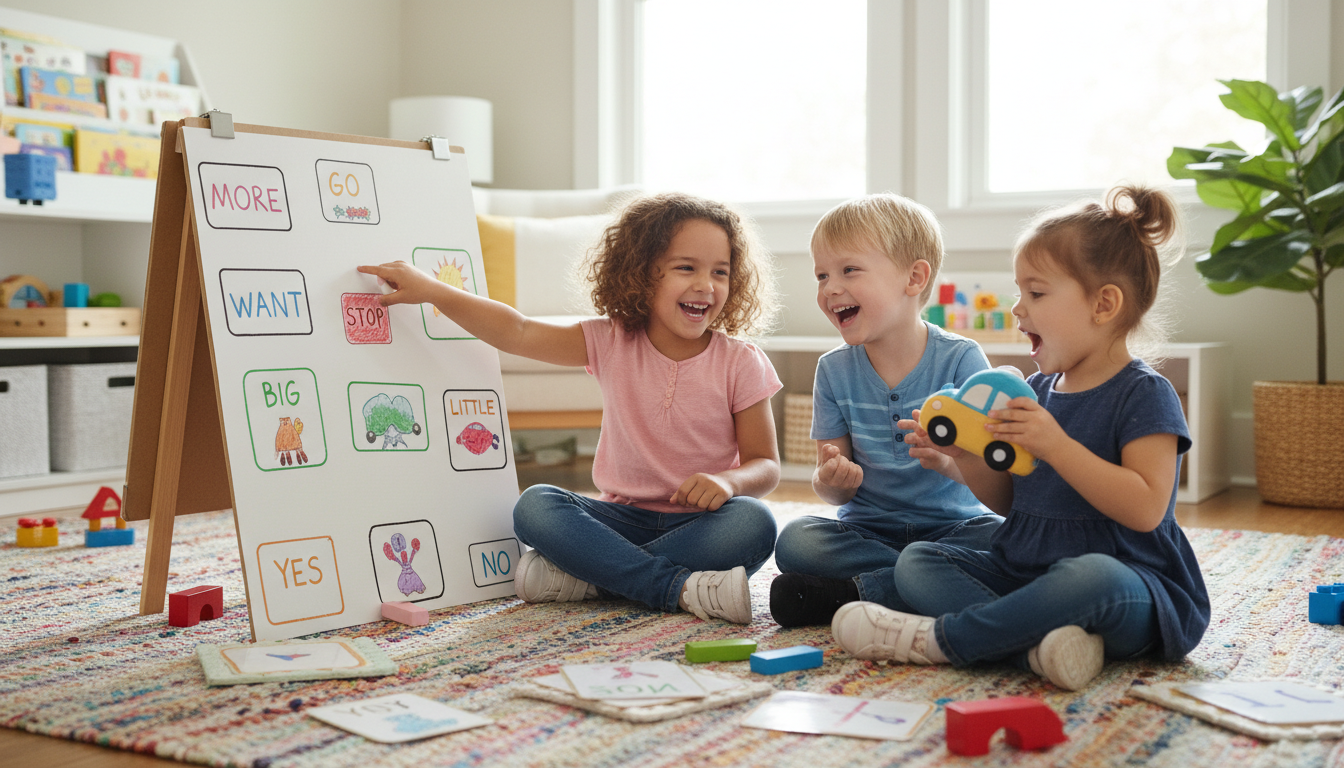
Table of Contents
- Introduction
- What Are Core Words in Speech Therapy?
- Core Words vs. Fringe Words: What’s the Difference?
- The Essential Core Words List for Early Learners
- Why Focusing on Core Vocabulary Is a Game-Changer
- The Science Behind the Success: Video Modeling
- Practical Scenarios: Core Words in Action
- The Descriptive Teaching Model: Moving Beyond Nouns
- Smart Screen Time vs. Passive Viewing
- Choosing the Best Plan for Your Family
- Fostering a Love for Communication
- Conclusion
- FAQ
Introduction
Did you know that a tiny group of just 200 words makes up roughly 80% of what we say every single day? While the English language contains hundreds of thousands of words, our daily communication relies on a surprisingly small, versatile "core." For parents of children with speech delays or those just beginning their language journey, this is incredible news. It means that by focusing on a specific core words list speech therapy strategy, you aren’t just teaching your child new words; you are giving them the keys to unlock almost any conversation.
At Speech Blubs, our mission is to empower children to "speak their minds and hearts." We understand that the journey to clear communication can sometimes feel overwhelming. You might wonder which words to teach first or how to help your child move beyond simply naming objects like "apple" or "ball." This blog post will dive deep into the world of core vocabulary. We will explore what core words are, why they are the foundation of effective communication, and how you can use our "smart screen time" tools to make learning these words a joyful, family-centered experience.

We will provide you with a comprehensive core words list, practical strategies for home implementation, and a clear understanding of how video modeling can accelerate your child's progress. By the end of this article, you will have a roadmap for fostering a love for communication and building the foundational skills your child needs to thrive.
What Are Core Words in Speech Therapy?
In the world of speech-language pathology, words are generally divided into two categories: Core Vocabulary and Fringe Vocabulary. Understanding the difference is the first step in supercharging your child's language development.
Core words are high-frequency words that are used across all contexts, environments, and topics. They aren't just nouns (people, places, or things). In fact, most core words are verbs, pronouns, adjectives, and prepositions. Think of words like go, stop, me, you, more, up, down, on, off, and want. These words are the "glue" of language. They are flexible and can be used whether your child is at the park, in the bathtub, or at the dinner table.
Because these words are so versatile, they provide the most "bang for your buck." If a child learns the word "dinosaur," they can only use it when they are playing with or seeing a dinosaur. But if a child learns the word "more," they can ask for more juice, more bubbles, more tickles, or more time on the swing.
At Speech Blubs, we focus on these high-impact words because they allow children to express a wide range of needs and thoughts with a relatively small vocabulary. This approach reduces frustration for both the child and the parent, creating more opportunities for joyful connection. If you are unsure where your child stands in their development, you can take our quick 3-minute preliminary screener to get a simple assessment and a free 7-day trial.
Core Words vs. Fringe Words: What’s the Difference?
To truly appreciate the power of a core words list speech therapy approach, it helps to look at the contrast between core and fringe vocabulary.

Fringe Vocabulary: The Specifics
Fringe words are low-frequency words that are specific to a particular topic, environment, or individual interest. These are mostly nouns. Examples include giraffe, pizza, helicopter, blue, or Grandma. While these words are important for adding detail to speech, they are limited in their use. You wouldn't use the word "pizza" while playing at the beach (unless you’re having a very specific picnic!).
Core Vocabulary: The Foundation
Core words, on the other hand, represent about 80% of what we say. They are the words that allow us to form sentences and express complex ideas.
- Core words are abstract: Unlike a "ball," which you can hold, a word like "want" or "all gone" is a concept. This makes them slightly harder to teach through simple pictures alone, which is why modeling is so important.
- Core words have multiple meanings: The word "up" can mean "pick me up," "look up at the sky," or "turn the volume up."
- Core words lead to sentences: You cannot build a sentence with only fringe words. "Pizza apple dog" doesn't make sense. But "I want more pizza" uses three core words and one fringe word to create a perfect sentence.
We believe in a balanced approach. While we love teaching fun fringe words (who doesn't love saying "hippopotamus"?), we prioritize core words because they give your child the power to communicate in any situation. To see how this approach has helped thousands of families, you can read our parent testimonials.
The Essential Core Words List for Early Learners
If you are looking for a starting point, the following words are widely considered the most "universal" core words. These are the words we recommend focusing on during daily play and routines.
Level 1: Basic Needs and Actions
- All gone: Perfect for finishing meals or ending an activity.
- More: The ultimate word for requesting.
- Stop: Essential for safety and setting boundaries.
- Go: Great for cars, running, or starting a game.
- Help: Reduces frustration by giving the child a tool to ask for assistance.
- Want: The foundation of expressing desires.
- Mine: A natural early word for expressing ownership.
Level 2: Social and Positional Words
- You / Me: Developing a sense of self and others.
- Up / Down: Great for physical play (being picked up, slides, stairs).
- In / Out: Perfect for cleaning up toys or getting in the car.
- On / Off: Useful for lights, clothes, or electronic toys.
- Like: Expressing preferences.
- Look: Directing attention to something interesting.
Level 3: Describing and Directing
- Different: Noticing changes in the environment.
- Finished / Done: Transitioning between tasks.
- Open: For snacks, doors, or boxes.
- Put: Following directions or organizing play.
- That: A powerful word for pointing things out from a distance.
By integrating these words into your child's daily life, you are building a robust communication system. You can download Speech Blubs on the App Store to see these words brought to life through our engaging video modeling sessions.
Why Focusing on Core Vocabulary Is a Game-Changer
Focusing on a core words list speech therapy plan isn't just about the words themselves; it’s about the function of communication. When a child learns core words, they gain the ability to use different "communication functions."
- Requesting: "More juice," "Open that."
- Rejecting: "No," "Stop," "All gone."
- Commenting: "Like it," "Big dog," "Look up."
- Asking Questions: "What that?" "Where go?"
- Directing Actions: "You go," "Put in."
If we only teach nouns, a child can mostly only label things. Labeling is a great skill, but it doesn't lead to deep conversation. If your child points at a dog and says "Dog!", they are labeling. But if they say "Big dog go!", they are using core words to describe an action and an attribute.
At Speech Blubs, we designed our app to encourage these various functions. We don't want kids to just repeat words; we want them to understand how to use them to interact with you. This is why our approach is rooted in research-backed methodology, specifically the use of video modeling to trigger mirror neurons in the brain.
The Science Behind the Success: Video Modeling
Our company was born from the personal experiences of our founders, who all grew up with speech problems. They created the tool they wished they had—one that blends scientific principles with pure, unadulterated play.
The core of our method is video modeling. Have you ever noticed how your child is fascinated by other children? In our app, kids watch videos of their peers—real children, not cartoons—performing mouth exercises and saying core words.
Why Peer-to-Peer Learning Works:
- Mirror Neurons: When a child watches another child speak, the "mirror neurons" in their brain fire as if they were doing the action themselves. This makes imitation more natural and less forced.
- Confidence: Seeing another "kid like me" succeed builds confidence. It removes the pressure that sometimes comes with adult-led therapy.
- Engagement: Children are naturally drawn to other children’s faces. Our "smart screen time" experience transforms a passive activity into an active, imitative one.
This is why we consider Speech Blubs a "powerful tool for family connection." It’s not meant to be a babysitter; it’s meant to be a bridge. We encourage parents to sit with their children, watch the "Blubers" together, and practice the words in real time.
Ready to see the difference for yourself? Create your account and begin your 7-day free trial today.
Practical Scenarios: Core Words in Action
Let’s look at some real-world ways you can use a core words list speech therapy strategy at home. These scenarios show how easy it is to weave these words into things you are already doing.
Scenario 1: The Animal Lover
For a parent whose 3-year-old "late talker" loves animals, the "Animal Kingdom" section of Speech Blubs offers a fun, motivating way to practice core words. Instead of just naming the animals, you can use core words:
- While looking at a cow: "The cow says 'Moo'. Do you want more moo?"
- While watching a bird: "Look! The bird go up!"
- Using the app's face filters: "I see you! You are a lion!"
Scenario 2: The Mealtime Routine
Mealtime is a goldmine for core vocabulary.
- Open: "Open the jar."
- More: "Want more crackers?"
- All gone: "The milk is all gone!"
- Like: "Do you like the apple?"
Scenario 3: The Car Enthusiast
If your child is obsessed with toy cars, focus on "Go" and "Stop."
- Hold the car at the top of a ramp. Say, "Ready, set..." and wait. When they make a sound or look at you, say "Go!"
- As the car reaches the bottom, say "Stop!"
- Ask, "Where car?" and help them find it.
These moments don't require special equipment or hours of time. They just require you to be present and mindful of the core words you are using. To get more ideas and see our full range of activities, visit the Speech Blubs homepage.
The Descriptive Teaching Model: Moving Beyond Nouns
One of the most powerful strategies for using core words is the Descriptive Teaching Model. This is especially helpful as children get older and start learning more complex concepts in school or through play.
Instead of pressuring a child to learn a very specific, difficult noun, we teach them to describe the concept using the core words they already know.
Example: A child is learning about the weather. Instead of struggling to say the word "precipitation," the child can use core words to say "Water fall down" or "Wet outside."
This model has several incredible benefits:
- Reduces Frustration: The child doesn't get stuck because they can't remember a specific name.
- Demonstrates Understanding: If a child can describe what a "chrysalis" is by saying "bug sleep inside," you know they actually understand the concept.
- Encourages Creativity: It forces the child to think about how to use their existing tools (core words) to solve a communication problem.
At Speech Blubs, we love this approach because it aligns with our goal of helping kids "speak their minds and hearts." We aren't looking for "perfect" speech; we are looking for effective, confident communication.
Smart Screen Time vs. Passive Viewing
We know that many parents are concerned about screen time, and we share those concerns. Not all screen time is created equal. Watching a fast-paced cartoon is a passive experience—the child sits back and watches things happen to someone else.
Speech Blubs is different. We call it smart screen time because it requires active participation.
- Imitation: The child is encouraged to copy the sounds and movements of the peer models.
- Voice Recognition: Our app uses voice-activated technology to trigger fun animations when the child makes a sound.
- Family Co-Play: We design our activities to be done with an adult. The app is the spark, but the interaction with you is the flame that builds language.
By choosing our yearly plan, you get access to all of these features, plus our Reading Blubs app, which helps transition those speech skills into early literacy. You can download Speech Blubs on Google Play Store to start your journey.
Choosing the Best Plan for Your Family
We want to be transparent about our pricing so you can make the best choice for your child’s development. Our goal is to provide an immediate, effective, and joyful solution for the 1 in 4 children who need speech support.
- Monthly Plan: $14.99 per month. This is a great "pay-as-you-go" option if you want to try it out for a short period.
- Yearly Plan: $59.99 per year. This is our best value plan, breaking down to just $4.99 per month—a 66% savings compared to the monthly rate.
Why the Yearly Plan is the Clear Winner:
When you choose the Yearly Plan, you aren't just saving money. You are getting a comprehensive support package designed for long-term success:
- 7-Day Free Trial: You can explore everything we have to offer before committing.
- Reading Blubs App: Included for free! This is a powerful companion app that focuses on phonics and early reading skills.
- Priority Support: Get a 24-hour response time from our dedicated support team.
- Early Access: Be the first to try out our new updates and features.
The Monthly plan does not include the free trial, Reading Blubs, or priority support. We highly recommend the Yearly plan to ensure your child has the consistent, high-quality practice they need to build lasting skills. Sign up today to lock in these benefits.
Fostering a Love for Communication
At the end of the day, a core words list speech therapy strategy is about more than just vocabulary—it’s about connection. When your child realizes that they can use the word "more" to get another hug or "stop" to end a game they don't like, they realize they have power. They have a voice.
We don't promise that your child will be giving public speeches in a month. Every child develops at their own pace. What we do offer is a way to:
- Foster a genuine love for learning and communication.
- Build the foundational skills necessary for later language and literacy.
- Reduce the frustration that comes with being misunderstood.
- Create joyful, playful memories during your daily learning moments.
Our founders know exactly what it's like to feel left out because you can't express yourself. That’s why everything we do at Speech Blubs is infused with empathy and science. We are here to support you every step of the way.
Conclusion
Teaching core words is one of the most effective ways to support your child’s speech development. By focusing on high-frequency, versatile words like go, more, help, and want, you are providing your child with the essential building blocks for a lifetime of communication. Remember that the goal is not perfection, but progress and confidence.
We invite you to join the Speech Blubs family and see how our unique video modeling approach can transform your "smart screen time" into a powerful learning experience. Whether you are using our 200+ exercises to practice sounds or our face filters to make each other laugh, you are doing the important work of helping your child "speak their mind and heart."
Ready to get started? Download Speech Blubs on the App Store or Google Play Store today. We highly recommend choosing our Yearly Plan to take advantage of the 7-day free trial, the Reading Blubs app, and the best overall value. Let’s make communication joyful together!
FAQ
1. What exactly are core words in speech therapy? Core words are a set of roughly 200 high-frequency words that make up about 80% of our daily language. Unlike fringe words (which are specific nouns like "dinosaur"), core words are versatile and can be used across many different situations. Examples include verbs like go, pronouns like me, and prepositions like on.
2. How do I start teaching a core words list at home? The best way to start is through modeling. Use the words yourself while you play and go through your daily routines. For example, during bath time, you can repeat the words "in," "out," "on" (for the water), and "all gone" (when the water drains). You don't need to force your child to say the words; simply hearing you use them in context is a powerful first step.
3. Is Speech Blubs a replacement for professional speech therapy? Speech Blubs is designed to be a powerful supplement to a child's overall development plan. While it is rooted in scientific principles and used by many therapists, it is not a replacement for professional, one-on-one therapy when needed. It is an excellent tool for daily practice and building confidence at home between therapy sessions.
4. Why is the Yearly Plan better than the Monthly Plan? The Yearly Plan offers the best value at $59.99/year (only $4.99/month), which is 66% cheaper than the Monthly Plan. More importantly, it includes exclusive features like a 7-day free trial, the Reading Blubs app for early literacy, and 24-hour priority support. The Monthly Plan does not include a free trial or access to Reading Blubs.
About the author