
Do Sippy Cups Cause Speech Delay?
 By Speech Blubs Team•Mar 12, 2026•16 min.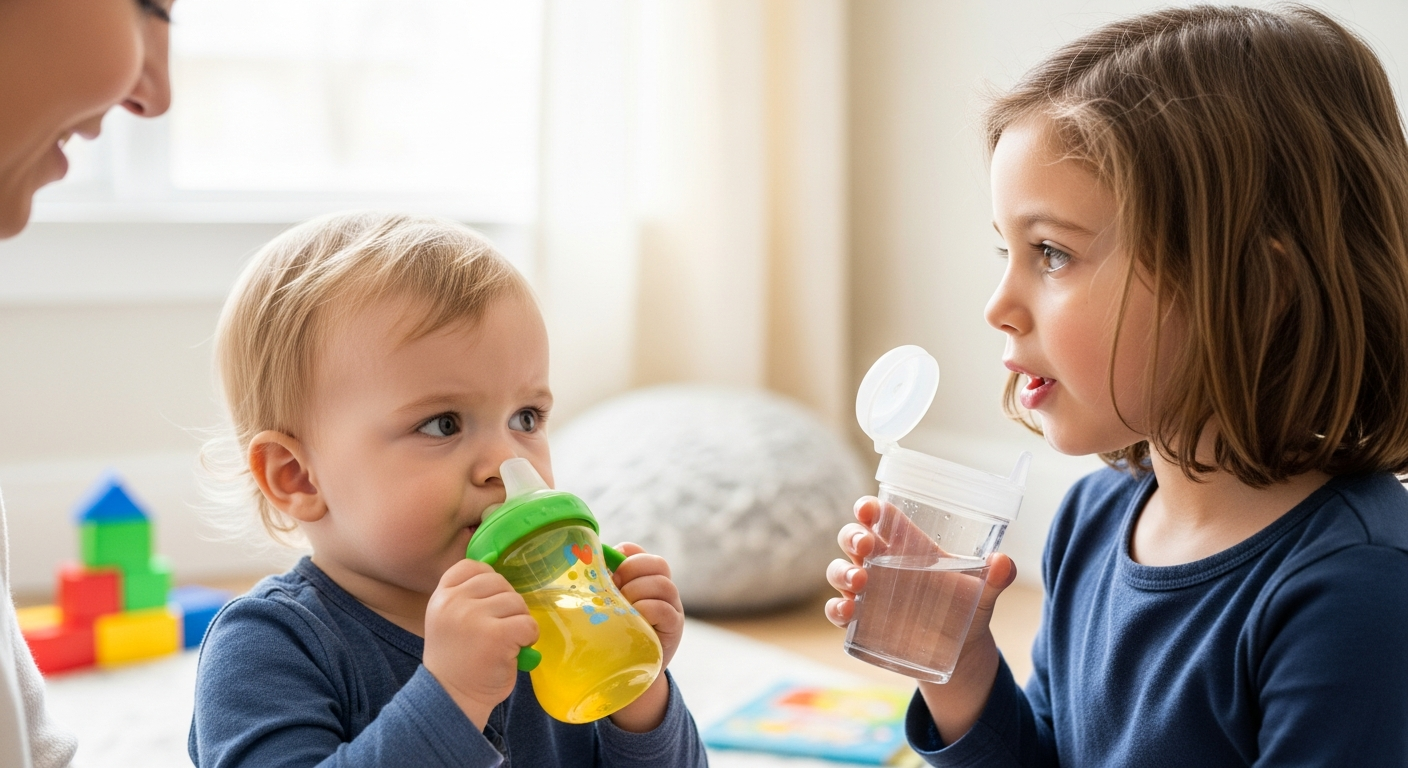
Table of Contents
- Introduction
- The Science of Swallowing: Suckle vs. Mature Patterns
- How Sippy Cups Can Impede Speech Articulation
- The Problem with "Paci-Mouth" and Facial Development
- Straw Cups: The Better Alternative
- The Open Cup: The Ultimate Goal
- Practical Scenarios: Connecting Speech Blubs to Your Daily Routine
- Understanding the Value of Your Speech Journey
- Oral Health and Dental Concerns
- How to Transition Away from the Spout
- When to Seek Professional Support
- Speech Blubs: Creating Joyful Family Learning Moments
- FAQ
- Conclusion
Introduction
As parents, we are always on the hunt for tools that make our lives a little easier. When it’s time to transition away from the bottle, the spill-proof sippy cup often feels like a gift from the heavens. No more juice stains on the rug! No more milk-soaked car seats! In fact, the sippy cup was famously invented by an engineer who was simply tired of cleaning up his toddler’s messes. But while these cups are a victory for our carpets, they might not be such a win for our children’s development. Many parents are surprised to learn that what happens in the mouth during those thousands of daily sips can have a profound impact on how a child learns to speak.
The question of whether sippy cups cause speech delay is one that brings many families to our community. At Speech Blubs, our mission is to empower children to "speak their minds and hearts." We were founded by a team who grew up with speech challenges themselves, so we understand the frustration that comes when communication doesn't feel easy or joyful. We want to provide you with the best "smart screen time" tools and the most up-to-date developmental information so you can make the best choices for your little one.

In this post, we are going to dive deep into the science of oral motor development. We will explore how traditional hard-spout sippy cups can affect a child’s swallow pattern, why the way a child drinks matters for their speech articulation, and which alternatives are better for building the muscles needed for clear communication. By the end of this article, you will have a clear understanding of the "sippy cup trap" and how to transition your child toward healthier drinking habits that support their speech and language journey.
The Science of Swallowing: Suckle vs. Mature Patterns
To understand why a cup could possibly influence speech, we first have to look at how babies drink. When an infant is breastfeeding or bottle-feeding, they use a "suckle" reflex. This is an anterior-posterior (front-to-back) movement where the tongue stays relatively flat and moves like a piston to draw milk out. In this stage, the tongue often sits low and forward in the mouth. This is perfectly normal and necessary for the first few months of life.
However, as a child approaches their first birthday, their anatomy begins to change. They are ready to develop what experts call a "mature swallow." In a mature swallow, the tip of the tongue should lift up and rest against the "bumpy ridge" behind the upper front teeth—this is known as the alveolar ridge. From there, the tongue performs a wave-like motion to propel liquid or food toward the back of the throat.
This is where the traditional hard-spout sippy cup becomes a problem. When a child uses a hard spout, the spout itself occupies the space where the tongue tip needs to go. The tongue is forced to stay down and forward, essentially "trapped" under the spout. Instead of practicing the elevation needed for a mature swallow, the child continues to use the infant suckle pattern. If a child uses these cups for hours every day, they aren't getting the "gym workout" their tongue needs to move into the next phase of development.
If you are worried that your child’s drinking habits might be affecting their progress, you are not alone. About 1 in 4 children will need some form of speech support. You can start by taking our quick 3-minute preliminary screener which consists of 9 simple questions to help you understand your child’s current communication level and provide you with a next-steps plan.

How Sippy Cups Can Impede Speech Articulation
Speech is a complex physical act. It requires incredible coordination and strength from the lips, tongue, and jaw. If the muscles in the mouth aren't being exercised properly during drinking and eating, it can lead to difficulties when it comes time to produce specific speech sounds.
The "T," "D," and "L" Connection
Remember that alveolar ridge we mentioned? It’s not just for swallowing. It is the "launching pad" for many of our most common consonant sounds. To say "T," "D," "N," or "L," the tongue tip must be strong enough and coordinated enough to touch that ridge behind the teeth. If a child has spent a year or more with a hard sippy cup spout blocking that movement, their tongue might lack the elevation and strength required for these sounds. This can lead to a "tongue thrust," where the tongue pushes forward against or between the teeth during speech, often resulting in a lisp or "slushy" sounding speech.
Lip Strength and the "M," "P," and "B" Sounds
Early speech development also relies heavily on the lips. Sounds like "M," "P," and "B" (the "bilabial" sounds) require the lips to press together firmly. Traditional sippy cups don't require much lip engagement; the child often just bites the spout or uses their tongue to manage the flow.
At Speech Blubs, we use a unique "video modeling" methodology to help children overcome these hurdles. In our app, your child watches videos of other children—their peers—making these specific sounds and mouth movements. Seeing a real child’s face and lips move to say "Ma-ma" or "Ba-ba" is a powerful tool for imitation. This peer-to-peer connection is part of our scientific approach to making speech practice feel like play rather than work.
The Problem with "Paci-Mouth" and Facial Development
Beyond just the sounds a child makes, the constant use of hard spouts (and prolonged pacifier use) can actually change the physical structure of a child's mouth and face. This is often referred to by specialists as "paci-mouth."
When the tongue is constantly pushed low and forward by a spout, it doesn't provide the internal "scaffolding" that the roof of the mouth (the palate) needs to develop a wide, healthy arch. This can lead to:
- A Narrow Palate: Which can cause dental crowding.
- An Open Bite: Where the top and bottom teeth don't meet in the front because the spout or tongue has been in the way.
- Mouth Breathing: When the tongue rests low, the jaw often drops open, leading the child to breathe through their mouth rather than their nose. Chronic mouth breathing can lead to its own set of developmental and health issues, including poor sleep quality.
We believe in providing an immediate, effective, and joyful solution for these challenges. While a cup might seem like a small thing, it’s one piece of the larger puzzle of your child's growth. Our app is designed to be a powerful supplement to your child's overall development plan. You can download Speech Blubs on the App Store or find us on Google Play to start building those foundational communication skills today.
Straw Cups: The Better Alternative
If traditional sippy cups are off the table, what should parents use? Most speech-language pathologists (SLPs) and feeding specialists point toward straw cups as the gold standard for transitional drinking.
Drinking from a straw is an active process that requires several key oral motor skills:
- Lip Rounding: The lips must create a tight seal around the straw. This strengthens the same muscles needed for sounds like "Ooo," "W," "P," and "B."
- Tongue Retraction: Unlike a sippy cup which pushes the tongue forward, sucking through a straw encourages the tongue to pull back into the mouth, which is essential for a mature swallow.
- Cheek Strength: To create suction, the muscles in the cheeks must be engaged.
Pro-Tip: The Shortened Straw
To get the most benefit out of a straw cup, try to ensure your child isn't putting the straw too far into their mouth or biting it for stability. Ideally, only the very tip of the straw should be between their lips. Many parents find success by using a "lip block" or by simply cutting a plastic or silicone straw so that it's shorter. This forces the child to use their lip muscles rather than their tongue or teeth to hold the straw in place.
The Open Cup: The Ultimate Goal
While straw cups are convenient for on-the-go, the ultimate goal for oral development is the open cup. Learning to drink from an open cup teaches a child how to grade their jaw movement—controlling how much they open and close their mouth—and how to use their upper lip to "sip" the liquid rather than sucking it.
Most children can begin practicing with an open cup as early as 6 months old with a lot of help from mom or dad. By 18 months, many children can manage an open cup independently (though spills are still part of the learning process!).
For a parent whose 2-year-old "late talker" is still very attached to their bottle or sippy cup, transitioning to an open cup might feel like a battle. However, making this change can reduce frustration in the long run by giving them the physical tools they need to speak more clearly. In the meantime, you can use the Speech Blubs app to turn practice into a game. For example, in our "Early Sounds" section, kids can practice "Ooo" and "Ahhh" sounds that mimic the lip shapes they use when drinking from different containers.
Practical Scenarios: Connecting Speech Blubs to Your Daily Routine
We know that life with a toddler is busy. You don't need another chore on your to-do list; you need strategies that fit into your day. Here is how you can pair physical oral development with Speech Blubs to create joyful family learning moments.
Scenario 1: The Animal Lover
If your child is a fan of all things furry and feathered, use the "Animal Kingdom" section of our app. While they are practicing their "Moo" and "Baa" sounds—which require great lip closure—you can offer them water from a straw cup. The physical act of sealing their lips on the straw reinforces the "M" sound they are seeing the peer models make in the video.
Scenario 2: The Transition Struggle
If your child is resistant to giving up their hard-spout cup, try "Smart Screen Time" as a reward or a distraction. Set aside 10-15 minutes of "Blub time" where you sit together and explore the app. As they watch other children speak, they are building confidence. This is a great time to introduce a new "big kid" open cup with just a small amount of water, making the whole experience feel like a special event.
Our approach is backed by science, placing us in the top tier of speech apps worldwide. We focus on the "video modeling" method because it taps into mirror neurons—the parts of the brain that fire when we watch someone else perform an action. This makes it much easier for a child to grasp complex communication skills.
Understanding the Value of Your Speech Journey
We are committed to being a long-term partner in your child's development. Because speech and language skills take time to build, we offer different ways to access our tools.
- Monthly Plan: For $14.99 per month, you get full access to the Speech Blubs app. This is a great way to try us out and see how your child responds to our peer models.
- Yearly Plan (Best Value): Our yearly plan is $59.99, which breaks down to just $4.99 per month—a 66% saving compared to the monthly rate.
We highly recommend the Yearly plan not just for the price, but for the extra support it provides. The Yearly plan includes:
- A 7-day free trial so you can explore everything risk-free.
- Reading Blubs: A dedicated app to help your child transition from speaking to reading.
- Priority Support: You’ll get a 24-hour response time from our team for any questions you have.
- Early Access: You'll be the first to receive new updates and content.
Ready to take the next step? Create your account and begin your 7-day free trial today.
Oral Health and Dental Concerns
It’s not just about speech; it’s about those pearly whites, too! Dentists often warn against the "sippy cup habit" for reasons beyond articulation.
Baby Bottle Tooth Decay
When children carry a sippy cup around all day filled with milk or juice, their teeth are constantly "bathed" in sugar. Even natural sugars in fruit juice or milk can lead to cavities if they sit on the teeth for long periods. This is often called "baby bottle tooth decay," but it happens just as easily with sippy cups. If you must give a sippy cup for comfort throughout the day, specialists recommend filling it only with water.
Alignment Issues
As mentioned earlier, prolonged use of hard spouts can lead to misaligned teeth or an overbite. If you've noticed your child's front teeth starting to tilt outward, it may be time to hide the sippy cups and move toward open cups or straw cups. Correcting these dental issues later in life can be expensive and uncomfortable, so making the switch now is a great preventative measure.
Many parents have shared their success stories with us after making these small but significant changes. You can read about their experiences and how Speech Blubs helped their children gain confidence on our testimonials page.
How to Transition Away from the Spout
Change can be hard for toddlers (and for us!), but you can make the transition from sippy cups to open or straw cups smoother with a few simple steps.
- The One-Meal Switch: Start by replacing the sippy cup with a regular cup or straw cup during just one meal a day—breakfast is often a good time when everyone is fresh. Once they are comfortable, move to two meals, and finally, all three.
- Water-Only Rule: A common strategy is to put milk or juice in the "big kid" cup and only put plain water in the sippy cup. This makes the new cup much more appealing!
- Choose the Right Tools: Look for straw cups that are "weighted" so they can be used at any angle, or 360-degree cups that allow a child to drink from any edge like an open cup but have a seal to prevent huge spills.
- Model the Behavior: Show your child how you drink from an open cup. Toddlers love to imitate, which is why our peer-modeling videos are so effective. If they see you—and the kids in Speech Blubs—doing it, they'll want to do it too.
When to Seek Professional Support
While changing your child's cup can make a big difference, it’s important to remember that every child is unique. If you have significant concerns about your child's speech, language, or feeding abilities, please consult a professional Speech-Language Pathologist (SLP).
An SLP can perform a comprehensive evaluation to see if there are underlying issues, such as tongue-tie (ankyloglossia) or sensory processing challenges, that might be making the transition difficult. Early intervention is key, and an SLP can provide tailored strategies to help your child flourish. Our app is a powerful tool, but it works best when used as part of a holistic approach to your child's well-being.
Speech Blubs: Creating Joyful Family Learning Moments
At the end of the day, our goal is to reduce the frustration that can come with speech delays and foster a genuine love for communication. We don't want speech practice to feel like another chore or a clinical exercise. We want it to be a time of connection between you and your child.
When you use Speech Blubs, you aren't just handing your child a tablet to watch cartoons. You are engaging in "smart screen time" that encourages them to be active participants. They mimic, they laugh, and they learn. This builds the foundational skills—both the physical muscle movements and the cognitive language patterns—that will serve them for a lifetime.
Our founders created this tool because they wanted the world to hear what every child has to say. By moving away from the "sippy cup trap" and engaging in purposeful play, you are giving your child the best possible start.
FAQ
1. Can a sippy cup really cause a permanent speech delay? While a cup alone may not cause a "permanent" delay, prolonged use of hard-spouted sippy cups can reinforce immature swallow patterns and weaken the muscles needed for clear articulation. This can lead to a lisp or difficulty with specific sounds like T, D, and L. Making the switch to straw or open cups early on helps prevent these issues from becoming ingrained habits.
2. At what age should I stop using a sippy cup? Most experts recommend beginning the transition away from bottles and sippy cups around 12 months. Ideally, a child should be using a straw cup or an open cup (with help) by their first birthday and be proficient with an open cup by 18 to 24 months.
3. My child refuses to use anything but their sippy cup. What should I do? Don't worry, this is a common struggle! Try the "water-only" rule: put their favorite drinks (like milk) in a new straw cup and only put plain water in the sippy cup. You can also let them pick out a new "big kid" cup with their favorite character to get them excited about the change.
4. Are all sippy cups bad, or just the ones with hard spouts? The main concern is the hard, fixed spout that prevents the tongue from elevating. "Sippy cups" that use a soft straw or a 360-degree rim (which mimics an open cup) are generally considered much better for oral motor development and are great alternatives.
Conclusion
The journey of child development is filled with small choices that lead to big milestones. While the sippy cup was designed for our convenience, the science shows that our children’s speech and oral health benefit much more from straw and open cups. By encouraging a mature swallow and strengthening those vital lip and tongue muscles, you are laying the groundwork for clear, confident communication.
We know that parenting is a marathon, not a sprint. Whether you are dealing with a "late talker" or just want to give your child every advantage, we are here to support you. From our peer-modeling videos to our developmental screener, Speech Blubs is designed to make the process of learning to talk a joyful, family-centered experience.
Don't wait to start building those foundational skills. Download Speech Blubs on the App Store or Google Play today to begin your 7-day free trial. We highly recommend choosing the Yearly plan to get the best value, including access to Reading Blubs and our priority support. Let's work together to help your child speak their mind and heart!
About the author