
Fun and Easy Toddler Crafts with Pipe Cleaners
 By Speech Blubs Team•Feb 20, 2026•15 min.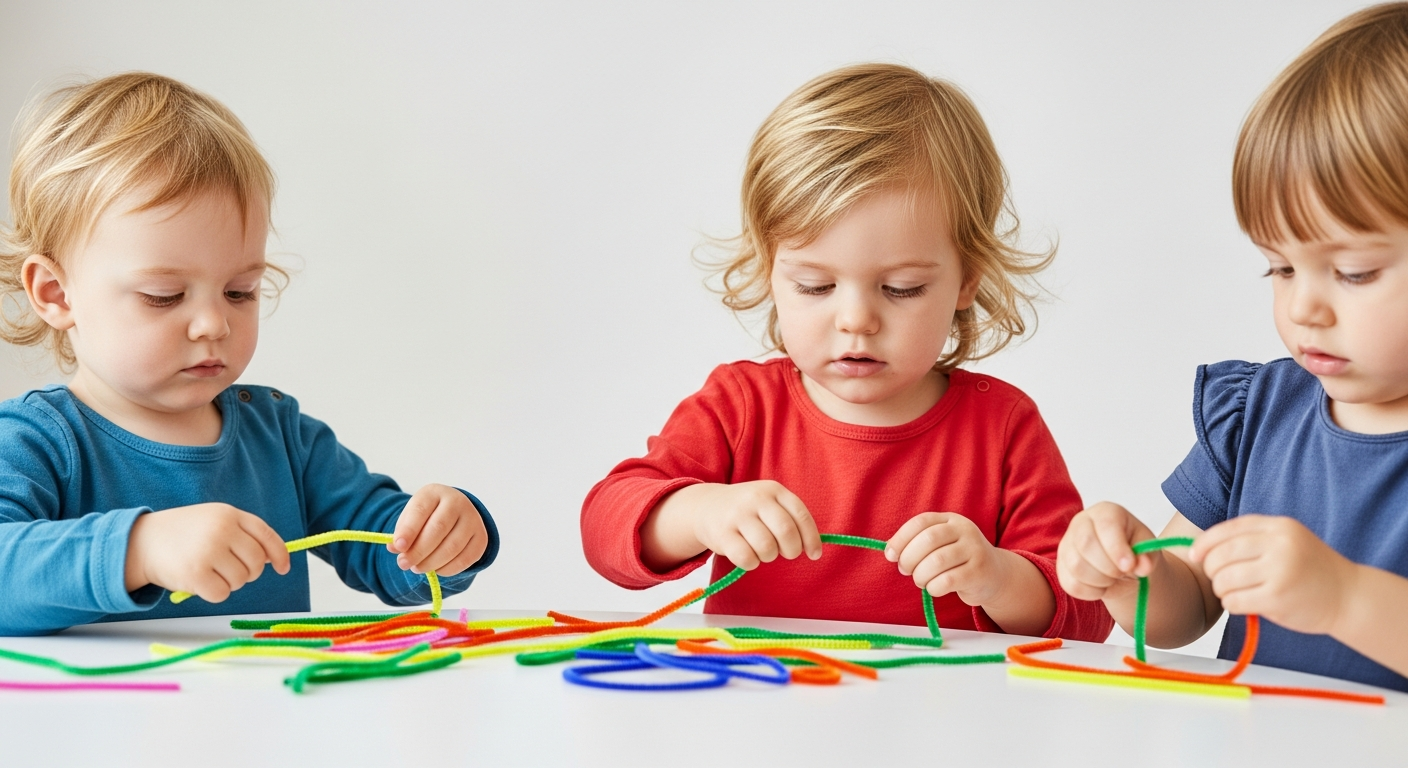
Table of Contents
- Introduction
- Why Pipe Cleaners are a Toddler’s Best Friend
- The Developmental Benefits of Pipe Cleaner Play
- Simple Pipe Cleaner Activities for Busy Toddlers
- Creative Animal and Character Crafts
- Interactive Games and Wearable Art
- Integrating "Smart Screen Time" with Speech Blubs
- Tips for Success: Making Crafting Joyful
- Conclusion
- Frequently Asked Questions
Introduction
Did you know that a simple kitchen colander and a handful of fuzzy, colorful wires can often capture a toddler’s attention longer than the most expensive electronic toy on the market? It sounds almost too good to be true, but the magic of pipe cleaners (also known as chenille stems) lies in their simplicity, tactile appeal, and endless versatility. As parents and caregivers, we are constantly searching for ways to engage our little ones that don’t involve passive screen time. We want activities that spark joy, build confidence, and help our children "speak their minds and hearts."
At Speech Blubs, we understand the unique challenges of the toddler years. Our founders grew up with speech hurdles themselves, and they created the tool they wished they’d had—a way to blend scientific principles with the pure joy of play. This blog post is designed to bridge the gap between physical, hands-on play and the developmental milestones we all want our children to reach. We will explore a wide variety of toddler crafts with pipe cleaners that foster fine motor skills, encourage communication, and provide those precious moments of family connection.

By the end of this guide, you’ll have a toolbox full of creative ideas that utilize common household items. We’ll also discuss how these activities complement the "smart screen time" provided by our app, helping your child build foundational communication skills through the power of peer-to-peer video modeling. Whether you have a "late talker" who loves animals or a budding artist who loves bright colors, there is something here for every child.
Why Pipe Cleaners are a Toddler’s Best Friend
Pipe cleaners are a staple in the world of early childhood development for good reason. Originally designed to clean tobacco pipes, these fuzzy wires have been reclaimed by educators and therapists worldwide. Their bendy nature allows children to manipulate them with ease, providing immediate feedback that builds a sense of agency. When a child bends a pipe cleaner and it stays in that shape, they realize they have the power to change their environment.
For toddlers, sensory input is everything. The soft texture of the chenille, combined with the slight resistance of the internal wire, provides a multi-sensory experience. This is crucial for children who may be sensory-seeking or those who simply learn best by doing. Furthermore, pipe cleaners are incredibly inexpensive and reusable. If a "sculpture" doesn't go as planned, you can simply straighten the wire and start again—a great lesson in resilience and the idea that "mistakes" are just part of the creative process.
We often see parents who are worried about their child's engagement levels. If you find yourself wondering if your child is meeting their developmental marks, you aren't alone. You can take our quick 3-minute preliminary screener to get a simple assessment and a free 7-day trial of our yearly plan. It’s a great way to see where your child stands while you explore these tactile crafts.
The Developmental Benefits of Pipe Cleaner Play
While it looks like just "playing around," toddler crafts with pipe cleaners are hard at work building the brain.

Fine Motor Mastery
Fine motor skills involve the coordination of small muscles in the hands and fingers. These skills are the building blocks for later tasks like buttoning a shirt, using a fork, and eventually, writing. When a toddler pinches a pipe cleaner to pick it up or threads it through a small hole, they are strengthening the muscles in their hands. This "pincer grasp" is a major milestone that we celebrate because it requires significant neurological coordination.
Color and Shape Recognition
Most pipe cleaner packs come in a vibrant rainbow of colors. This provides a natural opportunity for language reinforcement. As you play together, you can narrate the experience: "You picked up the blue wire!" or "Can you find the yellow one?" This casual, pressure-free environment is perfect for expanding vocabulary.
Boosting Confidence Through Creativity
There is no "wrong" way to use a pipe cleaner. This lack of rigid rules is vital for a toddler's self-esteem. When a child creates something—even if it just looks like a tangled ball of wire to us—and we acknowledge their effort, it builds confidence. This confidence often spills over into their willingness to try new speech sounds and communication styles. We see this same boost in confidence when children use Speech Blubs on the App Store, where they see other kids successfully making sounds and feel empowered to copy them.
Simple Pipe Cleaner Activities for Busy Toddlers
Let’s dive into some specific activities that you can set up in under two minutes using things you likely already have in your kitchen.
The Colander Masterpiece
This is the "gold standard" of pipe cleaner activities. All you need is a kitchen colander (the one with the holes for draining pasta) and a bunch of pipe cleaners.
- Place the colander upside down on the floor or a table.
- Show your child how to poke a pipe cleaner through one of the holes.
- Let them take over!
Some toddlers will poke them in and leave them there, creating a "porcupine" look. Others might thread them through one hole and out another. This activity is incredible for hand-eye coordination. It requires the child to visually track the hole and move their hand with precision.
Pro Tip: If your child is working on specific sounds, you can "assign" a sound to each color. For example, every time they use a green pipe cleaner, you can both make a "G-G-G" sound. For a parent whose 3-year-old "late talker" loves animals, the "Animal Kingdom" section of our app offers a fun, motivating way to practice these sounds before or after your crafting session.
The Spice Jar Challenge
If the colander is too easy, try an old spice jar with a shaker lid (the kind with several small holes). Cut the pipe cleaners into shorter pieces (about 2-3 inches long). Ask your child to "feed the jar" by dropping the pieces through the holes. This requires even more precision than the colander and is an excellent "quiet time" activity.
Safety Note: The ends of pipe cleaners can be a bit pokey. You can use a pair of pliers to bend the sharp tips over if you are concerned, but many parents find that simply supervising and showing the child how to hold the "fuzzy part" is sufficient.
Making Music: Pipe Cleaner Bracelets
Toddlers love wearable art. You can make simple bracelets by twisting a pipe cleaner around their wrist (not too tight!). To make it a "musical" activity, thread a few plastic beads or even a small bell onto the wire before securing it. Now, every time they wave their hands or dance, they create a sound. This helps them understand cause and effect, which is a foundational concept in communication.
Creative Animal and Character Crafts
Once your child has mastered the basics of poking and threading, you can move on to creating "friends" for them to play with.
Fuzzy Caterpillars and Snakes
This is a fantastic activity for practicing patterns and counting.
- Take one long pipe cleaner.
- Have your child thread large plastic beads (pony beads) onto the wire.
- When the wire is full, bend the ends to keep the beads from sliding off.
- Add some googly eyes to one end with a tiny bit of glue (or just twist the wire into a "head" shape).
This beaded snake or caterpillar becomes a tactile toy they can bend and wiggle. You can use this toy to practice directional words like "up," "down," "over," and "under." Our scientific methodology emphasizes that children learn best through play and imitation, and these little characters provide the perfect "co-player" for your child’s imaginative stories.
Beaded Dragonflies
To make a dragonfly, you’ll need two pipe cleaners.
- One pipe cleaner stays straight for the body (add beads here!).
- The second pipe cleaner is twisted into two loops and attached to the middle of the body to act as wings.
Dragonflies are "fast" and "zippy"—great words to practice while you fly your new creation around the room!
Pipe Cleaner Finger Puppets
Finger puppets are a wonderful way to encourage vocalization. To make one, simply wrap a pipe cleaner around your finger to create a coil. Slide the coil off your finger, and glue a small pom-pom to the top for a head. Add googly eyes, and you have a puppet!
We find that children who are shy about speaking often find it easier to "talk" through a puppet. You can act out simple scenarios, like the puppet saying "Hello!" or "How are you?" This mimics the peer-to-peer interaction found in Speech Blubs, where children learn by watching and imitating their peers. If you're looking for more ways to encourage this kind of interaction, download Speech Blubs on Google Play to explore our interactive modules.
Interactive Games and Wearable Art
Pipe cleaners aren't just for static crafts; they can be used to create tools for active play.
DIY Bubble Wands
Forget the plastic wands that come with bubble solution. You can make your own in any shape you want!
- Create a circle, heart, or star shape at one end of a pipe cleaner.
- Twist the end around the "stem" to secure the shape.
- Dip the fuzzy shape into bubble solution.
Because pipe cleaners are absorbent, they actually hold onto the bubble solution better than plastic wands, often resulting in bigger, longer-lasting bubbles. Blowing bubbles is a classic speech therapy tool because it helps children develop breath control and lip rounding, both of which are essential for clear speech.
Royal Crowns and Scepters
For a rainy afternoon of dress-up, you can create a crown by twisting several pipe cleaners together into a large circle that fits your child’s head. Add "points" to the crown by attaching V-shaped wires around the rim. Use sparkly or metallic pipe cleaners for a truly "royal" effect.
Creating a scepter is as simple as attaching a star shape to the end of a straight wire. This kind of pretend play allows children to experiment with different "voices" and roles, expanding their communicative range. You can see how other parents have used play to spark progress by reading our success stories and testimonials.
The Pipe Cleaner Fishing Game
This is a wonderful way to practice coordination and patience.
- The Fish: Bend small pieces of pipe cleaner into "fish" shapes (a simple loop with the ends crossing for a tail).
- The Pole: Tie a piece of string to a stick or a long pipe cleaner. At the end of the string, create a small "hook" out of another pipe cleaner.
- The Play: Place the fish in a "pond" (a blue towel or a bowl) and have your child try to catch them with the hook.
This game is great for practicing turn-taking ("My turn, now your turn") and celebrating success!
Integrating "Smart Screen Time" with Speech Blubs
While hands-on crafts are essential, we live in a digital world. At Speech Blubs, we believe in "smart screen time"—an experience that is active, educational, and designed to facilitate real-world interaction rather than replace it. Our app is a powerful tool for family connection, intended to be used with an adult to maximize learning.
Our methodology is rooted in video modeling. Research shows that children are highly motivated to copy other children. When your child sees a peer on the screen making a specific sound or word, their "mirror neurons" fire, making it easier for them to replicate that sound. This is far more effective than a cartoon or a passive video.
We provide a screen-free alternative to the "zombie mode" that often happens with traditional media. After a session of playing with pipe cleaners, you might spend 10-15 minutes on Speech Blubs to reinforce the sounds you practiced during your craft time. This holistic approach ensures that your child is getting the best of both worlds: tactile, sensory play and scientifically-backed digital learning.
Choosing the Right Plan for Your Family
We want to be transparent about our pricing so you can make the best choice for your child’s development. We offer two main paths:
- Monthly Plan: For $14.99 per month, you get full access to our main app and its library of 1,500+ activities.
- Yearly Plan: For $59.99 per year, which breaks down to just $4.99 per month.
The Yearly Plan is the clear favorite for families committed to seeing progress. Not only do you save 66%, but the Yearly Plan also includes exclusive features you won't get on the monthly subscription:
- A 7-day free trial to explore everything we have to offer.
- The Reading Blubs app, specifically designed to help toddlers and preschoolers transition from speech to early literacy.
- Early access to all new updates and content.
- Priority 24-hour support response time from our dedicated team.
To get the full suite of features and the free trial, we encourage you to sign up on our web page and select the yearly option.
Tips for Success: Making Crafting Joyful
To ensure your crafting sessions are a success, keep these tips in mind:
- Follow Their Lead: If your child wants to pull all the pipe cleaners out of the colander instead of putting them in, let them! Destruction is often just as educational as construction for a toddler.
- Narrate Everything: Use your voice to describe what is happening. "Oh, that's a stretchy wire!" or "Look, you made a circle." This constant stream of language helps build their internal dictionary.
- Keep it Short: Toddlers have short attention spans. If they are done after five minutes, that’s okay. You can always leave the supplies out for them to come back to later.
- Emphasize Process over Product: It doesn't matter if the "dog" they made looks like a blob. What matters is the movement of their fingers, the focus in their eyes, and the giggles you share together.
- Co-Play is Key: Your presence is the most important part of the activity. When you sit on the floor and engage with them, you are signaling that their work is valuable and that communication is a joyful experience.
Conclusion
Toddler crafts with pipe cleaners are more than just a way to pass the time on a rainy afternoon. They are a gateway to fine motor development, sensory exploration, and language growth. By providing your child with these simple, tactile experiences, you are laying the foundation for a lifetime of confident communication.
At Speech Blubs, our mission is to empower your child to speak their mind and heart. We see our app as a powerful supplement to these real-world activities—a way to harness the power of peer modeling and "smart screen time" to reduce frustration and build key foundational skills. We don't promise overnight miracles, but we do promise a journey filled with joyful learning moments and evidence-based support.
Are you ready to see your child's confidence grow? Start your 7-day free trial today by downloading the app on the App Store or Google Play. Remember to select the Yearly plan to unlock the full value, including the Reading Blubs app and priority support. Let's make learning to talk the fun adventure it was always meant to be!
Frequently Asked Questions
1. Are pipe cleaners safe for toddlers who still put things in their mouths? While pipe cleaners are generally safe, they do contain a thin wire inside. Always supervise your child during play. If your child is a heavy "mouther," you might prefer to use extra-thick "chenille stems" or stick to threading activities with large noodles or cut-up straws until they pass that phase. Always check the ends of the wires to ensure they aren't overly sharp.
2. How exactly do these crafts help with my child's speech? Speech is a motor task. The same brain regions that handle fine motor movements (like using your fingers) are closely linked to those that handle speech sounds. Furthermore, these activities provide a low-pressure environment for "languaging." When you talk about the colors, shapes, and actions while crafting, your child is absorbing vocabulary and sentence structures in a natural, fun way.
3. My child gets frustrated easily when they can't get the wire in the hole. What should I do? Frustration is a natural part of learning! Use it as a teaching moment for emotional regulation. You can say, "It's hard to get that in, isn't it? Let's try together." Offer just enough help so they can succeed, but let them do the final "poke." This builds "self-efficacy"—the belief that they can solve problems.
4. Can I use Speech Blubs if my child is already seeing a professional speech therapist? Absolutely! We frame our app as a powerful supplement to professional therapy, not a replacement. Many therapists actually recommend Speech Blubs to their clients as a way to keep the momentum going between sessions. It’s a great way to make "homework" feel like a reward rather than a chore.
About the author