
10 Fun Watermelon Toddler Craft Ideas for Summer Play
 By Speech Blubs Team•Feb 20, 2026•13 min.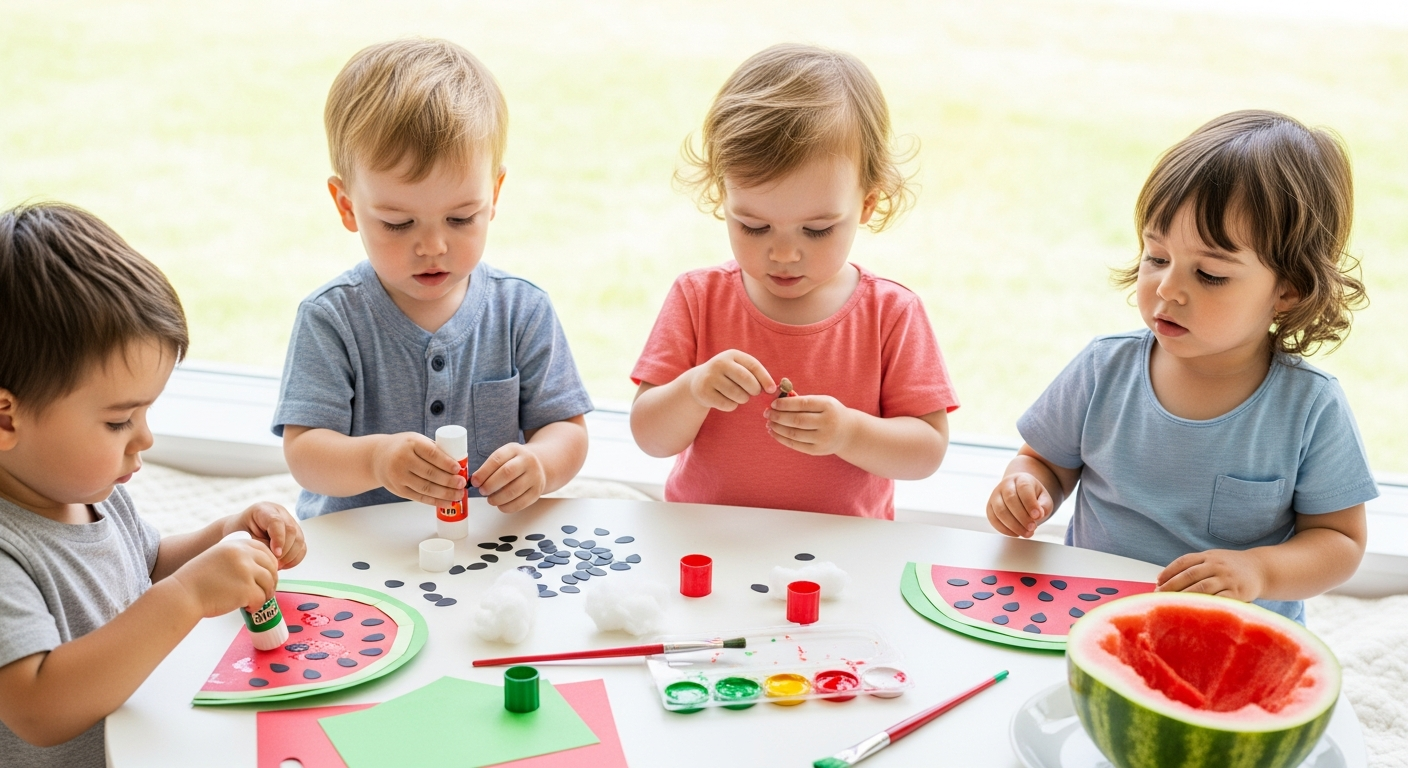
Table of Contents
- Introduction
- The Importance of Multi-Sensory Play
- 1. The Classic Paper Plate Watermelon Slice
- 2. Tissue Paper Scrunched Collage
- 3. Watermelon "Chill" Dough
- 4. Q-Tip Seed Poking Game
- 5. Watermelon Suncatchers
- 6. The "Who Ate the Watermelon Seed?" Reading Game
- 7. Melon Balling: A Kitchen "Craft"
- 8. Scissor Skills: Slicing the Melon
- 9. Fingerprint Seed Painting
- 10. Melting Frozen Watermelons
- Science Meets Play: The Speech Blubs Approach
- Choosing the Right Plan for Your Family
- Frequently Asked Questions
- Conclusion
Introduction
Do you remember the sticky, sweet feeling of watermelon juice running down your chin on a scorching July afternoon? For most of us, watermelon is the unofficial mascot of summer. But for a toddler, a watermelon isn’t just a delicious snack; it is a sensory explosion of vibrant reds, deep greens, and tiny black seeds. It is an opportunity to explore textures, colors, and shapes. At Speech Blubs, we believe that these everyday moments of joy are the perfect foundation for learning. Whether your child is a "late talker" or simply a curious explorer, engaging in a watermelon toddler craft is a fantastic way to boost fine motor skills, encourage descriptive language, and build confidence.
We know that approximately 1 in 4 children will face a speech or language delay at some point in their early development. This statistic isn't meant to cause alarm but rather to highlight how common the need for support truly is. Our mission is to empower children to speak their minds and hearts by turning screen time into "smart screen time." Our founders started Speech Blubs because they grew up with speech challenges themselves and wanted to create the joyful, effective tool they wish they’d had. By combining artistic play with our scientifically-backed video modeling—where children learn by watching and imitating their peers—we help bridge the gap between "doing" and "saying."

In this post, we are going to dive deep into ten creative, easy-to-implement watermelon crafts that you can do at home. We will explain how each activity supports your child's development and how you can use these moments to foster a deeper connection with your little one. From sensory dough to fine motor "seed" games, we’ve got your summer crafting covered.
The Importance of Multi-Sensory Play
Before we get our hands messy, it is helpful to understand why a watermelon toddler craft is so beneficial. When children engage in multi-sensory play—activities that involve touch, sight, smell, and even taste—they are building complex neural pathways. For a child working on communication, these physical experiences provide the "hooks" that words hang on. It is much easier to learn the word "cold" when your hands are buried in chilled watermelon dough, or the word "round" when you are painting a paper plate.
At Speech Blubs, we advocate for a holistic approach to development. We don't just want kids to repeat words; we want them to understand the world around them. This is why our app features sections like "Yummy Time," where children can see other kids interacting with food. You can download Speech Blubs on the App Store to see how our peer-led videos can supplement the hands-on fun you’re having in the kitchen or at the craft table.
1. The Classic Paper Plate Watermelon Slice
This is a staple for a reason. It is simple, high-contrast, and allows for varying levels of difficulty depending on your toddler's age.
Materials Needed:
- White paper plates
- Washable red and green paint
- Paintbrushes
- Black markers or black pom-poms
The Process:
Start by cutting the paper plate in half. This immediately introduces the concept of "half" and "whole." Encourage your child to paint the outer rim green (the rind) and the inner circle red. Once the paint is dry, they can add the seeds. Using a black marker to draw dots is great for "point" movements, while gluing down black pom-poms or even real dried watermelon seeds provides a fantastic tactile experience.

Speech Tip:
While they paint, narrate their actions. "You are painting the green rind. It goes around and around!" This helps them associate the action with the vocabulary. If you’re curious about where your child stands in their language milestones, you can take our 3-minute preliminary screener to get a quick assessment and a personalized plan.
2. Tissue Paper Scrunched Collage
This watermelon toddler craft is a powerhouse for developing the pincer grasp—the ability to pick up small objects between the thumb and forefinger. This skill is foundational for later tasks like holding a pencil or buttoning a shirt.
The Steps:
- Cut a paper plate in half or draw a large triangle on cardstock.
- Provide small squares of red and green tissue paper.
- Show your child how to "scrunch" the paper into tiny balls.
- Apply glue to the watermelon template and have your child press the scrunched paper onto the glue.
The varying textures of the tissue paper provide excellent sensory input. For a child who might find painting too "messy" or overwhelming, the dry texture of tissue paper can be a more comfortable entry point into crafting.
3. Watermelon "Chill" Dough
Sensory bins and playdough are favorites in the Speech Blubs community because they encourage open-ended play. Creating a watermelon-themed dough adds a refreshing summer twist.
Recipe:
- 2 cups of flour
- 1 cup of salt
- 2 tablespoons of cream of tartar
- 2 tablespoons of vegetable oil
- 1.5 cups of boiling water
- Red food coloring and a drop of watermelon extract (optional)
Once the dough is cooled, you can even put it in the refrigerator for an hour to make it "chill" dough. Give your toddler green and red dough, along with some black beans to act as "seeds."
Practical Scenario:
For a parent whose 3-year-old is a "late talker," the watermelon dough offers a low-pressure environment to practice "m" and "p" sounds. As you press the beans into the dough, you can say, "Pop! Pop! Pop!" This kind of play is exactly how we frame our "Mouth Gym" exercises in the app—making vocalization a fun, rhythmic part of the game. You can find more about our research-backed methodology here to see why these simple sounds are so important.
4. Q-Tip Seed Poking Game
This is a clever way to recycle an old cardboard box and turn it into a high-engagement fine motor activity.
How to Build It:
Take a small cardboard box and tape a piece of red paper to the top. Draw a watermelon shape on it. Using a screwdriver or a thick needle (adults only!), poke small holes throughout the "red" area. Give your child a handful of Q-tips. You can even paint the tips of the Q-tips black to look like seeds.
Your toddler’s mission is to "plant" the seeds by poking the Q-tips into the holes. This requires focus, hand-eye coordination, and spatial awareness. It’s also incredibly satisfying for a toddler to see the Q-tip disappear into the hole!
5. Watermelon Suncatchers
Decorating your windows with summer art is a great way to build a child's pride in their work.
Materials:
- Contact paper (clear adhesive paper)
- Red and green tissue paper
- Black construction paper circles
Instructions:
Cut a circle out of the center of a paper plate, leaving just the rim. Paint the rim green. Place a piece of contact paper across the hole. Let your child stick red tissue paper squares and black "seed" circles onto the sticky surface. Hang it on a sunny window and watch the red glow!
This activity encourages "sticky" vs. "smooth" vocabulary. At Speech Blubs, we love activities that turn the home environment into a gallery of learning.
6. The "Who Ate the Watermelon Seed?" Reading Game
This activity bridges the gap between a craft and a literacy game. It is perfect for toddlers who are starting to recognize names or simple sight words.
Setup:
Take three or four green plastic cups. On the bottom of each, write a family member's name (e.g., MOM, DAD, KATE). Take a small black pom-pom (the "seed"). While your child closes their eyes, hide the seed under one of the cups.
The Game:
Ask your child, "Did DAD eat the watermelon seed?" Your child has to find the cup that says "DAD" and lift it up. If the seed isn't there, try another name. This encourages name recognition and helps them follow multi-step directions.
7. Melon Balling: A Kitchen "Craft"
Sometimes the best watermelon toddler craft is working with the fruit itself. Kids love to feel helpful in the kitchen, and using a melon baller is an incredible workout for their wrist and hand muscles.
Activity:
Cut a watermelon in half and give your child a melon baller and a large bowl. Show them how to scoop out the fruit. It’s okay if they don't make perfect spheres; the goal is the effort and the sensory experience.
Safety and Connection:
This is a high-supervision activity that creates a wonderful "family learning moment." As your child scoops, talk about how the watermelon feels (wet, cold) and how it tastes (sweet). This builds a rich descriptive vocabulary. To see how other families have integrated these kinds of real-world activities with our app, check out these parent success stories.
8. Scissor Skills: Slicing the Melon
Learning to use scissors is a major milestone for preschoolers. You can create a "safe" way to practice using a watermelon theme.
The Craft:
Draw a large semi-circle on green cardstock and a smaller one on red paper. Glue them together to make a watermelon slice. Draw dotted lines from the flat edge to the rounded edge. Ask your child to "slice" the watermelon by cutting along the dotted lines.
This helps them practice opening and closing the scissors while following a visual guide. Even if they don't stay perfectly on the line, they are building the hand strength necessary for writing later on.
9. Fingerprint Seed Painting
For a quick and easy craft, nothing beats finger painting.
The Process:
Have your child paint a red triangle on a piece of paper. Then, have them dip just the tip of their pointer finger into black paint. They can then "stamp" their fingerprints onto the red triangle to create seeds.
Why It Works:
This focuses on "isolated finger movement." Many toddlers want to use their whole hand to paint. Encouraging them to use just one finger is a specific developmental skill that helps with fine motor precision.
10. Melting Frozen Watermelons
This is a great outdoor sensory activity for a hot day.
Preparation:
Freeze chunks of real watermelon or red-colored ice cubes with "seeds" (black beans) inside. On a tray, give your child a squirt bottle or a dropper filled with warm water.
The Play:
Have them squirt the warm water onto the frozen watermelon to "melt" it and reveal the seeds. Using a squirt bottle is excellent for strengthening the muscles in the hand, which are the same muscles needed for many daily tasks.
Science Meets Play: The Speech Blubs Approach
You might wonder how a watermelon toddler craft relates to a speech therapy app. At Speech Blubs, our scientific methodology is centered on the concept of video modeling. Research shows that children are highly motivated by watching their peers. When a child in our app makes a "m-m-m" sound while "eating" a digital watermelon, your child is likely to mimic that behavior because of mirror neurons in the brain.
Our app isn't a passive experience like watching a cartoon; it is an interactive tool designed for "co-play." We encourage parents to sit with their children, use the app for 10-15 minutes, and then transition into a hands-on activity like the ones listed above. This "app-to-world" transition is where the real magic happens. By using the app to spark interest and then using a craft to solidify the concept, you are providing a comprehensive learning environment.
Ready to see how video modeling can help your child? Get it on Google Play and start your journey today.
Choosing the Right Plan for Your Family
We want to be transparent about how you can access our full suite of tools. While we offer a variety of content, our Yearly plan is designed to provide the most consistent support for your child's development.
- Monthly Plan: $14.99 per month. This is a great way to test the waters if you're looking for a short-term boost.
- Yearly Plan: $59.99 per year. This breaks down to just $4.99 per month, saving you 66% compared to the monthly rate.
Why the Yearly Plan is the Best Choice:
The Yearly plan isn't just about the price; it includes several exclusive features that help you get the most out of Speech Blubs:
- 7-Day Free Trial: You can explore everything we offer risk-free for a full week.
- Reading Blubs App: Included at no extra cost, this app helps transition your child from speech to early reading skills.
- Early Access: You get the latest updates and new activities before anyone else.
- Priority Support: Our team will respond to your questions within 24 hours.
Create your account today and select the Yearly plan to unlock these "smart screen time" benefits.
Frequently Asked Questions
What age is best for a watermelon toddler craft?
Most of these activities are designed for children aged 2 to 5. However, they can easily be adapted. For younger toddlers, focus on the sensory aspects (the cold fruit or the squishy dough). For older children, focus on more complex tasks like using scissors or name recognition in the "Who Ate the Seed?" game.
How do these crafts help with speech delay?
Crafts provide a context for language. Instead of asking a child to "say red," you are working with red paint, talking about red paper, and looking at red fruit. This repetition in a fun, low-stress environment helps children naturally acquire and use new words.
Is Speech Blubs a replacement for speech therapy?
Speech Blubs is a powerful supplement to professional therapy, not a replacement for it. If you have concerns about your child's development, we always recommend consulting a licensed Speech-Language Pathologist (SLP). Our app is an excellent tool to use at home to reinforce the skills learned in therapy sessions.
Can I do these crafts if I’m not "crafty"?
Absolutely! The goal isn't to create a masterpiece for a museum; the goal is to have a "joyful family learning moment." Most of these crafts use basic household items like paper plates, glue, and markers. Your child doesn't care if the watermelon looks perfect—they just care that they are doing something fun with you.
Conclusion
A watermelon toddler craft is more than just a way to pass a summer afternoon. It is a bridge to communication, a workout for tiny fingers, and a chance to build lasting family memories. Whether you are scrunching tissue paper, poking Q-tip seeds, or scooping out fruit with a melon baller, you are giving your child the tools they need to explore and describe their world.
At Speech Blubs, we are here to support you every step of the way. Our mission is to help every child speak their mind and heart through joyful, science-based play. We invite you to join our community of over 5 million parents who are turning screen time into a powerful developmental tool.
Don't wait to start building your child's confidence. Download Speech Blubs on the App Store or Google Play today. We recommend choosing the Yearly plan to take advantage of the 7-day free trial, the bonus Reading Blubs app, and the best overall value at just $4.99/month. Let's make this summer a season of growth, laughter, and lots of "sweet" success!
About the author