
12 Creative Toddler Crafts With Leaves for Fall Play
 By Speech Blubs Team•Feb 23, 2026•16 min.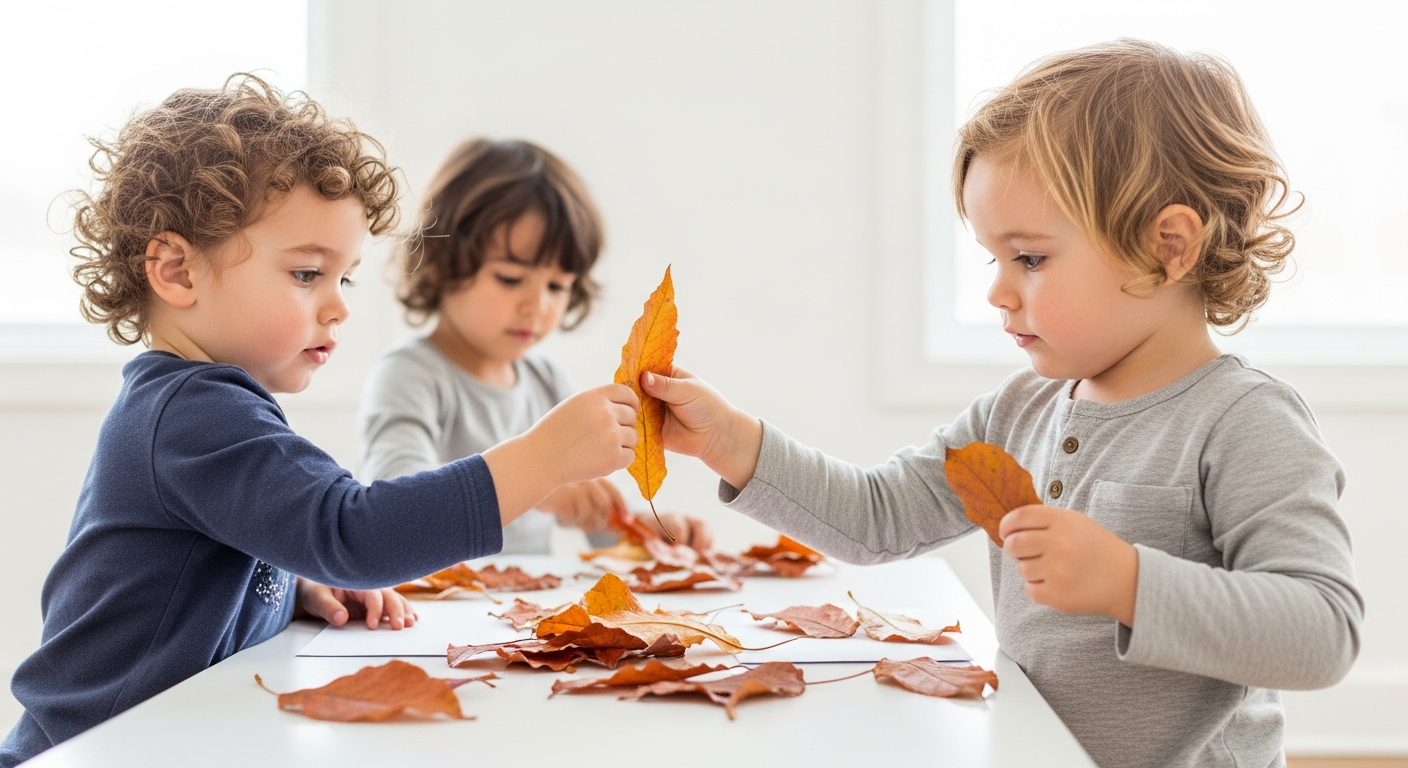
Table of Contents
- Introduction
- Why Nature Play and Crafting Boost Language Skills
- Preparing for Your Leaf Adventure
- 1. The Classic Fall Leaf Tree
- 2. Leaf Animals and Collages
- 3. Nature Confetti (The Fine Motor Powerhouse)
- 4. Leaf Suncatchers
- 5. Leaf Rubbing Collage
- 6. Leaf Ghosts (Spooky Fall Fun)
- 7. The Leaf Crown
- 8. Glass Jar Leaf Lanterns
- 9. Leaf Mobiles
- 10. Leaf Stamping
- 11. Preserving Leaves with Beeswax
- 12. Leaf Puppets
- Maximizing Value: Smart Screen Time and Family Connection
- Fostering a Love for Communication
- Conclusion
- Frequently Asked Questions
Introduction
Have you ever watched a toddler discover a crunchy autumn leaf for the first time? To an adult, it’s just yard waste, but to a child, it is a sensory explosion of sound, texture, and vibrant color. This natural curiosity provides a golden window for learning, connection, and language development. In this post, we are going to explore why nature play is so vital and provide you with a comprehensive list of toddler crafts with leaves that will keep your little ones engaged all season long. We will cover everything from simple leaf collages to more complex (but manageable!) projects like leaf lanterns and crowns.
Our goal at Speech Blubs is to help children speak their minds and hearts. We know that the best learning happens through play, and what better playground is there than the Great Outdoors? We were founded by a group of friends who all grew up with speech challenges, so we understand the importance of making learning joyful rather than a chore. Whether you are working through a speech delay or simply want to foster your child’s blossoming communication skills, these activities are designed to build confidence and joy. By the end of this article, you will have a full toolkit of autumn activities and a better understanding of how to use "smart screen time" to supplement your child’s growth.

Why Nature Play and Crafting Boost Language Skills
At Speech Blubs, our mission is to provide an immediate, effective, and joyful solution for the 1 in 4 children who need speech support. While our app uses scientific principles like video modeling, we always encourage parents to pair digital learning with real-world tactile experiences. Toddler crafts with leaves are a perfect example of this synergy.
When a child handles a leaf, they aren't just making art; they are engaging in a multi-sensory experience. They feel the ridges (tactile), see the crimson and gold (visual), and hear the "crunch" (auditory). This sensory input is the foundation of language. For a parent whose child is just starting to mimic sounds, the "cr-cr-crunch" of a leaf is a fantastic opportunity to practice consonant clusters in a fun, non-pressured way.
Furthermore, these activities foster fine motor skills. Gripping a glue stick, tearing a leaf, or using a hole punch builds the muscles in the hands that are eventually needed for writing. As we like to say, we are building the foundational skills that help kids express themselves fully. If you are ever unsure where your child stands in their development, you can take our quick 3-minute preliminary screener which consists of 9 simple questions to give you a clearer picture and a next-steps plan.
Preparing for Your Leaf Adventure
Before you start crafting, you need the most important ingredient: the leaves! This is an activity in itself. Grab a basket or a small bucket and head to a local park or even just your backyard.
Tips for Collecting Leaves
- Dryness Matters: Try to go out on a dry day. Wet leaves are harder to glue and can grow mold if you try to preserve them.
- Variety is Key: Look for different shapes (maple, oak, birch) and a range of colors.
- The "Freshness" Factor: For many crafts, you want leaves that are still a bit flexible. If they are already bone-dry and crumbling, they won’t survive the gluing process.
- Immediate Action: If you aren't going to craft right away, put your finds in a plastic bag in the fridge or press them between the pages of a heavy book to keep them flat.
As you walk, narrate the experience. "Look at this big, red leaf!" or "I found a crunchy, brown leaf!" This modeling of descriptive language is exactly what we advocate for at Speech Blubs. You can see how this methodology translates to our digital platform by visiting our research page, where we explain the science of imitation and peer modeling.

1. The Classic Fall Leaf Tree
This is the perfect introductory craft for toddlers around 2.5 to 3 years old. It combines basic drawing with the magic of a glue stick.
What You Need:
- White construction paper
- Brown crayon or marker
- Glue stick
- A handful of colorful leaves
The Process:
- Draw the Base: Draw a simple tree trunk with several bare branches. Don't worry about being an artist; your toddler won't mind!
- The Modeling Phase: This is where you use the "I do, we do, you do" method. Show your child how to swipe the glue stick on the paper.
- Collaborative Gluing: Help them press a leaf onto the glue. Say the word "Press!" as you do it.
- Independence: Let them take over. They might put all the leaves in one corner or off the branches entirely—and that’s okay! The goal is the process, not a museum-quality result.
For a child who is a "late talker," this activity provides a repetitive, low-stress environment to practice functional words like "glue," "stick," "on," and "more." You can even use the Speech Blubs app on the App Store to find animal sounds or simple words to practice while you work together.
2. Leaf Animals and Collages
Toddlers love animals, and leaves come in shapes that naturally look like ears, tails, and wings.
The Creative Spark: Help your child look at a leaf and ask, "What does this look like?" A wide maple leaf might be a lion’s mane. A long willow leaf could be a fish.
Steps:
- Give your child a piece of cardstock.
- Encourage them to arrange the leaves to make a "leaf monster" or a "leaf kitty."
- Use a marker to add eyes, or use googly eyes if you have them.
In our app, we have a whole "Animal Kingdom" section. If your child creates a leaf dog, you might open the app and watch a peer model say "Woof!" This reinforcement helps bridge the gap between a physical activity and communicative intent.
3. Nature Confetti (The Fine Motor Powerhouse)
If your toddler is obsessed with buttons and small gadgets, they will love this. It’s a great alternative to plastic glitter, which we all know is impossible to clean up.
What You Need:
- Large, colorful fall leaves
- A standard hole punch or shaped punches (stars, hearts)
What to Do: Simply give your child the leaves and the punch. Show them how to slide the leaf in and "snap!" the punch down. It is incredibly satisfying for them to see the little colorful circles fall out.
Why it works: Using a hole punch requires significant hand strength and coordination. This is a direct precursor to the "pincer grasp" needed for holding a pencil. Once you have a pile of leaf confetti, you can glue them onto a drawing or even put them inside a clear ornament for a fall decoration.
4. Leaf Suncatchers
These look stunning when the autumn sun hits them, and they are surprisingly easy for toddlers to help with because they involve "sticky paper" (contact paper).
Materials:
- Clear contact paper
- Pressed leaves (thin ones work best)
- Embroidery hoop or a construction paper frame
Instructions:
- Cut two squares of contact paper.
- Peel the backing off one and lay it sticky-side up on the table.
- Let your toddler "drop" leaves onto the sticky surface.
- Place the second sheet of contact paper on top, sealing the leaves inside.
- Trim it into a circle and place it in an embroidery hoop or frame it with paper.
This activity is a great "screen-free" alternative to passive viewing. However, if you want to use technology intentionally, you could show your child a video of how leaves change color on our homepage or through our educational modules to explain the "why" behind their craft.
5. Leaf Rubbing Collage
This is a classic for a reason. It feels like a magic trick to a three-year-old.
The Method: Place a leaf "vein-side up" under a thin sheet of white paper. Show your child how to rub the side of a crayon (peel the paper off the crayon first!) over the leaf. Suddenly, the skeletal structure of the leaf appears on the paper.
Language Tip: Use words like "hidden" and "surprise!" Discuss the "texture" of the leaf. Is it bumpy? Is it smooth? This introduces more complex adjectives to their growing vocabulary.
6. Leaf Ghosts (Spooky Fall Fun)
As Halloween approaches, you can turn your nature walk finds into adorable little spirits.
How to make them:
- Find leaves with a somewhat rounded or "ghostly" shape (maple works well).
- Paint the leaves white using washable tempera paint.
- Once dry, use a black marker to draw two eyes and a "BOO!" mouth.
- String them together to make a spooky garland.
This activity is fantastic for practicing the "B" sound. Say "B-B-Boo!" every time you draw a mouth. Using the Speech Blubs app on Google Play can provide more examples of peer models making these exact sounds, which encourages your child to join in the fun.
7. The Leaf Crown
Every toddler wants to be the king or queen of the forest.
Easy Construction:
- Cut a long strip of construction paper or cardstock that fits around your child's head.
- Cover the strip with double-sided tape or a thick layer of glue.
- Let your child press their favorite leaves all along the strip.
- Staple or tape the ends together.
Wearing the crown can lead into a session of imaginative play. Ask, "What does the Forest King say?" This encourages role-play, which is a vital stage in cognitive and linguistic development.
8. Glass Jar Leaf Lanterns
These create a cozy, warm glow for those darkening autumn evenings.
Supplies:
- Clean glass jars (jelly or mason jars)
- Mod Podge (or watered-down school glue)
- Paintbrush
- Colorful leaves
- LED tea lights
Steps:
- Paint a layer of Mod Podge onto the outside of the jar.
- Stick the leaves onto the jar.
- Paint another layer of Mod Podge over the leaves to seal them.
- Let it dry completely (it will turn from cloudy to clear).
- Drop in an LED tea light.
Safety Note: Always use LED tea lights with toddlers rather than real candles to prevent any accidents.
9. Leaf Mobiles
Bring the outdoors in by hanging a collection of leaves from a branch.
How to Assemble:
- Find a sturdy stick on your walk.
- Tie different lengths of string or yarn to the stick.
- Tape or tie leaves to the ends of the strings.
- Hang the branch from the ceiling or a curtain rod.
This craft is great for teaching concepts like "high" and "low" or "long" and "short" as you look at the different strings.
10. Leaf Stamping
If your child loves getting their hands messy, leaf stamping is a hit.
Instructions:
- Paint one side of a sturdy leaf with a thin layer of paint.
- Press the painted side down onto paper like a stamp.
- Lift it up to reveal the print.
You can use different colors to create a "rainbow forest." This is a great time to work on color identification. Check out the testimonials on our site to see how other parents have integrated these kinds of labeling activities with the Speech Blubs app to see real progress in their children's speech.
11. Preserving Leaves with Beeswax
If you want your toddler's creations to last until Thanksgiving, you might consider dipping them in beeswax. This is a task for the adult, but the toddler will love the "magic" of the leaf becoming shiny and stiff.
Warning: This involves hot wax. Toddlers should observe from a safe distance.
- Melt beeswax pastilles in a double boiler.
- Hold the leaf by the stem and dip it quickly into the wax.
- Let the excess drip off and lay it on parchment paper to cool.
- Once cool, these leaves won't crumble or lose their color for a long time!
12. Leaf Puppets
Turn your leaves into characters for a puppet show.
Steps:
- Glue a large leaf to a popsicle stick.
- Add a face with markers or stickers.
- Hide behind a "stage" (like the back of a couch) and have the leaves talk to each other.
Puppetry is a powerful tool for speech therapy. It allows children to "speak through" a character, which often reduces the anxiety they might feel when speaking directly to an adult.
Maximizing Value: Smart Screen Time and Family Connection
At Speech Blubs, we believe in "smart screen time." This means that when your child is using a device, it should be an active, educational experience that encourages them to interact with the world around them, not just zone out. Our app is a powerful tool for family connection because it’s designed for you to play with your child.
When you are finished with your toddler crafts with leaves, you might spend 10–15 minutes on the Speech Blubs app to reinforce the words you used. This combination of physical play and digital modeling is what makes our approach unique.
Choosing the Right Plan for Your Family
We want to be transparent about our pricing so you can make the best choice for your child's journey. We offer two main paths:
- Monthly Plan: For $14.99 per month, you get full access to our library of over 1,500 activities and frequent content updates.
- Yearly Plan (Best Value): This is the clear choice for families committed to long-term progress. It costs $59.99 per year, which breaks down to just $4.99 per month.
Why the Yearly Plan is Superior: The Yearly plan isn't just a 66% saving; it also comes with exclusive benefits that the Monthly plan does not:
- A 7-Day Free Trial: You can try everything before you pay a cent.
- Reading Blubs App: You get our additional app dedicated to early literacy at no extra cost.
- Early Access: You get to try new updates before anyone else.
- Priority Support: We guarantee a 24-hour response time for any questions you have.
Ready to get started? Create your account and begin your 7-day free trial today.
Fostering a Love for Communication
It is important to set realistic expectations. While toddler crafts with leaves and using the Speech Blubs app are powerful tools, every child develops at their own pace. We aren't here to promise that your child will be giving public speeches in a month. Instead, we are here to help you foster a love for communication, build their confidence, and reduce the frustration that comes when a child can't express their needs.
Our "video modeling" methodology is backed by science. It leverages "mirror neurons" in the brain—the same neurons that fire when a child watches a peer perform an action. By watching other children speak and play on the screen, your child is naturally motivated to imitate them. This is the same principle as the "I do, we do, you do" method we suggested for the leaf tree craft.
Conclusion
Autumn is a fleeting, beautiful season that offers a wealth of free "toys" right on the ground. Engaging in toddler crafts with leaves is more than just a way to pass the time until nap; it’s a way to build a bridge between your child’s inner thoughts and their spoken words. From the fine motor skills required for nature confetti to the imaginative play of leaf puppets, these activities are foundational for a lifetime of learning.
We invite you to join the Speech Blubs family and take the next step in your child's developmental journey. Whether you use our free resources or dive into the full app experience, we are here to support you.
Take the next step today: Download Speech Blubs on the App Store or Google Play. Remember to choose the Yearly Plan to unlock your 7-day free trial, the Reading Blubs app, and the best possible value for your family. Let’s help your little one speak their mind and heart, one leaf and one word at a time.
Frequently Asked Questions
1. At what age can my toddler start using glue sticks for leaf crafts?
Most toddlers are ready to experiment with glue sticks around 2 to 2.5 years old. At this age, they are developing the hand-eye coordination to press the stick onto paper. However, they will need close supervision to ensure the glue ends up on the craft and not in their mouths! Use the "I do, we do, you do" method to model the behavior first.
2. How can I help my child who is a "late talker" during these activities?
Focus on "parallel talk." Instead of asking them a lot of questions (e.g., "What color is this?"), narrate what you are doing: "I am sticking the red leaf on. Put it on. On, on, on!" This provides a rich language environment without the pressure to perform. Pair this with the peer modeling found in Speech Blubs to encourage natural imitation.
3. What if I don't have access to real fall leaves?
If you live in a climate where leaves don't change color or you don't have easy access to a park, you can still participate! You can use green leaves from indoor plants (with permission!), cut leaf shapes out of construction paper, or buy a bag of "silk" leaves from a local craft store. The benefits for fine motor skills and language development remain the same.
4. How does the Speech Blubs app supplement these physical crafts?
The app serves as a "digital companion." If you are making a leaf lion, you can go to the "Animal Kingdom" section of the app to see a child model the "Roar!" sound. This reinforces the concept and gives the child a clear, peer-led example of how to use their voice to represent the craft they just made.
About the author