
12 Joyful Toddler Easter Activities for 2 Year Olds
 By Speech Blubs Team•Feb 23, 2026•15 min.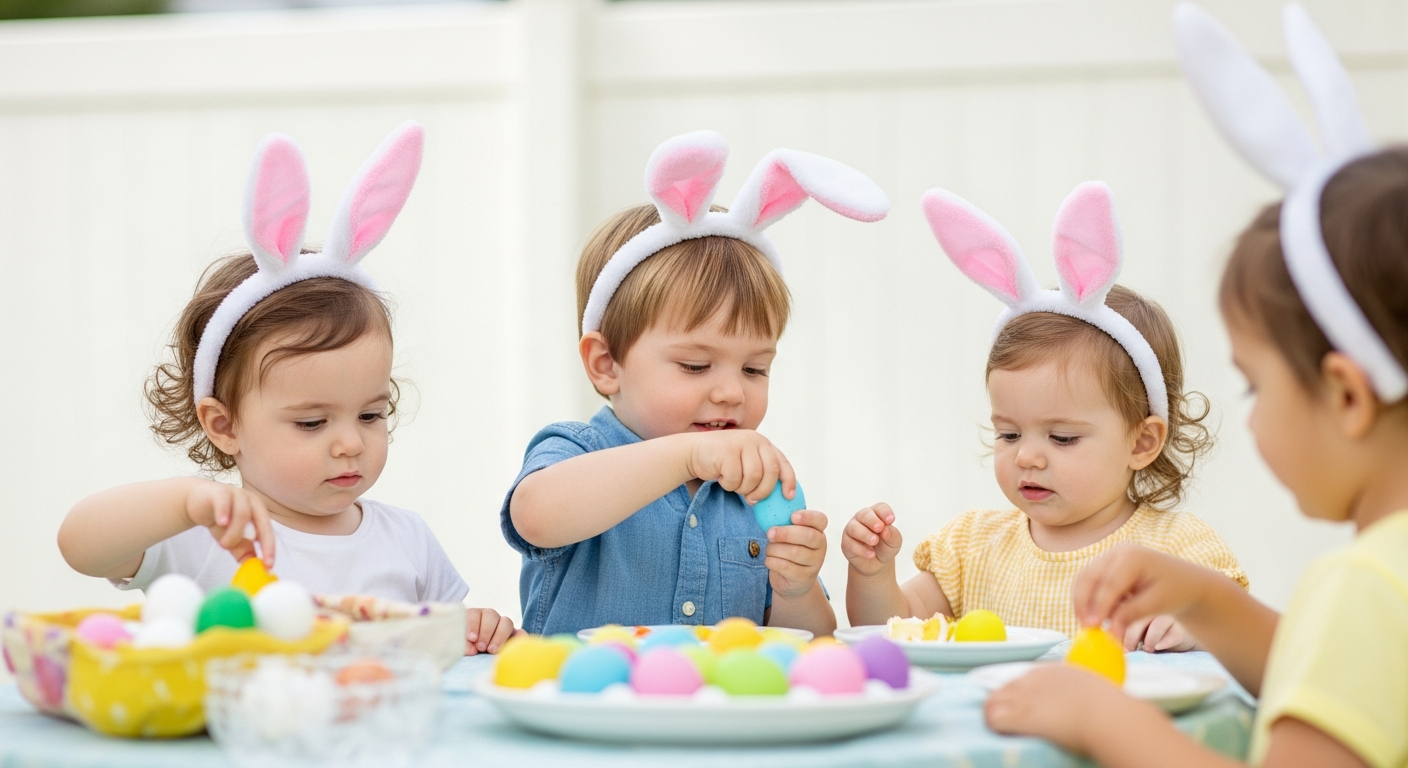
Table of Contents
- Introduction
- The Power of Play in Speech Development
- 1. ABC Easter Egg Hunt
- 2. Giant Easter Sensory Bin
- 3. Easter Egg Snack Hunt
- 4. Shaving Cream Egg Painting
- 5. Bunny Pom-Pom Drop
- 6. Sticky Wall Egg Match
- 7. Egg Stacking Challenge
- 8. Easter Color Sorting
- 9. Egg on a Spoon Walk
- 10. Spring Chick Paper Plate Craft
- 11. Edible Egg Painting
- 12. "Feed the Bunny" Vegetable Toss
- Why We Focus on "Smart Screen Time"
- Choosing the Right Plan for Your Family
- Realistic Expectations: Fostering a Love for Communication
- Practical Scenarios: How It Works in Real Life
- Setting Up for Success
- Conclusion
- FAQ
Introduction
Did you know that approximately one in four children will experience some form of speech or language delay during their early years? For a parent of a two-year-old, this statistic can feel overwhelming, especially when you are looking for ways to support your child’s growth through everyday play. Holidays like Easter offer a magical opportunity to bridge the gap between simple fun and meaningful developmental progress. At Speech Blubs, our mission is to empower children to "speak their minds and hearts," and we believe that holiday traditions are the perfect stage for this growth.
Easter isn’t just about chocolate bunnies and hidden eggs; it is a sensory-rich season filled with new textures, bright colors, and exciting sounds that can stimulate a child's desire to communicate. Whether your little one is already a chatterbox or is currently a "late talker" finding their voice, engaging in intentional play can foster a deep love for communication and build much-needed confidence. This post will explore 12 comprehensive toddler Easter activities for 2 year olds that focus on fine motor skills, sensory exploration, and language development.

Our goal is to provide you with a toolkit of activities that turn "screen time" into "smart screen time" and traditional play into a powerful family connection. By the end of this article, you will have a full itinerary of activities that are easy to set up and backed by the same spirit of joyful learning we infuse into our app.
The Power of Play in Speech Development
Before we dive into the list, it is important to understand why these activities are so beneficial. For a two-year-old, play is their primary "work." It is how they learn the names of objects, how to follow directions, and how to express their needs.
When we engage in toddler Easter activities for 2 year olds, we aren't just passing the time; we are building "mirror neurons." This is a scientific concept we hold dear at Speech Blubs. Our research-backed methodology utilizes video modeling, where children watch their peers perform actions and make sounds. This peer-to-peer connection is incredibly motivating for toddlers, and many of the activities below mimic this natural way of learning.
"Children learn best when they are happy, engaged, and playing with the people they love most."
1. ABC Easter Egg Hunt
This activity takes the traditional egg hunt and adds a literacy twist. For a two-year-old, recognizing letters is less about reading and more about "shape recognition" and "labeling."
- How to do it: Hide plastic eggs around your living room or yard. Inside each egg, place a small paper or plastic letter.
- The Speech Connection: As your child finds an egg, encourage them to "Open!" (a great functional word). Once open, name the letter and make its sound. "Look, it’s an 'A'! /a/ /a/ /apple/!"
- Speech Blubs Integration: If your child finds a letter that corresponds with an animal (like 'B' for Bear), you can open the "Animal Kingdom" section of Speech Blubs to watch a peer make the animal sound. This reinforces the connection between the symbol, the sound, and the real-world object.
2. Giant Easter Sensory Bin
Sensory bins are a staple for a reason. They provide a contained space for a child to explore different tactile sensations, which is vital for cognitive development.

- How to do it: Fill a large plastic tub with "Easter grass" (the crinkly paper kind), plastic eggs, shovels, and perhaps some hidden plastic carrots or toy bunnies.
- The Speech Connection: This is a vocabulary goldmine. Use descriptive words like crinkly, soft, green, hidden, and found. Ask your child, "Can you find the blue egg?" or "Where is the bunny hiding?"
- Pro Tip: If your child is hesitant with new textures, let them use a tool like a spoon or tongs first. This reduces the sensory "threat" while still engaging them in the activity.
3. Easter Egg Snack Hunt
Two-year-olds are highly motivated by snacks! Turning snack time into a game is an excellent way to practice "requesting."
- How to do it: Place small, healthy snacks (like blueberries, Cheerios, or yogurt melts) inside clean plastic eggs. Hide them in plain sight.
- The Speech Connection: This activity is perfect for practicing "More," "Please," and "Open." For a child who is struggling to speak, the motivation of a snack often provides the extra push they need to attempt a word or a sign.
- Safety Note: Always supervise your child during any activity involving small objects or food to prevent choking.
4. Shaving Cream Egg Painting
For toddlers who love a mess, shaving cream "painting" is a winner. It’s a high-sensory activity that encourages "crossing the midline," a physical development milestone.
- How to do it: Fill a tray with shaving cream and drop in some food coloring or liquid watercolors. Give your child plastic eggs to roll through the "clouds."
- The Speech Connection: Use "action" words. Roll, push, splash, mess! When your child looks at their messy hands, it’s a great time to practice the "Oh oh!" or "Uh-oh!" sounds found in our "Early Sounds" section.
- Speech Blubs Tip: Our app was created by founders who grew up with speech problems, and we know that sometimes the best way to get a child talking is to get them laughing. Messy play is a surefire way to trigger those joyful vocalizations.
5. Bunny Pom-Pom Drop
This activity is fantastic for fine motor control and hand-eye coordination.
- How to do it: Take an empty plastic water bottle or a cardboard box and draw a bunny face on it. Cut a hole where the bunny’s "mouth" would be. Give your child colorful pom-poms to "feed" the bunny.
- The Speech Connection: Every time a pom-pom goes in, say "Pop!" or "Yum!" or "In!" This repetition helps the child map the word to the action.
- Refining Skills: If your child finds this too easy, use smaller pom-poms or a smaller opening to increase the challenge.
6. Sticky Wall Egg Match
Sticky walls are a "magic" toddler hack. All you need is contact paper and some tape.
- How to do it: Tape a piece of contact paper to the wall, sticky side out. Draw an outline of a large Easter basket. Cut out paper eggs of different colors.
- The Speech Connection: Ask your child to "Put the egg on the basket." This practices spatial prepositions (on, under, beside).
- Social Proof: Many parents in our community testimonials have noted that their children respond better to speech practice when it involves a physical, vertical component like a sticky wall.
7. Egg Stacking Challenge
Simple, yet effective. Two-year-olds are just beginning to master the art of balancing objects.
- How to do it: Break apart a dozen plastic eggs. Challenge your child to stack the halves as high as they can.
- The Speech Connection: Use the concepts of "Up, up, up... Down!" and "Tall" vs "Short." When the tower inevitably falls, it’s the perfect time to practice "Boom!" or "Crash!"
- Support: If your child gets frustrated, model the behavior for them. Say, "It's okay! Let's try again. Pick up the blue one."
8. Easter Color Sorting
Sorting is a foundational cognitive skill that precedes more complex math and logic.
- How to do it: Set out three colored bowls (e.g., red, blue, yellow). Give your child a pile of eggs in those same colors and ask them to match the egg to the bowl.
- The Speech Connection: Repeat the color names constantly. "Yellow egg goes in the yellow bowl."
- Speech Blubs Advantage: Use our "Colors" section in the app to reinforce these concepts. Seeing another child point to "Yellow" on the screen can motivate your toddler to do the same in real life.
9. Egg on a Spoon Walk
This is a classic gross motor activity that helps with balance and focus.
- How to do it: Give your child a large wooden spoon and place a plastic egg on it. Mark a "start" and "finish" line on the floor with tape.
- The Speech Connection: Use "Go!" and "Stop!" commands. This helps with "inhibitory control"—the ability to stop an action, which is a key part of following directions.
- Modification: For a two-year-old, the egg will fall often. Keep the tone light and encouraging. Focus on the effort rather than the "win."
10. Spring Chick Paper Plate Craft
Crafting allows for "sequencing" practice—learning that things happen in a certain order (first glue, then feathers).
- How to do it: Paint a paper plate yellow. Glue on orange triangles for feet and a beak, and large googly eyes.
- The Speech Connection: Label body parts. "Where is the chick’s eye? Where is his beak?"
- Smart Screen Time: After making the craft, you can watch the "Bird" video in Speech Blubs. Our video modeling shows kids chirping like chicks, which your child can then imitate with their new craft.
11. Edible Egg Painting
Since two-year-olds still put everything in their mouths, edible paint is the safest way to explore art.
- How to do it: Mix plain Greek yogurt with a few drops of food coloring. Give your child hard-boiled eggs to "paint" with their fingers or a brush.
- The Speech Connection: Talk about how the paint feels (cold, smooth, wet). Ask, "Do you want more blue?"
- Success Story: One parent mentioned that her "late talker" said his first color word during a painting session because he was so focused on the sensory experience that the word just "popped out."
12. "Feed the Bunny" Vegetable Toss
Combine healthy habit building with gross motor play.
- How to do it: Use a box with a bunny face (like in activity #5) but make it larger. Use real carrots or orange beanbags to "feed" the bunny from a distance.
- The Speech Connection: Practice the "Mmm" sound for "Yummy!" and use the word "Target" or "Throw."
- Confidence Building: This game is great for building confidence. Every time they make it in, celebrate with a "High five!" or a "Yay!"
Why We Focus on "Smart Screen Time"
In today's world, it is impossible to avoid screens entirely, and at Speech Blubs, we don't think you have to. Instead, we advocate for a screen-free alternative to passive viewing. When a child watches a cartoon, they are often in a trance-like state. When they use Speech Blubs, they are part of a conversation.
Our app is a powerful tool for family connection. We encourage "co-play," where you sit with your child, watch the peer models together, and then practice the sounds in real life—just like in the toddler Easter activities for 2 year olds listed above. This is what we mean by "smart screen time." It is an immediate, effective, and joyful solution for the 1 in 4 children who need speech support.
If you are unsure where your child stands developmentally, we offer a quick 3-minute preliminary screener. It involves 9 simple questions and provides you with a personalized assessment and a next-steps plan. It’s a great way to get peace of mind before starting your Easter celebrations.
Choosing the Right Plan for Your Family
We want to make speech support accessible to every family. To get the most out of Speech Blubs, we offer two main subscription options. While both give you access to our library of over 1,500 activities, there is a clear winner when it comes to value.
The Monthly Plan
- Price: $14.99 per month.
- Best for: Parents who want to try the app for a short period.
- Note: This plan does not include a free trial or the additional Reading Blubs app.
The Yearly Plan (Best Value!)
- Price: $59.99 per year (breaks down to just $4.99/month).
- Why it’s the best choice:
- Save 66% compared to the monthly price.
- 7-Day Free Trial: You can explore everything risk-free for a full week.
- Reading Blubs App Included: A secondary app designed to help your child transition from speaking to reading.
- Priority Support: 24-hour response time for any questions you have.
- Early Access: Be the first to see new updates and sections.
Ready to see the difference for yourself? You can download Speech Blubs on the App Store or get it on Google Play today. If you prefer to set up everything on your computer first, you can create your account and sign up here.
Realistic Expectations: Fostering a Love for Communication
While we are incredibly proud of the progress children make using our tools, we always want to set realistic expectations. Speech development is a marathon, not a sprint. You won't see your child giving public speeches in a month, and that is perfectly okay!
The goal of these toddler Easter activities for 2 year olds and our app is to:
- Foster a love for communication: Making it fun, not a chore.
- Build confidence: Helping them feel "heard."
- Reduce frustration: Giving them the tools to express their needs.
- Develop foundational skills: Like imitation, turn-taking, and joint attention.
Think of Speech Blubs as a powerful supplement to your child’s overall development plan and professional therapy. It’s about creating those joyful family learning moments that stay with you long after the Easter candy is gone.
Practical Scenarios: How It Works in Real Life
Imagine a parent, Sarah, whose 2-year-old son, Leo, is a "late talker." Leo loves everything that goes "vroom," but he rarely uses words to ask for his toys. During an Easter egg hunt, Sarah puts small toy cars inside the eggs.
When Leo finds an egg, he brings it to Sarah. Instead of just opening it for him, Sarah opens the Speech Blubs app to the "Early Sounds" section. They watch a peer model making the "O" sound for "Open." Leo watches intently, his mirror neurons firing. He tries to shape his mouth the same way. When he finally lets out a small "O!" sound, Sarah cheers, opens the egg, and gives him the car.
This isn't a "drill"—it's a joyful, rewarding interaction that builds Leo's confidence. This is the heart of what we do.
Setting Up for Success
To make your Easter activities go smoothly, keep these tips in mind:
- Follow the child's lead: If they want to spend 20 minutes just feeling the Easter grass and ignoring the eggs, let them! Sensory exploration is still learning.
- Keep it short: Two-year-olds have short attention spans. 5–10 minutes of focused play is a huge win.
- Use visual cues: Use your hands, facial expressions, and tools like Speech Blubs to provide multiple ways for your child to understand the information.
- Minimize distractions: Turn off the TV in the background so your child can focus on the sounds you are making.
Conclusion
Easter is a season of renewal and growth, making it the perfect time to focus on your child's blossoming communication skills. By integrating these toddler Easter activities for 2 year olds into your holiday weekend, you are providing your little one with the sensory, motor, and linguistic input they need to thrive. Remember, the goal isn't perfection; it's about the joy of discovery and the bond you build together.
At Speech Blubs, we are honored to be a part of your parenting journey. Whether you are hiding eggs, painting with yogurt, or practicing sounds on the screen, know that every effort you make is building a foundation for your child to eventually speak their mind and heart.
Are you ready to give your child the best start possible? Download the Speech Blubs app on the Apple App Store or Google Play Store to begin your journey. Don’t forget to choose the Yearly Plan during checkout to unlock your 7-day free trial, the Reading Blubs app, and the best overall value for your family. Happy Easter and happy chatting!
FAQ
1. My 2-year-old isn't talking yet. Are these activities still useful? Absolutely! Even if your child isn't using words yet, these activities build "pre-linguistic" skills like joint attention, imitation, and cause-and-effect. These are the necessary building blocks that must be in place before verbal speech begins.
2. How much screen time is "too much" for a toddler? The American Academy of Pediatrics suggests limiting screen time for children ages 2 to 5 to one hour per day of high-quality programming. At Speech Blubs, we recommend 10–15 minutes of "smart screen time" per day, always with an adult present to co-play and reinforce the lessons.
3. What makes the Speech Blubs Yearly Plan better than the Monthly Plan? The Yearly Plan is significantly more cost-effective, saving you 66% over the year. More importantly, it includes a 7-day free trial, the Reading Blubs app for literacy development, and priority 24-hour support, which are not available on the Monthly Plan.
4. Can I use these activities if my child is already in speech therapy? Yes! These activities and the Speech Blubs app are designed to be a powerful supplement to professional therapy. They provide a fun way to practice the skills your therapist is working on at home, keeping your child motivated between sessions.
About the author