
15 Creative Easter Craft for Toddler Language Growth
 By Speech Blubs Team•Feb 23, 2026•15 min.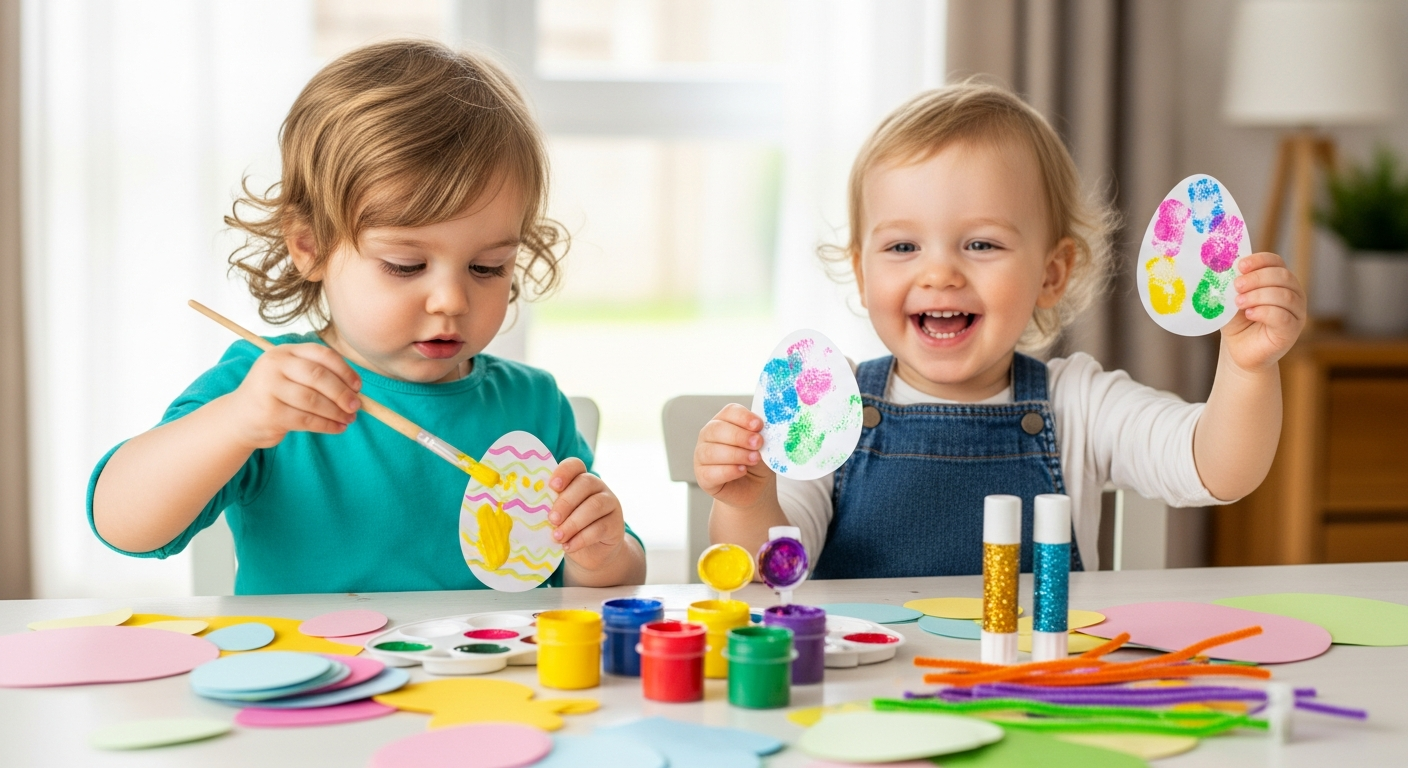
Table of Contents
- Introduction
- The Speech Blubs Philosophy: Why We Craft
- 1. Dot Marker Chicks: Mastering Repetitive Sounds
- 2. Coffee Filter Easter Eggs: Exploring Descriptive Words
- 3. Paper Towel Easter Eggs: Science and Surprise
- 4. Sidewalk Chalk Bunny Prints: Movement and Prepositions
- 5. Cardboard Easter Art: Labeling and Categorization
- 6. Eggs in the Grass: Fine Motor Fun
- 7. Paper Rainbows: Sequencing and Colors
- 8. Custom Coloring Sheets: Linking Digital and Physical
- 9. Egg Carton Garland: Collaborative Play
- 10. Bunny Feet Stamp: Animal Sounds and Action Words
- 11. Shaving Cream Marbled Eggs: Sensory Integration
- 12. Masking Tape Resist Eggs: The Power of "Open"
- 13. Nature Bunnies: Vocabulary of the Great Outdoors
- 14. Paper Plate Wreaths: Following Directions
- 15. The "Screener" Egg Hunt: Assessment Through Play
- Smart Screen Time: The Perfect Companion to Crafting
- Setting Realistic Expectations
- Practical Scenario: The "Animal Kingdom" Connection
- Conclusion
- Frequently Asked Questions
Introduction
Have you ever noticed how a toddler’s eyes light up when they finally grasp a new word while their hands are covered in finger paint? There is a profound, almost magical connection between a child’s tactile world and their emerging ability to communicate. At Speech Blubs, we believe that every "squish," "splat," and "pop" is a building block for language. Our mission is to empower children to speak their minds and hearts, and we know that the best way to do that is through joyful, play-based learning.

This blog post is designed to help you navigate the holiday season with a collection of purposeful Easter craft for toddler development. We aren't just looking for refrigerator-worthy art; we are looking for opportunities to foster vocabulary, practice foundational speech sounds, and build the confidence your child needs to express themselves. We will cover fifteen engaging crafts, explain the science behind why creative play works, and show you how to integrate "smart screen time" to supplement your child's progress.
By the end of this guide, you will have a toolkit of activities that turn simple household items into powerful speech therapy tools. Our goal is to help you create joyful family moments where learning feels like nothing more than a fun afternoon of play. If you are curious about where your child stands in their development, you can always start by taking our quick 3-minute preliminary screener to receive a personalized assessment and a next-steps plan.
The Speech Blubs Philosophy: Why We Craft
Before we dive into the glitter and glue, it is important to understand our "why." Speech Blubs was born from the personal experiences of our founders. All of them grew up with speech challenges and set out to create the tool they wished they had during their own childhoods. They recognized that 1 in 4 children will need some form of speech support, and that traditional methods can sometimes feel like a chore for a busy toddler.
We believe in a "smart screen time" approach that acts as a bridge to real-world interaction. Unlike passive cartoons that encourage a child to zone out, our app uses a unique "video modeling" methodology. Children learn best by watching and imitating their peers. When a toddler sees another child on a screen making a "b-b-b" sound or saying "bunny," their mirror neurons fire, making them more likely to attempt the sound themselves. This peer-to-peer connection is at the heart of our scientific research and methodology.
When we combine this digital modeling with hands-on Easter crafts, we create a multi-sensory learning environment. The app introduces the sounds and concepts, and the crafts provide the "functional" environment to use them.

1. Dot Marker Chicks: Mastering Repetitive Sounds
Dot markers are a toddler favorite because they provide immediate, vibrant feedback with very little physical pressure. For a child working on early consonant sounds, this is the perfect Easter craft for toddler speech practice.
How to do it: Draw several large ovals on a piece of paper. Provide your toddler with a yellow dot marker. As they press the marker down, encourage them to say "pop," "dot," or "tap." This repetitive motion paired with a repetitive sound helps reinforce the motor planning required for speech.
Language Boost: Once the ovals are filled, help your child glue on a small orange triangle for a beak and googly eyes. Use this time to practice "yellow," "eyes," and "peep peep." If your child is a "late talker" who loves animals, you might also use the "Animal Kingdom" section of our app to practice bird sounds before you start.
2. Coffee Filter Easter Eggs: Exploring Descriptive Words
This craft is a lesson in color blending and absorption, which naturally leads to "Wh-" questions and descriptive adjectives.
How to do it: Cut coffee filters into large egg shapes. Give your toddler watercolors or diluted food coloring. As the colors bleed together, the eggs become beautiful, marbled masterpieces.
Language Boost: Focus on words like "wet," "dry," "blue," and "more." Ask your child, "What color comes next?" Even if they are non-verbal, you are providing a "language-rich" environment by narrating their actions. This process mirrors the success stories we hear in our parent testimonials, where parents notice their children becoming more engaged through shared, narrated activities.
3. Paper Towel Easter Eggs: Science and Surprise
Similar to the coffee filter craft, this version uses the texture of paper towels to create a different sensory experience.
How to do it: Use washable markers to draw patterns on a paper towel cut into an egg shape. Then, have your child use a spray bottle or a wet paintbrush to watch the ink "grow."
Language Boost: The use of a spray bottle is excellent for strengthening the small muscles in the hand, which is closely linked to fine motor control for speech. Use the word "spray" or "squeeze" every time they pull the trigger.
4. Sidewalk Chalk Bunny Prints: Movement and Prepositions
Getting outside is a great way to reduce the "pressure" of learning. This activity combines gross motor movement with language.
How to do it: Draw a trail of large bunny paw prints leading to the front door or a hidden treat. Encourage your toddler to "hop" from one print to the next.
Language Boost: This is the perfect time to practice prepositions. Use words like "on," "over," "next," and "stop." Say, "Hop on the bunny foot!" This physical movement helps solidify the meaning of these abstract words in a toddler's mind.
5. Cardboard Easter Art: Labeling and Categorization
Don't throw away those cereal boxes! Cardboard provides a sturdy canvas for toddlers who might be a bit "heavy-handed" with their art.
How to do it: Cut the cardboard into egg or bunny shapes. Provide your child with bits of colored tape, stickers, or scraps of fabric to decorate.
Language Boost: Practice labeling the different materials. "Is this tape sticky?" "Is the fabric soft?" Building a vocabulary of textures helps children describe the world around them more accurately.
6. Eggs in the Grass: Fine Motor Fun
This craft repurposes toilet paper tubes into "grass" to hold decorated eggs.
How to do it: Have your child paint a cardboard tube green. Once dry, an adult can cut fringe into the top half to look like blades of grass.
Language Boost: Use this to practice the "G" sound in "grass" and "green." If your child is struggling with specific sounds, you can download Speech Blubs on the Apple App Store or Google Play Store to find specific exercises that target these phonemes.
7. Paper Rainbows: Sequencing and Colors
Easter and Spring go hand-in-hand. This craft helps with sequencing—a vital skill for eventually putting sentences together.
How to do it: Cut a rainbow arc from cardboard. Have your child glue colored paper squares in order.
Language Boost: Talk about "first," "then," and "last." "First, we use red. Then, we use orange." Sequencing thoughts is a precursor to narrative speech.
8. Custom Coloring Sheets: Linking Digital and Physical
At Speech Blubs, we offer downloadable coloring pages that feature the same characters and themes found in our app.
How to do it: Print out Easter-themed coloring sheets.
Language Boost: As your child colors, open the app to the corresponding section. This reinforces the "video modeling" they've seen. When they see a peer in the app say "egg" and then they color an "egg," the concept is doubled down in their memory.
9. Egg Carton Garland: Collaborative Play
Crafting doesn't have to be a solo mission. A garland is a "team" project that encourages social communication.
How to do it: Cut an egg carton into individual cups. Have your child paint them different colors. Once dry, string them together.
Language Boost: This is a great chance to practice "help." If they can't quite get the string through the hole, wait for them to indicate they need assistance before jumping in. Encouraging a child to ask for "help" or "more" is a foundational step in reducing communication frustration.
10. Bunny Feet Stamp: Animal Sounds and Action Words
Toddlers love to stamp, and using everyday items as stamps is a great way to spark curiosity.
How to do it: Use a toilet paper roll for the main foot and a bent, oval-shaped roll for the toes. Dip them in paint and stamp away!
Language Boost: Every time you stamp, make a sound. "Thump, thump, thump!" This encourages "vocal play," which is essential for kids who are still finding their voice.
11. Shaving Cream Marbled Eggs: Sensory Integration
Sensory play is vital for children with sensory processing sensitivities, which often co-occur with speech delays.
How to do it: Fill a tray with shaving cream and drop food coloring on top. Use a stick to swirl the colors. Lay a paper egg on top, then scrape off the excess cream to reveal a marbled design.
Language Boost: Focus on sensory words: "cold," "fluffy," "smelly," and "hidden."
12. Masking Tape Resist Eggs: The Power of "Open"
This craft has a "reveal" moment that toddlers find fascinating.
How to do it: Place strips of masking tape on a white paper egg in a pattern. Have your child paint over the whole thing. Once the paint is dry, peel the tape off.
Language Boost: Use the word "off" or "peek-a-boo" as you reveal the white lines underneath. "Off! Look, it's white!"
13. Nature Bunnies: Vocabulary of the Great Outdoors
Take your crafting supplies into the backyard.
How to do it: Go on a "nature walk" to collect leaves, twigs, and stones. Glue them onto a bunny silhouette to create a "forest bunny."
Language Boost: Identify everything you find. "Is this leaf crunchy?" "Is this stone heavy?"
14. Paper Plate Wreaths: Following Directions
Following simple commands is a key developmental milestone.
How to do it: Cut the center out of a paper plate. Have your child glue paper eggs or flowers around the rim.
Language Boost: Practice two-step directions. "First, pick the blue egg, then glue it on the plate."
15. The "Screener" Egg Hunt: Assessment Through Play
Make your Easter egg hunt more than just a search for candy.
How to do it: Inside plastic eggs, place small pictures of items your child can name (or sounds they are practicing).
Language Boost: When they open an egg, they have to name the picture or make the sound. This is a "real-world" version of the assessments we provide. If you want a more formal look at their progress, you can create your account and begin your 7-day free trial today to access our full suite of developmental tools.
Smart Screen Time: The Perfect Companion to Crafting
We know that many parents feel guilty about screen time. However, at Speech Blubs, we've designed a "smart" alternative to passive viewing. Our app is meant to be a co-play experience. Just as you sit on the floor and help your child with an Easter craft for toddler development, you can sit with them and engage with the app.
Our method is built on the science of mirror neurons. When your child sees a peer on the screen performing a speech exercise, they are naturally inclined to copy them. This builds confidence and reduces the frustration that often comes with speech delays. We don't promise that your child will be giving public speeches in a month, but we do focus on fostering a love for communication and building those key foundational skills.
Choosing the Right Plan for Your Family
To get the most out of Speech Blubs, we recommend our Yearly plan. While we do offer a Monthly plan for $14.99 per month, the Yearly plan is the clear best choice for families committed to their child's progress.
The Yearly plan is $59.99 per year, which breaks down to just $4.99/month—a savings of 66% compared to the monthly rate. More importantly, the Yearly plan includes exclusive features that the Monthly plan does not:
- A 7-day free trial: Test all the features before you commit.
- Reading Blubs: Our companion app that focuses on early literacy and phonics.
- Early Access: Be the first to try new updates and activities.
- Priority Support: A 24-hour support response time to help you with any questions.
Ready to see the difference? You can sign up on our website to lock in the Yearly plan value.
Setting Realistic Expectations
As a parent, it's easy to look at Pinterest and feel like your child's Easter craft for toddler time should result in a masterpiece. But in the world of child development, the process is more important than the product.
If your 2-year-old just wants to rip the paper instead of gluing it, they are still learning about texture and cause-and-effect. If they only want to use the color black for their Easter egg, they are still making a choice and expressing a preference. Your role is to be their "language narrator." By describing what they are doing, you are feeding their brain the vocabulary they will eventually use to speak back to you.
Speech Blubs is a powerful supplement to this process. Whether your child is working with a professional therapist or you are just looking for ways to boost their development at home, our app provides a joyful, low-pressure environment to practice.
Practical Scenario: The "Animal Kingdom" Connection
Imagine you have a 3-year-old who is a "late talker" but is absolutely obsessed with bunnies. You've tried to get them to say "bunny" dozens of times with no luck.
Instead of pushing, you sit down to do the "Bunny Feet Stamp" craft. Before you start, you open the Speech Blubs app to the "Animal Kingdom" section. You watch a video of a peer making a rabbit "twitching nose" movement and saying "hop." Your child laughs and tries to twitch their nose too.
Then, you start stamping. Every time you hit the paper, you say "Hop! Hop! Hop!" Because your child just saw a peer doing it on the screen, the word is "fresh" in their mind. Suddenly, as they stamp their own bunny foot, they let out a small, quiet "hop."
That is the Speech Blubs magic. It’s not about perfection; it’s about creating the right environment for that first "hop" to happen.
Conclusion
Easter is a season of growth, and there is no better way to celebrate than by supporting your child’s journey toward communication. These fifteen Easter craft for toddler language development are more than just a way to pass the time; they are opportunities to connect, learn, and grow together. By combining hands-on play with the "smart screen time" provided by Speech Blubs, you are giving your child a multi-dimensional learning experience that respects their pace and celebrates their progress.
We invite you to join our community of over 5 million parents who are helping their children "speak their minds and hearts." Remember, the best value for your family is our Yearly plan, which includes a 7-day free trial, the Reading Blubs app, and priority support.
Don't wait to start building your child's confidence. Download Speech Blubs on the App Store or get it on Google Play today to begin your journey. Choose the Yearly plan to unlock the full suite of features and give your child the joyful start they deserve.
Frequently Asked Questions
1. What kind of Easter crafts are best for toddlers with speech delays?
Think simple, sensory, and repetitive. Activities like "Dot Marker Chicks" or "Bunny Feet Stamps" are excellent because they allow you to pair a physical action with a repetitive sound (like "tap" or "thump"). Sensory-rich activities using shaving cream or watercolors also encourage descriptive language (like "wet," "soft," or "cold"), which helps expand a child's vocabulary.
2. How much prep time is required for these Easter crafts?
We know parents are busy! Most of these crafts use everyday household items like paper towels, toilet paper rolls, and cardboard boxes. You can set up most of these in under five minutes. The goal is to focus on the interaction with your child rather than the complexity of the craft itself.
3. Can "smart screen time" really help my child learn to talk?
Yes, when used correctly! Unlike passive TV viewing, Speech Blubs uses "video modeling," which is a scientifically proven method where children learn by imitating their peers. This "peer-to-peer" approach makes children more likely to attempt sounds and words. When used alongside hands-on crafts, it provides a powerful, multi-sensory learning experience.
4. Is the Yearly plan worth the extra cost?
Actually, the Yearly plan is much cheaper in the long run! At $59.99 per year, it works out to only $4.99 per month, which is 66% less than the Monthly plan. It also includes the 7-day free trial, the Reading Blubs app for literacy, and priority 24-hour support, making it the best value for families who want a comprehensive developmental tool.
About the author