
15 Creative Toddler Heart Craft Ideas for Playful Learning
 By Speech Blubs Team•Feb 20, 2026•16 min.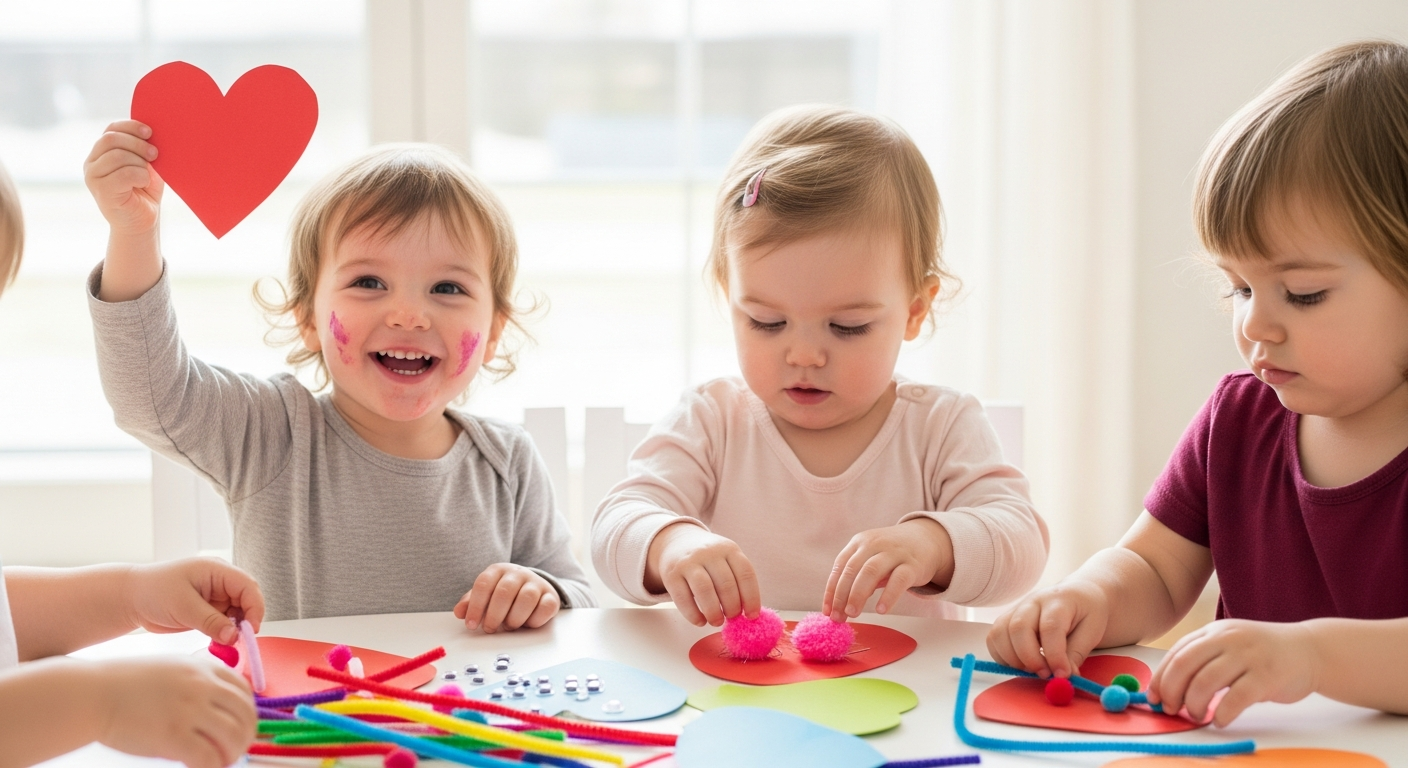
Table of Contents
- Introduction
- The Developmental Magic of Crafting
- 1. The World’s Easiest Tape-Resist Heart
- 2. Mess-Free Ziploc Bag Heart Painting
- 3. Dot Marker Pointillism Hearts
- 4. The "Love Monster" Yarn Craft
- 5. Bubble Wrap Print Hearts
- 6. Tissue Paper "Crinkle" Hearts
- 7. Wax-Resist Magic Hearts
- 8. Shake Painting Hearts
- 9. Coffee Filter "Stained Glass" Hearts
- 10. Fingerprint Family Hearts
- 11. Styrofoam Printmaking
- 12. "Sponge-Bob" Heart Canvas
- 13. Shredded Paper Collage Heart
- 14. Chalk Heart "Shadows"
- 15. The "I Love..." Heart Book
- Making the Most of Your "Smart Screen Time"
- Practical Tips for Crafting with Toddlers
- Integrating Speech Blubs into Craft Time
- Conclusion
- Frequently Asked Questions
Introduction
Did you know that by the age of three, a child’s brain has twice as many neural connections as an adult’s? This explosive period of growth is why every scribble, every squish of paint, and every "toddler heart craft" is more than just a cute refrigerator decoration—it is a foundational building block for cognitive, emotional, and linguistic development. At Speech Blubs, our mission is to empower children to speak their minds and hearts, and we believe that the best way to foster these skills is through the magic of play.
Our company was born from the personal experiences of our founders, who all grew up with speech problems and set out to create the tool they wished they had as children. We understand that for the 1 in 4 children who need speech support, traditional methods can sometimes feel like work. That’s why we’ve blended scientific principles with joyful play into one-of-a-kind "smart screen time" experiences. We provide a screen-free alternative to passive viewing and a powerful tool for family connection.

In this guide, we will explore 15 engaging heart-themed crafts specifically designed for toddlers and preschoolers. We will go beyond the instructions to explain the "why" behind each activity, showing you how these creative moments build fine motor skills, boost vocabulary, and foster confidence. From mess-free sensory painting to artist-inspired process art, we are here to help you turn craft time into a developmental milestone. Our goal is to foster a love for communication and create joyful family learning moments that resonate long after the glue has dried.
The Developmental Magic of Crafting
Before we dive into the glitter and glue, it is important to understand why we advocate for these hands-on activities. When your child participates in a toddler heart craft, they aren't just making a Valentine; they are engaging in a multi-sensory workout.
Building Fine Motor Skills
Cutting, peeling tape, and squeezing glue bottles are essential for developing the small muscles in the hands and fingers. These are the same muscles your child will eventually use for writing, buttoning their clothes, and even certain aspects of speech articulation. Activities like our "Tissue Paper Heart" require precise "pincer grasp" movements that strengthen these neural pathways.
Expanding Vocabulary and Language
Crafting is a natural environment for language immersion. As you work together, you can model words like squish, sticky, bright, overlap, and smooth. This mirrors our unique approach at Speech Blubs, where we use video modeling to teach complex communication skills. In our app, children learn by watching and imitating their peers; in the craft room, they learn by watching and imitating you.
Fostering Emotional Confidence
At Speech Blubs, we focus on building confidence and reducing frustration rather than demanding perfection. The same applies to art. By focusing on "process art"—where the experience is more important than the final result—you allow your child to feel successful and proud of their unique creation. This sense of agency is a core value of ours: helping children find the voice to express their "minds and hearts."

1. The World’s Easiest Tape-Resist Heart
If you are looking for a craft that takes two minutes to set up but provides twenty minutes of engagement, this is it. It is perfect for the "youngest artists" who are still in the enthusiastic scribbling phase.
Materials:
- Heavy paper or cardstock
- Markers, crayons, or oil pastels
- Painter’s tape
Instructions:
- Use the painter’s tape to form a large heart shape in the center of the paper. Ensure the edges are pressed down firmly.
- Hand your toddler the markers and encourage them to "go to town." The goal is to cover as much of the paper as possible, especially around the edges of the tape.
- Once the masterpiece is complete, slowly peel back the tape to reveal a crisp, clean white heart amidst the colorful chaos.
Why we love it: This activity is excellent for practicing spatial awareness. For a parent whose 3-year-old "late talker" is just beginning to explore shapes, this craft provides a visual "win" that builds confidence. You can even use this moment to practice "stop" and "go" language as they color.
2. Mess-Free Ziploc Bag Heart Painting
For many parents, the word "paint" triggers thoughts of stained carpets and messy hands. This version offers all the sensory benefits of finger painting with zero cleanup.
Materials:
- Gallon-sized Ziploc bag
- Cardstock cut into a heart shape
- Washable paint (2-3 colors)
- Tape
Instructions:
- Place a few "blobs" of paint directly onto the cardstock heart.
- Carefully slide the heart into the Ziploc bag and seal it tightly (you can even tape the seal for extra security).
- Tape the bag to a table or a window.
- Let your child squish, mush, and spread the paint through the plastic.
The Speech Connection: This is a perfect opportunity to talk about color mixing. "Look, the red and yellow made orange!" This type of descriptive language helps build cognitive associations. If you’re looking for more ways to assess your child’s current development, you can take our quick 3-minute preliminary screener to get a simple assessment and a free 7-day trial of our comprehensive learning tools.
3. Dot Marker Pointillism Hearts
Dot markers (or "bingo daubers") are a staple in toddler classrooms for a reason: they are easy to grip and provide immediate sensory feedback.
Instructions:
- Provide your child with a large sheet of paper and various colored dot markers.
- Encourage them to fill the page with dots.
- Once dry, use a heart-shaped punch or scissors to cut out multiple small hearts.
Pro-Tip: Introduce the concept of "Pointillism" by showing them a picture of George Seurat’s work. Even at a young age, children can appreciate that many small dots can make one big picture!
4. The "Love Monster" Yarn Craft
Inspired by the beloved children’s book Love Monster by Rachel Bright, this craft is fantastic for older toddlers who are working on their bilateral coordination (using both hands together).
Materials:
- Empty toilet paper roll
- Yarn
- Googly eyes
- Pipe cleaners
Instructions:
- Have your toddler help you wrap yarn around a piece of cardboard about 100 times (don’t worry about the count, just focus on the movement).
- Tie the yarn in the middle and cut the loops to create a pom-pom effect.
- Glue the "hair" to the top of the toilet paper roll.
- Add googly eyes and pipe-cleaner "antennae" with little paper hearts on the ends.
Why it works: Wrapping yarn is a rhythmic, calming activity. It’s also a great way to talk about emotions. "Is the Love Monster happy? Is he looking for a friend?" Using characters to explore feelings is a wonderful way to help children "speak their hearts."
5. Bubble Wrap Print Hearts
Don't throw away that packing material! Bubble wrap creates a fascinating texture that toddlers find irresistible.
Instructions:
- Cut a small square of bubble wrap and tape it to the table, bubble-side up.
- Let your child paint the bubbles with a brush or sponge.
- Press a piece of paper onto the wet paint, then lift it up to see the "polka dot" heart pattern.
- Cut the paper into a heart shape once dry.
Developmental Note: The "peeling" action of lifting the paper works on graded motor control—learning how much force to use without ripping the paper.
6. Tissue Paper "Crinkle" Hearts
This is a classic fine motor powerhouse. It’s simple, inexpensive, and keeps little fingers very busy.
Materials:
- Cardboard heart cutouts
- Pink and red tissue paper squares
- School glue
Instructions:
- Show your child how to "crinkle" a small square of tissue paper into a tiny ball.
- Dip the ball into a small pool of glue and press it onto the cardboard heart.
- Repeat until the entire heart is covered in "fluffy" texture.
Speech Tip: Use this activity to practice "action words." Crinkle, squeeze, press, stick. These verbs are the "engines" of sentences. In the Speech Blubs app, we emphasize these functional words to help late talkers build their first sentences. You can download Speech Blubs on the App Store or Google Play to find specific sections dedicated to early verbs and actions.
7. Wax-Resist Magic Hearts
To a toddler, this craft looks like a magic trick. It uses the scientific principle that oil (wax) and water (watercolor paint) don't mix.
Instructions:
- On a white piece of paper, use a white wax crayon to draw hearts or write your child's name.
- Give your child a tray of watercolors and a brush.
- As they paint over the "blank" paper, the white hearts will magically "pop" through the paint.
Why we love it: It builds anticipation and curiosity. "Where is the heart? Can you find another one?" This encourages social interaction and joint attention, two vital precursors to speech.
8. Shake Painting Hearts
If you have a high-energy toddler, this kinesthetic art project is a must-try. It turns painting into a full-body movement game.
Materials:
- A plastic container with a secure lid
- A heart-shaped piece of paper
- Two or three marbles
- Squirts of paint
Instructions:
- Place the heart paper at the bottom of the container.
- Add a few drops of paint and the marbles.
- Seal the lid tightly and let your child shake! They can dance, jump, and wiggle while the marbles roll the paint across the paper.
Refining the Experience: This is "smart screen time" in reverse—total physical engagement. Once you're done, you can transition to a calming session of Speech Blubs to regulate their energy levels. See what other parents are saying about how our app helps balance their child's daily routine.
9. Coffee Filter "Stained Glass" Hearts
These look beautiful hanging in a sunny window and teach children about color absorption and saturation.
Instructions:
- Cut coffee filters into heart shapes.
- Let your child color them with washable markers.
- Use a spray bottle or a wet paintbrush to "mist" the hearts with water.
- Watch the colors bleed and blend together like tie-dye.
Safety First: Always supervise the use of spray bottles. This is also a great way to practice the "p" sound in "spray" or "splash!"
10. Fingerprint Family Hearts
Keepsake crafts are a wonderful way to document how much your little one has grown. This one involves the whole family.
Instructions:
- Use a stamp pad or a thin layer of paint.
- Have each family member press their thumb onto a piece of cardstock.
- By overlapping two thumbprints at an angle, you create a perfect little heart.
- Label each heart with the family member's name.
Connection: This builds a sense of "self" and "others." Point to the prints and ask, "Whose thumb is bigger? Whose is smaller?" This introduces comparative language.
11. Styrofoam Printmaking
Reuse those clean Styrofoam trays from the grocery store (the ones that hold produce) to teach the basics of printmaking.
Instructions:
- Cut the flat bottom out of a Styrofoam tray.
- Have your child use a dull pencil or a chopstick to "draw" a heart into the foam (you may need to help them press down deep enough).
- Paint over the foam, then press it onto paper like a giant stamp.
12. "Sponge-Bob" Heart Canvas
Sponge painting is excellent for toddlers because sponges are easy to grip and require less precision than a traditional paintbrush.
Instructions:
- Cut a kitchen sponge into a heart shape.
- Let your child dip the sponge into paint and "stamp" it all over a canvas or large piece of paper.
- For a finished look, you can outline the sponge prints with a marker once they are dry.
13. Shredded Paper Collage Heart
If you have a paper shredder or just lots of old magazines, this is a great "recycled" craft.
Instructions:
- Draw a large heart outline on a piece of cardboard.
- Fill the inside with glue.
- Let your child pile "shreds" of paper onto the glue.
- Press down and shake off the excess.
14. Chalk Heart "Shadows"
This is a great outdoor activity if the weather permits, or it can be done on black construction paper.
Instructions:
- Place a cardboard heart cutout on the paper/sidewalk.
- Have your child color heavily with chalk around the edges of the cardboard.
- Use a finger or a tissue to "smudge" the chalk outward.
- Lift the cardboard to see a "glowing" heart shadow.
15. The "I Love..." Heart Book
Our final craft is the most language-heavy. It’s a simple "book" made of paper hearts stapled together.
Instructions:
- Cut 5-6 large paper hearts.
- On each page, write "I love..." and ask your child to finish the sentence.
- They can draw a picture (or you can glue a photo) of the thing they love (e.g., "I love my dog," "I love bananas").
The Why: This directly supports our mission to help kids "speak their minds." It gives them a platform to express their preferences and feelings, which is a massive step in social-emotional development.
Making the Most of Your "Smart Screen Time"
While hands-on crafting is essential, we know that modern parents also need digital tools they can trust. At Speech Blubs, we don’t believe all screen time is created equal. Most "passive" screen time, like watching cartoons, doesn't require a child to interact or communicate. Our app is different.
We utilize video modeling, a scientifically proven method where children watch videos of other children—their "peers"—performing speech exercises. This triggers "mirror neurons" in the brain, making the child much more likely to try the sounds themselves. It’s the digital equivalent of you showing your child how to crinkle that tissue paper; they see a peer doing it, and they think, "I can do that too!"
Why Choose the Yearly Plan?
If you're ready to integrate Speech Blubs into your daily routine, we recommend our Yearly plan. While we offer a Monthly plan for $14.99, the Yearly plan is the clear best choice for families committed to their child's progress.
At $59.99 per year, the cost breaks down to just $4.99 per month—a 66% savings. But the value goes beyond the price tag. The Yearly plan includes:
- A 7-day free trial to explore all features risk-free.
- The Reading Blubs app, a dedicated tool to transition from speech to early literacy.
- Early access to all new content updates.
- Priority 24-hour support response time.
The Monthly plan does not include these exclusive, high-value features. By choosing the Yearly plan, you are investing in a comprehensive suite of tools designed to grow with your child. Ready to get started? Create your account and begin your 7-day free trial today.
Practical Tips for Crafting with Toddlers
To ensure your "toddler heart craft" session is a success, keep these expert tips in mind:
- Embrace the Imperfection: Your child’s heart might look like a purple blob. That’s okay! In fact, it’s great. Praise their effort ("I love how hard you worked on that!") rather than the outcome.
- Follow Their Lead: If your child wants to use blue paint instead of red, let them. Giving them choices builds autonomy.
- Keep it Short: Toddler attention spans are famously brief. If they're done after five minutes, let it go. You can always come back to it later.
- Narrate Everything: "You’re picking up the red marker. Now you're drawing a big circle. Oh, it’s so sticky!" This constant stream of "parallel talk" is one of the best ways to boost language development.
- Use High-Quality Tools: Toddlers get frustrated with markers that are dried out or glue that won't come out of the bottle. Ensure your supplies are "toddler-friendly."
Integrating Speech Blubs into Craft Time
You can seamlessly bridge the gap between digital learning and physical play. For example, if you are doing the "Love Monster" craft, you can open the "Animal Kingdom" or "Living Shapes" section of Speech Blubs.
For a child who loves animals, practicing the "m-m-m" sound for "monster" or the "h-h-h" sound for "heart" in the app provides the phonetic foundation they need. Then, as you craft, you can reinforce those sounds in a real-world context. This "blended learning" approach is exactly why we created Speech Blubs—to be a powerful supplement to a child's overall development plan and professional therapy.
Download Speech Blubs on the Google Play Store to explore over 1,500 activities that make these connections possible.
Conclusion
Whether you are peeling tape to reveal a secret heart or watching your child mimic a peer on Speech Blubs, you are doing the vital work of building their communication skills. A simple "toddler heart craft" is an invitation to connect, a chance to learn, and a way to celebrate your child's unique voice.
Remember, our goal isn't to create "perfect" art or "perfect" speech—it's to foster a love for communication, build confidence, and create joyful family moments. We want to help your child find the words to "speak their minds and hearts."
We invite you to join our community of over 4 million families. Start your journey today by taking advantage of our best offer. Download Speech Blubs and select the Yearly plan to get your 7-day free trial, the Reading Blubs app, and full access to our peer-led video modeling library. Let’s make screen time "smart" and craft time "meaningful" together.
Frequently Asked Questions
1. My toddler still puts everything in their mouth. Which heart craft is safest?
The Ziploc Bag Painting (Craft #2) is the safest option because the paint is completely sealed inside a heavy-duty bag. Always supervise your child during any craft involving small parts, glue, or paint, even "non-toxic" ones.
2. How can heart crafts help my child who is a "late talker"?
Crafts provide a "low-pressure" environment for language. By using "parallel talk" (narrating what your child is doing) and "self-talk" (narrating what you are doing), you provide a rich language model. Combining these activities with the peer-led video modeling in Speech Blubs can help bridge the gap between hearing words and saying them.
3. What if my child gets frustrated because they can't draw a "perfect" heart?
Focus on Process Art. Instead of asking them to draw a heart, give them a pre-cut heart shape and let them decorate it however they wish. Use encouraging language that focuses on their actions ("I like how you're using the brush!") rather than the final product. Building confidence is the first step toward successful communication.
4. Is the Yearly plan really worth it compared to the Monthly one?
Yes! The Yearly plan is $59.99 (roughly $4.99/month), which is a 66% saving over the $14.99 Monthly plan. More importantly, only the Yearly plan includes the 7-day free trial and the Reading Blubs app, which helps children transition from speaking to reading. It’s the best value for long-term developmental support.
About the author