
15 Creative Toddler Pipe Cleaner Crafts for Busy Hands
 By Speech Blubs Team•Feb 20, 2026•17 min.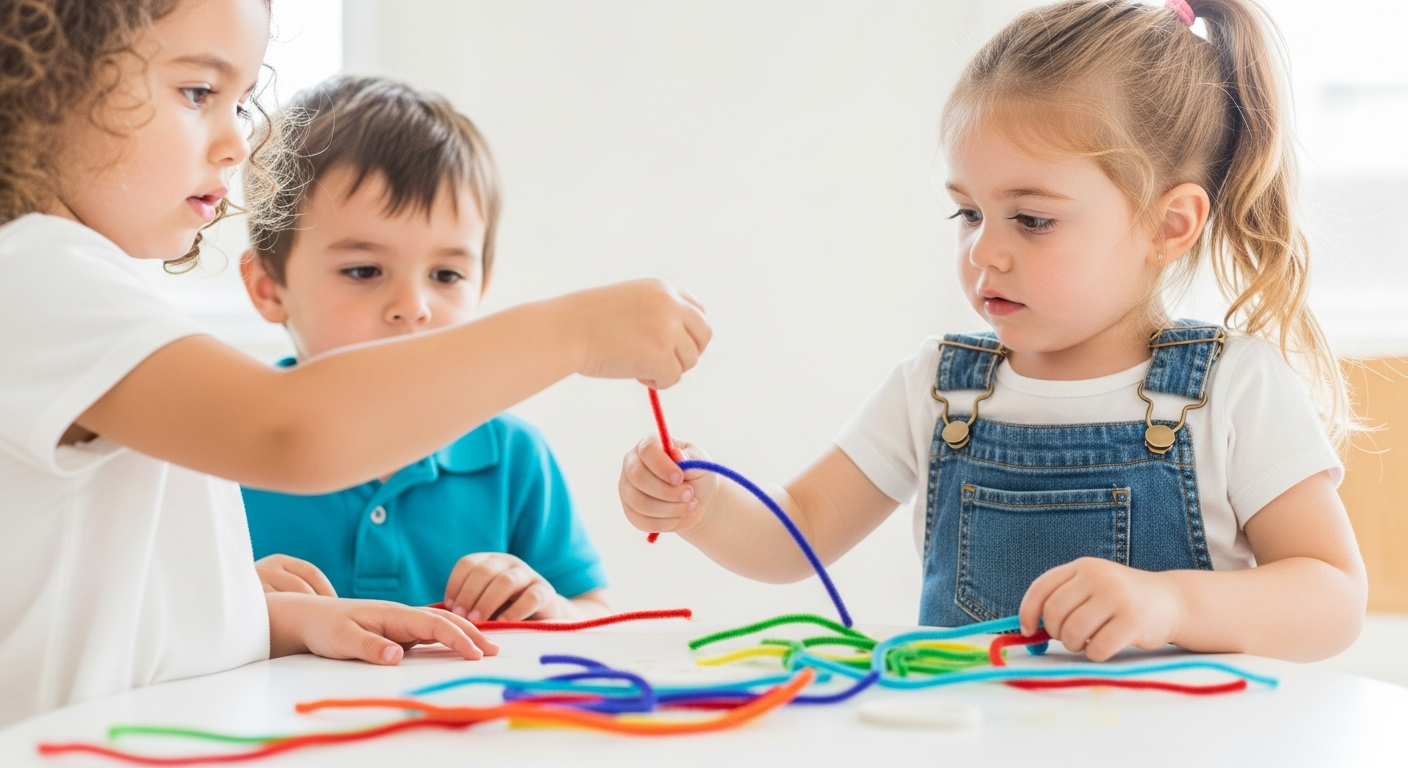
Table of Contents
- Introduction
- The Magic of Pipe Cleaners in Toddler Development
- Safety and Preparation
- 1. The Classic Colander Threading
- 2. Pipe Cleaner Animal Kingdom
- 3. Beaded Counting and Color Sorting
- 4. DIY Bubble Wands
- 5. Pipe Cleaner Flowers
- 6. Alphabet and Number Shaping
- 7. Bejeweled Rings and Jewelry
- 8. Pipe Cleaner Fishing Game
- 9. Monster Finger Puppets
- 10. Rainbow Clouds
- 11. Pipe Cleaner Sculpture
- 12. Beaded Dragonflies and Butterflies
- 13. Pipe Cleaner Tic-Tac-Toe
- 14. Seasonal Pipe Cleaner Crafts
- 15. Wearable Crowns and Scepters
- Why "Smart Screen Time" and Crafts Go Hand in Hand
- Choosing the Right Path for Your Child
- Practical Advice for Parents
- Summary of Key Takeaways
- FAQ
- Conclusion
Introduction
Have you ever noticed how a simple, fuzzy wire can keep a toddler captivated longer than a pile of expensive plastic toys? It is a common scene in households everywhere: the elaborate toy sits ignored while the child becomes obsessed with a stray cardboard box or a handful of colorful pipe cleaners. As experts in child development and the team behind Speech Blubs, we know that the most effective learning often happens through the simplest forms of play. For the 1 in 4 children who may experience speech or developmental delays, these tactile, low-pressure activities are not just fun—they are foundational.

The purpose of this guide is to provide you with a comprehensive list of toddler pipe cleaner crafts that go beyond simple "busy work." We want to show you how these bendable sticks can be used to boost fine motor skills, encourage vocabulary growth, and foster the confidence your child needs to "speak their minds and hearts." In the following sections, we will explore 15 engaging activities, discuss the science of why tactile play matters, and explain how you can pair these crafts with our "smart screen time" to create a holistic learning environment at home.
Ultimately, toddler pipe cleaner crafts offer a unique bridge between physical exploration and cognitive development. By the end of this article, you will have a toolkit of ideas to help your little one develop the coordination and communication skills they need to thrive.
The Magic of Pipe Cleaners in Toddler Development
Before we dive into the specific toddler pipe cleaner crafts, it is worth looking at why these humble craft supplies are so highly recommended by therapists and educators. Pipe cleaners (also known as chenille sticks) are an ideal medium for little hands because they are pliable, colorful, and provide immediate feedback.
When a toddler bends a pipe cleaner, they are engaging in "heavy work" for their fingers. This strengthens the small muscles in the hands and wrists, which are the same muscles they will eventually use to hold a pencil or button a shirt. Furthermore, the fuzzy texture provides sensory input that can be incredibly grounding for children who are still learning to regulate their sensory systems.
At Speech Blubs, we believe in the power of joy and play. Our founders all grew up with speech problems and created the tool they wished they had—one that blends scientific principles with genuine fun. Just as our app uses video modeling to help children learn by watching their peers, these crafts allow children to learn by doing. When you combine a physical activity like shaping a pipe cleaner with the vocal practice found in our app, you create a powerful, multi-sensory learning moment.

Safety and Preparation
When working with toddler pipe cleaner crafts, safety is always the priority. While pipe cleaners are generally safe, the ends can sometimes be a bit sharp. A quick tip for parents is to use a pair of pliers to fold over the sharp metal tips or cover them with a small dab of hot glue (let it cool completely!) before handing them to your child.
Always supervise your toddler during these activities, especially if you are incorporating small items like beads or buttons. If you are ever unsure about your child's developmental milestones or want to see where they stand, you can take our quick 3-minute preliminary screener. It consists of 9 simple questions and provides an assessment and next-steps plan to help you support your child's journey.
1. The Classic Colander Threading
This is perhaps the most famous of all toddler pipe cleaner crafts, and for good reason. It requires almost zero setup and provides endless fascination.
How to do it: Give your child a kitchen colander and a bundle of colorful pipe cleaners. Show them how to poke the pipe cleaner through one of the holes.
The Developmental Link: This activity is a powerhouse for hand-eye coordination. As your child focuses on aiming the tip of the wire into the small hole, they are practicing "visual-motor integration." For a parent whose 2-year-old is struggling with focus, this "quiet time" activity can be a great way to build the stamina needed for more complex tasks later.
2. Pipe Cleaner Animal Kingdom
If your child loves animals, this is the craft for them. You can create simple snakes, snails, or even legs for a "pet" rock.
How to do it:
- Snails: Roll a pipe cleaner into a tight spiral for the shell and leave a small straight bit for the head.
- Snakes: Simply wiggle a pipe cleaner and add googly eyes.
- Spiders: Wrap four pipe cleaners around a large pom-pom to create eight wiggly legs.
The Speech Blubs Connection: While you build your animals, open the "Animal Kingdom" section in the Speech Blubs app. As your child sees a peer making a "hiss" sound for a snake on the screen, they can mirror that sound while playing with their handmade pipe cleaner snake. This use of peer-to-peer video modeling is backed by the science behind our method, which utilizes mirror neurons to encourage imitation.
3. Beaded Counting and Color Sorting
Adding beads to your pipe cleaner crafts introduces a new layer of complexity and learning.
How to do it: Set out bowls of different colored "pony beads" (the large plastic ones). Ask your child to thread only the red beads onto a red pipe cleaner, blue onto blue, and so on.
The Developmental Link: This helps with color recognition and early math skills. Counting the beads as they go ("One, two, three!") builds basic numeracy. It’s a low-stress way to practice vocabulary related to colors and numbers.
4. DIY Bubble Wands
Who says you have to buy plastic bubble wands? You can make custom shapes with pipe cleaners!
How to do it: Take a pipe cleaner and loop the end into a circle, heart, or triangle. Twist the end around the "stem" to secure it. Dip it into a bubble solution and blow!
The Developmental Link: Blowing bubbles is actually a fantastic speech therapy exercise. It helps children develop oral-motor control—the ability to control the muscles in their mouth and breath. This is essential for producing clear speech sounds. You can find more exercises like this in the "Mouth Exercises" section of our app. Download Speech Blubs on the App Store to explore these activities further.
5. Pipe Cleaner Flowers
These "forever" blooms are a great way to practice creative expression.
How to do it: Use a green pipe cleaner for the stem. For the petals, take another colorful pipe cleaner and bend it into loops. You can even use a large button as the center of the flower by threading the "stem" through the button holes.
The Practical Scenario: Imagine your child wants to give a gift to Grandma. Making these flowers allows them to practice the social-emotional skill of "giving" and provides a sense of accomplishment. You can encourage them to say "Flower" or "For you" as they present their gift, fostering a love for communication.
6. Alphabet and Number Shaping
For older toddlers who are starting to show interest in letters, pipe cleaners are a wonderful tactile way to learn the alphabet.
How to do it: Sit with your child and try to form the first letter of their name. An "L" is just one bend; an "O" is a simple circle.
The Educational Value: Learning letters through touch (tactile learning) helps many children retain information better than just looking at a page. It turns an abstract concept into something they can hold in their hands.
7. Bejeweled Rings and Jewelry
Pretend play is a vital part of toddlerhood.
How to do it: Wrap a small piece of pipe cleaner around your child's finger (make sure it’s loose enough to slide off!) and twist a "jewel" (a large bead or a shiny pom-pom) onto the top. You can do the same for bracelets or necklaces.
Social-Emotional Growth: Wearing their "jewelry" can lead to imaginative role-play. Are they a king? A queen? A superhero? This type of play encourages the use of descriptive language and storytelling. You can read more about how other families have used play to spark language in our parent success stories.
8. Pipe Cleaner Fishing Game
This activity turns craft time into a game that builds problem-solving skills.
How to do it: Bend several pipe cleaners into fish shapes (a simple loop with a twist at the end). Place them in a "pond" (a blue towel or bowl). Create a fishing pole using a wooden stick with a pipe cleaner "hook" at the end.
The Challenge: Your child has to use the hook to catch the fish. This requires patience and steady hands. If they get frustrated, it’s a perfect opportunity to model calm breathing or use phrases like "Try again" or "Almost there."
9. Monster Finger Puppets
Puppets are one of the most effective tools for encouraging a "late talker" to open up.
How to do it: Coil a pipe cleaner around your finger to create a spring-like body. Glue a pom-pom on top and add googly eyes.
The Speech Connection: Sometimes, it’s easier for a child to talk through a puppet than to talk directly to an adult. Use the finger puppet to "ask" your child questions or to narrate what you are doing. If you are using the Speech Blubs app, you might have the monster puppet "copy" the sounds the kids on the screen are making. This makes the experience even more joyful and interactive.
10. Rainbow Clouds
Teach the order of the colors while creating a beautiful piece of hanging art.
How to do it: Take six pipe cleaners in rainbow colors. Arc them together and secure the ends into two large "clouds" made of cotton balls glued to cardboard.
The Concept: This activity helps with sequencing (understanding that things follow a specific order). Sequencing is a key skill for both math and constructing sentences.
11. Pipe Cleaner Sculpture
Sometimes, the best craft is one with no rules.
How to do it: Give your child a block of styrofoam or some playdough as a base. Let them poke pipe cleaners, straws, and beads into the base to create a 3D sculpture.
Building Confidence: There is no "wrong" way to make a sculpture. This builds a child's confidence in their own creative choices. At Speech Blubs, we focus on fostering this confidence rather than demanding perfect results. Our goal is to create joyful family learning moments.
12. Beaded Dragonflies and Butterflies
These delicate-looking insects are surprisingly sturdy and fun to play with.
How to do it: Thread beads onto a pipe cleaner for the body. Use a second pipe cleaner, bent into a "figure-eight" shape, to create the wings. Twist them together in the middle.
Hand-Eye Coordination: Threading small beads requires a "pincer grasp," which is a crucial fine motor milestone.
13. Pipe Cleaner Tic-Tac-Toe
For a toddler who is ready for basic games, you can make a portable Tic-Tac-Toe set.
How to do it: Use four pipe cleaners to create a grid. Then, make "X" and "O" shapes out of contrasting colors.
Turn-Taking: This is a fantastic way to teach the social rules of communication, such as turn-taking and following simple instructions. "Your turn," "My turn," and "Wait" are all important functional language terms.
14. Seasonal Pipe Cleaner Crafts
Keep things fresh by making crafts that match the time of year.
How to do it:
- Fall: Make orange pumpkins by coiling pipe cleaners.
- Winter: Create snowflakes by crossing three pipe cleaners in the middle and adding beads.
- Spring: Make green carrots with orange tops.
Vocabulary Building: Each season brings a whole new set of words to practice. Using the seasons as a theme helps children understand the world around them.
15. Wearable Crowns and Scepters
Let your toddler be the ruler of the living room with their own handmade accessories.
How to do it: Create a circle large enough to fit your child's head and add "points" or "jewels" made of extra pipe cleaners. A scepter can be made by wrapping a pipe cleaner around a stick or a sturdy straw.
Roleplay Power: This is "smart screen time" come to life! If your child has been watching the "Toy Kingdom" or "First Words" sections in Speech Blubs, they can use their crown to act out the stories they’ve seen. Ready to get started? Create your account and begin your 7-day free trial today.
Why "Smart Screen Time" and Crafts Go Hand in Hand
You might wonder why a digital app like Speech Blubs is recommending physical toddler pipe cleaner crafts. The answer lies in our mission. We aren't just an app; we are a tool for family connection and child development. We provide a screen-free alternative to passive viewing (like mindless cartoons) by offering an experience that requires active participation.
Our "smart screen time" is designed to be a springboard for real-world interaction. When a child watches a peer in Speech Blubs make a sound or perform an action, they are primed to try it themselves. By having pipe cleaners and other craft supplies ready, you are giving them the physical tools to manifest what they’ve learned.
For example, if the app shows a child blowing a kiss, you can practice that movement, then move on to blowing bubbles with your pipe cleaner wand. This transition from screen to physical play is where the magic happens.
Choosing the Right Path for Your Child
Every child's developmental journey is unique. Some toddlers will dive right into these crafts, while others might need more encouragement or a different approach. We want to be clear: these activities and our app are powerful supplements to a child's overall development plan. They are designed to foster a love for communication and reduce frustration, but they are not a replacement for professional therapy when it is needed.
Our tool is effective because it is built on joy. We provide an immediate solution for parents who want to support their child's speech and motor skills right now, from the comfort of their home. To give your child the full suite of benefits, we highly recommend our Yearly Plan.
Why the Yearly Plan is the Best Value
We want to be transparent about our pricing to help you make the best choice for your family. While we offer a monthly subscription, the Yearly Plan is designed to provide the most consistent support for your child's growth.
- Monthly Plan: $14.99 per month. This is a great "pay-as-you-go" option, but it does not include several high-value features.
- Yearly Plan: $59.99 per year. This breaks down to just $4.99 per month, saving you 66% compared to the monthly rate.
When you choose the Yearly Plan, you also get:
- A 7-day free trial to explore everything we have to offer.
- The Reading Blubs app included at no extra cost, helping your child move from speech to literacy.
- Early access to new updates and 24-hour support response time.
- Exclusive features not available on the monthly plan.
Download Speech Blubs on Google Play Store to see the difference for yourself.
Practical Advice for Parents
As you embark on these toddler pipe cleaner crafts, remember that it’s about the process, not the product. Your toddler’s "flower" might look like a tangled ball of wire, and that is perfectly okay! In fact, it's great. It means they were exploring, bending, and using their muscles.
Here are a few tips to keep things stress-free:
- Narrate everything: "You're picking up the red pipe cleaner. It feels fuzzy, doesn't it?" This constant stream of language helps build their "inner dictionary."
- Follow their lead: If they want to just twist all the pipe cleaners into one big "nest," let them. Their curiosity is the best teacher.
- Use adult co-play: Your participation is the biggest motivator. When you sit down and "work" alongside them, you are modeling focus and creativity.
- Set realistic expectations: Don't expect a 20-minute focus session. Five minutes of engaged play is a huge win for a toddler!
Summary of Key Takeaways
Toddler pipe cleaner crafts are more than just a way to pass the time on a rainy afternoon. They are a versatile, affordable, and highly effective way to support your child’s development.
- Fine Motor Skills: Bending, threading, and shaping strengthen small hand muscles.
- Cognitive Development: Sorting, counting, and sequencing build foundational brain pathways.
- Communication: Tactile play provides a low-pressure environment to practice new words and sounds.
- Family Bonding: These activities create joyful moments of connection between you and your child.
By integrating these physical crafts with the "smart screen time" provided by Speech Blubs, you are giving your child a well-rounded approach to learning. We are here to empower you and your child, providing the tools needed to make communication a joyful, natural part of everyday life.
FAQ
1. Are pipe cleaners safe for all toddlers? Pipe cleaners are generally safe for toddlers aged 2 and up, but they do have wire centers. You should always supervise play to ensure your child doesn't put them in their mouth. To prevent scratches, you can fold over the sharp metal ends with pliers or add a small drop of hot glue to the tips before play.
2. My child isn't interested in crafts; what should I do? Don't force it! Every child has different interests. If they aren't into "making" things, try using pipe cleaners for "doing" things, like the colander threading or the fishing game. Sometimes, pairing the activity with a favorite character or animal from the Speech Blubs app can spark their interest.
3. How do pipe cleaner crafts help with speech? While pipe cleaners don't "teach" speech directly, they build the fine motor skills and hand-eye coordination that are closely linked to the brain's language centers. Additionally, the activities provide a "topic" for conversation, giving you a chance to model vocabulary and encouraging your child to use words to describe what they are making.
4. Can I use these activities alongside professional speech therapy? Absolutely! Many speech-language pathologists (SLPs) recommend tactile activities and "smart screen time" like Speech Blubs as a supplement to their sessions. It’s a great way to reinforce the skills they are learning in therapy through fun, everyday play at home.
Conclusion
The journey of helping your child find their voice is one filled with small, beautiful milestones. Whether it’s the first time they successfully thread a bead or the first time they mimic a sound from one of our peer models, these moments matter. Toddler pipe cleaner crafts are a simple yet profound way to encourage that growth.
At Speech Blubs, we are committed to being your partner in this journey. We invite you to join our community of parents who are choosing to turn screen time into an opportunity for growth, connection, and joy. Our mission is to help every child speak their minds and hearts, and we believe that with the right tools and a little bit of play, anything is possible.
Ready to boost your child's communication skills? Start your 7-day free trial today by signing up on our website. For the best value and access to all our premium features—including Reading Blubs and early updates—make sure to select the Yearly Plan. Let’s make learning a joyful adventure together!
About the author