
15 Creative Toddler Turkey Crafts for Holiday Fun
 By Speech Blubs Team•Feb 20, 2026•17 min.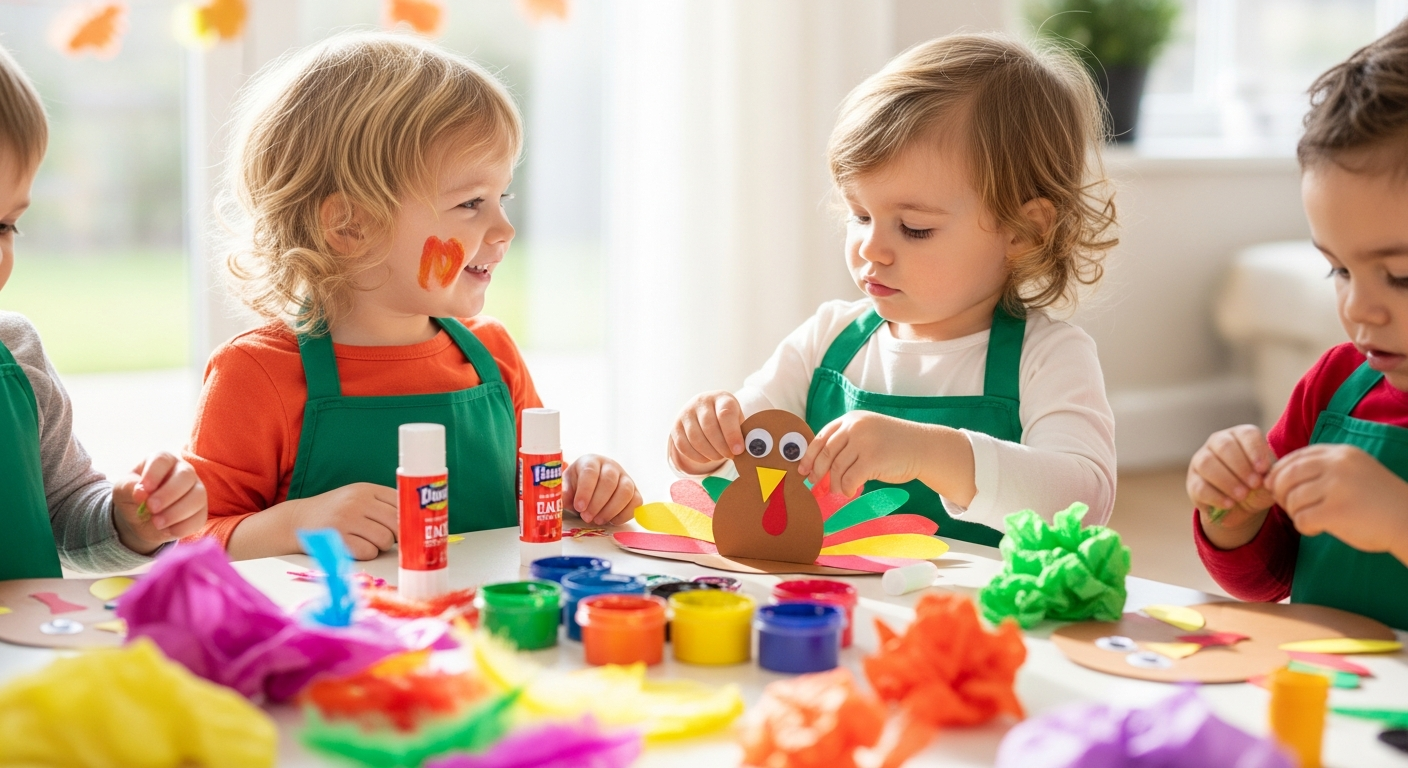
Table of Contents
- Introduction
- The Power of Crafting in Speech Development
- 1. The Classic Paper Plate Turkey
- 2. Handprint Turkey Keepsakes
- 3. Mess-Free Dot Sticker Turkeys
- 4. Nature-Inspired Leaf Turkeys
- 5. Playdough Sensory Turkeys
- 6. Coffee Filter Color-Diffusion Turkeys
- 7. Toilet Paper Roll Turkeys
- 8. Fork-Painted Feather Patterns
- 9. Cupcake Liner Turkeys
- 10. The "Thankful" Turkey
- 11. Contact Paper "Sun Catcher" Turkeys
- 12. Pinecone Turkeys
- 13. Shape Turkeys
- 14. Masking Tape Resist Turkey
- 15. Edible Fruit Turkey
- How Speech Blubs Enhances Your Crafting Time
- Understanding the Value: Why Choose the Yearly Plan?
- Real Stories: Connecting Play and Progress
- Maximizing Your Crafting Session: A Checklist
- FAQs About Toddler Crafts and Speech
- Conclusion
Introduction
Did you know that by the age of three, a child’s brain is twice as active as an adult’s brain? This incredible period of rapid neurological growth is the perfect time to introduce activities that blend sensory exploration with language development. As the leaves turn amber and the air grows crisp, Thanksgiving offers a unique opportunity to engage your little one in meaningful play. But for many parents, the holiday season can feel like a whirlwind of preparation, often leaving little room for quality one-on-one connection.

In this post, we are going to explore a variety of toddler turkey crafts that are not only easy to set up but are specifically designed to foster communication, fine motor skills, and joyful family moments. We will cover everything from mess-free sticker art to nature-inspired leaf turkeys, providing you with a toolkit of activities that adapt to your child's developmental stage.
At Speech Blubs, our mission is to empower children to speak their minds and hearts. We believe that every interaction—whether it’s gluing a feather onto a paper plate or mimicking a "gobble" sound—is a building block for a child's future communication. By the end of this article, you will see how these simple crafts, paired with the right digital support, can transform your holiday season into a time of significant growth and laughter.
The Power of Crafting in Speech Development
When we think of "speech therapy" or "language development," we might imagine flashcards or formal exercises. However, at Speech Blubs, we know that the most effective learning happens through play. Our founders, who all grew up with speech challenges, built our platform on the principle that "smart screen time" should be a joyful, interactive experience that translates into real-world communication.
Crafting is a multi-sensory experience. When a toddler touches sticky glue, sees bright orange paper, and hears the "crinkle" of a coffee filter, they are engaging multiple areas of their brain simultaneously. This "sensory-rich" environment is where vocabulary naturally blossoms. Instead of asking a child to repeat a word, you are creating a context where they want to use words to describe their experience.
Our science-backed methodology focuses on video modeling, where children learn by watching their peers. You can mirror this in your crafting by "modeling" the language. If you see your child reaching for a red feather, you can say, "Oh, you found the red feather! It’s so soft." This simple narration provides the linguistic blueprint they need to start expressing themselves.

1. The Classic Paper Plate Turkey
The paper plate turkey is a staple for a reason: it’s sturdy, accessible, and offers a large "canvas" for little hands.
What You’ll Need:
- A white paper plate
- Brown paint or markers
- Construction paper (red, orange, yellow)
- Googly eyes
- Glue stick
How to Do It:
- Have your toddler color or paint the center of the plate brown. This is the turkey’s body.
- Cut out feather shapes from the construction paper. For younger toddlers, you can pre-cut these; for older ones, this is a great time to practice "safety scissors" skills with help.
- Apply glue to the top rim of the plate and let your child press the feathers on.
- Add the eyes and a small orange triangle for the beak.
Language Tip: Focus on "action words." As they press the feathers, say "Push!" or "Stick!" This helps them associate the physical action with the verbal label.
2. Handprint Turkey Keepsakes
There is nothing more precious than the tiny hand of a toddler. This craft is a wonderful way to track growth while practicing body awareness.
What You’ll Need:
- Washable tempera paint (various fall colors)
- Cardstock or heavy paper
- Paintbrushes or sponges
How to Do It:
- Paint your child’s palm brown and their fingers different colors (red, orange, yellow).
- Help them press their hand firmly onto the paper.
- Once the "feathers" (fingers) and "body" (palm) are dry, draw a small eye and beak on the thumb.
Speech Connection: This activity is perfect for teaching body parts. "Where is your thumb? Let's paint the thumb orange!" This builds foundational vocabulary in a fun, tactile way.
3. Mess-Free Dot Sticker Turkeys
For those days when you just can't face a paint spill, dot stickers are a parent’s best friend.
What You’ll Need:
- A printed turkey outline (or a hand-drawn one)
- Colorful dot stickers
How to Do It:
- Draw a simple turkey body with large, arced lines for the tail.
- Give your child sheets of dot stickers in autumn colors.
- Encourage them to peel and stick the dots along the lines of the tail.
Developmental Benefit: Peeling stickers is an incredible workout for the pincer grasp—the same fine motor skill needed for holding a pencil later on. If your child is a "late talker" and loves repetitive motions, the "Early Sounds" section of Speech Blubs can be a great companion here. You can practice the "P" sound for "Peel" or "Pop" as they work.
4. Nature-Inspired Leaf Turkeys
Take the learning outdoors before you start your craft. A short walk to collect "turkey feathers" (leaves) adds a layer of physical activity to your day.
What You’ll Need:
- Dried or fresh fall leaves
- Cardboard circle (from a cereal box)
- Glue or double-sided tape
How to Do It:
- Go on a "treasure hunt" to find leaves of different sizes and colors.
- Glue the leaves to the back of the cardboard circle so they peek out like a fan.
- Draw a face on the front of the cardboard.
Language Tip: Use descriptive adjectives. "Is this leaf crunchy or soft?" "Is it big or small?" This expands their descriptive vocabulary beyond just simple nouns.
5. Playdough Sensory Turkeys
Combining sensory play with craft creation, playdough turkeys allow for 3D exploration.
What You’ll Need:
- Brown playdough (store-bought or homemade)
- Pipe cleaners or actual feathers
- Beads or googly eyes
How to Do It:
- Roll the playdough into two balls—one large for the body and one small for the head.
- Stack them together.
- Have your child "stab" the pipe cleaners or feathers into the back of the large ball.
- Press beads in for eyes.
Speech Tip: Playdough is great for "power words" like "more," "help," or "all done." If they need help sticking a feather in, wait for them to make a sound or gesture before assisting, encouraging that communicative intent.
6. Coffee Filter Color-Diffusion Turkeys
This craft introduces a bit of "science" to the holiday fun as kids watch colors blend.
What You’ll Need:
- White coffee filters
- Washable markers
- A spray bottle with water
- Brown construction paper
How to Do It:
- Let your toddler scribble all over a coffee filter with red, orange, and yellow markers.
- Mist the filter with water and watch the colors bleed together. Let it dry.
- Glue a brown paper turkey body to the center of the colorful filter.
Language Tip: Use the word "Watch!" and "Look!" to build joint attention. When the water hits the paper, you can say "Ooooh, it's changing!"
7. Toilet Paper Roll Turkeys
Recycling household items is a great way to teach resourcefulness while making cute decorations for the Thanksgiving table.
What You’ll Need:
- Empty toilet paper rolls
- Construction paper
- Glue
How to Do It:
- Wrap the roll in brown paper or paint it brown.
- Cut out several "teardrop" shapes for feathers.
- Glue the feathers to the inside back of the roll so they stand up.
Practical Scenario: For a parent whose 3-year-old is highly motivated by animals, the "Animal Kingdom" section in Speech Blubs offers a fun way to practice animal sounds. Before making your toilet paper turkey, you could watch the turkey model in the app together. Watching another child make the "gobble" sound through our video modeling technique can reduce the pressure on your child, making them more likely to try the sound themselves while they play with their finished roll turkey.
8. Fork-Painted Feather Patterns
Who says you need a paintbrush? Using a fork creates a unique texture that looks just like real feathers.
What You’ll Need:
- Plastic or metal forks
- Paint (red, yellow, orange)
- Paper with a turkey body already drawn or glued on
How to Do It:
- Dip the back of the fork into the paint.
- "Stamp" the fork in a fan shape around the turkey's body to create the plumage.
Speech Connection: This is perfect for rhythm and repetition. "Dip, stamp! Dip, stamp!" The rhythmic repetition of words paired with movement is a powerful tool for neurological encoding of language.
9. Cupcake Liner Turkeys
Cupcake liners are pre-pleated and perfectly circular, making them ideal for little ones who are still learning about shapes.
What You’ll Need:
- Colorful cupcake liners
- Glue
- Paper
How to Do It:
- Flatten the cupcake liners. You can use one large one or layer several different colors.
- Glue them to the paper.
- Add a small brown circle in the center for the body.
Language Tip: Talk about "big" and "small" circles. "We are putting the small circle on the big circle."
10. The "Thankful" Turkey
While toddlers may not fully grasp the abstract concept of gratitude, we can start building the foundation by talking about things they love.
What You’ll Need:
- Large paper turkey
- Paper feathers
How to Do It:
- As you glue each feather, ask your child, "What do you love?"
- They might say "Milk," "Doggie," or "Mama."
- Write their words on the feathers.
Speech Blubs Mission: At Speech Blubs, we want children to "speak their minds and hearts." This activity is a direct extension of that. If your child is struggling to find words, you can use the app to look at pictures of common objects and animals to give them ideas of what they might be thankful for.
11. Contact Paper "Sun Catcher" Turkeys
This is a great low-mess option that creates a beautiful decoration for your windows.
What You’ll Need:
- Clear contact paper
- Tissue paper squares (fall colors)
- Construction paper for the turkey body
How to Do It:
- Tape a piece of contact paper (sticky side out) to the table or a window.
- Let your toddler press tissue paper squares onto the sticky surface.
- Place the turkey body in the middle and seal it with another piece of contact paper.
Language Tip: Use the word "Sticky!" repeatedly. It's a fun word with a distinct "st" sound that kids often enjoy trying to mimic.
12. Pinecone Turkeys
If you live near evergreen trees, pinecones make fantastic textured bodies for turkeys.
What You’ll Need:
- Pinecones
- Pipe cleaners or felt scraps
- Glue
How to Do It:
- Tuck colorful pipe cleaners into the scales of the pinecone.
- Glue a small felt head to the tip of the pinecone.
Developmental Benefit: Manipulating pipe cleaners into the small crevices of a pinecone is excellent for "motor planning"—the ability to conceive, plan, and carry out a physical task.
13. Shape Turkeys
Turn your craft into a math lesson by using only geometric shapes to build your bird.
What You’ll Need:
- Pre-cut circles (body), triangles (beak), and ovals (feathers).
How to Do It:
- Identify each shape as you hand it to your child.
- "Here is the big circle. Where does the triangle go?"
Language Tip: This builds "receptive language" (the ability to understand instructions). Even if they aren't saying "triangle" yet, seeing if they can point to it when asked is a huge developmental milestone.
14. Masking Tape Resist Turkey
This "magic" craft is always a hit with toddlers who love a surprise.
What You’ll Need:
- Masking tape
- Watercolors
- Paper
How to Do It:
- Use masking tape to create the outline of a turkey on the paper.
- Let your child paint over the entire page, including the tape.
- Once dry, peel off the tape to reveal the white turkey shape underneath.
Speech Tip: The reveal is the perfect time for "Exclamatory words." "Wow!" "Look!" "Surprise!" These are often the first types of words children use because they are emotionally charged.
15. Edible Fruit Turkey
Who says crafts can't be a snack? This is perfect for kids with sensory sensitivities who learn through taste and smell.
What You’ll Need:
- A pear (body)
- Apple slices or grapes (feathers)
- Blueberries (eyes)
How to Do It:
- Lay the pear flat on a plate.
- Arrange the apple slices in a fan shape around the top.
- Eat as you go!
Language Tip: Focus on "tasting" words. "Sweet," "crunchy," "cold." This helps bridge the gap between physical sensation and verbal labeling.
How Speech Blubs Enhances Your Crafting Time
While these crafts provide the physical "doing," Speech Blubs provides the "learning model." Our app is designed as a powerful supplement to a child’s overall development plan. We encourage "co-play," where the adult and child use the app together, just as you would craft together.
If you are unsure where your child stands developmentally, we offer a quick 3-minute preliminary screener. It involves 9 simple questions and provides you with a personalized assessment and a next-steps plan. It’s a great way to see if your child could benefit from our unique approach.
We often hear from parents who are worried about screen time. We like to call Speech Blubs "smart screen time." Unlike passive cartoons, our app requires the child to be an active participant. They watch a peer, they see their own face in the "face filters" (which uses the front-facing camera to turn them into a turkey or a lion), and they are prompted to produce sounds. This is a screen-free alternative to passive viewing because it triggers the same "mirror neurons" that are activated during face-to-face play.
Understanding the Value: Why Choose the Yearly Plan?
We want to be transparent about how you can access these tools to support your child’s journey. To build the best foundation for your child, consistency is key. That is why we offer different ways to join our community.
- Monthly Plan: $14.99 per month. This is a great way to test the waters if you are just curious.
- Yearly Plan: $59.99 per year.
The Yearly plan is far and away the best value for families. When you break it down, it costs just $4.99 per month, which is a 66% savings over the monthly rate. But the value goes beyond just the price.
The Yearly Plan includes exclusive features not found in the monthly plan:
- 7-Day Free Trial: You can explore the entire app with your child risk-free for a full week.
- Reading Blubs: You get access to our sister app, Reading Blubs, which focuses on early literacy and phonics—the perfect next step after speech.
- Priority Support: You receive early access to all new content updates and a guaranteed 24-hour response time from our support team.
We recommend parents create your account and select the Yearly plan to ensure they have every tool available to help their child succeed.
Real Stories: Connecting Play and Progress
Don't just take our word for it. We have seen thousands of children make strides in their confidence and communication. One parent shared that her toddler, who was frustrated and prone to tantrums because he couldn't express his needs, finally started "pointing and naming" colors after using the app alongside their daily coloring sessions. You can read more parent success stories on our website to see how families like yours are using these tools.
Our goal isn't to promise that your child will be giving public speeches in a month. Every child’s path is unique. Instead, we focus on fostering a love for communication, building that crucial self-confidence, and creating joyful family learning moments that reduce the frustration often associated with speech delays.
Maximizing Your Crafting Session: A Checklist
To make the most of your toddler turkey crafts, keep these tips in mind:
- Follow Their Lead: If they want the turkey to have ten eyes, let it! The goal is engagement, not perfection.
- Narrate Everything: Be the play-by-play announcer for their activity. "You’re picking up the red paper... now you’re putting it on the glue!"
- Wait for a Response: After you ask a question or make a sound, count to five in your head. Give them the "processing time" they need to respond.
- Integrate Technology Wisely: Use Speech Blubs on the App Store or Google Play Store as a "warm-up" to the craft to get those vocal cords ready and the mind engaged.
FAQs About Toddler Crafts and Speech
1. My toddler still puts everything in their mouth. Are these crafts safe? Safety is always the priority. For children who are still in the "mouthing" phase, stick to edible crafts like the Fruit Turkey or use homemade, non-toxic playdough. Always supervise closely, especially with small items like googly eyes or beads, and consider using large "dot markers" instead of small stickers.
2. How long should a craft session last for a 2-year-old? Toddler attention spans are typically between 3 to 6 minutes. Don't be discouraged if they walk away halfway through! The process of starting, engaging, and interacting is more important than the finished product. You can always leave the craft out and return to it later in the day.
3. Can these crafts really help with a speech delay? While crafts are not a replacement for professional speech therapy if it's needed, they are a powerful supplement. They provide a low-pressure environment for "functional communication." By labeling colors, requesting "more" glue, and describing textures, your child is practicing the foundational skills of language in a natural setting.
4. How does Speech Blubs fit into a busy holiday schedule? We designed Speech Blubs to be used in short, effective bursts. Just 10-15 minutes a day can make a difference. It’s a great activity for those "in-between" moments—while you’re waiting for the turkey to finish in the oven or during a quiet moment after lunch.
Conclusion
Thanksgiving is a time for gratitude, family, and the joy of watching our children grow. By engaging in these toddler turkey crafts, you are doing so much more than making a decoration for the fridge; you are building a bridge to better communication and creating memories that last. Whether you’re painting handprints or sticking dots, remember that your presence and your voice are the most important tools your child has.
At Speech Blubs, we are honored to be a part of your journey. We invite you to join our family of over 4 million parents who are dedicated to helping their children speak their minds and hearts. There is no better time than now to give your child the gift of confidence.
Ready to get started? Download Speech Blubs on the App Store or find us on the Google Play Store to begin your journey. For the best value and access to all our premium features—including Reading Blubs and our 7-day free trial—be sure to select the Yearly plan. Let's make this holiday season a "gobble-tastic" success for your little one's development!
About the author