
15 Creative Toddler Valentine Craft Ideas for Home Fun
 By Speech Blubs Team•Feb 23, 2026•14 min.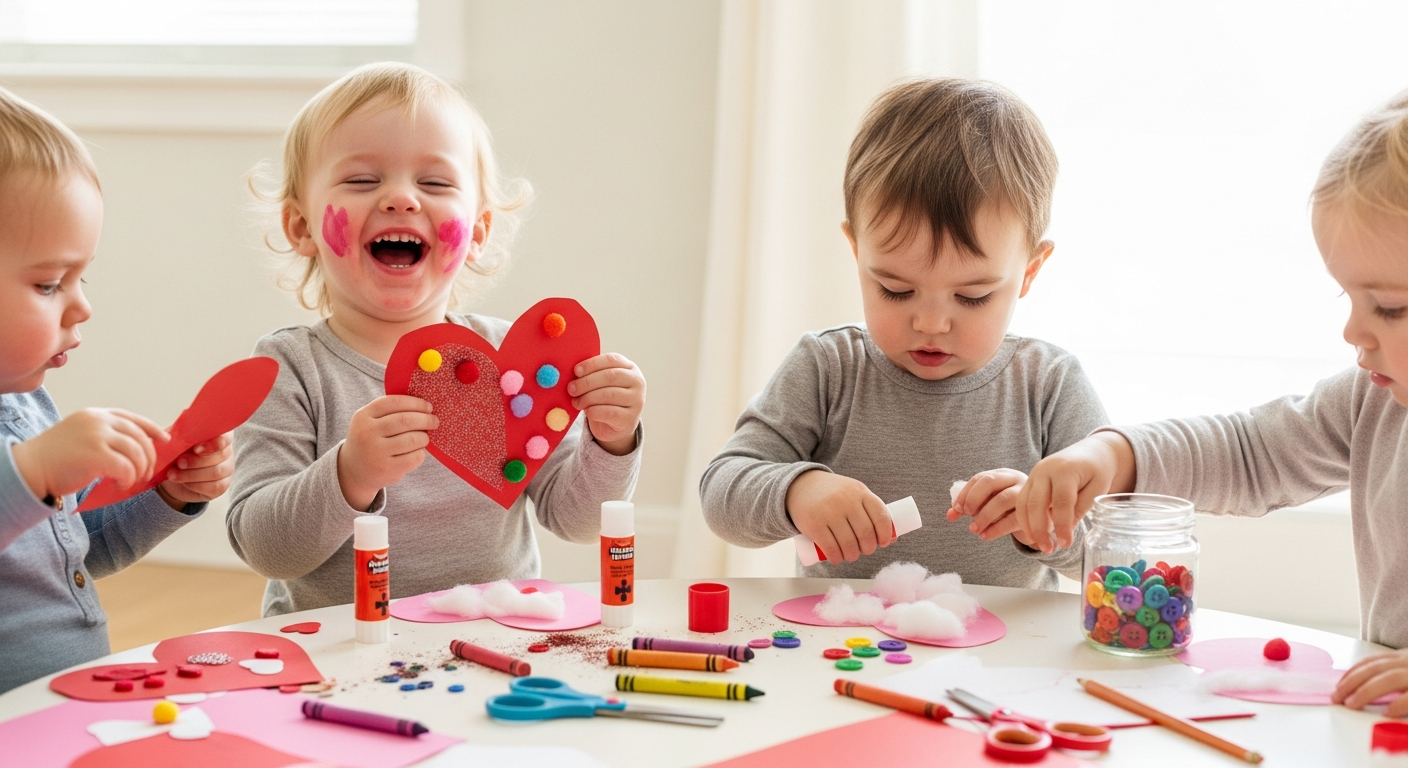
Table of Contents
- Introduction
- The Power of the Toddler Valentine Craft
- Sensory-Based Valentine Crafts
- Fine Motor Skill Builders
- Low-Mess Toddler Valentine Crafts
- Making Crafting "Smart": Incorporating Communication
- Practical Scenarios: Connecting Crafts to Speech Blubs
- Why Speech Blubs is the Right Choice for Your Family
- More Toddler Valentine Craft Ideas
- Frequently Asked Questions
- Conclusion
Introduction
Have you ever watched a toddler try to glue two pieces of paper together with the intense focus of a diamond cutter? There is a certain kind of magic in those sticky fingers and focused brows. While it might look like a simple afternoon of "organized chaos" to an outsider, for a developing child, every smear of red paint and every torn piece of pink construction paper is a massive leap in cognitive and motor development. At Speech Blubs, we believe that every moment of play is an opportunity for connection and communication. Our mission is to empower children to speak their minds and hearts, and what better time to practice that than during a season dedicated to love and expression?
In this guide, we aren’t just giving you a list of "Pinterest-perfect" activities. We are providing you with a toolkit of toddler valentine craft ideas that prioritize the process over the product. We will explore sensory-rich crafts, fine motor skill builders, and low-mess options for those days when you just can't face the glitter. Most importantly, we will show you how to turn these crafting sessions into "smart" moments that mirror the scientific methodology we use in our app—where children learn through imitation, joy, and peer-to-peer modeling. By the end of this post, you’ll have a month’s worth of activities and a deeper understanding of how to support your child's blossoming communication skills.

The Power of the Toddler Valentine Craft
When we think about Valentine’s Day, we think of cards and candy. But for a toddler, a craft is a multi-sensory workout. When your child picks up a small piece of tissue paper, they are refining their pincer grasp. When they describe the "sticky" glue or the "red" paint, they are building their vocabulary.
At Speech Blubs, we often talk about "smart screen time." This means moving away from passive viewing, like cartoons, and toward interactive experiences that require a response. Crafting is the screen-free equivalent of this philosophy. It’s an active, joyful experience that builds the foundational skills needed for complex communication. Our company was born from the personal experiences of our founders, who all grew up with speech problems. They created the tool they wished they had as kids—one that blends play with purpose. Whether you are using our app to practice sounds or sitting at the kitchen table with a glue stick, the goal is the same: fostering a love for communication and building the confidence your child needs to express themselves.
Sensory-Based Valentine Crafts
Toddlers learn best when they can use all their senses. Sensory play is a fantastic way to engage a child who might be a "late talker" or who needs a little extra motivation to engage in directed activities.
1. The Valentine’s Sensory Rice Bin
Sensory bins are a staple in many households for a reason—they provide endless entertainment while working on fine motor skills and descriptive language. To make a festive version, grab a large Ziploc bag and pour in a cup of white rice, a few drops of red or pink food coloring, and a tablespoon of vinegar. Shake it up and let it dry on a tray.
Once dry, place the rice in a bin with heart-shaped cookie cutters, spoons, and small cups.
- Communication Tip: Use this time to model "action" words. Say "pour," "scoop," or "dig" as your child plays. This mimics the way our app uses video modeling to show children how to form words and concepts.
2. Cotton Ball "Pop" Painting
This is a budget-friendly craft that creates a wonderful texture. Use a clothespin to pinch a cotton ball, creating a makeshift "pom-pom" brush. Dip it into red or pink washable paint and "pop" it onto a heart-shaped piece of paper.

- Scenario: For a parent whose 3-year-old loves sensory input, this "pop" action is highly motivating. You can practice the "P" sound every time the cotton ball hits the paper: "Pop! Pop! Pop!" This kind of repetitive, rhythmic sound play is exactly what we encourage in our early language modules.
3. Shaving Cream Heart Marbling
Fill a tray with a thin layer of shaving cream and drop red food coloring or paint on top. Use a stick to swirl the colors together. Press a paper heart onto the foam, lift it up, and scrape away the excess cream with a piece of cardboard. The result is a beautiful marbled heart.
- Caution: Always supervise toddlers with shaving cream to ensure they don’t try to taste it!
Fine Motor Skill Builders
Fine motor skills and speech development often go hand-in-hand. The same brain regions that control the small muscles in the hands are often involved in the fine movements required for speech.
4. Heart Tear Art
This is the ultimate zero-prep toddler valentine craft. Give your child scraps of red, pink, and purple construction paper. Show them how to rip the paper into small pieces. Then, let them glue those pieces onto a large heart outline.
- Why it works: Tearing paper requires bilateral coordination (using both hands together). As they glue, you can talk about "big" pieces and "small" pieces, introducing basic math and size concepts.
5. Potato Heart Stamps
Cut a large potato in half. Use a small heart-shaped cookie cutter to press into the flat side of the potato, then cut around the outside of the cutter with a knife to create a raised heart stamp.
- Practical Scenario: If your child is currently working on the "D" sound, use the word "Down" every time they press the stamp. "Down! Down! Down!" This provides a functional, real-world context for the sound, making it more likely to stick.
6. Pasta Heart Necklaces
Dye some dry penne or rigatoni pasta using the same food coloring/vinegar method used for the rice bin. Give your toddler a piece of yarn with a piece of tape wrapped around the end (to act as a "needle") and let them thread the pasta.
- Speech Connection: Threading takes concentration. During these quiet moments of focus, you can introduce "social" words like "please," "thank you," or "more" as they ask for different colors.
Low-Mess Toddler Valentine Crafts
We know that sometimes the thought of cleaning up paint is enough to make you skip crafting altogether. These "low-mess" or "mess-free" options are perfect for busy weekdays or for children who are sensitive to the feeling of wet paint on their skin.
7. Mess-Free Bag Painting
Squirt a few dollops of red and white paint into a heavy-duty gallon-sized freezer bag. Squeeze out the air and seal it tightly (you can even tape the top shut for extra security). Tape the bag to a table or a window. Your toddler can use their fingers to move the paint around and mix it to create pink, all without getting a single drop on their hands.
- Smart Screen Time Parallel: This activity is a great bridge to the interactive elements of the Speech Blubs app. Just as they move their fingers on the bag to see a result, they can engage with peer-led videos on the screen to trigger fun animations.
8. Wax Resist Valentines
Use a white crayon to draw hearts or write "I Love You" on white cardstock. Give your toddler a tray of watercolors and let them paint over the entire page. The wax will "resist" the water, and your hidden message will magically appear.
- The "Wow" Factor: This craft is great for building "anticipatory language." Ask your child, "What’s going to happen?" or "Where did the heart go?" to encourage them to use their words to predict and describe.
9. Sticker Heart Mandalas
Give your child a sheet of heart-shaped stickers and a paper plate. Encourage them to place the stickers all around the edge or fill the center. Stickers are excellent for developing the "pincer grasp" (the thumb and index finger pinch), which is vital for later writing skills.
Making Crafting "Smart": Incorporating Communication
As a child development expert, I always tell parents: the craft is just the vehicle. The real value is the conversation happening while you craft. At Speech Blubs, we focus on the "video modeling" method. This is where children learn by watching other children—their peers—perform a task or say a word. You can use this same principle at home.
When you are making a toddler valentine craft, don't just give instructions. Sit down and do it with them. Let them watch you.
- Model the Action: "Watch me. I am squeezing the glue."
- Wait for a Response: After you model an action or a word, give your child at least 5-10 seconds of "wait time." It can feel like an eternity, but it gives their little brains time to process what they saw and try to imitate it.
- Encourage Peer Interaction: If you have older siblings or friends over, let the toddler watch them. Children are often much more motivated to copy another child than an adult.
If you are unsure where your child stands in their development, we offer a quick 3-minute preliminary screener. It involves 9 simple questions and provides an assessment and next-steps plan. It’s a great way to see if your child could benefit from a more structured approach like our app, which is a powerful supplement to home activities and professional therapy.
Practical Scenarios: Connecting Crafts to Speech Blubs
We love seeing how parents integrate our "smart screen time" with real-world play. Here are a few ways to connect these Valentine's crafts to specific sections of the Speech Blubs app:
- The "Living Colors" Section: Before you start your mess-free bag painting or marbling, spend 5 minutes in the "Living Colors" section of the app. Your child can watch other kids say "Red," "Pink," and "Purple." Then, as you mix the paint, they will be much more likely to use those words themselves.
- The "Animal Kingdom" Section: For a parent whose 3-year-old "late talker" loves animals, the "Animal Kingdom" section offers a fun, motivating way to practice "moo" and "baa" sounds. You can then make "Cow-entines" by adding black spots to a heart and saying "Moo-my Valentine!"
- The "Toy Box" Section: If your child is obsessed with things that go, like our user Leo who loves cars, you can make "Valen-cars" using cardboard tubes. Practice the "Vroom" and "Beep" sounds found in the app while you "drive" your heart-shaped cars across the table.
Why Speech Blubs is the Right Choice for Your Family
We know there are many ways to spend your time and resources. Our goal is to provide an immediate, effective, and joyful solution for the 1 in 4 children who need speech support. We don't promise that your child will be giving public speeches in a month; development is a journey, not a race. Instead, we focus on fostering a love for communication, reducing frustration, and creating those joyful family learning moments that you'll remember long after the glue has dried.
Our app is a screen-free alternative to passive viewing because it demands engagement. It uses the camera to show your child's own face alongside their "peer teachers," utilizing mirror neurons to encourage imitation. This scientific approach has helped over 5 million families worldwide. You can read some of their stories on our testimonials page.
Understanding Our Pricing and Plans
We want to be transparent about how you can join the Speech Blubs family. We offer two main paths to help your child "speak their mind and heart":
- The Yearly Plan (Best Value): This is the clear choice for families committed to their child's development. For $59.99 per year (which breaks down to just $4.99/month), you save 66% compared to the monthly plan.
- Exclusive Yearly Features:
- A 7-day free trial to explore everything risk-free.
- Access to our Reading Blubs app, designed to bridge the gap between speech and literacy.
- Early access to new updates and a 24-hour support response time from our team.
- The Monthly Plan: This is available for $14.99 per month. Please note that this plan does not include the 7-day free trial, the Reading Blubs app, or priority support.
We highly recommend choosing the Yearly plan to get the full suite of features and the free trial period. You can start your journey here on our website or download the app directly.
More Toddler Valentine Craft Ideas
Let's keep the inspiration going with a few more quick-hit ideas:
- Heart Nature Weaving: Use a piece of cardboard with a heart cut out and rubber bands stretched across it. Let your toddler tuck leaves or flowers they find outside into the rubber bands.
- Coffee Filter Hearts: Let your child color on coffee filters with markers. Use a dropper or a spray bottle to add water and watch the colors bleed together. (Great for practicing the word "Wet!")
- Cardboard Tube Love Bugs: Use toilet paper or paper towel rolls. Wrap them in paper, add heart wings, and use pipe cleaners for antennae.
- Smush Art Hearts: Fold a piece of paper in half, put a few drops of paint inside the fold, and let your toddler "smush" it together. When you open it, you have a symmetrical heart design!
Frequently Asked Questions
1. What is the best age to start these toddler valentine crafts?
Most of these activities are designed for children aged 18 months to 4 years. For younger toddlers (18-24 months), focus on sensory-heavy activities like the rice bin or mess-free bag painting. As they approach 3 and 4, they will have the dexterity for more complex tasks like tearing paper or stringing pasta.
2. My child doesn't like getting their hands dirty. Should I force it?
Absolutely not! Sensory preferences are very real. If your child avoids wet textures, stick to "dry" crafts like sticker mandalas, heart tear art, or the mess-free bag painting. Forcing a child into a sensory experience they find unpleasant can create a negative association with crafting and communication.
3. How can I use these crafts to help with a speech delay?
The key is to use the craft as a "communication temptation." Don't give them everything at once. Give them the paper but hold onto the glue. Wait for them to ask for it, either through a gesture, a sound, or a word. This creates a functional need for them to communicate. Pair this with our Google Play Store app to see how peer modeling can further encourage those first words.
4. Can these crafts be done in a group setting?
Yes! Valentine's Day is a wonderful time for a "playdate craft." Group crafting allows for social modeling, where toddlers watch each other and learn social cues like sharing and turn-taking. Just ensure you have enough supplies for everyone to avoid frustration!
Conclusion
Valentine’s Day is about more than just cards; it’s about the joy of expression. Whether you are building a sensory rice bin, stamping potatoes, or exploring the "smart screen time" of Speech Blubs, you are providing your child with the building blocks of communication. Every "pop" of a cotton ball and every "vroom" of a cardboard car is a step toward your child speaking their mind and heart.
We invite you to make this Valentine's season extra special by focusing on connection. Use these toddler valentine craft ideas to spark new conversations and build confidence. And if you're looking for a powerful tool to supplement your child's growth, we are here for you.
Ready to see your child's communication blossom? Download Speech Blubs on the App Store or get it on Google Play to begin. Remember to choose the Yearly plan to unlock your 7-day free trial, the Reading Blubs app, and the best overall value for your family. Let’s make this Valentine’s Day a celebration of every little voice!
About the author