
15 Creative Under the Sea Toddler Crafts for Fun Learning
 By Speech Blubs Team•Feb 19, 2026•16 min.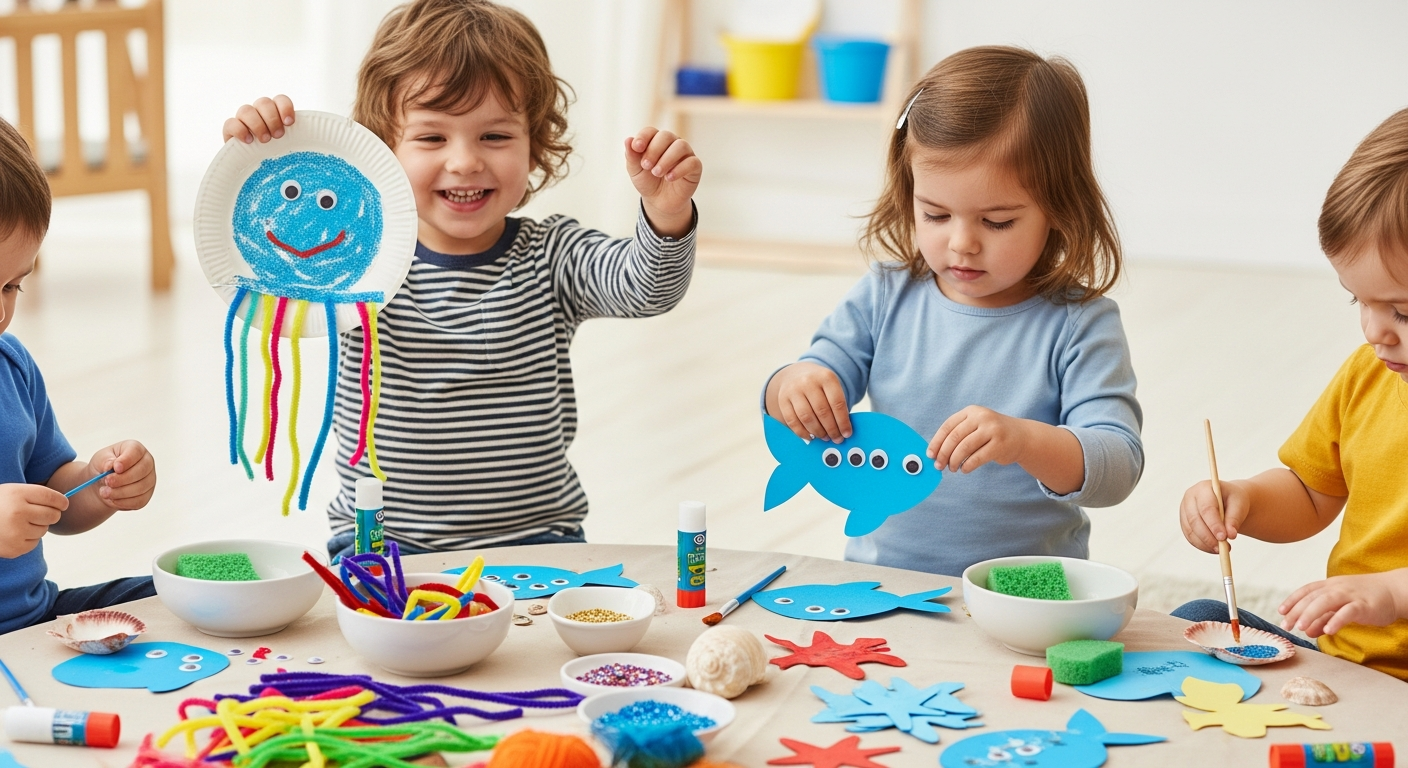
Table of Contents
- Introduction
- The Connection Between Crafting and Communication
- Preparing Your "Under the Sea" Craft Station
- 1. The Classic Paper Plate Jellyfish
- 2. Toilet Roll "Claw-some" Crabs
- 3. Egg Carton Whale Pods
- 4. Bubble Wrap Starfish
- 5. Shiny Foil Fish
- 6. Paper Plate Tropical Fish
- 7. Cardboard Tube Seahorses
- 8. Bouncy Ball Stamped Pufferfish
- 9. Cereal Box Aquarium
- 10. Rainbow Fish Paper Collage
- 11. Rock Fish Painting
- 12. Cupcake Liner Octopuses
- 13. Salt Dough Starfish
- 14. Coffee Filter Turtles
- 15. Handprint Crabs
- The Speech Blubs Methodology: Why it Works
- Realistic Expectations and Fostering Confidence
- Choosing the Best Support for Your Child
- Tips for Success During Craft Time
- Creating Joyful Family Learning Moments
- Conclusion
- Frequently Asked Questions
Introduction
Have you ever watched a toddler’s eyes light up when they see a colorful fish dart across a screen or a picture book? The ocean is a place of endless mystery and wonder, filled with vibrant colors, strange textures, and fascinating creatures that capture a child's imagination like nothing else. But beyond the visual appeal, the "deep blue sea" provides a rich landscape for developmental growth. Whether your little one is a "late talker" or simply a curious explorer, engaging in themed activities can be the spark that ignites their communication journey.

In this post, we are going to dive deep into the world of under the sea toddler crafts. We’ll explore 15 easy-to-make, budget-friendly projects that use everyday household items to bring the ocean into your living room. More importantly, we’ll discuss how these hands-on activities, when paired with the right tools, can foster language development, fine motor skills, and confidence. At Speech Blubs, our mission is to empower children to "speak their minds and hearts." We believe that blending scientific principles with the joy of play is the most effective way to help children reach their milestones. By the end of this article, you’ll have a treasure chest of ideas to create joyful family learning moments that go far beyond just "making art."
The Connection Between Crafting and Communication
For many parents, crafting is about keeping a toddler occupied or creating a cute keepsakes. However, as child development experts, we see it as a powerful therapeutic tool. When a child engages in under the sea toddler crafts, they aren't just gluing paper; they are practicing "joint attention," following multi-step directions, and expanding their vocabulary.
Think about the words associated with the ocean: splash, blue, cold, slippery, wiggly, pinch, swim. These are sensory-rich words that are easy for toddlers to visualize and imitate. For the 1 in 4 children who may need extra speech support, these tactile experiences provide a concrete foundation for abstract language. At Speech Blubs, our company was born from the personal experiences of our founders, who all grew up with speech problems. They created the tool they wished they had—one that turns learning into a game. We recommend using these crafts as a "bridge" to the digital world. While your child works with their hands, they can use our app to see real children making the sounds of the animals they are creating.
Preparing Your "Under the Sea" Craft Station
Before you start, it’s helpful to have a dedicated space. Toddler crafting is messy, and that’s a good thing! Sensory exploration—feeling the stickiness of glue or the coldness of paint—is vital for brain development.

Essential Supplies:
- Paper plates and toilet paper rolls
- Egg cartons and cereal boxes
- Washable paints (especially blues, greens, and oranges)
- Googly eyes (a toddler favorite!)
- Safety scissors and glue sticks
- Sensory extras: bubble wrap, aluminum foil, and cotton balls
To make the most of this time, we suggest setting a "smart screen time" intention. Instead of passive viewing, like putting on a cartoon in the background, you can use the Speech Blubs app to guide the session. For example, if you are making a fish, open the "Animal Kingdom" section to practice the "glub glub" sound together.
1. The Classic Paper Plate Jellyfish
This is a fantastic craft for practicing the "J" sound and fine motor coordination.
How to make it:
- Cut a paper plate in half.
- Let your toddler paint the half-circle a bright color (pink or purple works great).
- Punch holes along the flat bottom edge.
- Have your child help thread colorful ribbons or yarn through the holes to act as tentacles.
Speech Tip: As the tentacles "wiggle," say the word "wiggle" repeatedly. This repetitive, rhythmic language is exactly what we focus on in our research-backed methodology. By watching peers in the app do the same, your child uses their mirror neurons to mimic the mouth movements required for the "W" in wiggle.
2. Toilet Roll "Claw-some" Crabs
Repurposing toilet paper rolls is eco-friendly and provides a sturdy base for little hands to hold.
How to make it:
- Paint a toilet roll bright red.
- Cut out two "pincher" shapes from red construction paper.
- Glue the pinchers to the sides and add googly eyes to the top.
Real-World Scenario: For a parent whose child struggles with the "C" sound, making this crab is the perfect opportunity to practice. You can play a game of "Crab Catch," where the crab "pinches" different objects while you say "Crab, click, clack!" If you’re unsure where your child stands with their sounds, take our quick 3-minute preliminary screener to get an assessment and a next-steps plan.
3. Egg Carton Whale Pods
Don't throw away that egg carton! It can become a pod of friendly whales.
How to make it:
- Cut out individual "cups" from a cardboard egg carton.
- Paint them blue.
- Cut a small slit in the top and insert a blue pipe cleaner to represent the "spout."
- Add tiny fins to the sides.
Whales are great for practicing the "W" sound and the concept of "big." You can talk about how the whale is "big" and the egg carton cup is "small."
4. Bubble Wrap Starfish
Texture is everything for toddlers. Bubble wrap provides an irresistible sensory experience.
How to make it:
- Cut a starfish shape out of cardstock or a cereal box.
- Cut a piece of bubble wrap to fit over it.
- Let your child paint the bubble wrap and then press it onto the paper, or glue the wrap directly onto the starfish.
The "S" Sound: "Starfish" and "Sea" are excellent "S" sound targets. As your child presses the bubbles, encourage them to make a "pop" sound. This mimics the "Mouth Gym" exercises found in the Speech Blubs app, which help strengthen the muscles needed for clear speech.
5. Shiny Foil Fish
Using aluminum foil adds a visual element that captures a toddler’s attention longer than plain paper.
How to make it:
- Cut a fish shape out of cardboard.
- Wrap it in aluminum foil (this is great for fine motor "scrunching").
- Use permanent markers (with supervision) or stickers to decorate the "scales."
This craft is perfect for discussing "shiny" and "bright." You can see how other parents have used these creative prompts to help their children's progress by reading our user testimonials.
6. Paper Plate Tropical Fish
If your child loves the movie Finding Nemo, they will love this one.
How to make it:
- Cut a small triangle out of a paper plate (this becomes the mouth).
- Glue that same triangle to the back of the plate to become the tail.
- Decorate with bold stripes.
This craft teaches the concept of shapes (triangles) and spatial awareness. "The tail goes behind the fish." Using directional words helps build the foundational cognitive skills necessary for complex sentences later on.
7. Cardboard Tube Seahorses
Seahorses are unique creatures that can spark a conversation about how everyone is different.
How to make it:
- Flatten a toilet paper roll and cut a "J" shape out of it, keeping the tube structure somewhat intact.
- Paint it and add a small fin made of tissue paper.
- Add one googly eye (since we usually see seahorses from the side!).
Co-Play Strategy: At Speech Blubs, we advocate for adult co-play. Instead of letting your child craft alone, do it with them. Ask questions like, "Where is the seahorse going?" or "Is he hungry?" Even if they don't answer with words yet, you are modeling the flow of conversation.
8. Bouncy Ball Stamped Pufferfish
This activity is high-energy and high-reward.
How to make it:
- Draw a large circle on a piece of paper.
- Dip a small bouncy ball into paint.
- "Bounce" the ball inside the circle to create the "spikes" of the pufferfish.
This helps with hand-eye coordination. As the ball bounces, say "Boing! Boing!" mimicking the fun, playful sounds found in our Google Play Store app.
9. Cereal Box Aquarium
This is a more involved project that can serve as a "stage" for storytelling.
How to make it:
- Cut the front off a cereal box.
- Paint the inside blue.
- Hang the other crafts (like the small egg carton whales or foil fish) from the top of the box using string.
This creates a 3D environment. You can use this "aquarium" to act out scenes. "The fish is swimming under the whale." Storytelling is a peak communication skill, and this provides a low-pressure way to practice.
10. Rainbow Fish Paper Collage
Based on the famous book, this craft focuses on the social-emotional aspect of sharing.
How to make it:
- Draw a large fish outline.
- Provide scraps of colored paper and one "shiny" silver scrap.
- Glue the "scales" on.
As you work, talk about "giving" and "taking turns." These social cues are just as important as the sounds themselves.
11. Rock Fish Painting
If you can take a walk to a local park or beach first, this becomes a multi-sensory journey.
How to make it:
- Find smooth, flat rocks.
- Wash them (toddlers love water play!).
- Paint them to look like little fish.
Rocks are "heavy" and "hard." Comparing them to "soft" tissue paper or "light" feathers used in other crafts builds a child's descriptive vocabulary.
12. Cupcake Liner Octopuses
The humble cupcake liner is the perfect shape for a multi-legged friend.
How to make it:
- Flatten a cupcake liner.
- Cut eight strips of paper for the legs.
- Glue them to the bottom of the liner.
Counting Practice: This is the perfect time to practice counting 1 to 8. "One leg, two legs..." Counting helps with sequencing, which is a vital skill for structuring sentences.
13. Salt Dough Starfish
If you want something that lasts, salt dough is the way to go.
How to make it:
- Mix 1 cup flour, 1/2 cup salt, and 1/2 cup water.
- Model it into a star shape.
- Bake at a low temperature until hard, then paint.
The act of kneading the dough is excellent for strengthening the small muscles in the hands, which is closely linked to the brain areas responsible for language.
14. Coffee Filter Turtles
Watch the colors bleed and blend in this "science-meets-art" craft.
How to make it:
- Use markers to color a coffee filter.
- Spray it with a little water and watch the colors spread.
- Once dry, glue it to a green paper "shell" and add a head and legs.
This introduces the concept of "cause and effect." "I spray the water, and the color changes!" Understanding cause and effect is a prerequisite for understanding that "I make a sound, and I get what I want" (the basis of functional communication).
15. Handprint Crabs
There is nothing a parent loves more than a craft that captures how small their child’s hands once were.
How to make it:
- Paint both of your child’s hands red.
- Press them onto paper with the palms overlapping and fingers pointing outward (to look like legs).
- Add eyes to the "thumbs."
This is a very personal craft. You can say, "Look at your hands. These are my hands." Using pronouns correctly is a major milestone in toddler language development.
The Speech Blubs Methodology: Why it Works
You might wonder why we suggest pairing these under the sea toddler crafts with our app. It’s because our approach is rooted in the science of video modeling. In our app, children don't watch cartoons; they watch other children. When a toddler sees a peer performing a task or making a sound, it triggers their mirror neurons. This makes them significantly more likely to attempt the sound themselves.
Our "smart screen time" is designed to be active, not passive. We provide a screen-free alternative to mindless scrolling by creating a tool that encourages the child to look away from the screen and interact with you. Our mission is to provide an immediate, effective, and joyful solution for families. We aren't just an app; we are a partner in your child’s development.
Realistic Expectations and Fostering Confidence
It is important to remember that every child develops at their own pace. We do not suggest that after making a paper plate fish, your child will be giving public speeches in a month. Instead, the goal is to foster a love for communication, build confidence, and reduce the frustration that often comes with speech delays.
By focusing on the process rather than the final product, you create a safe space for your child to experiment with sounds. If they say "fi" instead of "fish," celebrate it! That’s a huge win. Building foundational skills in a joyful, low-pressure environment is the key to long-term success.
Choosing the Best Support for Your Child
While crafts and home activities are wonderful, many parents want a structured plan to ensure their child is on the right track. This is where Speech Blubs comes in as a powerful supplement to your child's overall development plan and, when applicable, professional therapy.
We offer two main ways to join our community:
- Monthly Plan: For $14.99 per month, you get access to our core library of speech-stimulating activities.
- Yearly Plan: For $59.99 per year (which breaks down to just $4.99/month), you get the absolute best value.
Why choose the Yearly Plan?
- 7-Day Free Trial: You can explore everything we offer risk-free for a full week.
- Reading Blubs: This plan includes our exclusive Reading Blubs app, which helps transition speech skills into early literacy.
- Priority Support: You get 24-hour support response times and early access to all new updates and features.
- Significant Savings: You save 66% compared to the monthly rate.
The Yearly plan is the clear choice for parents who are committed to a consistent, long-term approach to their child's communication journey. Create your account and begin your 7-day free trial today.
Tips for Success During Craft Time
To maximize the speech benefits of your under the sea toddler crafts, keep these tips in mind:
- Narrate everything: Be a "sportscaster" for your child. "I am picking up the blue paint. Now I am putting it on the plate."
- Use "Wait Time": After you ask a question or model a sound, wait at least 5-10 seconds. Toddlers need more time to process information and formulate a response.
- Follow their lead: If your child wants to turn the "crab" into a "hat," go with it! Engagement is more important than following the instructions perfectly.
- Incorporate Music: Sing "Baby Shark" or "The Waves in the Ocean" while you work. Music and rhythm are powerful drivers for language.
Creating Joyful Family Learning Moments
At the end of the day, these crafts are about more than just glue and paper. They are about the moments you spend sitting on the floor together, laughing at a googly eye that fell off, or celebrating a new sound your child made for the first time. We want to help you create a world where your child feels empowered to "speak their minds and hearts."
Whether you are navigating a diagnosed speech delay or just want to give your child a head start, Speech Blubs is here to support you. Our app is designed to be a tool for family connection, turning screen time into a bridge that brings you closer together.
Conclusion
Under the sea toddler crafts are a wonderful gateway to a world of learning and language. From the tactile sensation of bubble wrap to the fine motor challenge of threading ribbon through a paper plate, these activities provide the sensory input toddlers crave. By integrating these crafts with the Speech Blubs app, you are providing your child with a comprehensive, science-based approach to communication that feels like pure play.
We encourage you to start small. Choose one craft from this list and try it today. Remember to be patient, stay enthusiastic, and focus on the joy of the process. If you’re ready to take the next step in supporting your child’s speech journey, download Speech Blubs on the App Store or Google Play to begin. We recommend choosing the Yearly plan to unlock the full suite of features, including Reading Blubs and your 7-day free trial. Let’s dive into learning together!
Frequently Asked Questions
1. How do under the sea crafts specifically help with speech delays?
Crafts encourage "functional language." When a child needs a "blue" crayon or "more" glue, they are motivated to use words or gestures to communicate their needs. The ocean theme specifically offers many "power words" (like pop, splash, go, stop) that are easy for late talkers to imitate. Pairing these with the video modeling in Speech Blubs reinforces these sounds through peer imitation.
2. What is the best age to start these under the sea toddler crafts?
These activities are generally designed for children aged 2 to 5. However, they can be adapted for younger toddlers by focusing more on the sensory experience (like feeling the paint) and for older preschoolers by adding more complex steps like using safety scissors or following a multi-part story.
3. I'm worried about screen time. Is Speech Blubs just another cartoon?
Not at all! We provide a "smart screen time" experience that is a screen-free alternative to passive viewing. Our app uses real children (not cartoons) to encourage your child to interact with you and the physical world. It is designed to be used for short, impactful sessions that trigger actual vocalization and physical play.
4. How do I know if my child’s speech is actually behind?
Every child is different, but there are certain milestones to look for. If you are uncertain or seeking validation, we recommend taking our quick 3-minute preliminary screener. It involves 9 simple questions and provides you with an immediate assessment and a plan for the next steps to take.
About the author