
15 Easy Toddler Easter Craft Ideas for Creative Fun
 By Speech Blubs Team•Feb 20, 2026•16 min.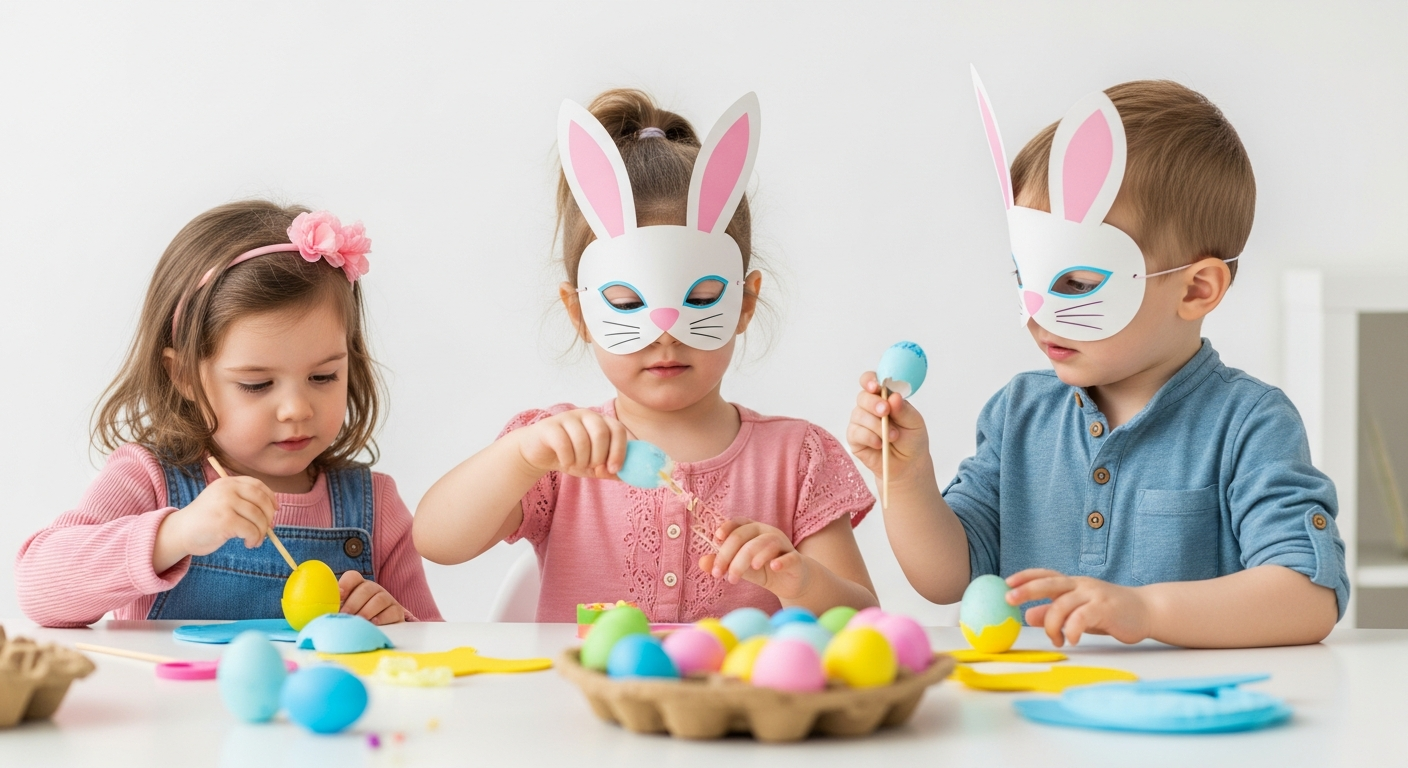
Table of Contents
- Introduction
- Why Crafting is a Speech and Language Powerhouse
- 1. Dot Marker Chicks
- 2. Coffee Filter Watercolor Eggs
- 3. Toilet Paper Roll Bunny Stamps
- 4. Paper Plate "Peeking" Chicks
- 5. Sensory Easter Grass Bins
- 6. Salt Dough Keepsake Eggs
- 7. The Sticky Contact Paper Egg
- 8. Potato Stamp Easter Eggs
- 9. Cotton Ball Lambs
- 10. Handprint Bunnies
- 11. Egg Carton Flowers
- 12. Paper Plate Easter Masks
- 13. Foil-Wrapped Painted Eggs
- 14. Easter Bunny Juice Boxes
- 15. The "Nature" Easter Egg
- Making the Most of "Smart Screen Time"
- Realistic Expectations and Joyful Learning
- Choosing the Right Plan for Your Family
- Summary of Key Takeaways
- Frequently Asked Questions
- Conclusion
Introduction
Did you know that by the time a child reaches age three, their brain is twice as active as an adult's? This window of rapid development is a magical time when every splash of paint, every crumpled piece of paper, and every sticky glue stick becomes a building block for future success. As the flowers begin to bloom and the holiday spirit takes hold, finding an easy toddler easter craft isn’t just about making cute decorations for the refrigerator—it’s about creating opportunities for your little one to "speak their minds and hearts."
At Speech Blubs, we believe that learning should be a joyful, collaborative experience. Our founders started this journey because they grew up with speech challenges themselves and wanted to create the tool they wished they’d had. Today, we focus on blending scientific principles with the power of play to provide an immediate, effective solution for the 1 in 4 children who need speech support. This blog post is designed to give you a comprehensive list of Easter crafts that are accessible, sensory-rich, and perfectly suited for tiny hands. We will explore how these activities foster fine motor skills, boost vocabulary, and provide a "smart screen time" alternative to passive viewing.

Our goal is to help you navigate this festive season with confidence, providing practical advice that builds foundational skills without the pressure of perfection. By the end of this guide, you’ll have a toolkit of activities that encourage family connection and support your child's communication journey. Whether you are working with a late talker or simply looking for a fun afternoon activity, these crafts are a gateway to discovery.
Why Crafting is a Speech and Language Powerhouse
Before we dive into the glue and glitter, it’s important to understand why we advocate for these hands-on activities. Crafting is inherently communicative. When you sit down with your toddler to make an easy toddler easter craft, you are naturally engaging in "parallel talk" and "self-talk," two of the most effective strategies for language development.
For example, when a parent of a 2-year-old who is just starting to use descriptive words sits down to paint, they might say, "I am using the big brush for the yellow paint." This simple interaction models vocabulary in a real-world context. At Speech Blubs, our research-backed methodology emphasizes video modeling, where children learn by watching their peers. Crafting operates on a similar principle of imitation: your child watches you, mimics your movements, and eventually mimics your words.
Building Foundational Skills
Crafting helps children develop:
- Fine Motor Strength: Squeezing glue bottles and holding crayons builds the muscles needed for writing and self-feeding.
- Cognitive Following: Following a two-step instruction like "First, dip the brush; second, paint the egg" is a major developmental milestone.
- Confidence: Completing a project—no matter how messy—gives a toddler a sense of agency and pride.
If you are ever unsure where your child stands in their developmental journey, we invite you to take our 3-minute preliminary screener. It involves 9 simple questions and provides a tailored assessment and next-steps plan to help you support your child's unique needs.

1. Dot Marker Chicks
Dot markers (also known as bingo daubers) are a toddler’s best friend. They require less precision than a traditional marker but offer an immediate, vibrant reward.
How to do it:
- Draw a large oval on a piece of white construction paper.
- Provide your child with a yellow dot marker and let them fill the oval.
- Once dry, help them glue on googly eyes and a small orange triangle for a beak.
For a child who is currently obsessed with the "Animal Kingdom" section of our app, this craft is the perfect way to practice the "cheep-cheep" sounds they’ve been imitating from their peers in the video models. It bridges the gap between the digital "smart screen time" experience and a physical, tactile one.
2. Coffee Filter Watercolor Eggs
This is a classic for a reason. It’s nearly impossible to "mess up," which reduces frustration for both the child and the parent.
How to do it:
- Cut coffee filters into large egg shapes.
- Set out a tray of watercolors and a small cup of water.
- Let your child "paint" the filters. Watch as the colors bleed and blend together.
This activity is excellent for discussing concepts like "wet" and "dry" or "more" and "less" paint. We often see that when parents move away from passive viewing like cartoons and toward active, shared activities, the child's willingness to vocalize increases significantly.
3. Toilet Paper Roll Bunny Stamps
Recycling household items into art tools is a fantastic way to teach resourcefulness.
How to do it:
- Take three empty toilet paper rolls. Leave one circular. Pinch the other two into oval "ear" shapes.
- Tape the two ovals to the top of the circle.
- Dip the end into a shallow dish of paint and stamp it onto paper to create an instant bunny silhouette.
For a parent whose 3-year-old is working on specific consonant sounds, the "B" in "Bunny" and "Blue" provides a natural opportunity for repetition during play. You can see how other families have used these types of interactive moments to spark language breakthroughs by reading our parent success stories.
4. Paper Plate "Peeking" Chicks
This craft introduces the concept of hidden objects, which is great for cognitive development and object permanence.
How to do it:
- Cut a paper plate in half with a zigzag line (to look like a cracked egg).
- Have your child paint a second, whole paper plate yellow.
- Fasten one half of the "cracked" plate to the bottom of the yellow plate using a brass fastener or simple tape at the edges.
- Add eyes to the yellow plate so the chick "peeks" out from the shell.
5. Sensory Easter Grass Bins
Sometimes the best "craft" is actually a sensory experience. Sensory bins are a cornerstone of early childhood education because they engage multiple senses at once.
How to do it:
- Fill a plastic bin with "Easter grass" (paper or plastic).
- Hide plastic eggs, small toy bunnies, or even spoons and cups inside.
- Encourage your child to find the items and describe them.
This is a prime time to use the descriptive vocabulary found in the Speech Blubs app. If your child is learning about "In" and "Under," hiding an egg under the grass provides a physical manifestation of that preposition. To start your journey with these kinds of "smart" learning tools, we recommend you download Speech Blubs on the App Store or get it on Google Play.
6. Salt Dough Keepsake Eggs
Salt dough is a wonderful, non-toxic medium that kids can manipulate like playdough, but it can be baked and kept for years.
How to do it:
- Mix 1 cup of flour, 1/2 cup of salt, and 1/2 cup of water.
- Knead until smooth and roll out.
- Use an egg-shaped cookie cutter (or a butter knife) to cut out shapes.
- Press your toddler’s thumb into the center to create a "thumbprint bunny" or "chick" base.
- Bake at 200°F (90°C) for 2–3 hours until hard, then paint.
7. The Sticky Contact Paper Egg
For younger toddlers who might still be tempted to put paint in their mouths, "sticky art" is a safer, mess-free alternative.
How to do it:
- Cut a large egg shape out of clear contact paper (shelf liner).
- Tape it to a window or a table with the sticky side facing out.
- Provide scraps of tissue paper, ribbons, or buttons.
- Let the toddler press the items onto the sticky surface to decorate their egg.
This is a beautiful way to decorate your home while allowing your child to lead the creative process. At Speech Blubs, we emphasize that the adult should be a co-player, not a director. Let them choose where the "blue" goes, even if it’s all in one corner!
8. Potato Stamp Easter Eggs
If you have a few potatoes in the pantry that are past their prime, they make the perfect stamps.
How to do it:
- An adult should cut a potato in half.
- Carve simple lines or dots into the flat surface of the potato.
- The toddler dips the potato into paint and stamps it onto paper.
This creates a rhythmic, repetitive action that many children find soothing. It’s also a great way to practice counting: "One stamp, two stamps, three!"
9. Cotton Ball Lambs
Texture is a huge part of the sensory experience for a toddler. The contrast between the "soft" cotton and the "hard" paper is a great conversation starter.
How to do it:
- Cut a cloud shape out of black or white paper.
- Let your child apply glue (with your help) to the shape.
- Have them pull apart cotton balls and stick them onto the glue to make a fluffy lamb.
- Add legs and a face.
For a child who loves animals, this is a perfect opportunity to pair the activity with our "Animal Kingdom" module. As they feel the cotton, they can practice the "Baa" sound they’ve seen their peer "teachers" do in the app. This is the essence of our mission: making communication a joyful, lived experience.
10. Handprint Bunnies
Nothing beats a handprint craft for a holiday keepsake.
How to do it:
- Trace your child’s hand on a piece of paper.
- Cut it out.
- Fold down the thumb and the pinky finger toward the "palm." This leaves the middle and ring fingers standing up like bunny ears.
- The folded fingers become the bunny’s "arms" hugging its tummy.
- Draw a face on the palm area.
11. Egg Carton Flowers
While technically a spring craft, these look beautiful as part of an Easter display.
How to do it:
- Cut the individual "cups" out of a cardboard egg carton.
- Have your child paint each cup a bright color.
- Glue a green pipe cleaner to the bottom for a stem.
- Place them in a jar to create an Easter bouquet.
12. Paper Plate Easter Masks
Toddlers love "pretend play," which is a vital stage for developing social communication skills.
How to do it:
- Cut eye holes in a paper plate.
- Glue on long paper ears for a bunny or a triangle beak for a chick.
- Attach a large popsicle stick to the bottom so your child can hold it up to their face.
Once the mask is made, use it as a prompt for a game of "peek-a-boo" or to act out stories. This type of play reduces frustration by giving the child a "character" to speak through, which often makes them feel more confident in trying out new sounds.
13. Foil-Wrapped Painted Eggs
This is a high-sensory, high-impact craft that toddlers find fascinating because of the shiny texture of the foil.
How to do it:
- Cut egg shapes out of cardboard (cereal boxes work perfectly).
- Wrap the shapes in aluminum foil, smoothing it down.
- Use acrylic paint or permanent markers to decorate the shiny surface.
The way the paint glides over the foil is a different tactile experience than paper, providing new sensory input for your child's developing brain.
14. Easter Bunny Juice Boxes
If you’re hosting an Easter brunch, let your toddler help "decorate" the drinks for their friends or cousins.
How to do it:
- Wrap a juice box in white paper.
- Let your child glue on ears and a cotton ball tail on the back.
- Draw a simple face on the front.
This involves your child in the "work" of the family, building their sense of belonging and contribution.
15. The "Nature" Easter Egg
Take the crafting outside! Combining fresh air with creativity is always a win.
How to do it:
- Cut a large egg shape out of cardboard and cover it with double-sided tape or a layer of glue.
- Go for a walk in the backyard or a local park.
- Have your child find "treasures" like small leaves, petals, or flat stones to stick onto their egg.
As you walk, you can talk about what you see. "I see a green leaf. Can you find a yellow flower?" This real-world application of language is exactly what we support at Speech Blubs.
Making the Most of "Smart Screen Time"
We know that in today’s world, screens are a reality. However, there is a massive difference between a child sitting passively in front of a cartoon and a child engaging with a tool designed by experts to elicit speech. At Speech Blubs, we provide a "screen-free alternative" to that passive viewing by turning the screen into a mirror.
Our video modeling methodology works because children are naturally drawn to other children. When they see a peer making a "pop" sound or sticking out their tongue to practice a motor movement, they are much more likely to try it themselves. This is why we call our app "smart screen time." It isn't meant to replace you; it’s meant to be a tool for family connection.
We encourage you to use the app with your child. After finishing your easy toddler easter craft, you might sit down together and explore the "Early Sounds" section of Speech Blubs to reinforce the sounds of the animals you just created. To get the full experience, start your 7-day free trial on our website and see the difference for yourself.
Realistic Expectations and Joyful Learning
As you embark on these crafts, we want to remind you to set realistic expectations. Your child’s chick might not look like a chick. The "bunny" might just be a glob of purple paint. And that is perfectly okay!
Our mission is to foster a love for communication and build confidence, not to produce professional artists or public speakers overnight. The goal is to reduce frustration and create joyful family learning moments. If a project isn't going as planned, follow your child's lead. If they want to spend 20 minutes just squishing a cotton ball, they are still learning about texture, pressure, and the world around them.
Choosing the Right Plan for Your Family
We are committed to being a transparent and effective partner in your child's development. To provide the best value and the most comprehensive support, we offer two primary subscription options:
- Monthly Plan: $14.99 per month. This is a great way to test the waters and see how your child responds to our peer-led video modeling.
- Yearly Plan: $59.99 per year. This is our best value plan, breaking down to just $4.99 per month—a 66% savings compared to the monthly option.
Why choose the Yearly Plan? When you choose the Yearly Plan, you don't just save money; you unlock a full suite of developmental tools that aren't available on the monthly plan:
- 7-Day Free Trial: Experience the full power of the app risk-free.
- Reading Blubs App: Access our dedicated app for early literacy, helping your child transition from speaking to reading.
- Priority Support: Receive a 24-hour response time from our support team.
- Early Access: Be the first to try new updates and features as we continue to grow and evolve.
Ready to invest in your child's future? Sign up today and join the thousands of families who are helping their children speak their minds and hearts.
Summary of Key Takeaways
Creating an easy toddler easter craft is more than just a holiday tradition; it is a powerful developmental exercise. Through these 15 activities, you can:
- Enhance fine motor skills through grasping, gluing, and painting.
- Expand vocabulary by labeling colors, shapes, and textures.
- Foster emotional bonding through shared creative play.
- Bridge the gap between digital learning and physical exploration.
Remember, the "best" craft is the one that results in a smile, a new word, or a moment of shared laughter. Use these ideas as a starting point, and don't be afraid to get a little messy!
Frequently Asked Questions
What is the best age to start Easter crafts with my toddler? Most toddlers can begin very simple crafts (like the sticky contact paper egg or finger painting) as early as 18 months. The key is to choose activities that match their current motor skills and to always provide adult supervision to ensure safety with small parts or art supplies.
How can I help my "late talker" engage more during craft time? Focus on "commenting" rather than "questioning." Instead of asking "What color is this?", try saying "I have the red paint!" or "Look, a fuzzy bunny!" This removes the pressure to perform and encourages the child to chime in when they feel comfortable. Pair these moments with the video modeling in the Speech Blubs app for maximum impact.
Do I need expensive supplies to make these crafts? Absolutely not! Many of the best toddler crafts use recycled materials like toilet paper rolls, egg cartons, and cereal boxes. A basic kit of non-toxic paint, glue, and construction paper is all you really need to get started.
How does Speech Blubs supplement professional speech therapy? While our app is a powerful tool, it is designed to be a supplement to, not a replacement for, professional therapy when needed. It provides a fun, engaging way to practice at home between sessions, keeping the child motivated and building the foundational skills they need to succeed in a therapeutic environment.
Conclusion
Easter is a season of renewal and growth, making it the perfect time to focus on your child's burgeoning communication skills. Whether you’re stamping potatoes or building sensory bins, every moment you spend engaged in play is an investment in their future. At Speech Blubs, we are honored to be a part of that journey, providing the "smart screen time" tools that empower children to express their deepest thoughts and feelings.
Don't wait to start building these joyful learning moments. We invite you to choose the Yearly plan today to receive the best value, including a 7-day free trial, the Reading Blubs app, and exclusive early access to our latest features. It’s the most comprehensive way to support your child’s love for communication.
Ready to see your child's confidence soar? Download Speech Blubs on the App Store or Google Play to begin your journey today!
About the author