
15 Engaging Toddler Planting Activities for Early Learning
 By Speech Blubs Team•Feb 23, 2026•14 min.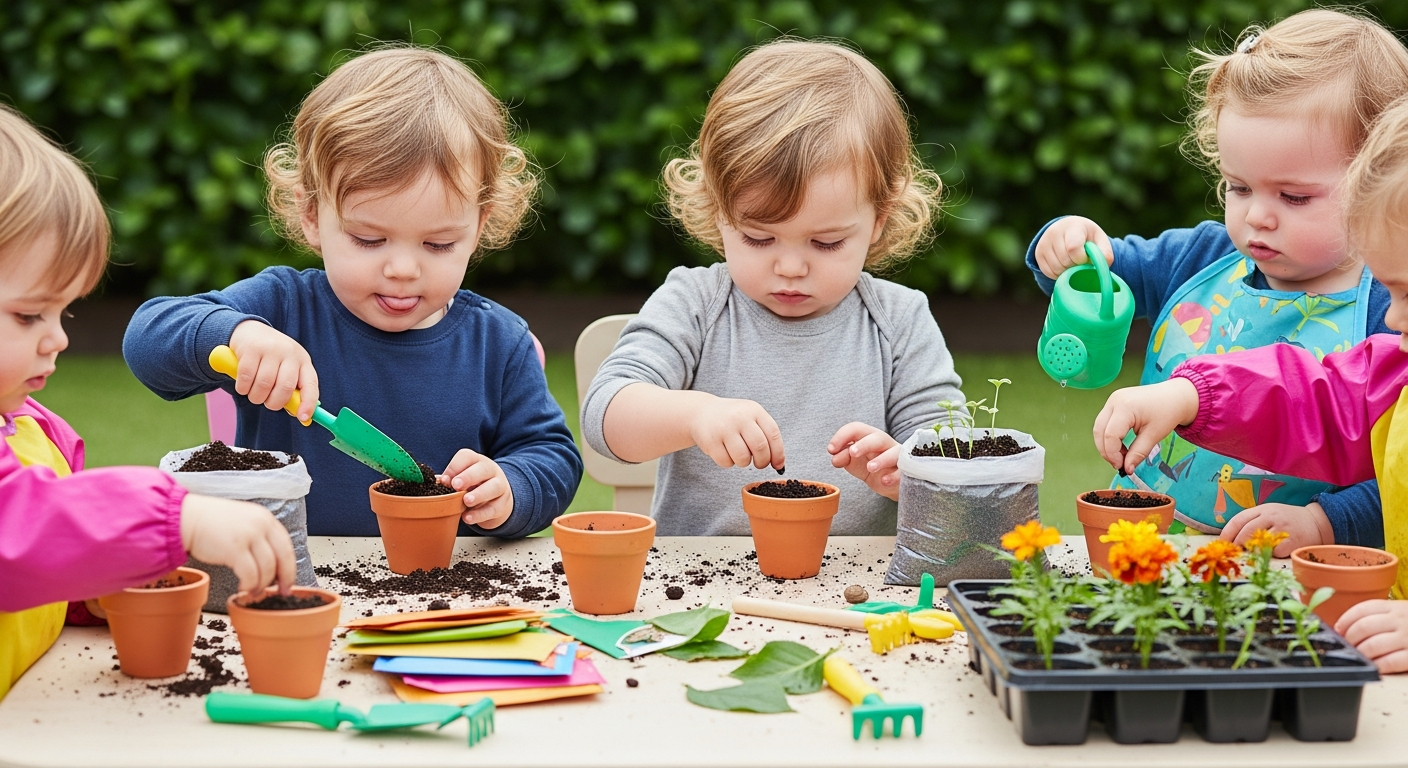
Table of Contents
- Introduction
- Why Gardening is a Powerhouse for Speech Development
- Getting Started: Simple Toddler Planting Activities
- 10 Best Kid-Friendly Plants to Grow
- Creating a Sensory "Mud Kitchen"
- Indoor Gardening for Rainy Days
- Educational Crafts: Beyond the Dirt
- The Science of Play: Why Our Methodology Works
- Choosing the Right Plan for Your Family
- Practical Tips for Stress-Free Gardening
- Building Confidence and Reducing Frustration
- A Powerful Supplement to Therapy
- Conclusion
- FAQ
Introduction
Have you ever noticed how a toddler’s face lights up at the sight of a simple dandelion or the squish of cool mud between their fingers? To a grown-up, a garden might look like a list of chores, but to a child, it is a living, breathing laboratory. There is a profound connection between the tactile world of nature and the way young children develop their first words. In fact, sensory-rich environments like a garden provide the perfect "fertile ground" for language acquisition, as they offer endless opportunities for children to see, touch, smell, and eventually name the world around them.
At Speech Blubs, our mission is to empower children to speak their minds and hearts. Our founders grew up with speech challenges themselves and created the tool they wished they had—a joyful, scientifically-backed experience that turns screen time into "smart screen time." We know that for the 1 in 4 children who need speech support, the best learning happens when play and science intersect. By combining real-world experiences like gardening with our unique video modeling approach, you can foster a love for communication that grows as fast as a sunflower in July.

In this post, we will explore a variety of toddler planting activities designed to boost fine motor skills, expand vocabulary, and create lasting family memories. We’ll cover everything from starting your first indoor herb garden to using nature-themed crafts to build confidence. Our goal is to provide you with practical, realistic ways to support your child’s development while having a whole lot of fun in the dirt.
By the end of this article, you will see how integrating outdoor play with supportive tools can transform your child’s communication journey. Whether you are dealing with a "late talker" or simply want to enrich your child's environment, these activities are designed to create joyful learning moments for the whole family.
Why Gardening is a Powerhouse for Speech Development
Before we dig into the activities, it’s important to understand why gardening is so effective for children working on their speech and language skills. Communication isn't just about the words we say; it's about the sensory experiences that give those words meaning.
Sensory Integration and Vocabulary
When a child pushes a seed into the soil, they aren't just gardening—they are experiencing "hard," "soft," "dry," and "wet." When they water a plant, they see "pouring," "splashing," and "growing." These are functional, high-frequency words that form the backbone of early language. By engaging all five senses, children create stronger neural connections to the words they are learning.
The Role of Video Modeling
At Speech Blubs, we utilize a method called "video modeling." This is based on the scientific principle that children learn best by watching and imitating their peers. If you see a child in the app excitedly pointing at a flower and saying "Bloom!", your toddler is much more likely to try that word themselves when they see a real flower in the backyard. This "smart screen time" acts as a bridge between the digital and physical worlds, reducing frustration and building the confidence needed to try new sounds.

If you're curious about where your child stands in their development, we invite you to take our quick 3-minute preliminary screener. It involves just 9 simple questions and provides a clear assessment and next-steps plan to support your child's unique needs.
Getting Started: Simple Toddler Planting Activities
You don't need a massive backyard or a "green thumb" to start gardening with your toddler. The best activities are often the simplest ones that allow for maximum exploration.
1. The "Cup Garden" Sprout
This is a classic for a reason. All you need is a clear plastic cup, some damp paper towels, and a few large beans (like lima beans or black beans).
- The Activity: Have your toddler help you tuck the beans between the paper towel and the side of the cup.
- The Learning: Because the cup is clear, your child can see the roots grow down and the shoots grow up. This is a fantastic way to practice spatial words like "up," "down," "inside," and "outside."
- Speech Tip: Use the "First Words" section of Speech Blubs to practice the names of the colors you see, like "green" for the sprout and "white" for the roots.
2. Eggshell Planters
Don't throw away those eggshells after breakfast! Rinse them out, and they become the perfect tiny pots for little hands.
- The Activity: Let your toddler use a small spoon to fill the eggshells with soil and drop in a few grass seeds or cress seeds.
- The Learning: This requires significant fine motor control. Balancing the eggshell and using a spoon helps develop the same muscles used for self-feeding and eventually writing.
- Speech Tip: Practice the "sh" sound in "shell" or the "g" sound in "grass."
3. Kitchen Scrap Gardening
This is a wonderful way to show children that "trash" can turn into "treasure."
- The Activity: Take the bottom of a head of celery or the top of a carrot and place it in a shallow dish of water.
- The Learning: Within days, new green leaves will begin to sprout. It's almost like magic for a two-year-old!
- Practical Scenario: For a parent whose 3-year-old is a "late talker" and gets frustrated when they can't explain what they want, this activity provides a slow-paced, low-pressure environment to practice simple "look!" and "see!" commands.
10 Best Kid-Friendly Plants to Grow
When choosing plants for toddler planting activities, you want varieties that are "forgiving," fast-growing, and—most importantly—safe if a curious mouth decides to take a nibble.
- Sunflowers: They grow taller than the child, which is incredibly motivating and exciting to track.
- Cherry Tomatoes: These are like nature's candy. Picking a "red" tomato directly from the vine is a high-reward activity.
- Sugar Snap Peas: They have large seeds that are easy for tiny fingers to handle, and they taste delicious raw.
- Mint: The scent of mint is very strong and provides an immediate sensory "pop."
- Lamb’s Ear: This plant has fuzzy, soft leaves that feel like a literal lamb’s ear—perfect for tactile learners.
- Carrots: Digging a carrot out of the ground feels like finding buried treasure.
- Zucchini: These grow remarkably fast and can reach giant sizes, which is hilarious to a toddler.
- Marigolds: Bright colors and very sturdy stems make these great for "clumsy" watering.
- Pumpkins: Watching a tiny seed turn into a massive orange globe over several months teaches patience and the passage of time.
- Radishes: These are some of the fastest-growing vegetables, often ready to harvest in just 25 days!
Key Takeaway: The goal of gardening with toddlers isn't a high yield of produce; it's the joy of the process. Focus on plants that offer immediate sensory feedback through smell, touch, or bright colors.
Creating a Sensory "Mud Kitchen"
Sometimes the best toddler planting activity doesn't involve actual seeds at all—it involves the medium of the garden. A mud kitchen is a dedicated outdoor space where children can "cook" with dirt, water, and natural finders like petals and stones.
Building Communication through Play
In a mud kitchen, you can model complex language naturally. "Can you stir the mud soup?" "Is it too thick?" "Should we add more water?" This type of adult co-play is essential. At Speech Blubs, we always frame our activities with the understanding that you are your child's first and best teacher. Our app is a powerful tool, but the magic happens when you use it together.
To see how other families have used our tools to spark this kind of creative communication, you can read our parent testimonials. Seeing the success of others can be a great motivator when you're just starting your own journey.
Indoor Gardening for Rainy Days
We can't always get outside, but that shouldn't stop the learning. Indoor toddler planting activities are perfect for apartment living or winter months.
The Windowsill Herb Garden
Herbs like basil, parsley, and chives grow perfectly in small pots on a sunny windowsill.
- The Activity: Let your child be the "Official Waterer." Use a small spray bottle, which is excellent for strengthening the muscles in the hand.
- The Language Connection: Herbs offer a "vocabulary of scent." You can teach words like "spicy," "sweet," and "fresh."
- Speech Blubs Integration: While you're working on your indoor garden, you can use the "Yummy Time" section in the app to learn about the different foods these herbs go into. This helps your child make the connection between the plant in the pot and the food on their plate.
Educational Crafts: Beyond the Dirt
Gardening doesn't end when the sun goes down. You can extend the theme into art and sorting activities that reinforce what they've learned outdoors.
Vegetable Stamping
Use the ends of bell peppers, celery, or potatoes as "stamps." Dip them in non-toxic paint and press them onto paper.
- Why it works: It turns familiar food into an artistic tool. This reduces "food neophobia" (fear of new foods) and encourages children to talk about the shapes they see. A bell pepper slice looks like a flower!
Seed Sorting
Give your child a variety of large seeds (dried beans, sunflower seeds, pumpkin seeds) and a muffin tin.
- The Activity: Ask them to sort the seeds by color or size.
- The Learning: This is an early math skill called "categorization." It’s also a great time to practice "more" and "less."
The Science of Play: Why Our Methodology Works
At Speech Blubs, we don't just pick activities because they are "cute." Everything we do is rooted in scientific principles. Our methodology is built on the idea of mirror neurons—the brain cells that fire both when we perform an action and when we see someone else perform that same action.
When your child watches a peer in our app successfully make a "b" sound or name a "flower," their brain is essentially practicing that action. This makes the transition to the physical garden much smoother. Our approach has earned us a high rating on the MARS (Mobile App Rating Scale) and is trusted by parents worldwide. You can dive deeper into the science and research behind our method on our website.
Choosing the Right Plan for Your Family
We want to make sure every family has access to these powerful learning tools. We offer two main ways to join the Speech Blubs family:
- The Monthly Plan: At $14.99 per month, this is a great way to test the waters and see how your child responds to our video modeling methodology.
- The Yearly Plan: This is our most popular option and the clear best value at $59.99 per year (which breaks down to only $4.99 per month).
When you choose the Yearly plan, you aren't just saving 66% compared to the monthly rate. You also unlock exclusive, high-value features that are not available in the monthly version:
- A 7-day free trial to explore everything we have to offer at no risk.
- The Reading Blubs app, which helps transition those early speech wins into literacy skills.
- Early access to all new updates and content releases.
- 24-hour support response time from our dedicated team.
We encourage you to sign up and create your account today to take advantage of the Yearly plan’s full suite of features.
Practical Tips for Stress-Free Gardening
Gardening with a toddler can be messy, and that's okay! Here are a few ways to keep the experience positive for both of you:
- Set Realistic Expectations: Your child might only be interested in the dirt for five minutes before they want to go chase a butterfly. That’s perfectly fine! Follow their lead. The goal is to create joyful family learning moments, not to finish a project.
- Adult Co-Play is Key: Don't just set them in the dirt; get down there with them. Your narration of what they are doing ("Oh, you found a wiggly worm!") is what builds their vocabulary.
- Safety First: Always supervise your child to ensure they don't ingest soil, fertilizers, or non-edible plants. Use child-safe, blunt-tipped tools.
- Focus on the Process: If the seeds don't sprout, use it as a teaching moment. "Sometimes plants need more sleep/water/sun." This builds emotional resilience and reduces frustration when things don't go perfectly.
Building Confidence and Reducing Frustration
One of the biggest hurdles for children with speech delays is the frustration of not being understood. This can lead to tantrums or withdrawal. Toddler planting activities provide a "success-oriented" environment.
When a toddler successfully plants a seed, they feel a sense of agency. When they use a word to describe that seed and you respond with excitement, that positive reinforcement is incredibly powerful. We want to foster a love for communication that isn't tied to "getting it right" every time, but rather to the joy of connecting with you.
If you are ready to see your child blossom, download Speech Blubs on the App Store or Google Play to begin your journey.
A Powerful Supplement to Therapy
While Speech Blubs is a robust tool, we always recommend using it as a supplement to overall development and, when applicable, professional speech therapy. Think of us as the "daily exercise" that keeps the muscles of communication strong between therapy sessions.
Our app provides a screen-free alternative to passive viewing. Unlike cartoons, where a child just watches images flash by, Speech Blubs requires active participation. It is "smart screen time" that encourages the child to look away from the screen and interact with you and their environment.
Conclusion
Gardening with your toddler is about so much more than just plants. It is about nurturing the foundational skills of communication—curiosity, imitation, sensory awareness, and confidence. Whether you are planting giant sunflowers or simply sorting seeds in a muffin tin, you are providing your child with the building blocks they need to eventually "speak their minds and hearts."
We have seen firsthand how the combination of real-world toddler planting activities and our unique video modeling methodology can change lives. We invite you to join our community of over 5 million parents who are dedicated to making learning a joyful, everyday experience.
Ready to get started? We recommend the Yearly plan as your best path forward. For just $59.99 a year, you'll get the full Speech Blubs experience, the bonus Reading Blubs app, and a 7-day free trial to see the benefits for yourself. Don’t wait to start building those joyful learning moments.
Download Speech Blubs today and let's get growing together!
FAQ
1. What are the best toddler planting activities for children who don't have a backyard?
You don't need a yard to garden! Windowsill herb gardens, eggshell planters, and "cup gardens" are all fantastic indoor options. You can also create a "sensory bin" filled with dried beans or rice to simulate the digging experience of a garden without the mud.
2. At what age can I start gardening with my child?
You can start as early as 12 to 18 months! While younger toddlers won't be able to handle complex planting, they can certainly enjoy the sensory aspects like touching soft leaves, smelling herbs, and feeling the texture of soil. Always ensure they are closely supervised to prevent them from putting non-edible items in their mouths.
3. How does gardening specifically help with speech delays?
Gardening is a high-sensory activity that provides clear, functional "labels" for the world. Words like "dig," "wet," "green," and "flower" are easier to learn when a child is physically interacting with those objects. Furthermore, gardening with a parent encourages "joint attention," a crucial precursor to verbal communication.
4. Is the Speech Blubs app safe for toddlers?
Yes! Speech Blubs is designed to be "smart screen time." It is an interactive experience that encourages children to vocalize and interact with their environment rather than passively watching a screen. Our content is created by experts and designed to be joyful, effective, and safe for young learners.
About the author