
15 Fun Toddler Easter Activity Ideas for Speech and Play
 By Speech Blubs Team•Feb 23, 2026•16 min.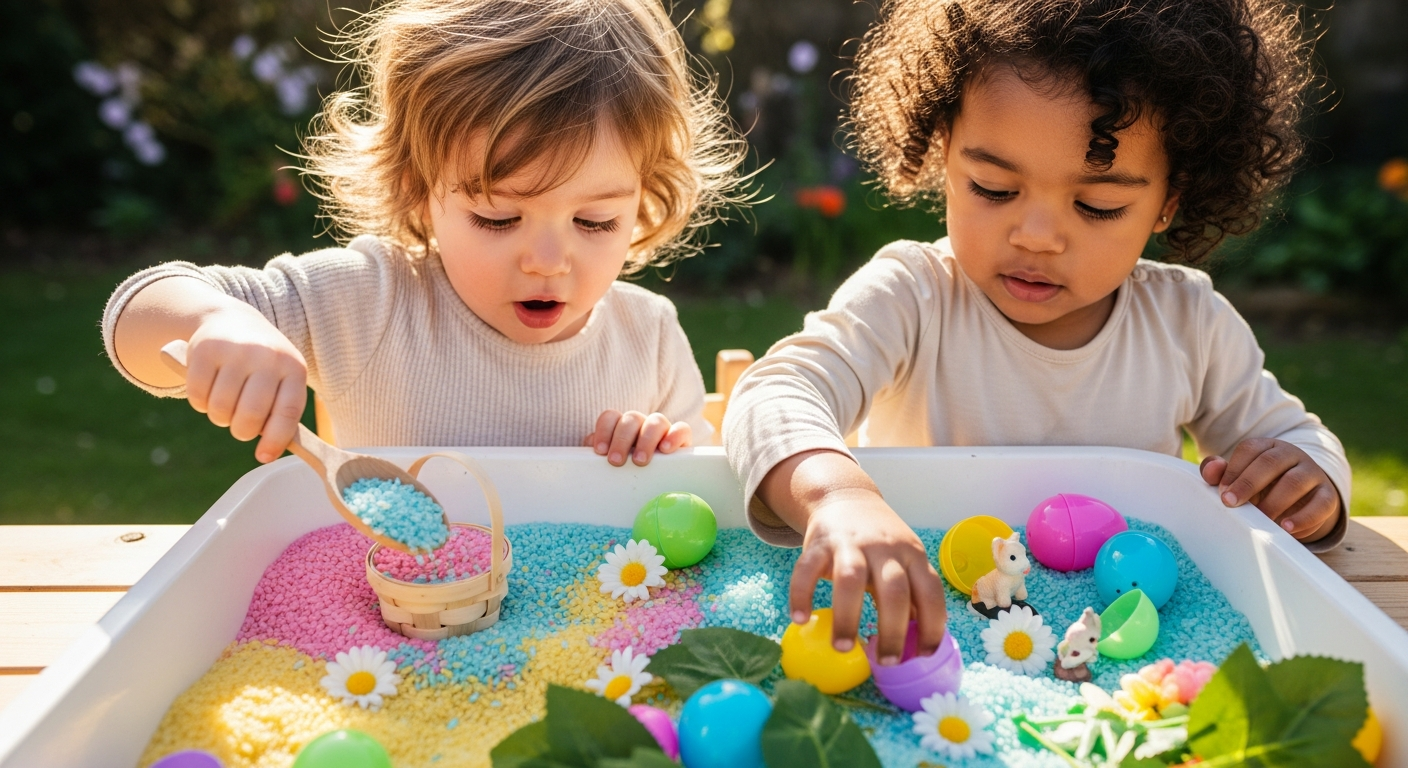
Table of Contents
- Introduction
- The Power of Thematic Play in Early Development
- 1. The Giant Easter Sensory Bin
- 2. Easter Egg Snack Hunt
- 3. Dot Sticker Egg Decorating
- 4. The "Bunny Hop" Gross Motor Game
- 5. Shaving Cream Egg Play
- 6. Video Modeling with Speech Blubs
- 7. Bunny Pom-Pom Drop
- 8. Sticky Wall Egg Hunt
- 9. Easter Color Sort
- 10. Q-Tip Painting Eggs
- 11. Easter Storytime
- 12. Egg on a Spoon Balance Walk
- 13. Spring Chick Craft with Feathers
- 14. Easter "Mystery" Sound Eggs
- 15. The "Feed the Bunny" Color Game
- Why Smart Screen Time Matters This Holiday
- Choosing the Right Support for Your Child
- Conclusion
- Frequently Asked Questions
Introduction
Have you ever watched the sheer, unadulterated joy on a toddler’s face when they spot a bright neon plastic egg peeking out from behind a flowerpot? To a two-year-old, a simple plastic egg isn't just a container; it’s a treasure, a mystery, and a gateway to a world of wonder. At Speech Blubs, we believe that these moments of holiday magic are the perfect "windows of opportunity" for learning. Easter isn't just about chocolate bunnies and Sunday brunch; it is a vibrant, multi-sensory season that provides endless opportunities to boost your child’s communication, motor skills, and confidence.
Our mission is to empower children to speak their minds and hearts, and we know that the best learning happens when children are having so much fun they don’t even realize they are working on their milestones. We were founded by a team who grew up with speech challenges themselves, and we created the tool we wished we had: one that turns "screen time" into "smart time" through the power of play.

In this post, we will explore a wide variety of toddler Easter activity ideas that go far beyond the traditional egg hunt. We’ll look at sensory bins that spark descriptive language, crafts that build fine motor strength, and ways to integrate "smart screen time" to help your little one find their voice. Whether you are looking for a way to reduce holiday-related frustration or simply want to create joyful family memories, these activities are designed to foster a love for communication and keep those little hands and minds busy.
The Power of Thematic Play in Early Development
Why do we get so excited about holiday-themed activities? It’s because thematic play provides a "hook" for a child’s memory. When a toddler sees bunnies, eggs, and chicks everywhere—from the grocery store to their favorite books—their brain begins to form connections. This repetition is the bedrock of language acquisition.
When we engage in a toddler Easter activity, we are providing a context for new vocabulary. Words like "hop," "crack," "hide," and "find" become much more than just sounds; they become actions tied to an emotional experience. This is exactly why our methodology at Speech Blubs relies on video modeling. We show children their peers performing these actions and making these sounds because children learn best by watching and imitating other kids.
If you're curious about where your child stands in their communication journey before diving into these activities, you can take our quick 3-minute preliminary screener. It involves just 9 simple questions and provides an assessment and a next-steps plan to help you support your child's growth.
1. The Giant Easter Sensory Bin
Sensory bins are a staple in speech therapy for a reason. They provide a low-pressure environment where children can explore textures while parents narrate the experience.
How to set it up:
Fill a large plastic tub with "Easter grass" (the crinkly paper kind is safer than the plastic fringe), dried green split peas, or even dyed rice. Hide plastic eggs, small toy bunnies, and plastic carrots inside.

The Speech Connection:
As your toddler digs through the bin, use descriptive "mapping." If they pull out a blue egg, say, "Oh! You found a blue egg. It’s smooth." This builds their internal dictionary. For a child who is just starting to use word combinations, you can practice "In the bin" or "Open egg."
For a parent whose 3-year-old "late talker" loves animals, this sensory bin can be a great bridge to our app. After finding a toy chick in the bin, you can open the "Animal Kingdom" section in Speech Blubs to watch a peer make the "cheep cheep" sound. This reinforces the connection between the physical toy and the spoken word.
2. Easter Egg Snack Hunt
Who says egg hunts are only for Sunday morning? A "snack hunt" is a fantastic way to motivate a toddler to move and communicate.
How to set it up:
Instead of candy, fill plastic eggs with toddler-friendly snacks like goldfish crackers, blueberries, or cereal. Hide them in plain sight around the living room.
The Speech Connection:
This activity is perfect for practicing "Where?" questions. "Where is the egg? Is it under the chair?" It also encourages the use of "manding" (requesting). If your child can’t open the egg themselves, it creates a "communication temptation." They have to come to you and indicate they need "help" or say "open" to get the prize inside.
3. Dot Sticker Egg Decorating
Traditional egg dyeing can be... messy. For younger toddlers, dot stickers offer a frustration-free way to be creative while building the "pincer grasp" needed for future writing.
How to set it up:
Cut out large egg shapes from construction paper. Give your toddler a sheet of colorful dot stickers and let them decorate.
The Speech Connection:
Focus on color identification. Ask, "Can you find a yellow dot?" or "Where should the red dot go?" This simple toddler Easter activity helps with following one-step directions, a key cognitive milestone.
4. The "Bunny Hop" Gross Motor Game
Movement and language are deeply linked. When children move their bodies, it actually helps stimulate the parts of the brain responsible for speech.
How to set it up:
Use painter's tape to create "lily pads" or "bunny burrows" on the floor. Tell your child they are a little bunny and they need to "hop" from one to the next.
The Speech Connection:
Use repetitive, rhythmic language. "Hop, hop, hop!" or "Ready, set... jump!" This helps children understand the prosody (rhythm) of speech. If they fall or miss, it’s a great time to model "uh-oh" or "try again," reducing the frustration that often comes with learning new physical skills.
5. Shaving Cream Egg Play
If you aren't afraid of a little mess, this is a high-engagement activity that toddlers absolutely love.
How to set it up:
Spray a layer of shaving cream onto a tray or inside a plastic bin. Throw in some plastic eggs. Encourage your child to "hide" the eggs under the "snow" (shaving cream) and find them again.
The Speech Connection:
This is a "target-rich" environment for verbs. Use words like "squish," "hide," "wash," and "wipe." The tactile feedback of the shaving cream helps solidify the meaning of these words in the child's mind.
6. Video Modeling with Speech Blubs
At Speech Blubs, we provide a screen-free alternative to passive viewing. Instead of your child zoning out to a cartoon, they are actively participating with a "digital playmate."
How it works:
Our app uses a scientific methodology called video modeling. When your child sees another child on the screen making a "b" sound for "bunny," their mirror neurons fire. This makes them much more likely to attempt the sound themselves. We recommend using the app as a "smart screen time" tool where you sit with your child and mirror the sounds together.
To see how this has worked for thousands of other families, you can read our testimonials and success stories. It’s not about overnight miracles; it’s about building confidence and making the process of learning to speak a joyful one.
7. Bunny Pom-Pom Drop
This activity is excellent for hand-eye coordination and can keep a toddler occupied for a surprisingly long time.
How to set it up:
Take an empty plastic bottle or a cardboard box with a small hole cut in it. Decorate it to look like a bunny (add paper ears and a face). Give your child a bowl of colorful pom-poms and tell them to "feed the bunny."
The Speech Connection:
This is great for practicing "More" and "All gone." Every time the bunny eats a pom-pom, you can say, "Num num num!" This type of symbolic play is a precursor to more complex language skills.
8. Sticky Wall Egg Hunt
This is a favorite among parents because it keeps the "mess" contained to the wall and encourages toddlers to stand and stretch, which is great for core strength.
How to set it up:
Tape a piece of contact paper (sticky side out) to a wall or window. Cut out paper eggs or use lightweight plastic egg halves. Hide them around the room and have your child find them and "stick" them to the wall.
The Speech Connection:
Model spatial concepts like "up high" and "down low." As your child reaches up to stick an egg, say, "You’re reaching up!" When they find one behind the sofa, say, "It was behind the couch!"
9. Easter Color Sort
Sorting is a foundational math and logic skill, but it’s also a great way to practice specific vocabulary.
How to set it up:
Use colored construction paper or bowls that match the colors of your plastic eggs. Have your child sort the eggs into the matching colored "home."
The Speech Connection:
Consistency is key here. Focus on one or two colors if your child is younger. "The blue egg goes in the blue bowl." If they make a mistake, don’t say "No," simply model the correct way: "Oh, this one is green! Let’s find the green bowl."
10. Q-Tip Painting Eggs
For toddlers who are still developing their fine motor control, a paintbrush can be overwhelming. A Q-tip is the perfect size for their small hands.
How to set it up:
Draw an egg outline on paper. Provide small dots of paint and Q-tips. Let them "dot" the egg to create patterns.
The Speech Connection:
This is a quiet, focused activity that allows for "parallel talk." You can describe what your child is doing as they do it: "You are making a blue dot. Dot, dot, dot." This provides a continuous stream of language without requiring the child to respond, which can be very helpful for children who feel pressured by direct questions.
11. Easter Storytime
Never underestimate the power of a good book. Reading together is one of the best ways to foster a love for communication and create family connection.
Recommended Titles:
- Llama Llama Easter Egg by Anna Dewdney
- How to Catch the Easter Bunny by Adam Wallace
- The Itsy Bitsy Bunny by Jeffrey Burton
The Speech Connection:
Don’t just read the words on the page. Point to the pictures and ask, "What is the bunny doing?" or "Where is the chick?" If your child is non-verbal, you can ask them to "Point to the egg." This builds receptive language (understanding) which always comes before expressive language (speaking).
12. Egg on a Spoon Balance Walk
This is a classic for a reason! It’s a fun way to work on balance and gross motor planning.
How to set it up:
Give your child a large wooden spoon and place a plastic egg on it. Create a "path" on the floor with tape or string and see if they can walk the path without dropping the egg.
The Speech Connection:
This is perfect for practicing "Steady," "Slow," and "Careful." If the egg falls, it’s another chance for a joyful "Uh-oh! Let’s try again!" Building resilience is just as important as building vocabulary.
13. Spring Chick Craft with Feathers
Tactile crafts are wonderful for sensory seekers who need extra input to stay engaged.
How to set it up:
Cut a circle out of yellow paper. Let your child glue yellow feathers all over it. Add googly eyes and an orange triangle for a beak.
The Speech Connection:
Focus on body parts. "Where are the eyes?" "The chick has a beak." You can even practice the "soft" sound of the feathers vs. the "sticky" feel of the glue.
14. Easter "Mystery" Sound Eggs
This activity focuses on auditory discrimination—the ability to hear the differences between sounds.
How to set it up:
Fill several plastic eggs with different items: one with a coin, one with rice, one with a bell, and one with a cotton ball. Shake them and have your child guess what’s inside.
The Speech Connection:
This builds the listening skills necessary for speech. Use words like "Loud," "Quiet," "Shake," and "Listen."
15. The "Feed the Bunny" Color Game
This combines color recognition with a fun physical action.
How to set it up:
Create several "bunnies" out of different colored construction paper (a red bunny, a blue bunny, etc.). Use matching colored pom-poms or paper scraps as "food."
The Speech Connection:
"The red bunny is hungry! Can you find red food?" This encourages the child to process multiple pieces of information at once (color + action).
Why Smart Screen Time Matters This Holiday
During the holidays, schedules often get hectic. Between travel, cooking, and hosting family, it’s tempting to hand a toddler a tablet just to get a few minutes of peace. We understand that reality—our founders lived it! That’s why we designed Speech Blubs to be a "powerful tool for family connection" rather than a passive distraction.
When you use Speech Blubs, you aren't just giving your child a toy; you're giving them a science-backed learning platform. Our app is rated highly on the MARS scale for its educational value and engagement. You can learn more about the research behind our method, including how we use mirror neurons to trigger speech.
"At Speech Blubs, we believe every child deserves to find their voice. Our app is a supplement to your child's overall development plan, helping to bridge the gap between 'not yet' and 'I did it!'"
Choosing the Right Support for Your Child
We know that every child’s path is unique. Some children are "late talkers" who just need a little extra nudge, while others may benefit from professional therapy alongside home activities. Our goal is to provide an immediate, effective, and joyful solution for the 1 in 4 children who need speech support.
If you are ready to make this Easter a turning point for your child’s communication, we invite you to join the Speech Blubs family. We offer two main plans to fit your needs:
- Monthly Plan: $14.99 per month. This is a great way to test the waters and see how your child responds to our peer-led video modeling.
- Yearly Plan (Best Value): $59.99 per year. This breaks down to just $4.99 per month, a savings of 66% compared to the monthly plan.
Why the Yearly Plan is the clear winner for parents: The Yearly plan isn't just about the price. It includes exclusive, high-value features that help you stay consistent with your child's learning:
- A 7-day free trial so you can explore everything risk-free.
- The Reading Blubs app included for free, helping your child transition from speech to early literacy.
- Early access to new updates and a 24-hour support response time.
- Long-term progress: Speech development is a marathon, not a sprint. A yearly commitment ensures you have the tools you need through every holiday and milestone.
The Monthly plan does not include the free trial, the Reading Blubs app, or the priority support. We highly recommend choosing the Yearly plan to get the full suite of features and the best possible start for your little one.
Conclusion
Easter is a season of new beginnings, making it the perfect time to focus on your child’s growing "minds and hearts." Whether you’re hiding eggs in a sensory bin, hopping like a bunny across the living room, or engaging in "smart screen time" with Speech Blubs, every activity is a step toward building a more confident, communicative child.
Remember, the goal isn't perfection. Your child might not be giving public speeches in a month, and that’s okay! The goal is to foster a love for communication, reduce frustration, and create those joyful family learning moments that you’ll cherish long after the last chocolate egg is gone.
Ready to see your child's face light up as they learn to mimic their peers? Download Speech Blubs on the Apple App Store or get it on Google Play today. You can also create your account on our website to begin your journey.
Don’t forget to select the Yearly plan during sign-up to unlock your 7-day free trial and the full Reading Blubs experience. Let’s make this Easter a holiday of words, wonders, and wins!
Frequently Asked Questions
What is the best toddler Easter activity for a child with a speech delay?
Sensory bins and "communication temptations" (like putting a snack inside an egg they can't open yet) are excellent. These activities encourage the child to use functional language like "help," "open," or "more" in a natural, low-stress environment.
Is Speech Blubs considered "bad" screen time?
No! We distinguish between "passive viewing" (like watching cartoons) and "smart screen time." Speech Blubs is an interactive tool that uses video modeling to encourage your child to speak, imitate, and engage with the world around them. It is designed to be used with an adult to foster connection.
How do I know if my child needs extra speech support?
While every child develops at their own pace, a general rule is that by age 2, a child should have about 50 words and be starting to put two words together. If you are concerned, you can take our 3-minute preliminary screener for an initial assessment and guidance on next steps.
How long should we play with the app each day?
We recommend short, frequent sessions—about 10 to 15 minutes a day. This keeps the experience fun and fresh without overwhelming your toddler. The key is consistency and pairing the app with real-world activities, like the Easter ideas mentioned above!
About the author