
15 Simple and Creative Toddler Valentine's Crafts
 By Speech Blubs Team•Feb 23, 2026•18 min.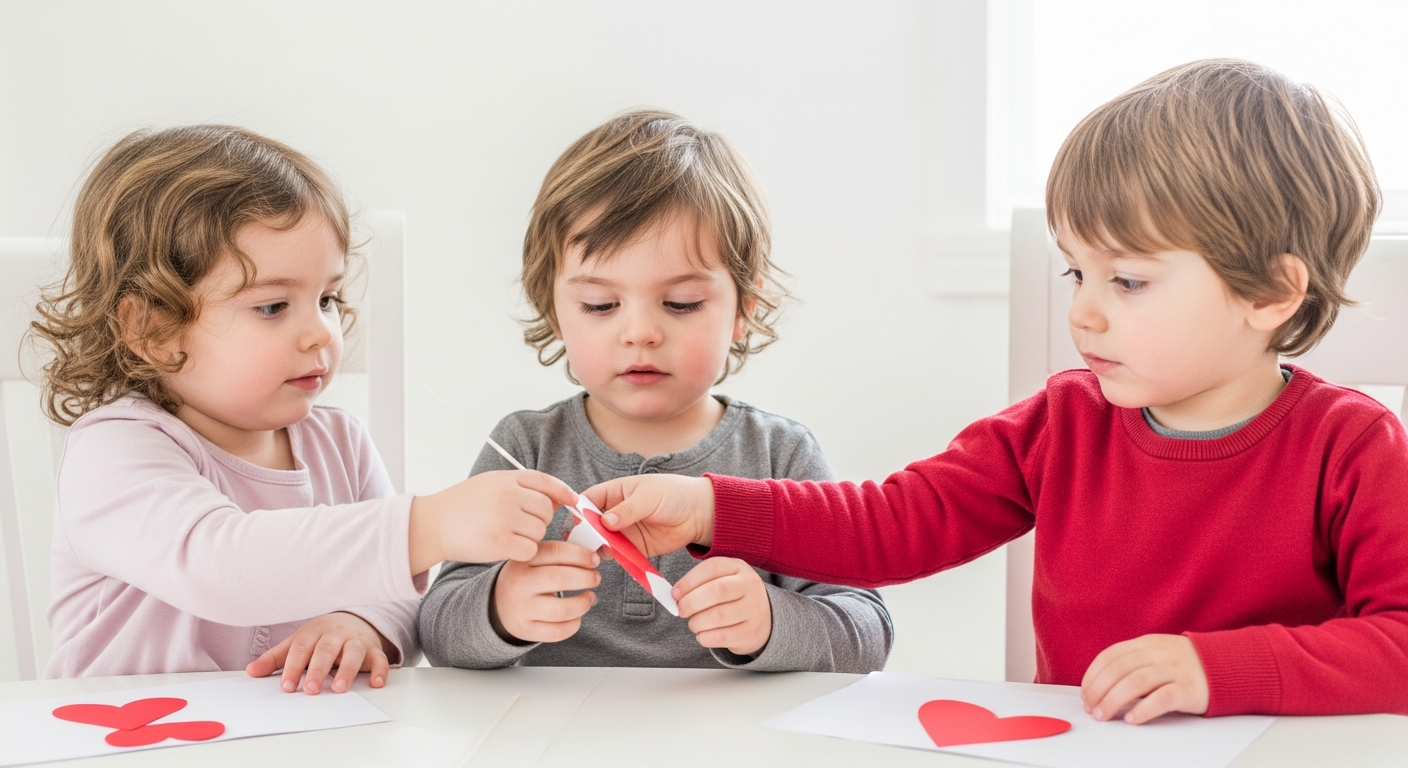
Table of Contents
- Introduction
- The Connection Between Crafting and Communication
- 1. Cotton Ball Heart Painting
- 2. Heart Tear Art
- 3. The Ultimate Valentine’s Sensory Bin
- 4. Mess-Free Heart Painting
- 5. Valentine’s Stamp Table
- 6. Tissue Paper Hearts
- 7. Microwave Heart Crayons
- 8. Homemade Pink and Purple Playdough
- 9. Pluffle Sensory Tray
- 10. Heart Fruit Snack Building
- 11. Fingerprint Love Bugs
- 12. Valentine’s Day Card Station
- 13. Heart Pipe Cleaner Bracelets and Wands
- 14. Paper Plate Heart Crowns
- 15. The "I Love" Collage
- Why "Smart Screen Time" Matters
- Understanding Our Methodology: Video Modeling
- Making the Most of the Yearly Plan
- Realistic Expectations for Your Child's Progress
- Tips for a Stress-Free Crafting Session
- Summary of Key Takeaways
- FAQs
- Start Your Journey Today
Introduction
Have you ever looked at a simple sheet of red construction paper and seen a world of possibilities, only to realize your toddler sees it primarily as a potential snack? We have all been there. The transition into the toddler years is a whirlwind of messy hands, emerging personalities, and the exciting, sometimes challenging, journey of language development. As February approaches, the air fills with talk of love and friendship, providing the perfect backdrop for one of the most effective tools in a parent's toolkit: crafting.

At Speech Blubs, we believe that every moment is an opportunity for connection. Our mission is to empower children to "speak their minds and hearts," and there is no better way to do that than through shared, joyful activities. This blog post is designed to provide you with a comprehensive list of toddler Valentine's crafts that are not only fun and easy to set up but are intentionally designed to foster communication, build fine motor skills, and create lasting family memories.
We will explore a variety of activities—from sensory bins to mess-free painting—while explaining the science behind why these activities work. We will also show you how to pair these physical crafts with our unique "smart screen time" approach. By the end of this guide, you will have a full itinerary of "Love Day" activities and a deeper understanding of how to support your child's speech journey through the power of play.
The Connection Between Crafting and Communication
When we think of "toddler Valentine's crafts," we often focus on the end product—the cute card for Grandma or the heart-shaped ornament for the tree. However, for a child’s developing brain, the process is where the real magic happens. Crafting is a multi-sensory experience that naturally encourages language. When a child dips a cotton ball into red paint, they aren't just making a mark; they are experiencing the concepts of "soft," "wet," "red," and "dab."
At Speech Blubs, we use a scientific methodology known as video modeling. This is where children learn by watching and imitating their peers. You can apply a similar principle during craft time. By sitting with your child and narrating your own actions—"I am squeezing the glue," or "Look, I made a big heart"—you are providing a linguistic map for them to follow. This "co-play" is essential. It moves the activity from a solo task to a shared communicative event.
Our company was born from the personal experiences of our founders, who all grew up with speech problems. They created the tool they wished they had: something that blends scientific principles with play. Whether you are using our app or glueing tissue paper, the goal is the same: reducing frustration and building the confidence your child needs to express themselves.

1. Cotton Ball Heart Painting
This is a fantastic activity for toddlers who are still refining their grip. Instead of a thin paintbrush, which can be frustrating for small hands, cotton balls provide a large, tactile surface area.
Materials Needed:
- Cotton balls
- Clothespins (to act as "handles")
- Red, pink, and white washable paint
- Cardstock or heavy paper cut into heart shapes
How to Play:
Clip a clothespin onto a cotton ball. Show your child how to dip it into the paint and "stamp" it onto the paper. As they work, focus on action words. "Dip, dip, dip!" and "Pop!" are great sounds to practice. This activity is almost impossible to mess up, making it a high-success task that builds a child's confidence in their creative abilities.
2. Heart Tear Art
If you are looking for a zero-prep activity that keeps little hands busy, heart tear art is the answer. It is also an excellent workout for the small muscles in the hands, which are necessary for eventual writing and self-feeding.
How to Play:
Give your child scraps of red, pink, and purple construction paper. Encourage them to rip the paper into small pieces. For many toddlers, the sound of tearing paper is endlessly entertaining. Once you have a pile of "confetti," help them glue the pieces onto a large heart outline.
For parents who are uncertain if their child is hitting their developmental milestones during these activities, we recommend taking our quick 3-minute preliminary screener. It involves 9 simple questions and provides an assessment and next-steps plan to help you support your child's specific needs.
3. The Ultimate Valentine’s Sensory Bin
Sensory play is a cornerstone of early childhood education because it engages multiple senses simultaneously, creating stronger neural pathways. To create a Valentine’s themed bin, you can use colorful rice.
Making Colorful Rice:
- Pour 1 cup of white rice into a Ziploc bag.
- Add a few drops of food coloring and a tablespoon of vinegar.
- Shake and squish the bag until the rice is coated.
- Spread it on a tray to dry for about an hour.
Practical Scenario:
For a parent whose 3-year-old "late talker" loves animals, the "Animal Kingdom" section of the Speech Blubs app offers a fun, motivating way to practice "moo" and "baa" sounds. You can bring this to life by hiding toy animals in your red and pink sensory rice. Ask your child, "Where is the cow?" When they find it, you can practice the animal sound together, mirroring the peer-led videos they see in the app. You can download Speech Blubs on the Google Play Store to find the perfect animal prompts for your sensory play.
4. Mess-Free Heart Painting
We know that "toddler" and "mess" usually go hand-in-hand, but sometimes you need a low-stress activity while you're making dinner or taking a breath.
How to Play:
Squirt a few drops of red and white paint into a gallon-sized freezer bag. Drop in a paper heart, seal the bag tightly (you can even tape it to the table), and let your child squish the paint around from the outside. They get the sensory input of the squishy paint and the visual excitement of seeing colors mix to create pink, all without a single drop of paint touching your carpet.
This is a great time to talk about "mixing." "Look, red and white make pink!" This kind of descriptive language expands their vocabulary beyond simple nouns.
5. Valentine’s Stamp Table
This is an easy way to practice letter and shape recognition. Tape a large piece of butcher paper or the back of wrapping paper to a low table. Draw various hearts and the letters "L-O-V-E" in large outlines.
Give your child heart-shaped stamps (or even a potato cut into a heart shape) and let them "trace" the lines with stamps. This helps with hand-eye coordination and introduces them to the shapes of the alphabet in a pressure-free way.
6. Tissue Paper Hearts
Tissue paper hearts are vibrant and look beautiful when taped to a sunny window.
How to Play:
Cut a heart shape out of contact paper (sticky paper) and tape it to the table, sticky side up. Give your child small squares of tissue paper to stick onto the heart. Because the paper is sticky, they don't have to struggle with glue sticks, which can sometimes be difficult for younger toddlers to navigate.
As they work, you can use our "smart screen time" app to show them videos of other children saying the names of the colors they are using. Our method is backed by science, placing us in the top tier of speech apps worldwide with a high rating on the MARS scale.
7. Microwave Heart Crayons
Do you have a drawer full of broken crayon bits? This craft is a lesson in recycling and color experimentation.
How to Play:
Have your child help you peel the paper off old crayons and break them into small pieces. Place the pieces into heart-shaped silicone molds. Microwave them in 30-second intervals until melted. Once they cool and harden, you have brand-new, multi-colored heart crayons!
This activity involves several steps, which is great for practicing "first/then" sequencing. "First, we peel the crayon. Then, we put it in the mold." Understanding sequences is a vital foundational skill for complex communication.
8. Homemade Pink and Purple Playdough
Playdough is the ultimate "open-ended" toy. It can be anything your child imagines.
Simple Recipe:
- 2 cups all-purpose flour
- 3/4 cup salt
- 4 teaspoons cream of tartar
- 2 cups lukewarm water
- 2 tablespoons vegetable oil
- Food coloring
Stir the ingredients over medium heat until the dough thickens and forms a ball. Once cool, knead in the food coloring. Provide your child with heart-shaped cookie cutters and rollers.
Working with playdough is very therapeutic and can help reduce frustration in children who are struggling to communicate their needs. It gives them a physical outlet for their energy while they practice words like "squish," "roll," and "cut."
9. Pluffle Sensory Tray
If you haven't discovered Playfoam Pluffle yet, it is a mesmerizing, "living" foam that never dries out. For Valentine’s Day, mix pink and purple Pluffle in a tray. Add some spoons, small bowls, and perhaps some plastic heart gems.
The unique texture of Pluffle is great for children who might be sensory-averse. It's a gentle way to introduce new tactile sensations. If you want to see how other families have used sensory play and our app to overcome speech delays, you can read our parent testimonials.
10. Heart Fruit Snack Building
Who says you can't play with your food? Using heart-shaped fruit snacks (or pieces of strawberry and melon) and toothpicks (with supervision), you can build 3D structures.
How to Play:
Show your child how to poke the toothpick into the fruit to connect pieces. This is a "heavy work" activity for the fingers and requires a lot of focus. As you build, talk about the structures. "Is it tall?" "Is it a house?" This combines snack time with a STEM lesson and a speech lesson all in one.
11. Fingerprint Love Bugs
This is a classic "keepsake" craft. Have your child dip their thumb in paint and press it onto a piece of paper twice to form a heart shape. Once dry, you can draw little antennae and legs to turn the hearts into "love bugs."
This is a wonderful way to teach body parts. "Where is your thumb?" "Let's put your fingerprint here." You can find more interactive ways to teach body parts and basic concepts by visiting the Speech Blubs homepage.
12. Valentine’s Day Card Station
Setting up a dedicated "station" for card making gives your child a sense of autonomy. Provide stickers, markers, pre-cut hearts, and envelopes.
The Role of Imitation:
Toddlers love to do what adults do. If you sit down and write a card, they will want to "write" one too. This imitation is the heart of our "video modeling" methodology. When a child sees another child in the Speech Blubs app making a funny face or saying a word, they are much more likely to try it themselves than if an adult simply tells them to do it.
13. Heart Pipe Cleaner Bracelets and Wands
Threading is a major developmental milestone. Using stiff pipe cleaners and large plastic beads, your toddler can make Valentine’s jewelry or "magic wands."
How to Play:
Shape a pipe cleaner into a heart at the top of a "wand." Let your child thread red and white beads onto the bottom. This requires intense hand-eye coordination. You can narrate the colors: "Red bead, white bead, red bead." This helps with pattern recognition, which is a precursor to math and reading skills.
14. Paper Plate Heart Crowns
Every toddler deserves to be royalty for a day.
How to Play:
Fold a paper plate in half and cut a heart shape out of the center, leaving the bottom of the heart attached to the rim of the plate. When you unfold it and push the heart up, it becomes a crown. Your child can then decorate the rim and the heart with markers and stickers.
Encourage "pretend play" once the crown is on. "What does the King of Hearts say?" This type of imaginative play is where toddlers begin to use language in more complex, social ways.
15. The "I Love" Collage
This activity focuses on the emotional side of Valentine’s Day. Cut out pictures from magazines or print photos of things your child loves: Grandma, the dog, apples, or their favorite toy.
How to Play:
Help your child glue these images onto a large poster board. This is a perfect opportunity for "receptive language" practice. "Can you find the picture of the dog?" When they point to it, celebrate their success! "Yes! You found the dog! The dog says woof!"
Why "Smart Screen Time" Matters
We know that parents are often worried about screen time. At Speech Blubs, we advocate for a different kind of digital experience. Instead of the passive viewing found in many cartoons, our app is an interactive tool designed for "smart screen time."
Our app is a screen-free alternative in spirit—meaning it encourages the child to look away from the screen to interact with you and the world around them. It is meant to be a powerful tool for family connection, not a digital babysitter. When you use the app together, you are co-playing, which is the gold standard for early childhood learning.
Ready to see the difference for yourself? Ready to get started? Create your account and begin your 7-day free trial today.
Understanding Our Methodology: Video Modeling
Why do we use kids in our videos instead of adults or animations? The answer lies in "mirror neurons." These are special cells in the brain that fire both when an individual performs an action and when they observe someone else performing that same action.
Children are naturally wired to mirror other children. When a toddler sees a peer on a screen successfully pronouncing a word or making a sound, their brain reacts as if they are doing it themselves. This reduces the "intimidation factor" that can sometimes come with formal therapy or adult-led instruction.
By incorporating Speech Blubs into your daily routine—perhaps as a 10-minute "warm-up" before you start your Valentine's crafts—you are priming your child's brain for imitation and communication.
Making the Most of the Yearly Plan
We want to make speech support accessible to as many families as possible. While we offer a monthly plan for flexibility, our Yearly plan is designed to provide the most comprehensive support for your child's development.
Pricing and Benefits:
- Monthly Plan: $14.99 per month.
- Yearly Plan: $59.99 per year (which breaks down to just $4.99/month).
Why the Yearly Plan is the Best Choice: Choosing the Yearly plan saves you 66% compared to the monthly subscription, but the value goes beyond the price. The Yearly plan includes:
- A 7-day free trial to explore all our features risk-free.
- The Reading Blubs app: An extra app specifically designed to help your child transition from speaking to reading.
- Early access to new updates: Be the first to try our latest activities and features.
- 24-hour support response time: We are here to help you whenever you need us.
The Monthly plan does not include these additional benefits. To give your child the full suite of tools they need to thrive, we encourage you to download Speech Blubs on the App Store and select the Yearly plan to start your free trial.
Realistic Expectations for Your Child's Progress
It is important to remember that every child's journey is unique. We are not here to promise that your child will be giving public speeches in a month. Instead, we focus on the beauty of the process.
Success looks like:
- A child who is less frustrated because they have found a new way to communicate.
- A child who gains the confidence to try new sounds.
- Joyful family moments spent crafting and playing together.
- A growing love for communication and connection.
Think of these toddler Valentine's crafts and our app as a powerful supplement to your child's overall development plan. If your child is already in professional therapy, Speech Blubs is an excellent tool to use between sessions to keep the momentum going.
Tips for a Stress-Free Crafting Session
- Embrace the Mess: Cover the table with an old tablecloth or newspaper. The more you worry about the mess, the less your child will enjoy the process.
- Follow Their Lead: If your child wants to turn the heart into a hat, let them! The goal is engagement, not perfection.
- Keep it Short: Toddlers have short attention spans. If they are done after five minutes, that’s okay. You can always come back to it later.
- Narrate Everything: Be a "sportscaster" for your child’s life. "You chose the blue marker! Now you are drawing a circle."
- Use Positive Reinforcement: Focus on the effort, not just the result. "I love how hard you are working on that sticker!"
Summary of Key Takeaways
Toddler Valentine's crafts are more than just a seasonal activity; they are a bridge to better communication. Through sensory play, fine motor tasks, and shared creative moments, you are helping your child build the foundational skills they need to "speak their minds and hearts."
By combining these physical activities with the "smart screen time" provided by Speech Blubs, you are giving your child a scientifically-backed, peer-led environment to practice their speech. Whether you are making a sensory bin of red rice or watching a video of a peer saying "I love you," you are creating a world where communication is joyful and effective.
We invite you to join our community of over 1 in 4 families who have sought extra speech support. Our founders created this tool out of a genuine need, and we are honored to share it with you.
FAQs
1. Are these crafts safe for 2-year-olds?
Yes, most of these crafts are designed with toddlers in mind. However, always supervise your child, especially with small items like beads or when using materials like glue and paint. For activities like the "Heart Fruit Snack Building," ensure the toothpicks are handled safely or substitute them with blunter alternatives like dry pasta for younger toddlers.
2. How does crafting help my child talk?
Crafting provides a rich environment for "language modeling." As your child interacts with different textures and colors, you can provide the words for what they are experiencing. It also encourages "joint attention," which is when you and your child are both focused on the same thing—a crucial precursor to communication.
3. What if my toddler has a very short attention span?
This is completely normal for the toddler age group! The key is to keep activities "open-ended." Don't worry about finishing a specific craft in one sitting. You can also use the "Smart Timer" in the Speech Blubs app to help your child understand when it's time to play and when it's time to move on to the next activity.
4. Can I use Speech Blubs alongside these crafts?
Absolutely! In fact, we recommend it. You can use the app to find specific words or sounds that relate to the craft you are doing. For example, if you are making "Love Bugs," use the "Animal Kingdom" section of the app to practice bug sounds or names. This reinforces the connection between the digital learning and the physical world.
Start Your Journey Today
The best time to start supporting your child's communication is today. By downloading our app and engaging in these fun toddler Valentine's crafts, you are taking a proactive step in your child's developmental journey.
We encourage you to download Speech Blubs on the App Store or Google Play to begin. Remember to select the Yearly plan to take advantage of the 7-day free trial, the Reading Blubs app, and the best overall value for your family. Let’s make this Valentine’s Day a celebration of love, creativity, and the amazing progress your child is making every day.
About the author