
20+ Fun Archery Games for Kids They'll Love
 By Speech Blubs Team•Jan 19, 2026•26 min.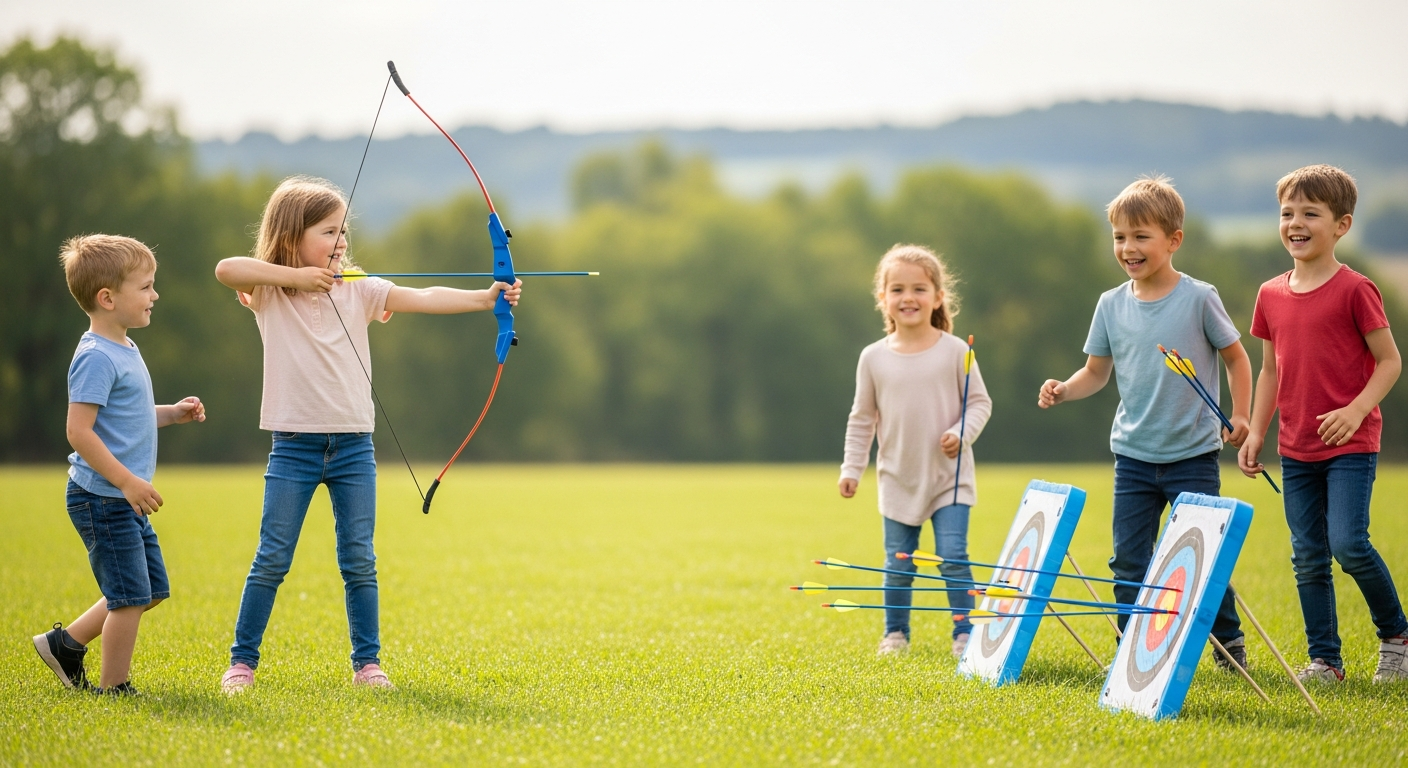
Table of Contents
- Introduction
- Why Archery Games are Essential for Kids' Development
- Setting Up Your Archery Fun Zone Safely
- Classic Archery Games with a Twist
- Creative Target Challenges
- Team & Collaborative Archery Games
- Archery Games for Skill Building & Drills (Disguised Fun)
- Bringing the Fun Indoors: When Weather Isn't Cooperative
- The Speech Blubs Difference: More Than Just Games, It's Growth
- Ready to Empower Your Child's Voice? Discover Speech Blubs Today!
- FAQ
Imagine a world where your child's playtime not only sparks joy and adventure but also secretly hones critical developmental skills like focus, patience, and even communication. For many parents, balancing engaging activities with truly beneficial ones can feel like a constant quest. But what if we told you that the ancient art of archery, reimagined with fun, kid-friendly games, could be exactly that? It’s not just about hitting a bullseye; it’s about building confidence, encouraging teamwork, and sharpening the mind in an exhilarating way.
This blog post is your ultimate guide to transforming a simple bow and arrow set into a gateway for unforgettable family moments and remarkable growth. We'll dive into over 20 engaging and safe archery games, perfect for children of all ages and skill levels. We’ll explore how these games do more than just entertain, subtly nurturing abilities that are crucial for overall development, including those foundational for strong communication. From precision challenges to team-based adventures, get ready to discover how "fun archery games for kids" can become a cornerstone of joyful, skill-building play in your backyard.

Introduction
Have you ever watched a child’s eyes light up with a sense of accomplishment, whether it’s hitting a target for the first time or successfully articulating a new word? That spark of achievement is a powerful motivator, driving growth and building confidence. In the realm of children's activities, finding that sweet spot where learning feels indistinguishable from play is the golden ticket. Archery, often seen as a serious sport, can be brilliantly adapted into a series of lively, imaginative games that deliver exactly this experience.
The purpose of this guide is to equip you with an arsenal of fantastic archery games that will keep your kids active, engaged, and learning. We’ll explore how these games cultivate not only physical coordination and focus but also vital cognitive and social skills. You'll learn how simple adjustments can make archery accessible and exciting for young archers, fostering a love for concentration and precision that extends far beyond the target range. Ultimately, we believe that by embracing these creative archery challenges, you’ll not only provide hours of wholesome entertainment but also empower your child with a stronger sense of self and an enhanced capacity for engaged learning, laying groundwork for them to truly speak their minds and hearts.
Why Archery Games are Essential for Kids' Development
Archery might seem like a niche hobby, but when presented as a series of engaging games, it transforms into a powerful developmental tool. Beyond the obvious physical benefits like improving hand-eye coordination, balance, and fine motor skills, archery games stealthily cultivate a range of cognitive and social-emotional abilities that are crucial for a child's holistic growth.
Consider the act of aiming: it demands sustained focus, patience, and problem-solving. A child learns to block out distractions, assess distance, and make micro-adjustments – skills that are highly transferable to academic tasks and everyday challenges. When they miss, they learn resilience and the importance of refining their approach. When they succeed, their confidence soars, encouraging them to tackle more complex tasks.

These games also provide a wonderful context for social interaction. Many archery games can be adapted for teams or competitive play, teaching children about sportsmanship, taking turns, encouraging teammates, and respectfully handling wins and losses. For children who might struggle with attention or social cues, a structured game provides a safe framework for practicing these skills. Just as hitting a specific ring in archery strengthens concentration, engaging with targeted learning activities can significantly boost a child's linguistic abilities. At Speech Blubs, we understand this deeply. Our mission is to empower children to speak their minds and hearts, and we know that an immediate, effective, and joyful solution is often the most impactful. We provide a powerful tool for family connection, where children learn and grow together.
Through play-based learning, children naturally develop their expressive and receptive language. Archery games, by requiring kids to follow instructions, verbalize their strategies, or cheer for others, indirectly strengthen communication. This mirrors our unique approach at Speech Blubs, where our founders, having grown up with speech problems themselves, created the tool they wished they had. We seamlessly blend scientific principles with play into one-of-a-kind "smart screen time" experiences that are a screen-free alternative to passive viewing. Our renowned video modeling methodology, where children learn by watching and imitating their peers, makes acquiring complex communication skills engaging and effective. To see how other families are transforming playtime into learning time, explore the testimonials from parents who love Speech Blubs.
Setting Up Your Archery Fun Zone Safely
Before the arrows start flying, safety is paramount. Creating a secure and appropriate environment ensures that "fun archery games for kids" remain enjoyable and accident-free.
Choose the Right Location
- Spacious Backyard: Look for an open area, free from obstructions like trees, fences, or delicate plants that could be damaged or obstruct a clear shot.
- Clear Background: Ensure there are no people, pets, or valuable items behind the target area. A natural earth mound or a solid wall is ideal.
- Sufficient Backstop: Always use a proper archery backstop. This could be a hay bale, a specialized archery net, or a thick foam target stand. This prevents arrows from flying past the target and getting lost or causing harm.
Essential Equipment & Gear
- Kid-Friendly Bows and Arrows: For young children, felt-tipped or soft-tipped arrows are a must. These are much safer than pointed arrows, significantly reducing the risk of injury or property damage. Lightweight, low-draw bows are also easier for small hands to manage.
- Eye Protection: While soft-tipped arrows are safer, protective eyewear should still be considered, especially if multiple children are playing.
- Targets: Foam boards, cardboard boxes, or even designated archery targets work well. You can get creative with these, as you'll see in our game ideas!
- Supervision: An adult must always be present to supervise, enforce safety rules, and offer guidance. This is non-negotiable.
Golden Rules of Safety
- One Archer, One Arrow: Only one person should shoot at a time. All other participants should wait safely behind the designated shooting line.
- Never Point at People or Animals: Emphasize that bows and arrows are never toys for pointing at living things.
- Clear the Line: Before anyone goes to retrieve arrows, ensure all bows are down and no one is shooting.
- Check Equipment: Regularly inspect bows and arrows for any damage.
By establishing a safe environment and clear rules, you create a foundation for endless fun and skill development. Ready to transform your backyard into an exciting archery arena? Let's dive into the games!
Classic Archery Games with a Twist
Some of the best "fun archery games for kids" are adaptations of familiar concepts or time-tested challenges that have been staples in archery practice for generations. They’re fantastic for building core skills in an engaging way.
1. H.O.R.S.E. Archery
- How to Play: Borrowed from basketball, this game is perfect for 2+ players or teams. The first archer designates a target or a specific shot (e.g., "hit the red ring from one knee"). If they make the shot, the next player must successfully replicate it. If they miss, they get the letter "H." If the first archer misses, the next player gets to set the challenge. The game continues, with players accumulating letters (H-O-R-S-E) for each missed replication. The first player to spell H.O.R.S.E loses.
- Skills Developed: Precision, observation, adaptability, creative problem-solving, and the ability to replicate actions. For a child learning new sounds or words, this concept of observation and replication is incredibly powerful. Much like how H.O.R.S.E. trains archers to mimic shots, Speech Blubs utilizes video modeling to help children learn speech through imitation, watching real kids articulate words and phrases.
- Variations: Add more letters for a longer game, or introduce "wildcard" shots that can be challenged differently.
2. Knockout
- How to Play: A thrilling elimination game for a group. All archers start at a designated line (e.g., 10 meters). They shoot one arrow. The goal might be to hit any part of the target, or a specific color (e.g., yellow or red rings). Those who miss are "knocked out" and sit down. The game continues, often with increasing difficulty (e.g., moving further back, or requiring a smaller target area like a "10" or "yellow ring" hit). The last archer standing wins.
- Skills Developed: Focus under pressure, accuracy, nerve control, resilience, and observing others' performance. This game builds mental toughness and the ability to perform when everyone is watching, which can translate to confidence in other public-facing scenarios, like speaking up in class.
- Variations: Add a "resurrection" rule where a player can rejoin if another player misses three times in a row.
3. Robin Hood (Long Distance Challenge)
- How to Play: This game tests progressive accuracy and distance shooting. All archers start at a close, easy distance from the target. Each archer takes a turn shooting one arrow. If they hit the target, they take a step back (or move a set distance, like 10 feet) for the next round. If they miss, they stay at their current distance. The game continues for a set number of rounds, or until only one archer can consistently hit the target from the furthest distance. The ultimate winner earns the title "Robin Hood."
- Skills Developed: Long-distance accuracy, spatial awareness, consistent form, and strategic progression. This game subtly pushes archers to refine their technique for varied distances, improving their overall proficiency.
- Variations: Instead of stepping back, archers could be required to hit a smaller zone on the target as they progress.
Creative Target Challenges
Sometimes, all it takes to make archery exciting is a fresh, imaginative target. These "fun archery games for kids" turn everyday items into captivating bullseyes.
1. Balloon Pop Archery
- How to Play: Attach balloons of various sizes and colors to a foam board or net. Assign different point values to colors or sizes (e.g., small red balloon = 10 points, large blue balloon = 5 points). Archers take turns shooting, aiming to pop as many balloons as possible to accumulate points. The satisfying "pop" is a huge motivator! You can even fill balloons with glitter or colored powder for an extra visual treat upon impact.
- Skills Developed: Precision, target acquisition, scorekeeping, and immediate sensory feedback. The visual and auditory feedback of a popping balloon is incredibly rewarding for children, reinforcing their efforts.
- Variations: Hang candy or small prizes from strings tied to the balloons; whoever pops the balloon gets the prize. Make it a team challenge where each team has a specific color balloon to pop.
2. Fruit Shot
- How to Play: Give those overripe fruits a heroic send-off! Instead of a traditional target, hang or place fruits (apples, pears, melons, pumpkins for bigger targets) in front of your backstop. Archers aim for the fruits. Hitting a fruit provides a unique, satisfying splatter. For advanced players, a buddy can gently toss the fruit, creating a moving target challenge where every successful hit earns a point.
- Skills Developed: Dynamic aiming, tracking (for moving targets), judgment of force and trajectory, and novelty engagement. This game introduces an element of unpredictability that can keep archers on their toes.
- Safety Note: Ensure the area behind the fruit is clear, as fruit fragments can scatter.
3. Ornament Shooter
- How to Play: Repurpose old holiday ornaments by filling them with glitter or colored powder and hanging them as targets. When an archer successfully hits an ornament, it shatters into a sparkly explosion. Assign points per hit, or just play for the sheer joy of the spectacular "break."
- Skills Developed: Fragile target aiming, precision for satisfying outcomes, and visual-spatial judgment. This game adds a festive and visually dramatic element to practice.
- Safety Note: Use plastic or non-sharp ornaments to avoid dangerous shards. Clear up broken pieces promptly.
4. Paper Towel Roll Split
- How to Play: Attach an empty cardboard paper towel roll (or toilet paper roll for an even smaller target) to the target face, so its open end faces the archer. The objective is to shoot an arrow through the roll. This sounds simple but is surprisingly difficult, requiring extreme precision. Archers earn a point for each arrow successfully passed through the tube.
- Skills Developed: Extreme precision, fine motor control, sustained focus on a very small target, and advanced aiming techniques. This is a game for honing the sharpest of skills.
5. Tic-Tac-Toe Archery
- How to Play: Draw a large tic-tac-toe grid on a piece of cardboard or a foam board. Two players (or teams) take turns shooting their arrows into the squares. Since felt-tipped arrows won't stick, use a marker or chalk to mark an "X" or "O" in the square where the arrow lands. The first player to get three in a row wins.
- Skills Developed: Strategic thinking, turn-taking, basic geometry (aiming for specific squares), and friendly competition. This game encourages forward planning and spatial reasoning, vital for academic success. Just as this game teaches kids to aim strategically, Speech Blubs guides children through targeted exercises that build foundational communication skills step-by-step. Discover how our engaging app helps children develop their voice by visiting the Speech Blubs website.
6. "V" Target Game
- How to Play: Draw a large "V" shape on a target board, extending from top to bottom. The goal is for archers to shoot an arrow as close to the bottom point of the "V" as possible without touching the lines. The arrow closest to the bottom, fully within the "V" lines, wins the round.
- Skills Developed: Micro-adjustments in aiming, understanding precision within defined boundaries, and competitive spatial reasoning.
- Variations: The next archer must shoot below the previous archer's lowest arrow to stay in the game, adding an elimination element.
Team & Collaborative Archery Games
Archery doesn't have to be a solitary pursuit. These "fun archery games for kids" emphasize teamwork, communication, and shared success, making them perfect for family gatherings or group activities.
1. "The Game" (Combined Score Challenge)
- How to Play: Divide archers into small teams (2-4 per target). Assign each team a target. A coach or parent calls out a target number (e.g., "17"). The team members take turns shooting one arrow each, aiming to hit rings whose combined scores add up to the called number. For example, if the number is 17, one archer might hit a 10, and their teammate needs to hit a 7. The first team to reach the target number wins the round.
- Skills Developed: Team communication, quick mental math, strategic aiming (e.g., if one person hits a low score, the next needs a higher one), and collaborative problem-solving. This game fosters a strong sense of camaraderie and shared purpose. This dynamic of working together and building upon each other’s contributions is mirrored in the way Speech Blubs encourages family involvement. Parents and children engage in activities together, turning learning into a shared, joyful experience. Download Speech Blubs on the App Store or Google Play to explore our engaging activities.
- Variations: Increase the difficulty by requiring specific colors or rings to be hit in sequence to achieve the total.
2. Capture the Flag – ArrowSoft Edition
- How to Play: Set up a playing field with obstacles and designated "bases" for two teams, each with a flag. Players use soft-tipped arrows to "tag out" opponents. If tagged, a player might have to sit out for a short period or return to their base to "reset." The goal is to capture the opposing team's flag.
- Skills Developed: Team strategy, agility, evasive maneuvers, quick decision-making, and communication under pressure. This is a highly active and engaging game that combines physical activity with tactical thinking.
- Safety Note: Emphasize strict rules about not aiming at faces and wearing protective eyewear if available. Ensure plenty of safe hiding places.
3. Archery Dodgeball
- How to Play: Similar to traditional dodgeball, but with soft-tipped arrows. Players are divided into two teams within a defined playing area. The objective is to "tag" opponents with arrows. If hit, a player is out of the round (or can be brought back in by a teammate catching an arrow). Bunkers or obstacles can be added for cover. Play with clear "honor rules" for calling hits.
- Skills Developed: Agility, dodging, throwing/shooting accuracy, teamwork, and quick reflexes. This game is high-energy and exciting.
- Safety Note: Always use soft-tipped arrows and reiterate rules about aiming only at the torso. Protective gear is recommended.
Archery Games for Skill Building & Drills (Disguised Fun)
These games are designed to sharpen specific archery skills, but they're so enjoyable that kids won't even realize they're practicing!
1. Archery Golf / Shoot the Holes
- How to Play: Set up several "holes" around your yard using empty cups, buckets, or hula hoops. Each hole is a target. Players "shoot" their arrows towards each hole, counting how many "strokes" (shots) it takes to get the arrow inside or as close as possible. The player with the lowest score after completing all holes wins, just like golf.
- Skills Developed: Varying distance judgment, strategic shot planning, understanding trajectory, and scorekeeping. This game transforms the backyard into a dynamic course.
2. Mini Olympics
- How to Play: Design different archery "events" around your yard. This could include a distance shoot (how far can you hit a large target?), a precision shoot (how many bullseyes in a row?), a moving target challenge (shooting at a gently swinging object), or even a "form challenge" (shooting while kneeling or from a specific stance). Assign points for performance in each event. The archer with the highest overall score is the Olympic champion!
- Skills Developed: Versatility in shooting, adaptability to different scenarios, physical stamina, and competitive spirit. This allows for a comprehensive test of various archery skills.
3. Blackjack Archery
- How to Play: Using a standard 10-ring target, archers shoot as many arrows as they like (typically 3-5 per round), aiming to get a total score as close to 21 as possible without going over. The rings score normally (1-10 from outer to inner). The X-ring (the very center) can be designated as an "ace," allowing the archer to choose its value as 1 or 11 points. If an archer goes over 21, they bust.
- Skills Developed: Mental math, strategic risk-taking, precision aiming for specific scores, and decision-making under pressure. This game adds a fun mathematical element to archery.
4. Lucky Dip
- How to Play: Archers shoot a set number of arrows (e.g., 6). Before scoring, they draw a slip of paper from a bag with unique scoring instructions (e.g., "Whites score 20," "Only odd numbers count," "All golds are negative points," "Ignore all 10s"). This introduces an element of randomness and forces archers to adapt their strategy even after shooting, or to shoot in a non-traditional way if they anticipate an unusual rule.
- Skills Developed: Adaptability, unconventional thinking, humor, and freedom from aiming for perfect scores every time. It's a great way to break routine.
5. Closest Arrow (Single Elimination)
- How to Play: A quick-fire competitive game. Two archers shoot one arrow each. The archer whose arrow is closest to the center of the target wins the round and advances. The loser is eliminated. This continues until only one champion remains.
- Skills Developed: Extreme precision, mental focus in head-to-head competition, and immediate pressure performance.
6. Bowling Archery
- How to Play: Use a standard 10-ring target. Hitting the 10-ring is a "strike." If an archer doesn't hit a 10, they get a second "frame" (another arrow) to try and hit a ring that, when added to their first shot's score, totals 10 (a "spare"). For example, if they hit a 7 with the first arrow, they need to hit a 3 with the second to get a spare. Play proceeds like bowling, with scores tallied over 10 frames.
- Skills Developed: Strategic two-shot planning, numerical aiming, and scorekeeping.
7. Save the Prince/Princess
- How to Play: Using a 10-ring target with colored rings, archers must hit each color in a specific sequence (e.g., white, black, blue, red, gold). The critical rule: hitting the X-ring (the very center) is a "scratch," and the archer is eliminated, as they've "hit the Prince/Princess." The game continues until one archer successfully hits all colors in sequence without hitting the X.
- Skills Developed: Sequential aiming, high precision, avoiding specific target zones, and disciplined shooting.
8. Shrinking Target / Master of the Target
- How to Play: Start with a large target or a blank sheet of paper. Archers shoot a set number of arrows. Any arrows that miss the target are eliminated. For the next round, the target is folded in half (or a smaller outer ring/color is removed from play on a standard target). Archers then shoot at the smaller target. This continues until only one archer can consistently hit the continuously shrinking target.
- Skills Developed: Progressive accuracy, adaptability to changing target sizes, and sustained focus under increasing difficulty.
9. Tiny Targets
- How to Play: Affix a collection of very small objects – like target dots, plastic spiders, bottle caps, or small stickers – to a larger piece of cardboard placed against your backstop. Archers shoot from a very close distance (e.g., 10-15 feet), aiming for these tiny targets. Even at close range, hitting something so small is a significant challenge.
- Skills Developed: Extreme close-range precision, magnification of aiming errors for self-correction, and developing fine motor control for minute adjustments. This is fantastic for refining form.
10. Find It
- How to Play: This game is great for younger kids. Take several blank cards (3x5 or 4x6 inches) and on the back of one, draw a simple picture, write "WINNER," or attach a sticker. Affix all cards face down to a target board in a spread-out grid. Archers take turns hitting a card. When a card is hit, it's turned over to reveal if it's the "Find It" card. The archer who hits the designated card wins a small prize. You can create a story around finding a "lost treasure" to make it more immersive.
- Skills Developed: Basic targeting, exploration, memory (if you hide multiple 'special' cards), and a fun, low-pressure way to engage with archery.
Bringing the Fun Indoors: When Weather Isn't Cooperative
Don't let a rainy day or cold weather dampen the fun! Many "fun archery games for kids" can be adapted for indoor play with the right precautions and equipment.
Indoor Archery Setup Tips:
- Designated Safe Zone: Clear a spacious area away from windows, delicate furniture, or high-traffic zones.
- Indoor-Specific Equipment: Invest in suction-cup arrows or very soft foam-tipped arrows designed for indoor use. Use lightweight, low-draw bows or even toy bows that are specifically rated for indoor play.
- Robust Backstop: Use a large cardboard box filled with old clothes or soft blankets, a heavy-duty blanket hung against a wall (with padding behind it), or a dedicated indoor archery target designed to absorb impact without damaging walls.
- Strict Rules: Emphasize even greater caution indoors. One archer at a time, clear line of sight, and no running with bows or arrows.
Indoor Game Ideas:
- Tic-Tac-Toe Archery: Perfect for indoors, using a soft target board.
- Balloon Pop (Mini Version): Use small balloons taped to a clothesline or cardboard box.
- Bowling Archery (Mini): Set up empty plastic bottles or soft toys as "pins" and shoot at them from a short distance.
- Find It (Mini Cards): Smaller cards can be taped to an indoor target.
- Points Challenge: Simply assign points to different sections of a homemade cardboard target.
Just as these indoor adaptations allow for continued skill development regardless of external conditions, Speech Blubs provides a consistent and engaging learning environment right in your home. We offer "smart screen time" that actively engages children in speech and language development, making every session count. Whether it’s too cold, too hot, or simply inconvenient to go outside, our app is ready to foster your child’s growth through playful, scientifically backed activities. Get started today and create your account for an immediate boost to your child’s communication journey by trying our free 7-day trial.
The Speech Blubs Difference: More Than Just Games, It's Growth
While "fun archery games for kids" provide incredible physical and cognitive benefits, developing strong communication skills is equally, if not more, foundational for a child's ability to truly connect with the world. At Speech Blubs, our mission is profound: to empower children to speak their minds and hearts. We understand firsthand the challenges many families face, as our company was born from the personal experiences of our founders, who all grew up with speech problems and created the tool they wished they had.
We are committed to providing an immediate, effective, and joyful solution for the 1 in 4 children who need speech support. We achieve this by blending scientific principles with play into one-of-a-kind "smart screen time" experiences. Unlike passive viewing like cartoons, Speech Blubs offers a dynamic, interactive alternative that encourages active participation. Our unique approach centers on our video modeling methodology, where children learn by watching and imitating their peers. This natural, engaging process is backed by extensive research, placing us in the top tier of speech apps worldwide with a high MARS scale rating. You can dive deeper into the science behind our methods and effectiveness on our research page.
We don't promise guaranteed outcomes like "your child will be giving public speeches in a month" because true development is a journey. Instead, we focus on the invaluable benefits of the process: fostering a love for communication, building confidence, reducing frustration, developing key foundational skills, and creating joyful family learning moments. Whether your child is working on articulation, expanding vocabulary, or improving social language, Speech Blubs offers a supportive and motivating environment.
Engaging with Speech Blubs is a powerful supplement to a child's overall development plan and, when applicable, professional therapy. It’s an opportunity for parents and caregivers to play an active role, creating a powerful tool for family connection. Just as an archer refines their aim with each practice, a child using Speech Blubs refines their voice, step by playful step.
Ready to Empower Your Child's Voice? Discover Speech Blubs Today!
Providing your child with engaging, developmental activities is one of the greatest gifts you can offer. Whether it's through the exciting world of archery games or the scientifically backed, playful learning of Speech Blubs, fostering a child's growth and confidence is incredibly rewarding.
If you've been wondering how to support your child's communication journey and build their confidence, we invite you to experience the Speech Blubs difference. Our app is designed to make learning fun and effective, ensuring that every moment spent is a step towards empowering your child to speak their minds and hearts. Unsure if your child could benefit? Take our quick 3-minute preliminary screener. It involves 9 simple questions and provides an assessment and next-steps plan, complete with a free 7-day trial!
We offer flexible plans to suit your family's needs:
- Monthly Plan: $14.99 per month.
- Yearly Plan: For an incredible value, our Yearly plan is just $59.99 per year, which breaks down to just $4.99 per month! This means you can save 66% compared to the monthly plan.
The Yearly plan is truly the best choice, as it includes exclusive, high-value features designed to give your child the ultimate learning experience:
- A 7-day free trial, allowing you to explore the full app and see the magic unfold.
- Access to the extra Reading Blubs app, further boosting literacy skills.
- Early access to new updates and a prioritized 24-hour support response time for any questions you may have.
The Monthly plan, unfortunately, does not include these fantastic benefits.
Don't miss out on the full suite of features and incredible savings! We highly encourage you to choose the Yearly plan to get your free trial and unlock the complete Speech Blubs experience. Give your child the gift of confident communication and joyful learning.
Ready to get started? Create your account and begin your 7-day free trial today!
FAQ
Q1: What age are these archery games suitable for?
A1: Most of these "fun archery games for kids" are suitable for children aged 4 and up, especially when using kid-friendly bows and soft-tipped arrows. Games like "Find It" or "Balloon Pop" are great for younger children, while more complex games like "Blackjack Archery" or "Knockout" are better for elementary school age and older, as they require more focus and strategic thinking. Always prioritize safety and adult supervision, regardless of age.
Q2: How can I ensure safety during archery games?
A2: Safety is paramount. Always designate a clear shooting area with a robust backstop (like a hay bale or specialized netting). Only use kid-friendly bows with low draw weight and soft-tipped arrows. Enforce strict rules: one archer shooting at a time, never point a bow at people or pets, and ensure the shooting line is clear before anyone retrieves arrows. Consistent adult supervision is essential to reinforce these rules and prevent accidents.
Q3: Can these games really help with my child's development beyond physical skills?
A3: Absolutely! Archery games are excellent for developing a wide range of non-physical skills. They significantly boost focus, concentration, and patience as children learn to aim and wait for the right moment. Many games involve strategy, problem-solving, and mental math. Team-based games foster communication, teamwork, and sportsmanship. The sense of achievement also builds confidence and resilience, crucial for overall emotional and cognitive development.
Q4: How does Speech Blubs fit into my child's overall development?
A4: Speech Blubs complements physical and cognitive development by focusing on crucial communication skills. Just as archery games build focus and precision, Speech Blubs uses engaging, play-based activities, specifically our video modeling methodology, to help children develop articulation, vocabulary, and social language. Our app offers "smart screen time" that actively engages children, making it an effective, joyful solution for speech support. It works as a powerful supplement to professional therapy and strengthens family connection by encouraging shared learning moments, ultimately empowering children to speak their minds and hearts.
About the author