
25 Easy Toddler Winter Crafts for Cold Days
 By Speech Blubs Team•Feb 20, 2026•13 min.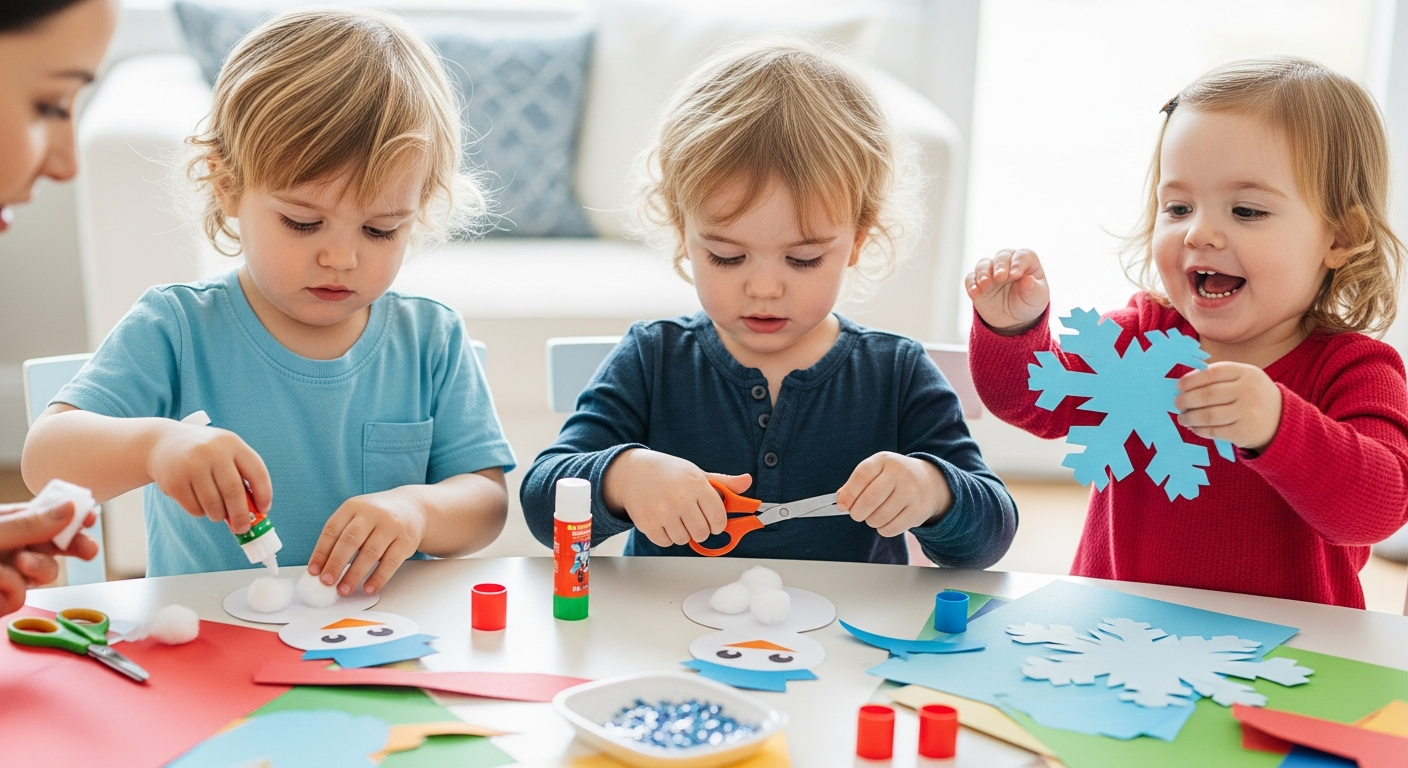
Table of Contents
- Introduction
- Why Winter Crafting is a Speech Therapy Secret
- Delightful Snowman Crafts for Tiny Hands
- Arctic Animal Adventures
- Process Art: Exploring Winter Textures
- Sensory and Science-Based Winter Fun
- Holiday Gifts and Keepsakes
- How to Craft Without the Stress
- Speech Blubs: Your Partner in Winter Learning
- Practical Advice for Parents of Late Talkers
- Conclusion
- FAQs
Introduction
Have you ever looked out the window on a gray Tuesday in January and felt that familiar "stircrazy" energy building up in your toddler? We have all been there. When the wind is biting and the park is a puddle of slush, the walls of your living room can start to feel a little close. But what if those long, chilly afternoons were actually the perfect opportunity to build your child’s vocabulary, boost their fine motor skills, and create joyful memories? At Speech Blubs, we believe that every moment is a chance for a child to "speak their minds and hearts," and winter crafting is one of the most effective—and fun—ways to make that happen.
The purpose of this guide is to provide you with a curated collection of easy toddler winter crafts that prioritize the process over the final product. We aren't looking for museum-quality masterpieces; we are looking for sticky fingers, big smiles, and the "oohs" and "aahs" of discovery. Throughout this post, we will explore crafts ranging from sensory snowmen to arctic animal art, all while explaining how these activities support your child’s speech and language development.

The main message we want to share is that you don't need a degree in art or a cupboard full of expensive supplies to foster your child’s growth. By combining hands-on play with intentional communication and the right tools—like our "smart screen time" experiences—you can turn a "drab" winter day into a powerhouse of learning and connection.
Why Winter Crafting is a Speech Therapy Secret
Before we dive into the glitter and glue, let’s talk about why we, as speech experts, love crafting so much. When your toddler is engaged in an activity like painting or sticking cotton balls, their brain is firing on all cylinders. They are learning "action words" (rip, stick, pour, paint), "descriptive words" (sticky, cold, white, soft), and "positional words" (on top, under, beside).
At Speech Blubs, our mission is deeply personal. Our founders grew up with speech challenges themselves and created the tool they wished they had. We know that the best learning happens when children are having fun. This is why our app utilizes video modeling—where kids watch and imitate their peers—and why we encourage "co-play" during crafts. When you craft alongside your child, you are their primary model for language.
Delightful Snowman Crafts for Tiny Hands
Snowmen are the quintessential symbol of winter. They are also fantastic for teaching body parts and shapes!
1. The Loofah Painted Snowman
Instead of a traditional brush, give your toddler a bath loofah. Dip it into white washable paint and "stamp" three circles onto blue construction paper.
- Speech Tip: Focus on the word "circle" and "round." Talk about the "big," "medium," and "small" parts of the snowman.
- Materials: Blue paper, white paint, a loofah, and scraps of paper for the nose and hat.
2. Marshmallow Snowman Collage
This is a sensory favorite because it’s edible! Using a glue stick, draw a snowman shape and let your toddler fill it in with mini marshmallows.
- Speech Tip: This is the perfect time to practice the "M" sound. "Mmm, marshmallows!" or "More marshmallows?"
- Practical Scenario: For a parent whose 3-year-old "late talker" is motivated by snacks, this activity creates a natural "communication temptation." They have to ask for "more" or "please" to get the next handful of marshmallows to stick.
3. Cotton Ball "Squeeze" Snowman
Tearing and pulling cotton balls is excellent for fine motor strength. Have your child glue these soft tufts onto a cardboard cutout.

- Speech Tip: Talk about the texture. Is it "soft" or "fluffy"? Does the glue feel "sticky"?
4. Melted Snowman Puffy Paint
Mix equal parts shaving cream and white school glue to create "puffy paint." Let your toddler swirl it around on a page. Add a construction paper hat and some "buttons" (pom poms). It doesn't have to look like a snowman; it’s supposed to be "melted"!
- Speech Tip: Use words like "oh no!" and "melted" to encourage emotional expression and exclamations.
5. Paper Plate Snowman Wreath
Cut the center out of a paper plate and let your toddler decorate the rim with white tissue paper or stickers. Add a simple snowman face in the middle.
Arctic Animal Adventures
Winter is the best time to introduce your child to the wonders of the North and South Poles. Our "Animal Kingdom" section in the app is a great companion here!
6. Fork Painted Polar Bear
Provide your child with a plastic fork and white paint. By "scratching" the paint across blue paper with the fork, they create a texture that looks just like polar bear fur.
- Speech Tip: Practice the "Grrr" sound for the bear or the "P" sound for "polar."
- Scientific Methodology: This mimics our video modeling approach. Just as children in our app watch peers make animal sounds, they watch you use the fork and then imitate the movement. This "mirroring" is a foundational skill for communication. If you want to see how your child's imitation skills are progressing, you can take our 3-minute preliminary screener to get a baseline assessment.
7. Handprint Penguins
Paint your child’s palm black and their fingers (excluding the thumb) black. Press it onto paper. Once dry, paint a white belly and add orange feet.
- Speech Tip: Talk about "hand," "fingers," and "tickle" while you paint their palm.
8. Cupcake Liner Penguins
Fold a black cupcake liner in half for the wings and use a white circle for the belly. It’s simple, low-mess, and adorable.
9. Tissue Paper Snowy Owl
Owls are great for practicing the "Hoo-hoo" sound. Let your toddler glue torn bits of white tissue paper onto an owl silhouette.
- Speech Tip: Focus on the "W" sound for "wing" and "white."
10. Footprint Arctic Fox
Similar to the handprint penguin, a footprint in white paint can become the face of a beautiful arctic fox.
Process Art: Exploring Winter Textures
Process art is about the doing, not the result. This reduces frustration for toddlers who are still mastering their coordination.
11. Tape Resist Snowflakes
Place strips of masking tape in a snowflake pattern on a piece of paper. Let your toddler paint the entire page blue or purple. Once dry, peel the tape away to reveal the white "snowflake" underneath.
- Speech Tip: The "reveal" is a great moment for the word "Look!" or "Wow!"
12. Icicle Drip Painting
Use a pipette or a medicine dropper to drip watered-down white or silver paint at the top of a piece of paper. Hold the paper upright and let the paint "race" down the page.
- Speech Tip: Use "go," "fast," and "down" to describe the movement.
13. Painting with Mittens
Put an old pair of mittens on your toddler's hands and let them dip their "paws" into the paint. It’s a hilarious, high-sensory experience that removes the pressure of holding a brush.
14. Salt Painting Snowflakes
Draw a snowflake with white glue, sprinkle it with salt, and then let your child "touch" the salt with a brush dipped in blue watercolor. Watch the color travel through the salt crystals.
- Speech Tip: This is "magic!" Talk about the color "spreading" and "moving."
15. Bubble Wrap Snowfall
Paint a piece of bubble wrap white and press it onto blue paper. The resulting dots look exactly like a gentle snowfall.
Sensory and Science-Based Winter Fun
Toddlers learn through their senses. These activities bridge the gap between "crafting" and "exploring."
16. Winter Sensory Bag
Fill a Ziploc bag with clear hair gel, blue glitter, and some silver sequins or "snowflake" cutouts. Tape the bag to a window or a table.
- Speech Tip: Ask your child to "find" the snowflake. This builds "receptive language" (understanding instructions).
17. Frozen Paint Cubes
Freeze washable paint in an ice cube tray with popsicle sticks as handles. Let your child "paint" on paper as the ice melts.
- Speech Tip: "Cold!" and "Brrr!" are the stars of the show here.
18. Sugar Cube Ice Castles
Give your toddler a box of sugar cubes and some non-toxic glue (or even thick frosting). Let them build "ice" towers.
- Speech Tip: Use "up," "high," and "fall down!"
19. Snowman "Sticky Wall"
Tape a piece of clear contact paper (sticky side out) to the wall. Give your child various white materials—cotton balls, paper scraps, white yarn—to stick onto the wall to build a giant snowman.
- Speech Tip: This is a "vertical surface" activity, which is great for shoulder stability and language because your child is at eye-level with you.
20. Shaving Cream "Snow" Play
Spray a pile of shaving cream on a tray. Add some small plastic animals or cars. Let them "hide" in the snow.
- Speech Tip: Practice "Where is the cow?" and "Found it!"
Holiday Gifts and Keepsakes
Winter is also the season of giving. Grandparents love these handmade treasures!
21. Pinecone Ornaments
Go for a "winter walk" to find pinecones. Back home, dab them with glue and roll them in white glitter or "snow" (Epsom salts).
- Speech Tip: Talk about "inside" and "outside."
22. Craft Stick Snowflakes
Glue three popsicle sticks together in a star shape. Let your toddler add buttons or gems.
- Speech Tip: Count the sticks. "One, two, three!"
23. Handprint Mitten Keepsake
Trace your child's hand on felt or heavy cardstock, cut it out in a mitten shape, and let them decorate it with "fur" (cotton balls) at the wrist.
24. Fingerprint Winter Tree
Paint a simple brown tree trunk and let your child use their fingerprints to add "snow" to the branches.
- Scientific Note: Our research shows that engaging in multiple modalities (touch, sight, sound) reinforces neural pathways, helping toddlers retain new words more effectively.
25. Winter Lanterns
Glue tissue paper squares onto a clean glass jar. Add a battery-operated tea light. It’s a "warm" light for a "cold" night.
How to Craft Without the Stress
We know that "toddler" and "crafts" can sometimes equal "mess" and "stress." Here are our top tips for keeping it joyful:
- Create a Station: Use a disposable tablecloth or an old shower curtain on the floor. It makes clean-up a breeze.
- Don't Be Pushy: If your child loses interest after two minutes, that’s okay! Toddlers have short attention spans. You can always come back to it later.
- Time it Right: Crafting is best done after a nap and a snack. A hungry or tired toddler won't have the patience for sticky glue.
- Focus on the Process: If their snowman has five eyes and an ear on its belly, celebrate it! Their independence is more important than the "correct" anatomy of a snowman.
Speech Blubs: Your Partner in Winter Learning
While hands-on crafting is essential, we know that parents also need a break. This is where Speech Blubs comes in. We offer "smart screen time" that isn't passive. Unlike cartoons, where a child sits and watches silently, Speech Blubs encourages your child to be an active participant.
Our app is a powerful supplement to your child's daily routine and professional therapy. We recommend it as a way to "warm up" for crafting. For example, you can watch the "Snowman" video in our app, and then go to the kitchen table to make your own loofah snowman!
We want to be transparent about how you can join our community. We offer two main paths:
- Monthly Plan: $14.99 per month. This is great for trying us out.
- Yearly Plan (Best Value): $59.99 per year. This breaks down to just $4.99/month, saving you 66%.
The Yearly Plan is designed to provide the most support for your family's journey. It includes:
- A 7-day free trial so you can explore everything risk-free.
- The Reading Blubs app, which helps transition your child from speaking to early reading.
- Early access to all our new updates.
- Priority 24-hour support response time.
Ready to see why millions of parents trust us? You can Download Speech Blubs on the App Store or find us on the Google Play Store to begin your journey today.
Practical Advice for Parents of Late Talkers
If you are a parent of a child who isn't yet meeting their milestones, winter can feel isolating. You might worry that your child is falling behind. Please know that you are not alone. About 1 in 4 children need some form of speech support.
When you are doing these easy toddler winter crafts, don't feel like you have to be a teacher. Just be a playmate. Use simple, one-word narrations. If your child points to the glue, say "Glue!" If they drop a pom-pom, say "Uh-oh!" These small interactions are the building blocks of communication.
For more inspiration, read our parent success stories to see how other families have used our tools to find their child's voice.
Conclusion
Winter doesn't have to be a season of "waiting for spring." It can be a season of vibrant growth and creative exploration. By trying out these easy toddler winter crafts, you are providing your child with the sensory input, fine motor practice, and language-rich environment they need to thrive.
Remember, the goal isn't a perfect craft; it's a confident child. Whether you are painting with mittens, building sugar cube castles, or following along with peers in the Speech Blubs app, you are doing the important work of helping your child "speak their mind and heart."
We invite you to join our family. Create your account and begin your 7-day free trial today. For the best experience and the full suite of features—including Reading Blubs—be sure to select the Yearly Plan. Let’s make this winter a season of joyful breakthroughs!
FAQs
1. What are the best mess-free winter crafts for 2-year-olds?
Sensory bags are a fantastic mess-free option. By filling a sealed bag with gel and winter-themed items, your toddler gets all the sensory benefits of "squishy" play without anything touching your carpet. "Contact paper" sticky walls are another great low-mess choice!
2. How do winter crafts help with speech delay?
Crafts create "communication opportunities." When a child needs a specific color or more glue, it encourages them to use gestures, sounds, or words to make a request. It also provides a concrete context for learning new descriptive words like "cold," "white," and "sticky."
3. Can I use Speech Blubs alongside these physical crafts?
Absolutely! In fact, we recommend it. Using the app to watch a peer make a "polar bear" sound before doing a polar bear craft is a great example of "smart screen time" transitioning into real-world play. This reinforces the learning through multiple senses.
4. What supplies should I keep in my "winter craft bin"?
To be ready for any snowy day, we suggest keeping: white and blue construction paper, cotton balls, washable white paint, glue sticks, masking tape, and empty toilet paper rolls. With just these few items, you can do almost half the crafts on this list!
Ready to get started? Download Speech Blubs on the App Store today and turn this winter into a season of speech!
About the author