
40+ Easy Crafts for Kids to Do at Home: Sparking Joy and Language Growth
 By Speech Blubs Team•Jan 13, 2026•19 min.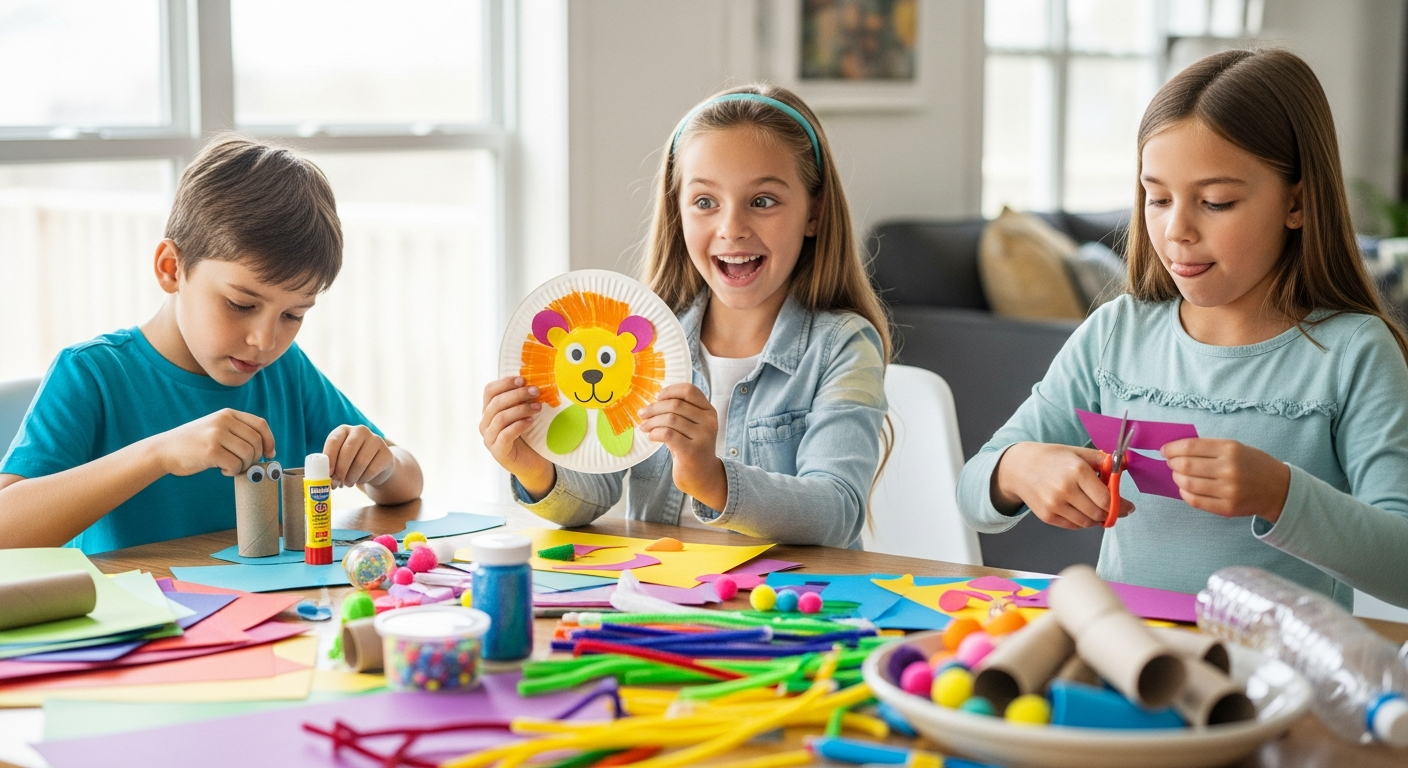
Table of Contents
- Introduction
- Why Crafts Are Developmental Superheroes
- Speech Blubs: Your Co-Pilot in the Crafting and Communication Journey
- Our Favorite Easy Crafts for Kids to Do at Home
- Speech Blubs: Your Partner in Building Confident Communicators
- Conclusion
- Frequently Asked Questions
Introduction
Have you ever watched a child's face light up as they transform a simple piece of paper into a soaring airplane, or a cardboard box into a magnificent robot? That spark of creativity, that intense focus on a developing masterpiece, is pure magic. In a world brimming with digital distractions, the tactile joy of crafting offers a profound opportunity for discovery, learning, and connection. It’s more than just keeping little hands busy; it’s about nurturing imagination, building crucial developmental skills, and creating cherished family memories.
This post is your ultimate guide to unlocking that magic with over 40 fantastic, easy crafts for kids to do at home, using materials you likely already have. We'll explore how these hands-on activities are not just fun, but powerful tools for cognitive growth, fine motor development, and most importantly, boosting communication skills. We believe that every child deserves the chance to express themselves fully, and here at Speech Blubs, we are committed to providing immediate, effective, and joyful solutions that blend scientific principles with play. Get ready to dive into a world where everyday objects become extraordinary creations, and every craft project is an adventure in speaking minds and hearts.

Why Crafts Are Developmental Superheroes
Crafting is far more than just a pastime; it's a foundational activity that supports a wide range of developmental milestones in children. When kids engage in arts and crafts, they're not just making something pretty; they're building critical skills that will serve them throughout their lives.
Fine Motor Skill Fortification
Think about all the intricate movements involved in crafting: cutting with scissors, gluing small pieces, drawing delicate lines, painting within boundaries, or threading beads. Each of these actions hones fine motor skills, strengthening the small muscles in the hands and fingers. This precision is vital for tasks like writing, buttoning clothes, and even eating independently. For a younger child, simply tearing paper or squeezing a glue bottle offers a fantastic workout for these developing muscles.
Cognitive Growth and Problem-Solving
Crafts inherently encourage problem-solving. A child might ask, "How do I make this stand up?" or "What color should I use here?" They're learning to plan, to experiment, to adapt when something doesn't go as expected, and to see a project through to completion. This process builds resilience, critical thinking, and the ability to follow multi-step instructions—all invaluable cognitive abilities. Imagining the final product and then working backward to create it is a powerful exercise in executive function.
Unleashing Creativity and Imagination
Perhaps the most obvious benefit, crafts provide an open canvas for imagination. There’s no right or wrong way to decorate a paper plate mask or design a goofy robot. This freedom allows children to express their unique perspectives, feelings, and ideas without judgment. It’s a safe space for them to explore fantasy worlds, tell stories, and develop their artistic voices, fostering self-esteem and confidence in their own creative capabilities.
Emotional Expression and Sensory Exploration
Crafts offer a wonderful outlet for emotional expression. Children can choose colors, shapes, and themes that reflect their current mood or interests, providing a non-verbal way to communicate. Furthermore, many crafts engage multiple senses—the feel of gooey glue, the smell of paint, the texture of different papers. This sensory exploration is crucial for brain development, helping children to better understand and interact with their environment.

Boosting Language and Communication Skills
This is where crafting truly shines as a partner in language development. Every step of a craft project is ripe with opportunities for verbal interaction and skill-building.
- Vocabulary Expansion: As you craft, you naturally introduce new words: "sticky glue," "sparkly glitter," "rough sandpaper," "smooth paper," "sharp scissors," "curved line." Describing colors, shapes, and textures broadens a child's lexicon.
- Following Instructions: Craft tutorials involve a sequence of steps. "First, cut the paper. Then, glue it here." This helps children understand and respond to multi-step commands, a vital language comprehension skill.
- Expressing Ideas and Choices: "What color should we paint this?" "Do you want to add stars or circles?" These questions encourage children to make choices, articulate their preferences, and describe their creative vision.
- Storytelling and Narration: Once a craft is complete, it often inspires storytelling. A monster puppet might have a silly adventure, or a paper plate pizza might be served at a make-believe restaurant. Narrating these stories develops sequencing, descriptive language, and imaginative play.
For a parent whose child might be a "late talker" or struggling with expressive language, crafting provides a low-pressure, engaging environment to practice these skills. For example, during a simple paper plate animal craft, a child who loves animals can use the "Animal Kingdom" section of our Speech Blubs app to practice animal sounds like "moo" or "baa," and then integrate those sounds into their craft play. This makes the learning context meaningful and fun, transitioning from structured app practice to spontaneous creative play. At Speech Blubs, we are dedicated to helping every child find their voice, and activities like crafting provide the perfect real-world laboratory for language growth.
Speech Blubs: Your Co-Pilot in the Crafting and Communication Journey
We know that parenting can be a whirlwind, and finding engaging, educational activities that also support speech and language development can feel like a tall order. That's why we created Speech Blubs. Our company was born from the personal experiences of our founders, who all grew up with speech problems and created the tool they wished they had. Our mission is to empower children to speak their minds and hearts, providing an immediate, effective, and joyful solution for the 1 in 4 children who need speech support.
We achieve this through our unique "smart screen time" approach, blending scientific principles with play. Unlike passive viewing experiences like cartoons, Speech Blubs provides a screen-free alternative that encourages active participation. Our core methodology is "video modeling," where children learn by watching and imitating their peers. This natural, engaging process is incredibly effective for developing complex communication skills.
Seamlessly Integrating Speech Blubs into Craft Time
Think of Speech Blubs as a powerful warm-up or cool-down activity for your crafting session.
Before the Craft: Setting the Stage for Language
- Vocabulary Prep: Before making a "Paper Plate Animal," explore the "Animal Kingdom" section in Speech Blubs. Your child can practice the names and sounds of different animals, making the craft more meaningful. If you're building a "Goofy Robot," use our "Occupations" section to talk about different jobs robots might do, expanding their vocabulary before construction even begins.
- Action Words: Many crafts involve actions like "cut," "glue," "paint," "fold," "mix," or "tear." Practice these action words within the app's "Action Words" section, preparing your child to use them verbally during the activity.
- Concept Introduction: If you're creating a "Colorful Butterfly," use Speech Blubs to review colors or simple shapes, reinforcing these concepts before they apply them to their art. For a child learning to identify shapes, our "Shapes" category can be a fun pre-craft activity.
During the Craft: Active Communication
- Descriptive Language: As you craft, narrate your actions and encourage your child to do the same. "I am cutting the red paper," or "Let's put the sticky glue on the round eye." This models rich descriptive language.
- Requesting and Asking Questions: Encourage your child to ask for materials: "More glue, please!" or "Where's the blue crayon?" If a child is non-verbal or minimally verbal, they can point or use single words, and you can model the full sentence.
- Imitation and Reinforcement: If your child is struggling with a particular sound or word, you can gently guide them. For instance, while making "Monster Puppets," you can use a monster sound from Speech Blubs and encourage imitation. The video modeling approach in our app, where children imitate other children, can make this imitation feel more natural and less like a "test."
After the Craft: Storytelling and Sharing
- Show and Tell: Encourage your child to describe their finished craft. "Tell me about your shiny robot!" "What does your paper plate pizza have on it?" This builds narrative skills and confidence.
- Imaginative Play: Use the finished crafts as props for imaginative play. Your "Dinosaur Feet" can stomp through a pretend jungle, or your "Recycled Guitar" can be part of a family concert. This extends the language learning beyond the craft itself. For children who may be shy or struggle with expressing themselves, creating a character through a craft can offer a safe avenue for communication. They can "speak" through their puppet or character, building confidence without direct pressure.
- Emotional Connection: Discuss how the craft makes them feel. "Are you proud of your flower?" This helps develop emotional vocabulary.
At Speech Blubs, we understand that every child's journey is unique. Our app is designed to be a powerful supplement to a child's overall development plan and, when applicable, professional therapy, providing a valuable tool for family connection and growth. We offer tools that empower children to communicate more effectively, fostering a love for communication, building confidence, and reducing frustration.
Ready to see how Speech Blubs can transform your child's communication journey? Download Speech Blubs on the App Store or Google Play to begin your 7-day free trial! Unsure if your child could benefit? Take our quick 3-minute preliminary screener to get a simple assessment and a free 7-day trial.
Our Favorite Easy Crafts for Kids to Do at Home
These craft ideas are designed to be low-cost, low-mess (mostly!), and high-impact, perfect for sparking creativity and conversation at home. Remember, the best part isn't the perfect outcome, but the process of creation and connection.
Paper & Cardboard Creations: Simple Supplies, Endless Possibilities
Paper and cardboard are perhaps the most versatile and readily available craft materials. With just a few basic tools, children can create entire worlds.
Paper Plate Wonders
Paper plates are not just for picnics! They're a fantastic base for countless crafts, offering a sturdy, circular canvas.
- Paper Plate Animals: Cut out shapes for ears, eyes, and noses, then glue them onto a paper plate to create a variety of animals like lions, pigs, or cats. Kids can practice animal sounds and names. For a parent whose 3-year-old "late talker" loves animals, the "Animal Kingdom" section of Speech Blubs offers a fun, motivating way to practice "moo" and "baa" sounds before making a cow or sheep mask.
- Paper Plate Masks: Cut eye holes, then decorate with paint, markers, feathers, or yarn. Encourage kids to act out characters with their masks, fostering imaginative play and role-playing dialogue.
- Paper Plate Suns and Rainbows: Paint plates yellow for the sun, and add strips of colored paper or yarn for rays. For a rainbow, use arched strips of colored paper. Discuss colors and weather.
- Paper Plate Food: Make pretend pizzas with construction paper toppings, or ice cream cones using cotton balls for scoops. Practice naming food items and discussing preferences ("Do you like pepperoni?").
- Paper Plate Spin Art: A classic! Use a salad spinner (or just spin by hand) with dollops of paint on a plate to create mesmerizing, abstract designs. Discuss colors and patterns.
Toilet Paper Roll Transformations
Don't toss those empty toilet paper rolls! They are goldmines for creativity.
- Toilet Paper Roll Animals/Characters: Paint or cover rolls with paper, then add features to make animals (ladybugs, owls) or characters (Olaf, robots). These are great for developing character voices and storytelling.
- Cardboard Tube Telescopes: Decorate a paper towel or toilet paper roll with paint, stickers, or glitter. Kids can use it for "bird-watching" or "stargazing," encouraging observation and nature vocabulary.
- String Puppets: Use cardboard rolls for the body, adding string for limbs. Kids can decorate them as people or monsters, then manipulate them, practicing actions and simple narratives.
Construction Paper Magic
Construction paper, with its vibrant colors, is a staple for a reason.
- Paper Chain Jewelry/Decorations: Cut paper into strips, loop them, and glue/staple to create chains. Great for counting, color recognition, and discussing patterns. Make necklaces, bracelets, or colorful garlands.
- Construction Paper Weaving: Cut slits in one piece of paper, and weave strips of another through them. This is excellent for fine motor skills and understanding patterns.
- Simple 3D Flowers: Cut strips of various lengths, curl them, and glue them into flower shapes on a paper base. Discuss flower parts and colors.
- Handprint Art: Trace your child's hands to create butterflies, trees, or other shapes. This is a wonderful way to capture memories and discuss body parts.
- Paper Mosaic Crafts: Tear or cut colored construction paper into small pieces and glue them onto a drawing or template to create a mosaic. This focuses on fine motor skills and color recognition, and is perfect for practicing shape names like "square" or "triangle."
Sensory & Messy Fun (Controlled Chaos for Learning!)
Some of the best crafts involve getting a little messy – and that's okay! These activities engage multiple senses and provide unique learning opportunities.
- Homemade Clay: Mix baking soda, cornstarch, water, and food coloring to create safe, non-toxic clay. Kids can mold, squish, and shape, developing hand strength and creativity. Discuss textures ("squishy," "soft") and actions ("roll," "flatten").
- Homemade Finger Paint: A simple mix of sugar, water, cornstarch, and food coloring creates a fantastic sensory experience. Kids can experiment with colors and textures on a large scale. Our "Sensory Play" section in Speech Blubs can help connect these tactile experiences with words.
- Ooey Gluey Suncatchers: Use glue and food coloring to create beautiful, translucent designs that can be hung in a window. This activity teaches patience and color mixing.
- Easy Sidewalk Paint/Chalk: Mix cornstarch, water, and food coloring for temporary outdoor art. A great way to take creativity outside and practice writing letters or drawing large shapes, engaging gross motor skills.
- Paint with Bubbles: Mix dish soap, water, and non-toxic paint, then blow bubbles onto paper. Kids love the surprise element and the abstract designs. Practice words like "blow," "pop," and "colorful."
Recycled Material Adventures: Turning Trash into Treasure
Repurposing household items for crafts teaches resourcefulness and sparks incredible ingenuity.
- Goofy Robots: Collect cardboard boxes of various sizes, plastic bottle caps, aluminum foil, and other odds and ends. Kids can glue, tape, and decorate their robots, giving them unique personalities and functions. This activity is a fantastic way to introduce vocabulary related to body parts (head, arms, legs) and actions (walk, talk).
- Recycled Guitar: An old shoebox, a paper towel roll, and a few rubber bands can become a working guitar! Kids can decorate it and experiment with sound, learning about cause and effect. Sing songs and practice music-related vocabulary.
- Water Microscope: Use a large googly eye, a paper cup, and water to create a simple magnifying tool. Great for curious kids interested in science, observing small objects like leaves or flowers. Introduce scientific vocabulary.
- DIY Keychains from Soda Cans: With adult supervision for cutting, soda cans can be transformed into unique keychains. This teaches about recycling and design.
- Pill Bottle Organizers: Decorate empty pill bottles to create small organizers for tiny treasures. Discuss sorting and categorizing objects.
Nature & Outdoor Inspired Crafts: Bringing the Outside In
Connecting crafts to nature inspires appreciation for the environment and expands relevant vocabulary.
- Flower Pens/Paper Filter Flowers: Use plastic flowers or coffee filters with food coloring to create beautiful floral decorations. Discuss flower names, parts, and colors.
- Easy Painted Rocks: Collect smooth rocks and paint them with bright designs, animals, or positive messages. These can be hidden for others to find, fostering community and kindness. Practice descriptive language about what they paint.
- Leaf Rubbings: Place leaves under paper and rub crayons over them to reveal their intricate patterns. Discuss leaf shapes, textures, and tree names.
Speech Blubs: Your Partner in Building Confident Communicators
At Speech Blubs, we believe that every child deserves the chance to communicate effectively and joyfully. Our entire approach is built on this foundation, born from our founders' personal journeys with speech challenges. We are committed to providing an immediate, effective, and joyful solution for the 1 in 4 children who need speech support, empowering them to speak their minds and hearts.
Our unique "video modeling" methodology is at the heart of what we do. Children learn best by watching and imitating their peers, and our app provides engaging "smart screen time" experiences that are miles away from passive cartoon viewing. This active learning environment is carefully designed to foster complex communication skills, from vocabulary and sentence structure to pronunciation and social cues. We provide a powerful tool for family connection, creating moments of shared learning and progress. You can explore the scientific research behind our highly-rated method and learn why we are trusted by thousands of families worldwide.
We understand that you, as parents, are looking for tools that truly make a difference. Speech Blubs is designed to be a supportive supplement to your child's overall development, reducing frustration and building confidence. It helps children develop key foundational skills for communication, fostering a lifelong love for language. Remember, consistent engagement, just like with crafting, yields the most rewarding results.
The Value of Speech Blubs: Choose Your Path to Progress
We offer flexible plans to fit your family's needs, but we truly believe in the superior value of our Yearly plan. Transparency is key to building trust, so let’s look at the options:
- Monthly Plan: For $14.99 per month, you get access to our core Speech Blubs app. This plan is ideal if you want to try it out for a short period, but it doesn't unlock the full range of benefits.
- Yearly Plan: This is our best value, priced at just $59.99 per year. That breaks down to an incredible $4.99 per month, which means you save 66% compared to the monthly option!
Why the Yearly Plan is the Best Choice:
Choosing the Yearly plan isn't just about saving money; it's about getting the complete, most enriching experience for your child's communication journey. With the Yearly plan, you receive:
- A 7-Day Free Trial: Experience the full power of Speech Blubs before committing. The Monthly plan does NOT include this trial.
- The Extra Reading Blubs App: Unlock our companion app, designed to further support literacy and language skills, seamlessly integrating with your child's learning.
- Early Access to New Updates: Be among the first to explore new features, activities, and content as we continuously enhance the Speech Blubs experience.
- 24-Hour Support Response Time: Get your questions answered quickly and efficiently with priority customer service.
The Monthly plan does not include these exclusive, high-value benefits. We want to give your child the best chance to thrive, and the Yearly plan provides the full suite of tools and support to make that happen.
Ready to invest in your child's communication future and unlock the full Speech Blubs experience? Start your 7-day free trial and choose the Yearly plan today! Download Speech Blubs on the App Store or Google Play to get started. Don't just take our word for it—see what other parents are saying about their child's success with Speech Blubs.
Conclusion
Easy crafts for kids to do at home offer a treasure trove of benefits, far beyond simple entertainment. They are powerful catalysts for developing fine motor skills, boosting cognitive abilities, nurturing creativity, and providing vital avenues for emotional expression. Most importantly, they create rich, organic opportunities for language development, turning everyday materials into tools for communication growth and joyful family connection.
By engaging in these hands-on activities, you're not only helping your child build tangible creations but also fostering their ability to "speak their minds and hearts." And when you combine the magic of crafting with the scientifically-backed, playful approach of Speech Blubs, you create an unparalleled environment for comprehensive growth. Our app acts as a supportive partner, reinforcing vocabulary, practicing action words, and encouraging storytelling, making every moment count.
We invite you to embark on this incredible journey of creativity and communication with your child. Fuel their imagination, strengthen their skills, and watch their confidence blossom. Ready to see the amazing difference Speech Blubs can make? Create your account and begin your 7-day free trial today! Remember to select the Yearly plan to unlock the full suite of features, including the extra Reading Blubs app and priority support, all while saving 66%. Download Speech Blubs on the Apple App Store or Google Play Store and start building joyful, confident communicators today!
Frequently Asked Questions
Q1: What age group are these easy crafts best suited for?
These crafts are generally appropriate for children aged 3 to 10 years old, but many can be adapted for younger toddlers with more adult supervision or simplified for older children to encourage more complex designs and independent work. The key is to focus on the process and the skills being developed, rather than just the final product.
Q2: How can I encourage my child to talk more during craft time?
Narrate your own actions ("I am cutting the blue paper"), ask open-ended questions ("What should we add next to make it sparkle?"), describe materials and colors, and encourage them to describe their choices. For children needing extra support, integrate activities from Speech Blubs, like practicing action words or animal sounds, just before or during the craft to provide a structured way to practice specific vocabulary in a fun context.
Q3: What if my child gets frustrated during a craft?
Frustration is a normal part of learning. Offer gentle encouragement, break the task down into smaller steps, or offer to help. Remind them that it's okay if it's not "perfect" and that the fun is in trying and creating. Sometimes, simply taking a short break or switching to another activity can help reset their mood. The goal is enjoyment and learning, not flawless execution.
Q4: How does Speech Blubs pricing work, and what's the best value?
Speech Blubs offers a Monthly plan at $14.99 and a Yearly plan at $59.99. The Yearly plan offers the best value, breaking down to just $4.99 per month and providing a significant 66% saving. It also includes exclusive benefits like a 7-day free trial, the Reading Blubs app, early access to updates, and 24-hour support, which are not available with the Monthly plan. We highly recommend choosing the Yearly plan to get the full suite of features and the most comprehensive support for your child's communication journey.
About the author