
Amazing Games for Kids Party: Boost Fun and Development
 By Speech Blubs Team•Jan 28, 2026•18 min.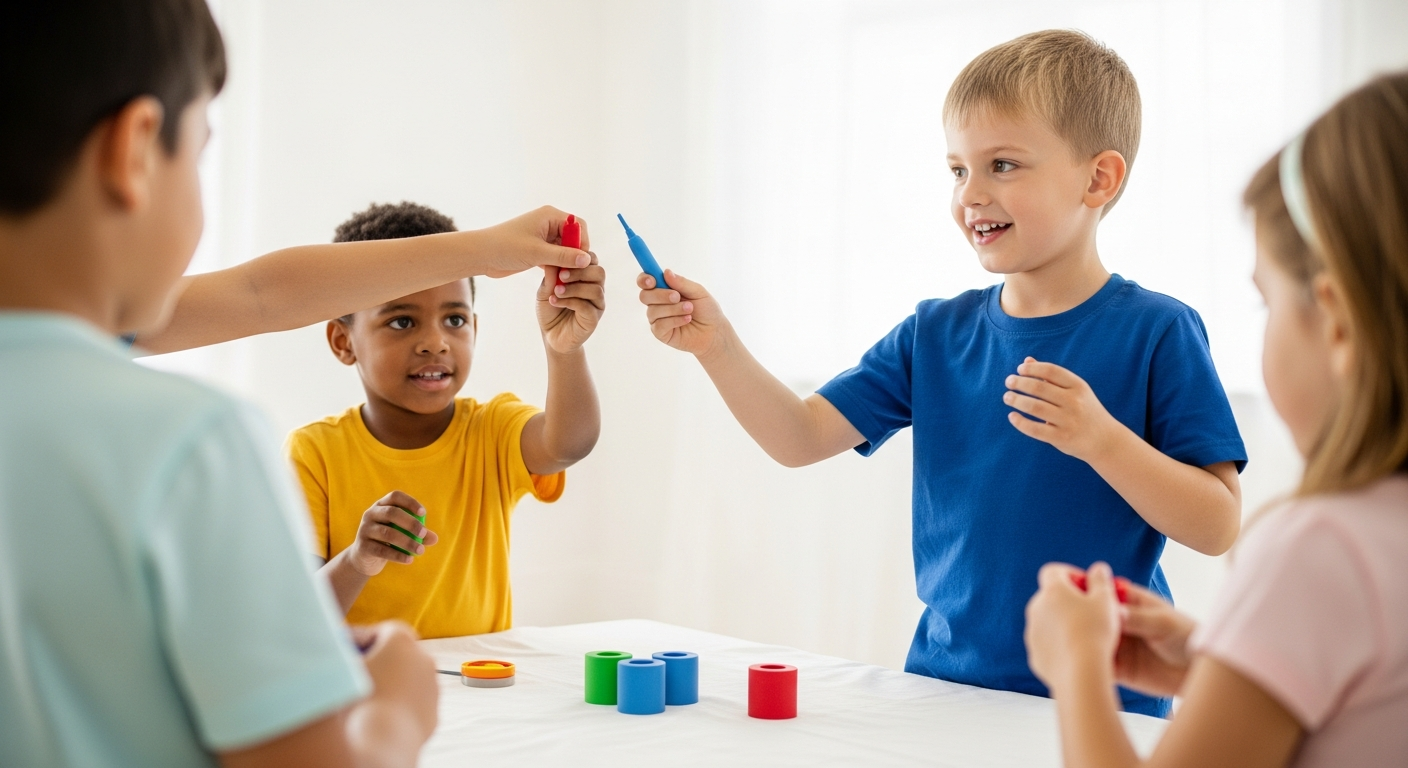
Table of Contents
- Why Party Games Are More Than Just Fun: The Developmental Benefits
- Choosing the Right Game for Every Party Age and Stage
- Transforming Party Play into Speech-Boosting Moments with Speech Blubs
- Making the Most of Your Speech Blubs Journey: Plans & Pricing
- Conclusion: Celebrate, Play, and Grow
- FAQ
The air is buzzing with anticipation, a vibrant mix of laughter, tiny shouts, and the happy chaos that only a child's party can bring. For many parents, planning a successful birthday bash or a simple playdate gathering often revolves around one crucial element: the games. But what if those joyful moments of play could be more than just entertainment? What if they could be powerful catalysts for your child's development, especially their communication skills?
It's a common misconception that party games are solely about keeping children occupied. In reality, the right game for a kids' party can be an incredible tool for fostering social interaction, building confidence, and significantly boosting language and speech development. This post isn't just about listing fun activities; it's about helping you discover how to select and adapt games to create enriching experiences that support your child's journey to "speak their minds and hearts." We’ll explore how popular party games inherently encourage communication, and how a tool like Speech Blubs can seamlessly extend that learning beyond the party, offering immediate, effective, and joyful speech support that truly blends scientific principles with play.

Why Party Games Are More Than Just Fun: The Developmental Benefits
Children are natural learners, absorbing information and developing skills through every interaction. Party games, in their vibrant and engaging nature, offer a unique playground for holistic development. They provide a structured yet playful environment where children can practice a multitude of skills without even realizing they're learning.
Fostering Social Skills and Emotional Regulation
Imagine a game of "Red Light, Green Light" or "Musical Chairs." These aren't just about running or sitting; they're micro-lessons in social dynamics. Children learn to take turns, share space, understand rules, and experience winning and losing gracefully. They practice patience, learn to read social cues from their peers, and develop empathy. For a child who might struggle with navigating social situations or expressing their feelings, the low-stakes, high-fun environment of a party game can be a safe space to practice these crucial interactions. When they successfully participate, even in a small way, it builds immense confidence and reduces frustration, which are vital precursors to effective communication.
Boosting Cognitive Development and Problem-Solving
Many party games inherently involve cognitive challenges. A scavenger hunt requires problem-solving to decipher clues and spatial reasoning to locate items. "Simon Says" demands acute listening skills and working memory to follow specific instructions (or not!). These activities stimulate various parts of the brain, enhancing focus, attention span, and critical thinking. When children are engaged in these mental gymnastics, their minds are primed for learning new vocabulary, understanding complex instructions, and formulating their own thoughts, all of which are foundational to advanced language development.
Enhancing Physical Coordination and Motor Skills
From tossing beanbags in "Cornhole" to jumping through an "Obstacle Course," party games are fantastic for physical development. Fine motor skills improve with tasks like picking up small objects, while gross motor skills are refined through running, jumping, and balancing. This physical engagement is often directly linked to cognitive readiness for speech. Activities that coordinate movement and thought can help organize neural pathways, which indirectly supports the complex motor planning required for articulate speech.

Crucially, Developing Communication and Language
Perhaps most importantly, every single game for a kids' party offers a rich context for communication and language practice. Whether it's verbalizing rules, asking questions, describing actions, negotiating turns, or cheering on a friend, children are constantly using and processing language.
- Receptive Language: Understanding instructions, listening to others, interpreting cues.
- Expressive Language: Stating preferences, describing observations, asking for help, explaining actions, and even inventing stories.
- Pragmatics: Learning the social rules of conversation, taking turns in dialogue, maintaining eye contact, and understanding non-verbal communication.
For a parent whose child is a "late talker" or is working on specific speech sounds, these games are invaluable. They provide natural, motivating scenarios for practicing target words or phrases. For instance, cheering "Go!" during a race, saying "My turn!" or "Your turn!" in a board game, or describing an object found in a scavenger hunt all offer organic opportunities for speech practice in a fun, pressure-free environment.
At Speech Blubs, we understand this intrinsic link between play and development. Our mission, born from the personal experiences of our founders who faced their own speech challenges, is to empower every child to "speak their minds and hearts." We provide an immediate, effective, and joyful solution for the 1 in 4 children who need speech support, seamlessly blending scientific principles with engaging play, much like the best party games do. We’ve designed our unique "smart screen time" experiences to be a powerful, screen-free alternative to passive viewing, fostering family connection and active learning.
Choosing the Right Game for Every Party Age and Stage
Selecting the perfect game for a kids' party means considering the age and developmental stage of the children attending. What captivates a toddler might overwhelm an older child, and vice-versa. Tailoring your game choices ensures maximum engagement and developmental benefit.
Toddlers (1-3 years): Sensory Play & Simple Imitation
For the youngest partygoers, simplicity and sensory engagement are key. Games should involve very few rules, lots of movement, and opportunities for imitation.
- Bubble Popping: A classic that never fails. A simple bubble machine provides endless fascination. As children chase and pop bubbles, encourage them to say "pop!" or "more!" This encourages early vocalizations and word imitation.
- Follow the Leader (Simple Version): The adult or a slightly older child performs simple actions (clap hands, stomp feet, touch nose), and toddlers imitate. This is excellent for motor imitation, a precursor to speech imitation, and introduces directional language.
- Parachute Play: A colorful parachute is a magical tool. Lift it high, pull it low, run underneath. Ask "Where did the ball go?" when a lightweight ball is placed on top and made to bounce. This activity encourages anticipation, shared attention, and basic language.
- Treasure Dig: Fill a sandbox or a large bin with sand or even rice and hide a few large, colorful toys. Give toddlers small shovels and cups. As they dig, encourage them to describe what they find: "Big truck!" "Red ball!" "Shiny!" This promotes descriptive language and object identification.
Preschoolers (3-5 years): Imaginative Play & Basic Rules
Preschoolers are ready for games with slightly more structure, imaginative elements, and opportunities to practice early social skills like turn-taking and sharing.
- Simon Says: This timeless game hones listening skills and the ability to follow directions. "Simon says touch your nose!" "Simon says jump!" It's also a playful way to introduce the concept of auditory discrimination ("Don't do it if Simon doesn't say!").
- Duck Pond Matching Game: Place plastic ducks (with numbers or shapes drawn on the bottom) in a baby pool. Children "fish" for ducks and find matches. This practices early numeracy, shape recognition, and turn-taking. Encourage them to say "I found a match!" or "Number two!"
- Charades (Simple): Write down simple actions or animals on slips of paper (e.g., "sleep," "jump," "dog," "cat"). Children act them out without speaking. This is brilliant for encouraging non-verbal communication, expressive language, and vocabulary. "For a child who is just starting to string words together, acting out 'jump' can be a bridge to saying the word with confidence."
- Keep It Up (Balloon Game): The goal is simple: don't let the balloon touch the ground! This promotes teamwork, gross motor skills, and provides opportunities to use words like "up," "down," "my turn," "your turn."
Early Elementary (5-8 years): Teamwork & Strategy
At this age, children enjoy games with more complex rules, team elements, and opportunities for strategic thinking. They are ready to engage in more elaborate verbal interactions.
- Red Light, Green Light: A classic that teaches impulse control, listening skills, and spatial awareness. The "stoplight" person can practice clear vocal commands, while "traffic" players learn to follow auditory cues.
- Scavenger Hunt: Create a list of items (pictures for non-readers, words for readers) for children to find. This encourages teamwork, problem-solving, and descriptive language. "I found a blue feather!" "Is this the round stone?" This is a fantastic way to expand vocabulary and practice asking and answering questions.
- Obstacle Course: Design a simple course using household items (pillows to jump over, blankets to crawl under, cones to weave through). Children can time each other or race. This is excellent for following multi-step directions, using prepositions ("over," "under," "through"), and providing clear instructions to others.
- Ring Toss or Cornhole: These games refine hand-eye coordination and provide opportunities to practice counting, turn-taking, and simple scoring. "I got two points!" "Your turn to throw!"
- Sardines: A fun twist on hide-and-seek where only one person hides, and everyone else looks. As each person finds the hider, they join them. This encourages stealth, quiet communication, and the use of directional language ("They're behind the tree!").
Older Kids (8+ years): Complex Challenges & Collaboration
Older children thrive on games that offer a genuine challenge, require deeper strategic thinking, and foster robust collaboration.
- Capture the Flag: A classic team game that demands strategy, communication, and negotiation. Children learn to plan, execute, and adapt. The need for clear communication within teams is paramount.
- NERF Wars: Set up a battlefield with obstacles. This high-energy game encourages strategic planning, teamwork, and quick decision-making, often requiring verbal communication for coordination.
- Mini Golf (DIY): Create a course with cups as holes and various household items as obstacles. This involves spatial reasoning, problem-solving, and the use of directional and descriptive language ("You need to hit it softer," "It went around the box").
- Truth or Dare (Age-Appropriate): When carefully curated with silly truths and dares, this game encourages verbal expression, creative thinking, and can be a fun way to practice asking and answering questions. Pre-written options ensure it stays light and fun.
Remember, the goal isn't just to play, but to use these games as a springboard for communication. Engage with your child, narrate the actions, ask open-ended questions, and model clear language. These interactions are where true developmental magic happens.
Transforming Party Play into Speech-Boosting Moments with Speech Blubs
You've just hosted a fantastic party, filled with laughter and exciting games. The kids have practiced following directions, shared, taken turns, and maybe even used some new words. But what happens after the party decorations are packed away? How can you continue to nurture those budding communication skills in a fun, consistent way? This is where Speech Blubs steps in, extending the joy of play into targeted, scientifically-backed speech practice.
The Power of "Smart Screen Time": How We Help
We know screen time can be a concern for parents. That's why we at Speech Blubs have revolutionized it, transforming passive viewing into what we call "smart screen time." Unlike cartoons or other apps where children are simply consumers of content, Speech Blubs is an active, interactive experience. Our app requires children to participate, to imitate, and to respond, making it a truly engaging and educational screen time option.
Our company was born from a very personal place: our founders all grew up with speech problems and created the tool they wished they had. This personal journey fuels our commitment to providing immediate, effective, and joyful solutions for children who need speech support. We believe that learning to communicate should be an exciting adventure, not a chore.
Our Unique Video Modeling Approach: Learning from Peers
The core of our scientific methodology is "video modeling," a highly effective technique where children learn by watching and imitating their peers. This approach is rooted in developmental psychology, recognizing that children are often most motivated and effective at learning from other children. When a child sees another child of a similar age confidently making a sound or saying a word, it creates a powerful connection and encourages them to try it themselves. It's like having a friendly, encouraging peer tutor right there on the screen.
Think about it: at a party, children naturally imitate each other during games. They learn new movements for "Follow the Leader" by watching their friends. Our app harnesses this natural inclination. This isn't just about repetition; it's about seeing the full context of a word or sound being produced by a relatable model, reinforcing the mirror neuron system and making learning intuitive and fun. Our research-backed methodology consistently places us in the top tier of speech apps worldwide, a testament to its effectiveness. Explore the research behind our approach.
Real-World Scenario: Connecting Party Fun to App Practice
Let's imagine your child had a blast playing "Animal Charades" at a party. They loved acting like a lion or making "moo" sounds for a cow. This excitement is a perfect bridge to Speech Blubs.
- For a parent whose 3-year-old "late talker" loves animals and enjoyed making animal sounds during charades: The "Animal Kingdom" section within Speech Blubs offers a fun, motivating way to practice "moo" and "baa" sounds, as well as the names of various animals. Children watch other kids make these sounds and imitate them, often with giggles and enthusiasm. This reinforces the sounds they enjoyed at the party and builds their confidence in a structured, yet playful, environment.
- If your child was practicing action words during an "Obstacle Course," like "jump," "climb," or "run," our "Early Sounds" or "Action Words" categories can provide further practice. They’ll see peers demonstrating these actions and saying the corresponding words, solidifying their understanding and pronunciation.
- For a child learning to ask "What's that?" during a "Scavenger Hunt," Speech Blubs offers interactive scenarios that encourage asking questions and naming objects, building on that curiosity.
The beauty is in the continuity. The same energy and engagement from the party can be channeled into targeted speech development, making learning feel like an extension of play. This approach supports a child’s overall development plan and can be a powerful supplement to professional therapy, helping bridge the gap between sessions and ensuring consistent progress.
Beyond the Party: Consistent Support for Communication Growth
Speech Blubs offers much more than just a quick fix; it's a comprehensive tool designed to support long-term communication growth. With a vast library of activities, including sound practice, early words, sentences, and even reading preparation with our Reading Blubs companion app, we cater to various developmental stages. We also emphasize that our app is a tool for family connection, encouraging parents to play alongside their children, turning screen time into quality time.
If you're wondering if your child could benefit from targeted speech support, we've made it easy to find out. Take our quick 3-minute preliminary screener which involves 9 simple questions. You'll receive an assessment and a next-steps plan, along with an invitation to start a free 7-day trial of Speech Blubs.
With Speech Blubs, you’re not just downloading an app; you’re joining a community dedicated to empowering children to communicate effectively and confidently. See what other parents are saying about their child's success with Speech Blubs.
Making the Most of Your Speech Blubs Journey: Plans & Pricing
We believe in making effective speech therapy accessible and affordable for every family. To ensure transparency and help you choose the best fit, we offer two clear subscription plans for Speech Blubs: Monthly and Yearly.
Our Plans:
- Monthly Plan: For just $14.99 per month, you get access to our core Speech Blubs app. This plan offers flexibility for those who prefer a month-to-month commitment.
- Yearly Plan: Our most popular and highly recommended option is the Yearly plan, priced at $59.99 per year.
Why the Yearly Plan is Your Best Value:
Choosing the Yearly plan isn't just about saving money, though that's a significant benefit! You'll save a remarkable 66% compared to the monthly plan, bringing the cost down to an incredibly affordable $4.99 per month. This makes top-tier speech support more accessible for consistent, long-term development.
Beyond the savings, the Yearly plan unlocks an entire suite of exclusive, high-value features designed to supercharge your child's communication journey:
- 7-Day Free Trial: Experience the full power of Speech Blubs before committing. The Monthly plan does not include a free trial.
- The Extra Reading Blubs App: Get access to our companion app, Reading Blubs, which helps prepare children for reading through engaging, interactive activities, building on the foundational language skills developed in Speech Blubs.
- Early Access to New Updates: Be among the first to explore new features, games, and content as we continuously enhance the Speech Blubs experience.
- 24-Hour Support Response Time: Get priority support from our dedicated team, ensuring any questions or technical needs are addressed swiftly.
The Monthly plan, while flexible, does not include these exclusive benefits, nor does it offer a free trial. We designed the Yearly plan to provide the most comprehensive support and the greatest value for families committed to fostering their child's communication development.
Ready to embark on this transformative journey with your child? We encourage you to choose the Yearly plan to get your free trial and unlock the full suite of features that will empower your child to speak their minds and hearts. Start your 7-day free trial and sign up for the Yearly plan today! You can also download Speech Blubs directly from the App Store or Google Play Store to get started!
Conclusion: Celebrate, Play, and Grow
Party games are far more than just time fillers; they are dynamic platforms for learning, connection, and profound developmental growth. From the simplest game of "Pop the Bubbles" for toddlers to the strategic depths of "Capture the Flag" for older children, each activity offers unique opportunities to build social skills, cognitive abilities, physical coordination, and, most importantly, communication and language. By thoughtfully selecting and engaging in these games, you’re not just throwing a party; you’re investing in your child's holistic development.
At Speech Blubs, we are passionate about extending that playful learning into every day, providing a powerful, "smart screen time" solution that bridges the gap between fun and foundational speech development. Our unique video modeling approach, where children learn by imitating their peers, ensures that progress is not only effective but also joyful and engaging. We are committed to empowering every child to communicate their thoughts and feelings with confidence, making the journey to "speak their minds and hearts" an exciting adventure.
Don't let the learning stop when the party ends! Continue fostering your child’s communication skills with the support of Speech Blubs. Download Speech Blubs on the App Store or Google Play today to begin your 7-day free trial. Remember to select the Yearly plan to unlock your free trial, gain access to the Reading Blubs app, enjoy early updates, and receive priority support—all while saving 66%! Sign up for your free trial and start your journey towards confident communication.
FAQ
Q1: How can I encourage my shy child to participate in party games?
A1: Start with games that have less pressure or allow for individual contribution before team play. "I Spy" or "Treasure Dig" can be great as they don't require direct interaction with a large group initially. You can also play alongside your child, modeling participation. For more targeted practice at home, Speech Blubs offers a safe, engaging environment where children can practice communication skills by imitating peers, building confidence they can later transfer to social settings.
Q2: What if kids at the party have a wide range of ages?
A2: Choose versatile games that can be easily adapted. For example, a "Scavenger Hunt" can have picture clues for younger kids and written clues for older ones. "Obstacle Courses" can have simpler or more complex challenges. Involve older children in helping the younger ones, fostering leadership and empathy. Many of the games we’ve discussed, like "Parachute Play" or "Charades," can be simplified or made more complex to suit different age groups simultaneously.
Q3: How do party games specifically help with speech development, beyond just general interaction?
A3: Party games create natural, highly motivating contexts for practicing specific speech and language skills. For instance, "Simon Says" directly practices receptive language (following commands), "Charades" boosts expressive language (non-verbal and verbal description), and "Red Light, Green Light" improves auditory processing and impulse control, all crucial for speech. When you narrate the game, ask open-ended questions, and model correct language during play, you amplify these benefits. Speech Blubs then offers targeted reinforcement of these skills through our video modeling activities.
Q4: Is Speech Blubs a replacement for traditional speech therapy?
A4: Speech Blubs is a powerful supplemental tool designed to complement and enhance a child's overall communication development. It provides consistent, engaging practice in a fun, accessible format, which can be particularly beneficial for the 1 in 4 children who need speech support. While it incorporates scientifically proven methods like video modeling, it is not a substitute for professional speech-language pathology diagnosis or personalized therapy plans for complex needs. We encourage parents to consult with a speech therapist to determine the best approach for their child, and Speech Blubs can serve as an excellent resource to support progress between therapy sessions.
About the author