
Best Toddler Craft Supplies for Creative Play at Home
 By Speech Blubs Team•Feb 20, 2026•13 min.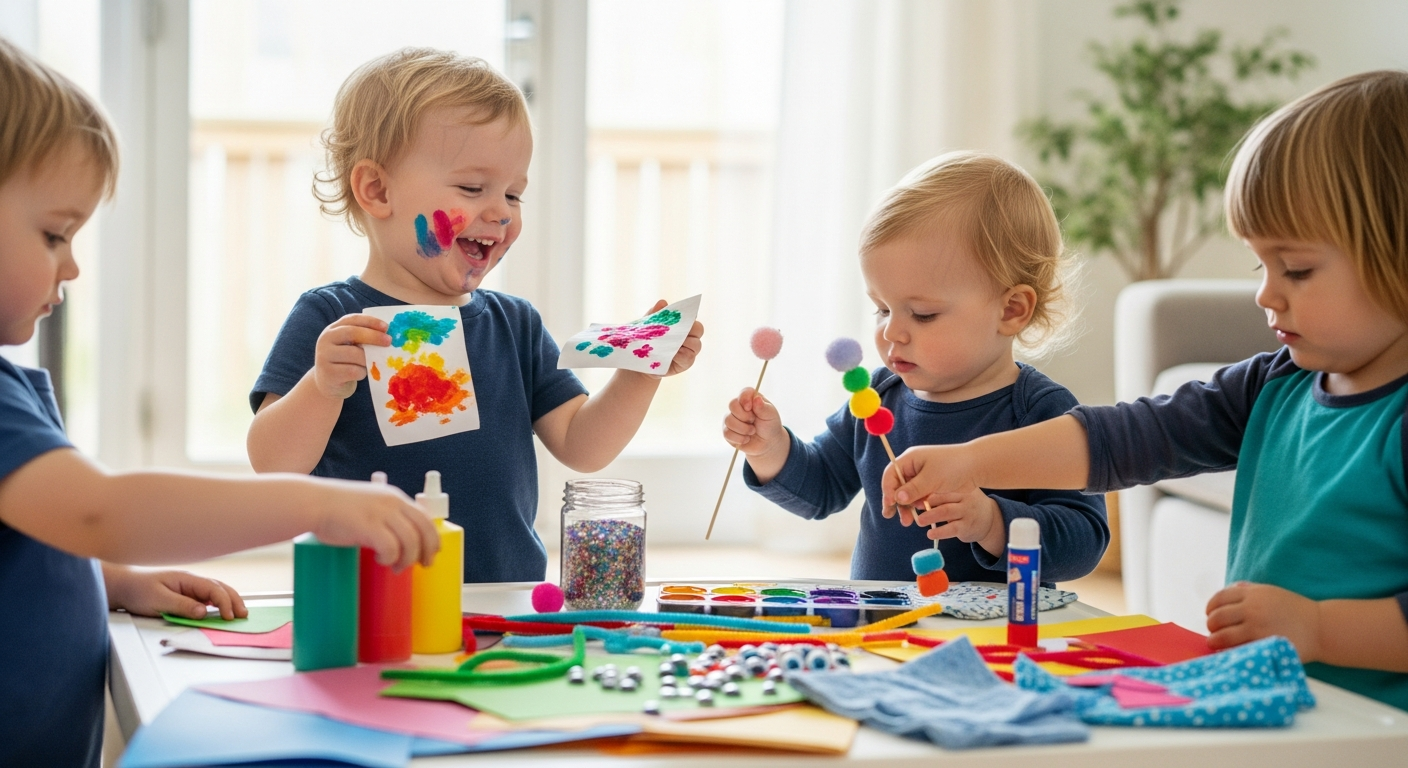
Table of Contents
- Introduction
- Why Creative Play is Essential for Language Development
- The Best Toddler Craft Supplies for Drawing and Painting
- Mess-Free Crafting: Stickers, Tape, and Paper
- Sensory and Three-Dimensional Fun
- Essential Tools for Success and Safety
- Our Scientific Approach: Learning Through Peer Modeling
- Practical Scenarios: Connecting Art to Speech
- Why Speech Blubs is the Perfect Supplement
- Choosing the Right Plan for Your Family
- Conclusion
- FAQs
Introduction
Have you ever walked into your living room to find your toddler proudly displaying a "mural" drawn in crayon across your freshly painted white walls? While your first instinct might be to reach for the magic eraser, that moment of messy creativity is actually a massive milestone in your child's development. At Speech Blubs, we believe that every scribble, smudge, and sticky fingerprint is a form of communication. For a toddler, art isn't just about making something pretty; it is about finding a way to "speak" before they have all the words they need.
In this post, we are going to dive deep into the world of creative play by identifying the best toddler craft supplies that foster independence, build fine motor skills, and spark joy—all while keeping the cleanup manageable for you. We’ll explore everything from vibrant paint sticks to sensory-rich play dough, and show you how to turn these activities into powerful language-building moments.

Our mission at Speech Blubs is to empower every child to speak their minds and hearts. We know that the journey to confident communication often starts with play. By the end of this article, you’ll have a curated list of essential supplies and a strategy for using them to support your child’s blossoming voice.
Why Creative Play is Essential for Language Development
It might seem like a stretch to connect a bottle of glue to speech therapy, but the two are intimately linked. When a child engages in "process art"—where the focus is on the doing rather than the final product—they are exercising their brains in ways that directly support communication.
Building the Foundation for Speech
Communication is a complex skill that requires more than just vocal cords. It requires focus, the ability to follow multi-step directions, and the fine motor control needed to coordinate the tongue and lips. Interestingly, the same neural pathways used for fine motor tasks (like holding a paintbrush) are closely linked to those used for speech. By providing the best toddler craft supplies, you are giving your child a "gym" for their developing brain.
Narrating the Process
Art provides a natural "script" for parents to model language. As your child works, you can narrate their actions: "You are squeezing the blue paint," or "Look at that long line!" This rich, contextual vocabulary helps toddlers map words to actions and objects in real-time. If you are ever unsure where your child stands in their development, taking a quick 3-minute preliminary screener can provide a helpful assessment and a roadmap for your next steps.
The Best Toddler Craft Supplies for Drawing and Painting
When you’re first starting out, the sheer number of options can be overwhelming. You want supplies that are vibrant enough to be satisfying but safe and washable enough to keep your home intact. Here are our top recommendations:
1. Tempera Paint Sticks
If we could only pick one "hero" product, it would be paint sticks. Imagine a giant, vibrant crayon that glides onto paper with the richness of real paint but dries in seconds. These are perfect for toddlers who haven't yet mastered the pressure needed for colored pencils. They offer immediate visual feedback, which builds confidence.

Pro-Tip: For a parent whose 3-year-old "late talker" loves animals, use paint sticks to draw a big green meadow. As you "stamp" the stick on the paper, you can practice the "p-p-p" sound for "paint" or "pop," which are great foundational speech sounds.
2. Dot Markers
Dot markers are a staple in almost every early childhood classroom for a reason. They are easy for small hands to grip and allow children to create "dots" of color with a simple tapping motion. This repetitive action is great for practicing rhythmic speech patterns. You can say "dot, dot, dot" as they work, encouraging them to imitate the sound and the movement.
3. Washable Tempera Paint and Thick Brushes
While "mess-free" is great, sometimes you just need to let them get their hands dirty. Traditional tempera paint is essential for teaching cause and effect (like color mixing). We recommend using "spill-proof" paint cups and thick, stubby brushes designed for a toddler’s palmar grasp.
4. Watercolor Palettes
Watercolors are fantastic because they require a different kind of focus. Teaching a toddler to dip their brush in water, then the paint, then the paper is a fantastic exercise in following a sequence. For older toddlers, we recommend palettes with larger "disks" of color to make it easier for them to succeed.
Mess-Free Crafting: Stickers, Tape, and Paper
Not every creative session needs to involve a bath afterward. Some of the best toddler craft supplies are completely dry.
5. Dot Stickers
Never underestimate the power of a sheet of office supply stickers. Peeling a sticker off a sheet and placing it on a specific spot is a high-level fine motor task. It requires "pincer grasp" strength, which is vital for later writing skills.
- Speech Connection: Use stickers to "label" things. Put a sticker on a toy "car" and say the word.
- Activity Idea: Draw a large letter (like the first letter of your child's name) and have them "trace" the letter by placing stickers along the lines.
6. Washi Tape
Washi tape is colorful, easy to tear by hand, and—most importantly—repositionable. You can let your toddler tape "roads" on the floor for their cars or create "frames" for their drawings. Because it doesn't leave a residue, it’s a low-stress way to encourage 2D construction.
7. A Variety of Paper Surfaces
Rotating your paper supply keeps the art area feeling fresh. Consider including:
- Construction Paper: For its sturdy texture and bright colors.
- Butcher Paper: Roll it out across the floor for a "mural" experience.
- Cardboard Boxes: The ultimate "free" craft supply. Turning a box into a house or a car provides endless opportunities for imaginative play and "pretend" language.
Sensory and Three-Dimensional Fun
Language is a multi-sensory experience. The more senses we involve, the stickier the learning becomes.
8. Play Dough and Tools
Play dough is the gold standard for sensory play. It builds hand strength, which is necessary for many daily tasks. When your child squishes, rolls, and cuts play dough, they are also engaging in symbolic play (e.g., "This circle is a cookie!").
- Speech Strategy: Practice "action" words. Squish, roll, cut, poke, hide. These simple verbs are the building blocks of early sentences.
9. Washable Liquid Glue and Pom Poms
Many parents fear liquid glue, but it is a fantastic tool for learning "just enough." Using a small squeeze bottle helps children develop hand strength and self-control. Pairing glue with soft pom poms or "googly eyes" allows them to create 3D characters, which can then become the stars of a story.
Essential Tools for Success and Safety
To make the most of the best toddler craft supplies, you need a few organizational "must-haves."
10. Trays and Smocks
A simple plastic tray (like a cafeteria tray) can define a child's workspace. It sends a visual cue that "the art stays here." Likewise, a waterproof smock or an old oversized T-shirt signals that it is okay to be messy.
11. Child-Safe Scissors
Learning to cut is a major milestone. Look for plastic-bladed scissors that only cut paper, not hair or clothing. Supervision is key, but allowing your child to "fringe" the edge of a piece of paper is incredibly satisfying for them and builds the bilateral coordination (using two hands together) that is necessary for many complex tasks.
12. Storage Solutions
If the supplies are a mess, you’re less likely to use them. We love using clear bins or a rolling "art cart" so children can see what is available. Independence is a core value we promote at Speech Blubs; when a child can choose their own materials, they feel empowered and more engaged in the process.
Our Scientific Approach: Learning Through Peer Modeling
At Speech Blubs, we don't just provide "screen time"; we provide "smart screen time." Our methodology is rooted in the science of video modeling. This is based on the idea of mirror neurons—the brain cells that fire both when we perform an action and when we watch someone else do it.
In our app, children watch videos of their peers performing speech exercises and making sounds. This creates a joyful, low-pressure environment where children feel motivated to imitate. Just as they might watch you use a paintbrush and then try it themselves, they watch children in our app speak and then find the confidence to try those sounds. This approach is backed by extensive research and has helped millions of children find their voices.
Practical Scenarios: Connecting Art to Speech
Let’s look at how you can use these craft supplies in a way that specifically targets language goals.
Scenario A: The "Quiet" Child If your child is more of an observer, sit beside them with a set of dot markers. Don’t ask them to "say red." Instead, use the marker yourself and say "Pop! My turn." Then hand it to them and wait. This "waiting" is a powerful speech therapy tool called an expectant pause. It gives the child the space to initiate communication, perhaps by reaching for the marker or making a small sound to signal their turn.
Scenario B: The Active Toddler For a child who can’t sit still, roll out a long piece of butcher paper on the floor. Give them paint sticks and encourage them to "run" the stick across the paper. You can use "speed" words like "Fast, fast, fast!" and "Slow... stop!" This helps them understand opposites and follow verbal commands while burning off energy.
Scenario C: Building Confidence If a child is frustrated because they "can't" draw something, use dot stickers. It removes the "skill" barrier of drawing and lets them focus on the creation. Seeing a finished product they are proud of builds the self-esteem necessary to try harder things—like new words. You can read more about how other families have seen this confidence grow in our parent testimonials.
Why Speech Blubs is the Perfect Supplement
While crafting is a wonderful offline activity, we know that modern parents also need digital tools that are actually beneficial. Speech Blubs was created by founders who grew up with speech problems themselves. They built the tool they wished they had: one that is immediate, effective, and, above all, joyful.
Our app serves as a powerful supplement to your child’s overall development plan. Whether you are working with a professional therapist or just want to give your child a head start, the combination of physical "messy play" and our peer-led video modeling creates a holistic learning environment.
Realistic Expectations
We want to be clear: every child’s journey is unique. We don't promise that your child will be giving public speeches in a month. However, we do focus on fostering a love for communication, reducing the frustration that comes from not being understood, and creating those joyful "aha!" moments that every parent lives for.
Choosing the Right Plan for Your Family
We believe in transparency and providing the best value for our community. To get the most out of the Speech Blubs experience, we offer two main paths:
- Monthly Plan: For $14.99 per month, you get full access to our comprehensive library of speech-building activities and peer-modeling videos.
- Yearly Plan: This is our most popular choice and clearly the best value. At $59.99 per year, the cost breaks down to just $4.99 per month—a savings of 66% compared to the monthly rate.
The Yearly Plan also includes exclusive features not found in the monthly option:
- 7-Day Free Trial: Try everything risk-free before you commit.
- Reading Blubs: Access to our additional app designed to help children transition from speech to early reading skills.
- Priority Support: 24-hour response time from our dedicated support team.
- Early Access: Be the first to try new updates and features.
We encourage families to choose the Yearly plan to ensure they have the full suite of tools needed to support their child’s long-term progress.
Conclusion
The journey of a thousand words begins with a single scribble. By stocking your home with the best toddler craft supplies, you are doing so much more than keeping your child busy; you are building their brain, strengthening their hands, and giving them the tools to express their inner world.
Whether you are "popping" with dot markers, squishing play dough, or watching peer-modeling videos together on Speech Blubs, the goal is the same: connection. We are here to support you every step of the way, providing a "smart screen time" solution that complements your messy, creative, wonderful real-world play.
Ready to see how peer modeling can transform your child’s communication? Download Speech Blubs on the App Store or get it on Google Play today. Don’t forget to select the Yearly plan to unlock your 7-day free trial and the full Reading Blubs experience. Let’s help your little one speak their mind and heart, one "masterpiece" at a time.
If you prefer to set up your account on your computer first, you can sign up on our web page to begin your journey.
FAQs
1. What are the best toddler craft supplies for a "mess-averse" parent?
If you want to encourage creativity without the cleanup, we highly recommend Tempera Paint Sticks, Dot Stickers, and Washi Tape. These provide vibrant color and fine motor practice without the drips, spills, or drying time associated with traditional paints.
2. How can I use craft supplies to help my child start talking?
The key is narration and "expectant pauses." As your child uses the supplies, describe what they are doing ("You’re rolling the red dough!"). Occasionally, stop and wait for them to make a sound or gesture to ask for more or a different color. This encourages them to use communication to control their environment.
3. Are these supplies safe for toddlers who still put things in their mouths?
You should always look for labels that say "Non-Toxic" and "ASTM D-4236" (which confirms the materials have been evaluated by a toxicologist). Even with non-toxic supplies, close adult supervision is essential, especially with small items like googly eyes, pom poms, or beads, which can be choking hazards.
4. Why should I use Speech Blubs alongside physical crafting?
While crafting builds fine motor and tactile skills, Speech Blubs specifically targets oral motor skills and articulation through peer-to-peer video modeling. Using both together provides a holistic approach—crafting gives them something to talk about, and Speech Blubs gives them the tools to say it.
About the author