
Best Toys for Speech Delayed Toddlers to Spark Talking
 By Speech Blubs Team•Mar 5, 2026•13 min.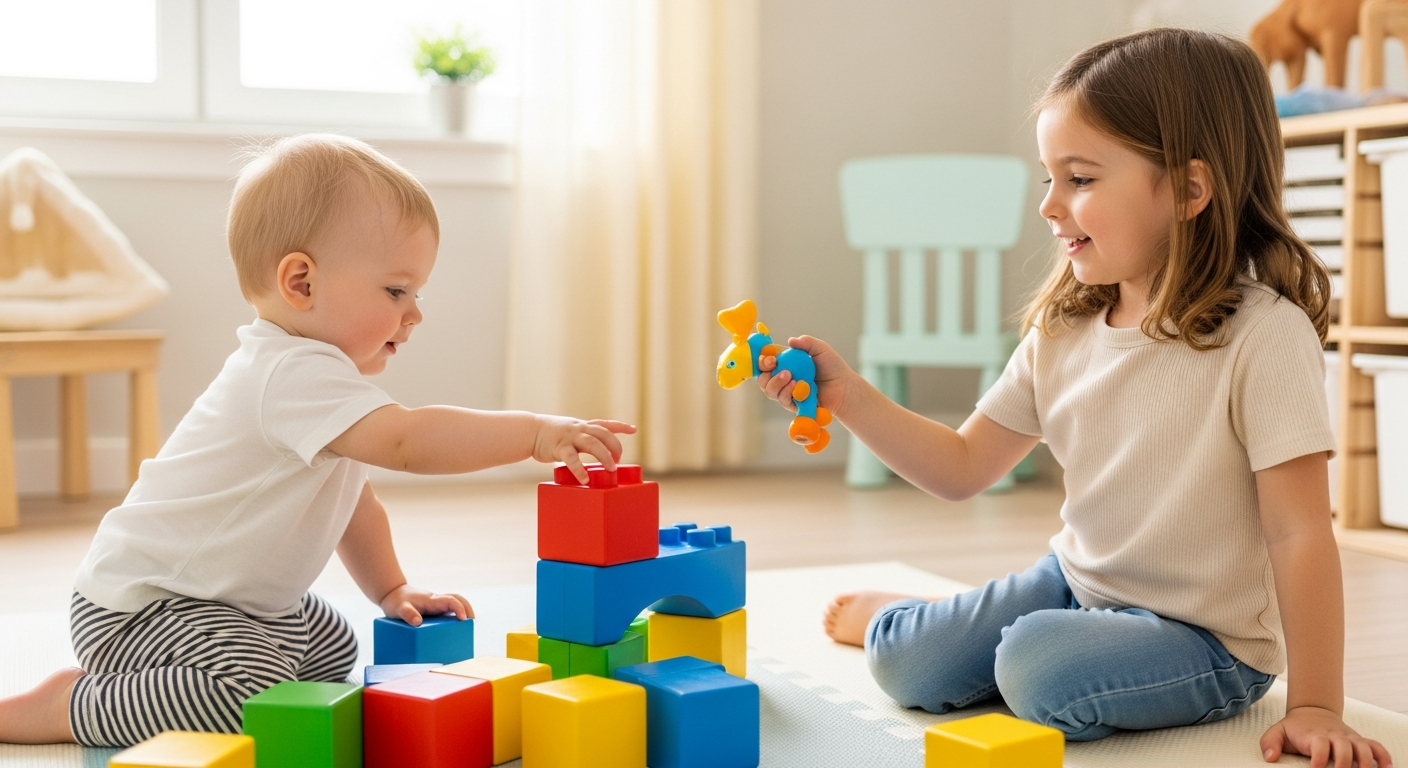
Table of Contents
- Introduction
- The Vital Connection Between Play and Language
- Cause and Effect Toys: The "First Words" Foundation
- Open-Ended Toys: Building Vocabulary Through Imagination
- Pretend Play: Learning the Rhythms of Conversation
- Sensory Play: Engaging the Whole Body
- Why "Smart Screen Time" is Different
- How to Choose: Tips for Buying Toys for Speech Delayed Toddler
- Understanding Speech Blubs Pricing and Plans
- Setting Realistic Expectations
- FAQ: Frequently Asked Questions
- Conclusion
Introduction
Have you ever sat on the living room floor, surrounded by a mountain of colorful plastic and blinking lights, wondering why your toddler isn't interested in any of them? Or perhaps you’ve felt that quiet pang of worry when you notice other children at the park chatting away while your little one remains silent, relying on pointing or frustrated tugs at your sleeve to communicate. If you are navigating the journey of a speech delay, you are far from alone. Statistics suggest that nearly 1 in 4 children will experience some form of speech or language delay during their early years. At Speech Blubs, we understand this journey intimately because our founders lived it. They grew up with speech challenges themselves and eventually created the very tool they wished they had as children to make learning to speak a joyful, play-filled experience.

The purpose of this post is to provide you with a thoughtful, science-backed guide to selecting the best toys for speech delayed toddler development. We aren't just looking for "educational" labels; we are looking for tools that foster connection, imitation, and functional communication. We will explore how different categories of toys—from cause-and-effect gadgets to open-ended pretend play sets—can be used as bridges to language. More importantly, we’ll show you how to pair these physical toys with our unique "smart screen time" approach to create a comprehensive environment for your child to thrive.
By the end of this article, you will have a clear roadmap for transforming playtime into a powerful language-learning opportunity. Our main message is simple: with the right toys, a lot of patience, and a dash of playful "video modeling," we can empower your child to speak their mind and heart.
The Vital Connection Between Play and Language
Before we dive into specific toys, it is crucial to understand why play is the "work" of childhood. For a toddler, language isn't learned through flashcards or repetitive drills; it is caught in the heat of a fun moment. When a child plays, they are experimenting with concepts like object permanence, cause and effect, and symbolic representation—all of which are cognitive precursors to talking.
"Play is the highest form of research." — Albert Einstein.
For a speech-delayed child, toys serve as a shared focus of attention. This is called "joint attention," and it is the foundation of all communication. If you and your child are both looking at the same spinning top, you have a shared context. You can say "Spin!" and they can see exactly what that word means in real-time. This is why we focus so heavily on play-based learning.
If you are currently feeling unsure about where your child stands in their development, you can start with our 3-minute preliminary screener. It consists of 9 simple questions and provides a personalized assessment and next-steps plan to help you understand your child’s needs more clearly.

Cause and Effect Toys: The "First Words" Foundation
The very first step in communication is the realization that "if I do something, something happens." This is the essence of cause and effect. A child who learns that pressing a button makes a puppet pop up is learning the same logic required for speech: "If I make a sound, Mom gives me a snack."
Pop-Up Pals and Busy Boxes
These classic toys are excellent because they require different motor movements—pushing, flipping, sliding, and turning—to get a result. They naturally elicit sounds of surprise and anticipation.
- Language Strategy: Use "Ready... set... GO!" routines. Pause before the "GO!" to see if your child makes a sound or a gesture to signal they want the puppet to pop.
- Speech Blubs Integration: For a child who is just starting to understand that their actions have power, our "Early Sounds" section is a perfect digital companion. Just as they press a button on a busy box, they can watch a peer in the app make a simple sound like "Moo" or "Baa," encouraging them to mirror that action.
Ball Ramps and Car Racers
Watching a ball zig-zag down a tower or a car zoom down a ramp provides a visual "story" with a clear beginning and end.
- Language Strategy: Focus on "action words" or verbs. "Go," "Down," "Fast," "Stop," and "Uh-oh!" are all high-frequency words that are easy to model during this type of play.
- Real-World Scenario: Imagine a parent whose 2-year-old is obsessed with anything that rolls. By using a car ramp, the parent can hold the car at the top, wait for eye contact, and say "Go!" before releasing it. To reinforce this, they can open the "Vehicles" section on Speech Blubs, where the child sees other kids saying "Vroom Vroom." You can Download on the App Store to explore these specific sections together.
Open-Ended Toys: Building Vocabulary Through Imagination
Open-ended toys are those that don't have a specific "right" way to be played with. They can be anything the child wants them to be, which encourages symbolic play. Symbolic play (e.g., using a block as a phone) is closely linked to language because both involve using one thing to represent another.
Blocks and Nesting Cups
Whether they are wooden, foam, or magnetic, blocks are a speech therapist's best friend. They can be stacked, knocked down, sorted by color, or used to build "houses" for other toys.
- Language Strategy: Use prepositions. "Put it on," "Take it out," or "It’s under the cup." These small words are often difficult for speech-delayed toddlers to grasp without a visual and physical example.
- The Power of "Uh-Oh": Knocking over a tall tower is the perfect opportunity to model "Uh-oh!" or "Fall down!" These are often among the first functional phrases a child will use because they are emotionally charged and fun to say.
Farm Sets and Animal Figures
Animals are a universal favorite. They allow for a wide range of sound effects, which are often easier for a child to imitate than actual words.
- Language Strategy: Focus on animal sounds first. "Moo," "Oink," and "Meow" use simple lip and tongue movements.
- Real-World Scenario: For a parent whose 3-year-old "late talker" loves animals, the "Animal Kingdom" section in our app offers a motivating way to practice these sounds. The child watches a peer make the sound, and through our scientific research on mirror neurons, they are biologically primed to try and imitate that peer.
Pretend Play: Learning the Rhythms of Conversation
As toddlers move into the 24-to-36-month range, pretend play becomes vital. This is where they begin to act out daily routines, which helps them learn the "scripts" of social interaction.
Play Kitchens and Food Sets
Cooking and eating are routines your child sees every day. By mimicking these, they learn nouns (apple, spoon, plate) and verbs (cut, eat, stir, wash).
- Language Strategy: Role-play a "tea party" or a "dinner." Ask simple questions like, "Can I have more?" or "Is it hot?" This teaches the back-and-forth rhythm of a conversation.
- Speech Blubs Connection: Our "Yummy Time" section features kids eating and naming various foods. Seeing another child "eat" a virtual apple can be just the spark your toddler needs to name the fruit in their own play kitchen.
Baby Dolls and Action Figures
Caring for a "baby" allows a child to practice body parts (eyes, nose, feet) and grooming words (brush, wash, sleep).
- Language Strategy: Use the doll to model "people words." "Baby is sleeping," or "Give the boy a hug." This also helps with the development of pronouns like "he," "she," and "it."
- Social Proof: Many parents in our community have shared how pretend play, combined with our app, reduced their child's frustration. You can read more about these success stories and testimonials to see how other families have navigated these milestones.
Sensory Play: Engaging the Whole Body
Sometimes, a child needs to "feel" the world to talk about it. Sensory play engages the tactile, vestibular, and proprioceptive systems, which can help regulate a child's nervous system and make them more "ready" to communicate.
Bubbles and Balloons
Bubbles are perhaps the most effective low-cost "toy" for speech. They are inherently motivating and provide endless opportunities for requesting.
- Language Strategy: Blow a few bubbles, then close the wand. Wait. This creates a "communication temptation." The child might reach, point, or eventually say "Bup" or "More."
- Oral Motor Skills: Blowing bubbles is also great for strengthening the muscles in the lips and cheeks, which are necessary for producing sounds like "p," "b," and "m." In the Speech Blubs app, we have a "Mouth Gym" section specifically designed to make these physical exercises fun through video modeling.
Water Tables and Kinetic Sand
Playing with water or sand allows for "descriptive" language. Is it "wet"? Is it "cold"? Is it "sticky"?
- Language Strategy: Parallel talk. Instead of asking your child questions (which can feel like a test), simply narrate what they are doing. "You are pouring the water. Splash! The water is blue." This provides a rich language model without the pressure of having to respond.
Why "Smart Screen Time" is Different
In a world where many parents are told to avoid screens entirely, we offer a different perspective. There is a massive difference between "passive" screen time (like watching a cartoon) and "smart" screen time.
At Speech Blubs, our methodology is based on video modeling. This is a scientifically proven technique where children learn new behaviors by watching their peers. When your child sees a real kid on the screen—not a cartoon—wearing a fun digital hat and saying "Pop!", they are far more likely to try it themselves.
We provide a tool for family connection. Our app is designed for you to use with your child. It isn't a "babysitter" app; it’s a bridge. You sit together, you laugh at the silly filters, and you practice the sounds together. This transforms the screen into an interactive toy that supplements your physical play.
Ready to see the difference for yourself? Get it on Google Play or the App Store to start your journey today.
How to Choose: Tips for Buying Toys for Speech Delayed Toddler
When you are out shopping or browsing online, keep these three rules in mind to ensure you are getting the most "bang for your buck" in terms of language development:
- 90% Child, 10% Toy: If a toy does everything for the child (it talks, it sings, it moves on its own), the child doesn't have to do or say anything. Choose toys that require the child’s input to work.
- Follow the Interest: If your child loves dinosaurs, don't buy them a dollhouse just because a blog said it was good for speech. Use the dinosaurs! You can teach the same concepts (in, out, big, small, eat, sleep) with a T-Rex as you can with a doll.
- Simplicity Wins: Often, the best "toys" are household items. A cardboard box can be a car, a house, or a mountain. This flexibility is what sparks the creative thinking necessary for language.
Understanding Speech Blubs Pricing and Plans
We want to be completely transparent about our pricing so you can make the best decision for your family. We offer two main paths to joining our community:
FeatureMonthly PlanYearly Plan (Best Value)
Price
$14.99 per month
$59.99 per year ($4.99/mo)
Free Trial
Not Included
7-Day Free Trial
Bonus App
Not Included
Reading Blubs Included
Updates
Standard
Early Access to New Content
Support
Standard
24-Hour Priority Response
Choosing the Yearly Plan is the best way to support your child's long-term progress. Not only do you save 66% compared to the monthly rate, but you also get a full week to try it out for free, and you gain access to Reading Blubs, which helps transition those hard-earned speech skills into early literacy. You can Create your account and sign up right now to lock in this value.
Setting Realistic Expectations
It is important to remember that every child’s path is unique. While the right toys and the right tools can make a significant impact, they are part of a larger ecosystem of support. We do not promise that your child will be speaking in full sentences overnight. Instead, we focus on the "small wins":
- A new sound during a bubble play session.
- Increased eye contact during a Speech Blubs video.
- Less frustration when they want to tell you they are hungry.
- A newfound love for learning and communication.
Our app is a powerful supplement to your child's overall development plan and works wonderfully alongside professional speech therapy. By focusing on the joy of the process, we reduce the pressure on both you and your child, creating a space where language can bloom naturally.
FAQ: Frequently Asked Questions
1. What are the best toys for speech delayed toddler development if I’m on a budget? The best "toys" are often already in your home! Kitchen spoons, plastic containers, and cardboard boxes are incredibly open-ended. Bubbles and sidewalk chalk are also very inexpensive but highly effective at encouraging requests and descriptive words. The key is how you interact with the child using the item.
2. Can screen time really help a child with a speech delay? Yes, but only if it is "active" and "educational" screen time. Traditional cartoons are passive—the child just sits and watches. Speech Blubs uses video modeling, which encourages the child to participate, imitate sounds, and interact with the person sitting next to them. It is designed to be a "smart" tool that promotes real-world engagement.
3. My child won't sit still to play with toys. What should I do? Focus on gross motor play! Use balls, indoor slides, or simple games like "hide and seek." You can model language while moving. When they are running, say "Fast, fast, fast!" When they stop, say "Stop!" Meet your child where they are energetically.
4. How long should I use the Speech Blubs app with my child each day? We recommend short, frequent bursts of "smart screen time"—about 5 to 15 minutes a day. The goal is to keep it fun and engaging, not to have them sit for long periods. Use the app as a "warm-up" for physical playtime.
Conclusion
Navigating a speech delay can feel like a long, uphill climb, but remember that every mountain is scaled one step at a time. By choosing the right toys—those that encourage cause and effect, open-ended imagination, and sensory exploration—you are giving your child the physical tools they need to explore language. When you pair that physical play with the peer-to-peer video modeling found in Speech Blubs, you create a powerful synergy that builds confidence and reduces frustration.
At Speech Blubs, we are more than just an app; we are a community of parents and experts dedicated to helping your child "speak their mind and heart." We invite you to join us and see the joy of communication come alive in your home.
Ready to start? Download Speech Blubs on the Apple App Store or Google Play Store today. We highly recommend choosing our Yearly Plan to take advantage of the 7-day free trial, the bonus Reading Blubs app, and the best overall value at just $4.99 a month. Let’s turn playtime into talk time, together!
About the author