
Beyond the Screen: Fun Kid Board Games for Growth
 By Speech Blubs Team•Jan 19, 2026•19 min.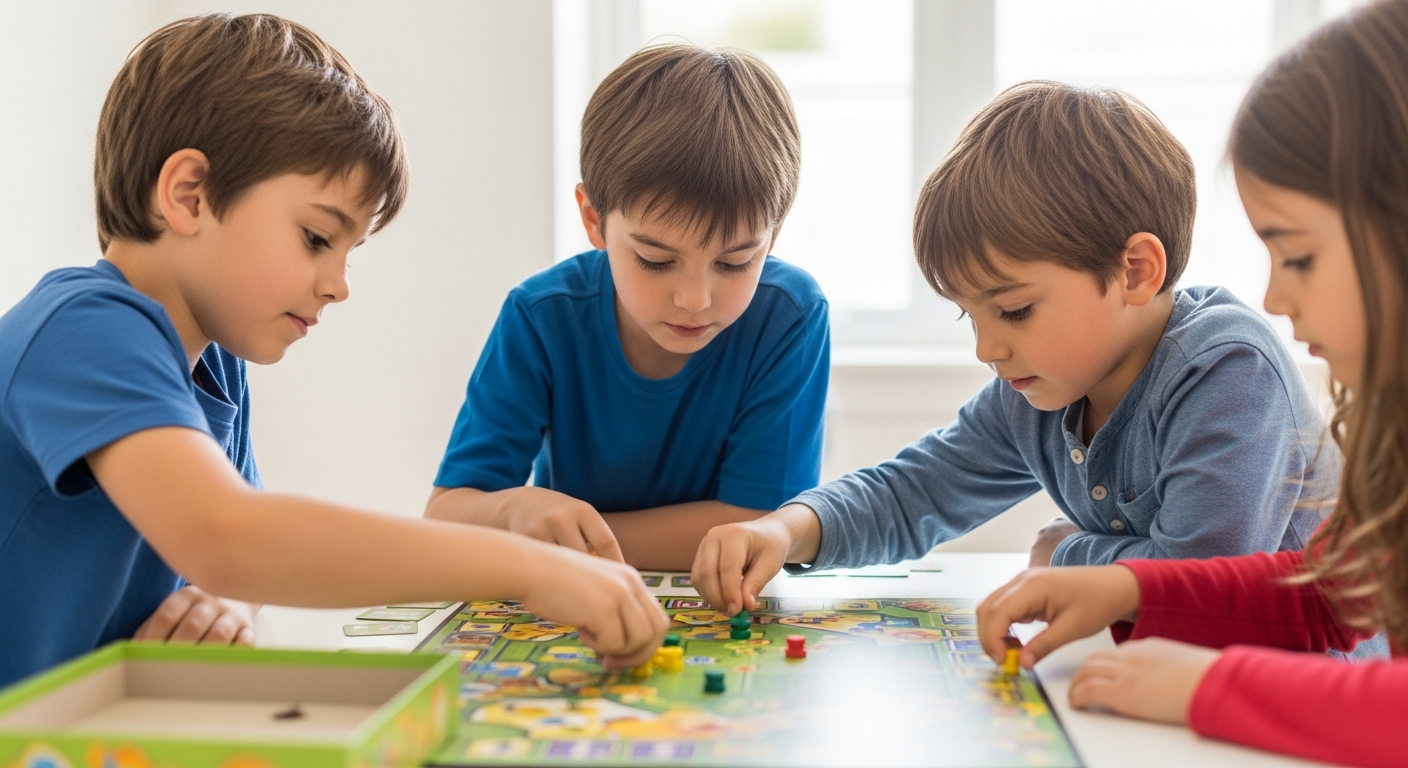
Table of Contents
- The Undeniable Power of Play: Why Board Games Are More Than Just Fun
- Choosing the Right Fun Kid Board Games for Your Family
- Top Picks: Fun Kid Board Games for Every Skill
- Making Board Game Play Even More Impactful
- Speech Blubs: Your Partner in the Communication Journey
- Conclusion
- FAQ
Remember the unmistakable joy of gathering around a table, dice clattering, cards shuffling, and laughter filling the air? In an era dominated by screens and digital distractions, the simple pleasure of a board game might seem like a relic of the past. Yet, these timeless treasures offer far more than just entertainment; they are powerful tools for fostering essential developmental skills in children, from critical thinking and problem-solving to social-emotional growth and, crucially, communication.
Here at Speech Blubs, we believe every child deserves to "speak their minds and hearts." Our mission, born from our founders' personal experiences with speech challenges, is to provide immediate, effective, and joyful solutions for the 1 in 4 children who need speech support. We champion "smart screen time" experiences that blend scientific principles with play, and we see board games as a magnificent, screen-free complement to our work.
This post will delve into the profound benefits of incorporating fun kid board games into your family routine. We’ll explore how these games nurture cognitive abilities, language, social skills, and emotional resilience. We'll also share our top recommendations for engaging board games across various developmental categories and discuss how integrating these hands-on experiences with interactive tools like Speech Blubs can create a holistic and enriching learning environment for your child. Ready to roll the dice on a new adventure? Download Speech Blubs from the App Store or Google Play to get started on your child's communication journey today!

The Undeniable Power of Play: Why Board Games Are More Than Just Fun
Board games offer a unique blend of education and entertainment, creating a dynamic learning environment that often feels less like "schoolwork" and more like shared joy. Beyond the obvious fun, these games are silent teachers, imparting vital life lessons and honing developmental skills in ways few other activities can.
Cognitive Development: Sharpening Young Minds
At their core, many board games are puzzles waiting to be solved, challenges waiting to be overcome. This inherent structure provides a fantastic workout for a child's brain:
- Logic and Reasoning: From deducing the culprit in Outfoxed to planning moves in Sequence for Kids, children learn to think critically, make predictions, and understand cause and effect. They develop the ability to consider multiple possibilities and choose the most effective course of action.
- Problem-Solving: Every game presents a problem – how to win, how to achieve a goal, how to thwart an opponent. Children learn to strategize, adapt their plans when things go awry, and creatively navigate obstacles. Games like Laser Maze and IQ Circuit are specifically designed to build these skills.
- Memory and Attention: Remembering rules, tracking opponents' moves, or recalling card values (as in Sleeping Queens) significantly boosts working memory and sustains attention. This focus is particularly beneficial in a world of constant distractions, helping children develop the ability to concentrate on a single task.
- Spatial Reasoning: Games involving grids, pieces, and layouts, such as Battleship or Azul, help children understand spatial relationships, visualize patterns, and plan their physical moves within a defined space.
Language and Communication: Building Confident Voices
Board games are natural conversation starters. They create a context-rich environment that encourages children to use and understand language in meaningful ways:
- Vocabulary Expansion: Whether it's the fantastical creatures in Dungeons & Dragons Adventure Begins or the words built in Scrabble Junior, games introduce new words and concepts naturally. As parents explain rules or discuss gameplay, children absorb new vocabulary, building their internal dictionary.
- Articulation and Expression: Explaining their moves, asking questions about rules, or describing a strategy requires children to articulate their thoughts clearly. For a child who might be a "late talker," these low-pressure, high-engagement moments can be incredibly motivating. For instance, a child playing P is for Pizza might shout out "Penguin!" when linking a letter to a category, practicing initial 'P' sounds in a fun, spontaneous way.
- Turn-Taking and Active Listening: A fundamental aspect of most board games is taking turns. This teaches children patience, the importance of listening to others' moves, and understanding the rhythm of conversation – crucial skills for effective communication.
- Storytelling and Narrative: Games like Rory's Story Cubes or Create A Story Cards are specifically designed to ignite imagination and encourage narrative development. Children learn to structure a story, connect events, and express themselves creatively, building confidence in sharing their ideas. This is a powerful step towards empowering children to "speak their minds and hearts," a core value we uphold at Speech Blubs.
Social-Emotional Growth: Learning Life's Lessons Through Play
Beyond intellect and language, board games are mini-laboratories for social and emotional development:

- Cooperation and Teamwork: Cooperative games like Forbidden Island or Flash Point Fire Rescue are fantastic for teaching children to work together towards a common goal. They learn to share ideas, support teammates, and celebrate collective success – or navigate collective failure – without the sting of individual loss. This fosters empathy and a sense of community.
- Patience and Frustration Tolerance: Waiting for a turn, experiencing bad luck, or losing a game are inevitable parts of board game play. These moments provide valuable opportunities for children to practice patience, manage frustration, and develop emotional regulation skills. Learning to lose gracefully is a vital life skill.
- Following Rules and Fair Play: Adhering to game rules teaches children about boundaries, fairness, and respecting agreed-upon structures. It helps them understand that shared experiences often require shared rules for everyone's enjoyment.
- Empathy and Perspective-Taking: When playing competitive games, children learn to anticipate opponents' moves and understand their motivations, subtly developing empathy and the ability to see things from another's point of view.
Screen-Free Connection: Fostering Family Bonds
Perhaps one of the most significant benefits in our modern world is that board games offer genuine, face-to-face interaction. They create dedicated pockets of time for families to connect, laugh, and learn together without the glow of individual screens. This shared experience strengthens family bonds, creates lasting memories, and reinforces the importance of being present with one another. We believe in providing screen-free alternatives to passive viewing and empowering families to connect, and board games perfectly align with this philosophy.
Choosing the Right Fun Kid Board Games for Your Family
With an overwhelming array of options available, selecting the perfect games can feel daunting. Here’s how to choose games that will be both fun and developmentally beneficial for your child:
Age-Appropriate Play
Start with games designed for your child's age group. Younger children typically thrive with simpler rules, less reading, and shorter playtimes. As they grow, they can handle more complex strategies, longer games, and games that require reading. Don't be afraid to adapt rules for younger players or simplify objectives to make a game accessible.
Interests and Themes
Involve your child in the selection process. Do they love animals, space, fantasy, or mysteries? Choosing games with themes that genuinely excite them will increase their engagement and motivation to play. For example, if your child adores animals, games with animal characters or themes can be a fantastic entry point.
Learning Goals
Consider what skills you'd like to reinforce. Are you working on counting, reading, social skills, or strategic thinking? Many games are designed with specific educational outcomes in mind:
- For Language & Communication: Look for games that involve storytelling, word building, or extensive discussion.
- For Cognitive & Logic Skills: Seek out deduction games, puzzles, or strategy-heavy options.
- For Math & Numeracy: Explore games that incorporate counting, money, or basic arithmetic.
- For Social-Emotional Development: Cooperative games are excellent for teaching teamwork and managing emotions.
Cooperative vs. Competitive
This is an important distinction, especially when playing with children who might be sensitive to winning and losing:
- Cooperative Games: In these games, everyone works together against the game itself. There are no individual winners or losers – either the team wins or the game wins. These are fantastic for fostering teamwork, communication, and a sense of shared accomplishment. They are particularly great for younger children or those who struggle with competition. Outfoxed, Forbidden Island, and The Mind are excellent examples.
- Competitive Games: These involve players competing against each other to achieve victory. They teach strategy, resilience in the face of defeat, and gracious winning. For older children or those comfortable with competition, these can be incredibly rewarding. Monopoly, Scrabble, and Catan fall into this category.
Top Picks: Fun Kid Board Games for Every Skill
Let's dive into some specific game recommendations that promise hours of fun while secretly building crucial skills. We've organized these by the primary skills they help develop, but remember, most games offer a multitude of benefits!
Games for Language & Communication
These games naturally encourage verbal expression, vocabulary building, and narrative skills, perfectly complementing the work we do at Speech Blubs.
- Rory's Story Cubes: This brilliant set of nine dice features various images. Players roll the dice and then weave a story using the images that land face up.
- Why it's great: An endless source of creative storytelling, vocabulary use, and imaginative expression. Excellent for children learning to sequence events and develop narrative structures. It encourages improvisation and flexible thinking, fostering a love for sharing ideas.
- Zingo!: A fast-paced bingo-style game where players match pictures and words.
- Why it's great: Fantastic for pre-readers and early readers, promoting word recognition and phonics skills. The quick-fire nature encourages children to vocalize words clearly and quickly.
- Scrabble Junior: A simplified version of the classic word game, designed for younger players.
- Why it's great: Helps children with letter recognition, spelling, and vocabulary building. It encourages thinking about word structure and how letters combine to form meaning.
- P is for Pizza: A fast-paced card game where players shout out words that link a letter on one card to a category on another.
- Why it's great: Boosts rapid word recall, categorizing skills, and vocalization. It's lively and encourages quick thinking and clear speech, making it a great way to practice articulation in an exciting context.
- Word on the Street: Teams try to capture letter tiles by thinking of words within specific categories.
- Why it's great: Expands vocabulary and encourages creative thinking under pressure. It's a great game for developing descriptive language and working collaboratively to find the right words.
For children who might be expanding their vocabulary through games like these, but struggle with clear pronunciation, Speech Blubs offers targeted support. Imagine playing a game with animal names; afterward, your child can practice saying "moo" or "baa" with our interactive video modeling feature, watching and imitating real kids.
Games for Cognitive & Logic Skills
These selections challenge children to think strategically, solve problems, and apply logical reasoning.
- Mastermind: A classic code-breaking game where one player creates a hidden code and the other uses logic to deduce it.
- Why it's great: Develops strong deductive reasoning, pattern recognition, and systematic thinking. It teaches children to analyze feedback and refine their hypotheses.
- IQ Circuit: A compact brainteaser where players arrange pieces to complete a circuit based on challenge cards.
- Why it's great: Builds concentration, spatial insight, and problem-solving abilities. It's excellent for developing mental flexibility and abstract reasoning.
- Laser Maze: Players use mirrors and beam-splitters to direct a laser beam through a maze.
- Why it's great: Combines logic, spatial reasoning, and an introduction to physics concepts. It encourages careful planning and understanding of angles and reflections.
- Battleship: The classic naval combat game where players use coordinates to locate and destroy opponents' hidden ships.
- Why it's great: Enhances strategic thinking, coordinate understanding, and deductive reasoning. It teaches children to plan ahead and anticipate opponents' moves.
- Catan Junior/Family: Simplified versions of the popular strategy game, Settlers of Catan.
- Why it's great: Introduces resource management, trading, and strategic planning in an accessible format. It helps children understand cause and effect in a larger game system.
Games for Math & Numeracy
Making math fun is key to building a positive relationship with numbers. These games do just that.
- Prime Climb: A colorful math game designed to teach multiplication, division, factorization, and prime number concepts.
- Why it's great: Visually intuitive, making complex math concepts approachable and engaging. Great for developing deeper number sense.
- Racko: Players race to arrange 10 cards in numerical sequence.
- Why it's great: Reinforces number order, sequencing, and strategic decision-making in a lighthearted way.
- Pay Day: A classic game about earning money, making deals, and paying salaries.
- Why it's great: Provides practical experience with money management, basic arithmetic (addition, subtraction), and understanding financial transactions.
- Sushi Go!: A fast-paced card drafting game where players collect sets of sushi dishes for points.
- Why it's great: Enhances strategic planning, probability assessment, and quick arithmetic as players calculate combinations for the highest score.
- Sleeping Queens: A whimsical card game that develops memory, strategy, and elementary arithmetic skills.
- Why it's great: A family favorite that blends imaginative play with math, requiring players to perform simple calculations to wake queens.
Games for Social-Emotional Development & Cooperation
These games are excellent for teaching teamwork, emotional regulation, and managing the ups and downs of gameplay.
- Outfoxed!: A cooperative deduction game where players work together to figure out which fox stole a pie.
- Why it's great: Perfect for younger kids, promoting collaboration, deduction, and problem-solving without competitive pressure. It's a wonderful introduction to cooperative play.
- Forbidden Island: Players work as a team to collect treasures from a sinking island before it disappears.
- Why it's great: Teaches cooperative strategy, communication, and adapting to changing circumstances. It encourages shared decision-making and handling pressure as a team.
- The Mind: A unique cooperative card game where players must play cards in numerical order without any verbal communication.
- Why it's great: Fosters non-verbal communication, intuition, and deep teamwork. It builds a shared understanding and connection among players, relying on subtle cues.
- Flash Point Fire Rescue: A cooperative game where players are firefighters rescuing people and pets from a burning building.
- Why it's great: Develops strategic planning, resource management, and intense teamwork under simulated emergency conditions. It's highly engaging and teaches collaborative problem-solving.
- My First Castle Panic: A simplified version of Castle Panic for younger children, where players work together to defend their castle from monsters.
- Why it's great: Introduces tower defense mechanics and cooperative strategy to very young players. It builds a sense of shared responsibility and accomplishment.
Making Board Game Play Even More Impactful
Playing board games is inherently beneficial, but with a little intentionality, you can amplify their positive effects on your child's development.
Active Participation & Coaching
Don't just set up the game and let your child play alone. Your involvement is key.
- Model good sportsmanship: Show them how to win humbly and lose gracefully. Acknowledge their frustrations but guide them towards resilience.
- Coach strategically: Especially in cooperative games, guide their thinking without simply telling them what to do. Ask questions like, "What do you think will happen if we do that?" or "What are our options here?"
- Encourage verbalization: Prompt them to explain their moves, justify their decisions, or ask for help when needed. This is a prime opportunity for communication practice.
Extending the Learning
The learning doesn't have to stop when the game ends.
- Discuss outcomes: Talk about what went well, what could have been done differently, and what new things they learned.
- Create your own variations: Modify rules or invent new challenges to encourage creative thinking and adaptation.
- Connect to real life: If you played a game about money, talk about budgeting for a toy. If you played a storytelling game, encourage them to write or draw their story.
Integrating "Smart Screen Time" with Speech Blubs
While board games offer wonderful screen-free interaction, modern tools can beautifully complement and enhance this learning. This is where Speech Blubs shines as a "smart screen time" experience.
For a parent whose 3-year-old "late talker" loves animals but struggles with specific animal sounds or names, a game like "P is for Pizza" might spark their interest. They might confidently shout "Dog!" or "Cat!" during the game. But what if they mispronounce "elephant" or struggle with the 'th' sound in "sloth"? This is where Speech Blubs provides a seamless next step. After the board game fun, you can transition to our app, which features a dedicated "Animal Kingdom" section. Here, children learn by watching and imitating their peers using our unique video modeling methodology. This direct visual and auditory input can help solidify correct pronunciation, build confidence, and reinforce the new vocabulary learned during game time.
Our app is designed to be an active, engaging tool that promotes interaction, unlike passive cartoons. It's a powerful way to:
- Build Foundational Skills: Speech Blubs helps children develop key speech and language skills, reducing frustration and building confidence, which in turn makes them more eager and able to participate fully in interactive activities like board games.
- Provide Targeted Practice: If a board game highlights a specific vocabulary gap or an articulation challenge, Speech Blubs offers a fun, focused way to practice those exact skills.
- Foster a Love for Communication: By blending scientific principles with play, we make learning to communicate joyful and accessible. This positive experience can spill over into all areas of a child's life, including their engagement in family games.
Unsure if your child could benefit from targeted speech support? Take our quick 3-minute preliminary screener to get a simple assessment and a free 7-day trial. You can also read what countless parents are saying about their child's success with Speech Blubs in our testimonials section.
Speech Blubs: Your Partner in the Communication Journey
At Speech Blubs, we are deeply committed to empowering children to communicate effectively and joyfully. Our company was born from the personal experiences of our founders, who all grew up with speech problems and created the tool they wished they had. We aim to provide an immediate, effective, and joyful solution for the 1 in 4 children who need speech support, blending scientific principles with play into one-of-a-kind "smart screen time" experiences. We provide a screen-free alternative to passive viewing (like cartoons) and a powerful tool for family connection, complementing hands-on play perfectly.
Our unique approach uses "video modeling," where children learn by watching and imitating their peers. This natural, engaging method is backed by science and helps develop complex communication skills, fostering a love for communication, building confidence, reducing frustration, and creating joyful family learning moments. We focus on benefits like fostering confidence and developing key foundational skills, providing powerful support that supplements a child's overall development plan.
We strive for transparency and value for our families. You can choose from two convenient plans:
- Monthly Plan: For $14.99 per month.
- Yearly Plan: For just $59.99 per year, which breaks down to an incredible $4.99 per month! This means you save 66% compared to the monthly plan.
The Yearly plan is truly the best value, offering exclusive, high-value features. With the Yearly plan, you receive:
- A 7-day free trial to experience the full app.
- Access to the extra Reading Blubs app.
- Early access to new updates and a 24-hour support response time.
The Monthly plan does not include these fantastic benefits.
Ready to unlock a world of communication and learning for your child, complementing their board game adventures and fostering a love for expression? We invite you to experience the full power of Speech Blubs. Create your account and begin your 7-day free trial today by selecting the Yearly plan for the best value and full suite of features! You can also download Speech Blubs from the App Store or Google Play directly.
Conclusion
Fun kid board games are more than just a pastime; they are vibrant arenas for growth, learning, and connection. From honing cognitive skills and expanding language to building social-emotional resilience and strengthening family bonds, the benefits are immense. By thoughtfully selecting games that align with your child's age, interests, and developmental goals, you provide invaluable opportunities for holistic growth.
Pairing the enriching, interactive nature of board games with the "smart screen time" benefits of Speech Blubs creates a powerful, well-rounded approach to fostering your child's development. We empower children to find their voice, and together with the magic of board games, we can help them "speak their minds and hearts" with confidence and joy.
Don't wait to discover the incredible impact that playful learning can have. Take the first step towards unlocking your child's full communication potential and enriching your family's playtime. Sign up for Speech Blubs today and start your 7-day free trial! Remember to choose the Yearly plan to get the free trial and access to all our exclusive features, offering you the best value for your child's journey to confident communication.
FAQ
Q1: What age should my child start playing board games?
A1: Children can start enjoying board games as early as 2-3 years old with simple picture-matching or dice-rolling games that focus on colors, shapes, and basic turn-taking. As they grow, they can progress to more complex rules and concepts. The key is to start with age-appropriate games that keep them engaged and minimize frustration.
Q2: How do board games help with speech and language development?
A2: Board games naturally create opportunities for verbal interaction. They encourage vocabulary expansion through new themes and concepts, promote articulation as children describe actions or make sounds, teach turn-taking and active listening, and foster storytelling skills. The interactive nature provides a low-pressure environment for practicing communication.
Q3: Are cooperative or competitive games better for kids?
A3: Both cooperative and competitive games offer unique benefits. Cooperative games are excellent for fostering teamwork, communication, and managing shared success or failure without individual pressure, making them ideal for younger children or those sensitive to losing. Competitive games teach strategy, resilience, and good sportsmanship. A healthy balance of both can provide a well-rounded experience.
Q4: How does Speech Blubs fit in with board game play?
A4: Speech Blubs beautifully complements board game play by providing targeted, engaging practice for speech and language skills that can be reinforced or sparked during games. If a game introduces new vocabulary, Speech Blubs can help with pronunciation through video modeling. If a child struggles with turn-taking in a game, Speech Blubs' interactive format can help build underlying communication confidence. It's "smart screen time" that supports and enhances hands-on learning, empowering children to communicate more effectively in all areas of life.
About the author