
Blossoming Voices: Easy Flower Crafts for Kids That Grow Communication Skills
 By Speech Blubs Team•Jan 13, 2026•17 min.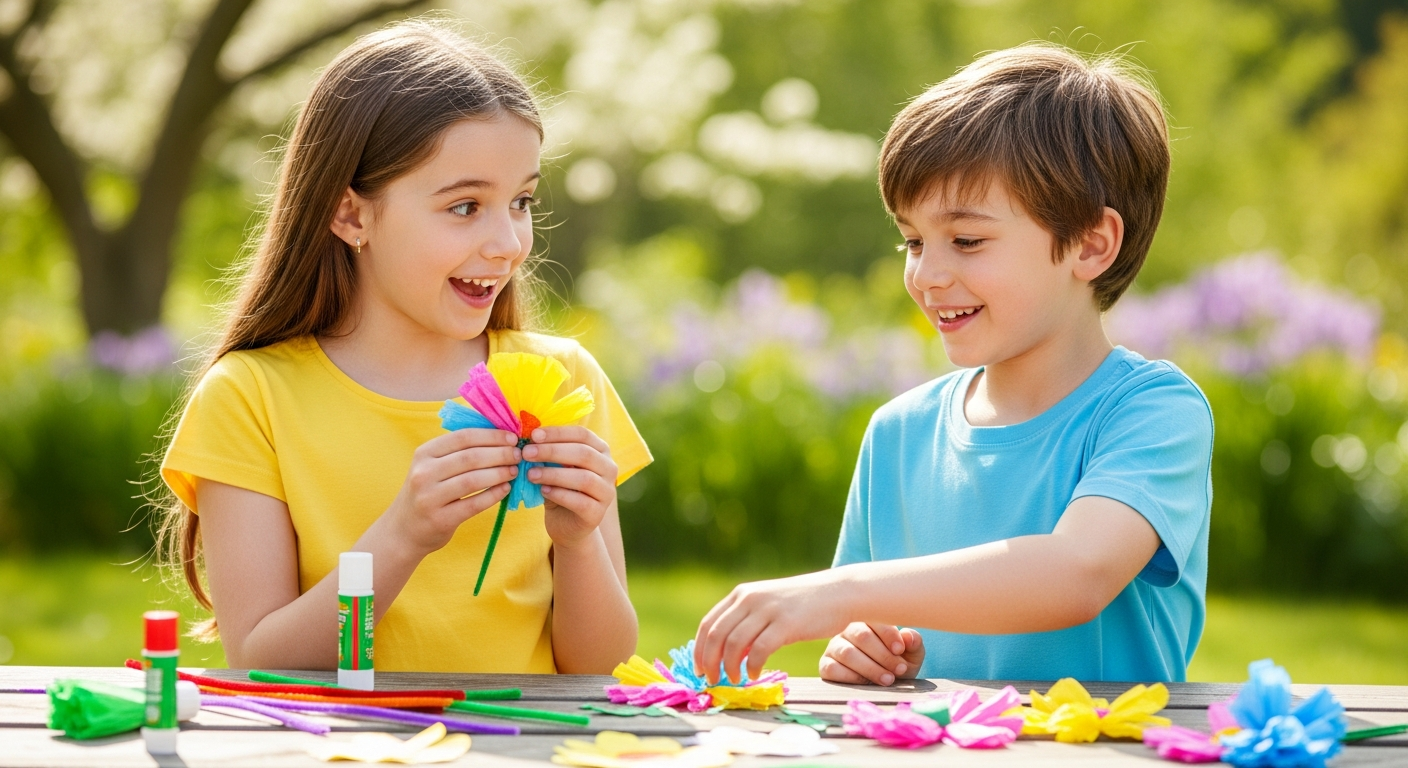
Table of Contents
- Introduction
- The Magic of Flower Crafts for Developing Minds
- Connecting Crafts to Communication Skills: A Blooming Conversation
- A Garden of Easy Flower Crafts for Every Age
- Speech Blubs: Nurturing Communication Through Play
- Empowering Every Child to Speak Their Hearts and Minds
- Unlock Your Child's Full Potential with Speech Blubs
- Conclusion
- Frequently Asked Questions
Introduction
Imagine a world where your child expresses themselves freely, their voice as vibrant and unique as a freshly bloomed flower. For many parents, this dream can feel distant, especially when navigating the complexities of speech and language development. But what if we told you that some of the most profound leaps in communication often begin with something as simple and joyful as crafting? Today, we're diving into the delightful world of easy flower crafts for kids – not just as a way to unleash creativity and decorate your home, but as powerful, playful tools to cultivate essential speech and language skills.
This post will explore a garden of engaging, simple flower crafts suitable for every age and skill level, showcasing how each snip, glue, and dab of paint can foster vocabulary, encourage expression, and build confidence. We'll connect these hands-on activities to tangible developmental benefits and reveal how integrating smart digital tools like Speech Blubs can further enhance this blossoming journey. Our mission at Speech Blubs, born from our founders' personal experiences with speech challenges, is to empower children to speak their minds and hearts. We provide an immediate, effective, and joyful solution for the 1 in 4 children who need speech support, blending scientific principles with play. Prepare to discover how bringing the beauty of flowers into your crafting time can help your child’s communication skills truly bloom!

The Magic of Flower Crafts for Developing Minds
Crafting isn't just about making pretty things; it's a multi-sensory experience that engages various parts of a child's brain, laying crucial groundwork for language development and overall growth. When children engage in easy flower crafts, they are not only creating art but also building a foundation for complex communication.
Cultivating Fine Motor Skills for Clearer Speech
The intricate movements involved in crafting—cutting petals, gluing leaves, threading yarn stems—are powerful exercises for fine motor skills. These are the small, precise movements of the hands and fingers. Why is this important for speech? The same neural pathways that control the delicate movements of the hands are closely linked to those controlling the muscles of the mouth, tongue, and jaw – essential for articulation. A child who can skillfully manipulate craft materials is often strengthening the underlying motor planning needed for clear speech.
Nurturing Creativity and Problem-Solving
Every craft project is an open invitation for creativity and problem-solving. What color should the petals be? How will the stem attach? What happens if the paper rips? These small decisions encourage children to think flexibly, experiment, and find solutions. This cognitive flexibility directly translates to language use, helping children construct sentences, adapt their communication to different contexts, and express abstract ideas.
Boosting Confidence and Self-Expression
Completing a flower craft, no matter how simple, gives a child a tangible sense of accomplishment. This boost in confidence empowers them to try new things, including attempting new words or initiating conversations. The act of creating art is also a form of self-expression, allowing children to convey emotions and ideas non-verbally, which often paves the way for verbal expression.
Connecting Crafts to Communication Skills: A Blooming Conversation
As your child enjoys their flower craft adventure, you have a unique opportunity to weave in rich language learning experiences. These activities become a natural springboard for dialogue, vocabulary expansion, and social interaction.

Expanding Vocabulary with Nature's Palette
Flower crafts introduce a wealth of new words. As you craft, describe every step, every material, and every observation.
- Colors: "What beautiful red petals!" "Let's use the yellow paper for the center."
- Shapes: "Cut a circle for the middle." "These petals are like ovals."
- Textures: "The pipe cleaner feels fuzzy." "This tissue paper is so crinkly."
- Actions: "We need to snip the paper, then fold it, and glue it down." "Time to paint the stem green."
- Parts of a flower: "Here's the stem, the leaf, and the petal." "This is the bud before it opens."
For a child who is just beginning to explore sounds and words, matching these concepts with tangible objects helps solidify their understanding. If your child loves learning about the world around them, Speech Blubs offers rich "Smart Screen Time" experiences that complement these discussions. Our "Outdoor Wonders" and "Animal Kingdom" sections feature engaging video modeling activities where children watch real peers articulate words like "flower," "bee," or "butterfly," and then imitate them. It's a powerful way to reinforce the vocabulary learned during crafting. Ready to see the magic for yourself? Start your free 7-day trial and empower your child's voice.
Fostering Receptive and Expressive Language
Crafting provides a perfect environment for practicing both receptive (understanding) and expressive (speaking) language.
- Following Multi-Step Directions: "First, pick up the scissors, then cut out the yellow circle." This helps children practice auditory processing and memory.
- Describing Their Creation: Encourage your child to talk about their flower. "Tell me about your flower. What colors did you use? What's your favorite part?" This prompts them to use descriptive language and build sentences.
- Asking and Answering Questions: "Do you want blue or pink petals?" "What should we do next?" Engaging in a back-and-forth conversation during crafting naturally builds conversational skills.
For a parent whose 3-year-old 'late talker' loves flowers and struggles with multi-step directions, a craft session provides a low-pressure, engaging context. You can model each step, then use the Speech Blubs app to reinforce related vocabulary and action words, building from single words to short phrases. Our app is designed to complement these real-world interactions, making learning fun and accessible.
Encouraging Turn-Taking and Social Skills
Crafting can be a wonderful collaborative activity. Sharing materials, waiting for turns, and working together on a joint project all contribute to the development of crucial social communication skills. "My turn to glue, then your turn to add the glitter." This teaches patience, cooperation, and the rhythm of conversation.
A Garden of Easy Flower Crafts for Every Age
Let's explore some fantastic, easy flower craft ideas, categorizing them by materials to make it simple for you to find something with what you already have at home. Each type offers unique developmental benefits.
Paper Power: Simple & Vibrant Creations
Paper is perhaps the most versatile crafting material, perfect for honing scissor skills, understanding shapes, and experimenting with layering.
1. Simple 3D Paper Flowers
- How to: Cut several paper circles of various sizes. Fold them in half, then in half again. Arrange and glue them, layering from largest to smallest, to create a multi-dimensional bloom. Add a paper straw or pipe cleaner for a stem.
- Skills: Scissor skills, shape recognition (circles), fine motor folding, spatial reasoning, sequencing.
- Language Boost: Describe "big" and "small" circles, "folding," "layering." Discuss colors.
2. Tissue Paper Suncatchers
- How to: Cut out flower shapes from contact paper (sticky side up). Let your child tear or cut colorful tissue paper into small pieces and stick them onto the contact paper. Cover with another piece of contact paper and trim. Hang in a window!
- Skills: Fine motor tearing/cutting, color identification, understanding transparency.
- Language Boost: Name colors ("red," "blue," "purple"), describe light ("bright," "shiny"), talk about the "sticky" paper.
3. Printable Paper Daffodils or Hyacinths
- How to: Many websites offer free printable templates for flower parts. Simply print, have your child cut out the pieces, and then glue them together.
- Skills: Following visual instructions, precise cutting, gluing, assembly.
- Language Boost: Practice action verbs like "print," "cut," "glue." Discuss the flower parts as you assemble them.
Recycled Wonders: Eco-Friendly & Creative Fun
Turn everyday items destined for the recycling bin into beautiful blooms, teaching children about sustainability and resourcefulness.
1. Egg Carton Flowers
- How to: Cut individual cups from an egg carton. Trim the edges to resemble petals. Paint them vibrant colors. Punch a hole in the center and insert a pipe cleaner for a stem.
- Skills: Scissor skills (for older kids, careful adult supervision for younger ones), painting, creativity, repurposing.
- Language Boost: Discuss "recycling," "transforming," "new colors." "What will we turn this egg carton into?"
2. Recycled Newspaper Flowers
- How to: Cut newspaper into various flower shapes and sizes. Paint them with watercolors or tempera paints, watching how the newspaper absorbs the color. Layer and glue for a unique texture.
- Skills: Painting techniques, understanding texture, layering, fine motor control.
- Language Boost: Talk about "rough" vs. "smooth" surfaces (before/after paint), "bright" vs. "dull" colors. Discuss the "news" on the paper.
3. Nature Weaving or Collages
- How to: Create a simple loom by cutting notches into a cardboard square and stringing yarn across. Take a nature walk to collect small flowers, leaves, twigs. Weave or glue these natural elements onto your loom or directly onto a piece of cardboard to create a flower collage.
- Skills: Fine motor weaving (threading), observation, categorization (different types of leaves/flowers), creativity.
- Language Boost: Name items collected ("twig," "leaf," "petal"), describe their characteristics ("soft," "prickly," "green," "small"), practice positional words ("over," "under," "through").
Painted Petals: Messy Play & Sensory Exploration
Painting is a fantastic sensory experience that allows for free expression and exploration of colors and textures.
1. Fingerprint/Thumbprint Flowers
- How to: Dip fingers or thumbs in paint and press them onto paper to create petals or the center of a flower. Use a paintbrush for stems and leaves.
- Skills: Sensory exploration (touch, texture), body awareness, color mixing (if using multiple colors).
- Language Boost: "My thumb made a petal!" "Look at the red dot!" "So squishy." Count the petals.
2. Pom-Pom Painting
- How to: Clip a pom-pom with a clothespin. Dip the pom-pom in paint and stamp it onto paper to create textured flower shapes.
- Skills: Grip strength (clothespin), stamping, cause-and-effect, fine motor control.
- Language Boost: Describe the "soft" pom-pom, the "stamping" action, the "round" shapes.
3. Watercolor Blooms
- How to: Use watercolors on paper. Encourage children to explore how colors blend and bleed into each other to create soft, abstract flowers. A simple technique is to draw a flower outline with a permanent marker, then fill with watercolor.
- Skills: Color blending, brush control, understanding water's effect on paint, abstract thinking.
- Language Boost: "The blue and yellow are mixing to make green!" "Look how the water spreads." "What a beautiful shade!"
Paper Plate Panache: Versatile & Engaging
Paper plates are inexpensive, readily available, and incredibly adaptable for a variety of flower crafts, often focusing on larger motor movements and scissor practice.
1. Weaving Sunflower
- How to: Cut a circle from the center of a paper plate, leaving a ring. Punch holes around the inner and outer edges of the ring. Have children weave yellow or brown yarn through the holes to create a textured sunflower.
- Skills: Fine motor weaving, hand-eye coordination, patience, bilateral coordination.
- Language Boost: Use words like "through," "around," "in," "out." "Push the yarn through the hole." "It's going around the circle."
2. Splat Paint Tulip
- How to: Fold a paper plate in half. On one half, squeeze blobs of different colored paint. Fold the plate closed again and "splat" it by pressing down. Open to reveal a symmetrical tulip design.
- Skills: Understanding symmetry, cause-and-effect, gross motor (splatting), color recognition.
- Language Boost: "Splat!" "Look! It's the same on both sides – symmetrical!" "What happened when we pressed it?"
3. Scissor Skill Flowers
- How to: Draw concentric circles on a paper plate. Have children cut along the lines to create spirals or fringed petals.
- Skills: Scissor skills, following lines, fine motor control.
- Language Boost: "Cut along the line." "Go slowly." "Wow, you're making a spiral!"
Nature's Treasures: Crafting with Found Objects
Step outside and collect natural treasures to transform into art. These crafts encourage observation, appreciation for nature, and imaginative play.
1. Pressed Flower Art
- How to: Gather fresh flowers and press them between sheets of newspaper inside heavy books for a week or two. Once dried, glue them onto paper to create delicate collages or decorate cards.
- Skills: Patience, observation of nature, delicate handling, design.
- Language Boost: Name the flowers, describe their "fragile" nature, discuss "drying," "pressing." "What does it feel like now?"
2. Twig and Flower Crowns
- How to: Collect flexible twigs and small flowers. Gently bend the twigs into a circular shape (you might need tape or floral wire to secure). Tuck small flowers and leaves into the interwoven twigs.
- Skills: Creativity, problem-solving (how to secure), fine motor manipulation, imaginative play.
- Language Boost: Discuss "soft" vs. "hard" materials, "bending," "wrapping." Encourage storytelling about who will wear the crown.
3. Nature Rainbows or Bracelets
- How to: For rainbows, draw a rainbow arc on paper, apply double-sided tape. Go on a nature walk to find natural items matching each color of the rainbow (e.g., green leaves, yellow petals, blue berries—ensure they're safe for handling). Press them onto the tape. For bracelets, wrap double-sided tape around a child's wrist, then stick found nature items onto it.
- Skills: Color identification, classification, observation, fine motor sticking.
- Language Boost: "Can you find something red?" "Where is the green leaf?" "This is a pattern of colors!"
Speech Blubs: Nurturing Communication Through Play
At Speech Blubs, we believe that learning should be an adventure, filled with joy and discovery. Our app is designed to seamlessly integrate with your child's natural play, offering a unique approach to speech and language development that complements hands-on activities like flower crafts.
Imagine a child who has just created a beautiful paper flower. They're excited to talk about it, but perhaps they struggle with forming the words. This is where Speech Blubs shines. Our core methodology, "video modeling," allows children to learn by watching and imitating their peers, not just animated characters. This approach taps into "mirror neurons," which are activated when we observe an action and then perform it ourselves. For a child learning about flowers, they can practice saying "petal," "stem," "bloom," or "grow" by watching other children articulate these words clearly and enthusiastically.
This "smart screen time" provides a powerful alternative to passive viewing, actively engaging your child's cognitive and communicative functions. It's not just an app; it's a tool for family connection, as we encourage parents to play alongside their children, cheering them on as they mimic sounds and words. Our founders, all of whom faced speech challenges in their own childhoods, created the tool they wished they had – one that is immediate, effective, and joyful.
Don't just take our word for it; read what other parents are saying about their children's incredible progress. Our unique methodology is backed by solid scientific research, ensuring effective, evidence-based learning that has placed us in the top tier of speech apps worldwide.
Empowering Every Child to Speak Their Hearts and Minds
Our mission is profoundly simple yet incredibly powerful: to empower every child to speak their minds and hearts. We understand the frustration and isolation that can come with communication delays, and we are committed to providing a supportive, engaging environment for learning. Whether your child is a late talker, struggles with specific sounds, or simply needs a boost in vocabulary, Speech Blubs offers a personalized path to progress.
We focus on the benefits of the process: fostering a love for communication, building confidence in self-expression, reducing frustration often associated with not being understood, developing key foundational speech and language skills, and creating joyful family learning moments. Our app acts as a powerful supplement to a child's overall development plan and, when applicable, professional speech therapy. We always encourage adult co-play and support, turning screen time into a shared, educational experience.
Unsure if your child could benefit? Take our quick 3-minute preliminary screener to get a simple assessment and a personalized next-steps plan. It's a quick way to gain insight and connect with resources that can truly make a difference.
Unlock Your Child's Full Potential with Speech Blubs
We believe in transparency and providing exceptional value to families. Choosing the right plan for Speech Blubs ensures you get the most out of our comprehensive program.
Our Monthly plan is available at $14.99 per month. However, for parents committed to their child's long-term development and looking for the best value, our Yearly plan is the clear superior choice.
With the Yearly plan, you pay just $59.99 per year, which breaks down to an incredible $4.99 per month – a phenomenal savings of 66%!
But the value doesn't stop there. The Yearly plan also includes exclusive, high-value features designed to supercharge your child's progress:
- A 7-day free trial: Experience the full power of Speech Blubs before committing.
- The extra Reading Blubs app: An additional resource to support literacy development.
- Early access to new updates: Be the first to enjoy new activities and improvements.
- 24-hour support response time: Get prompt assistance whenever you need it.
The Monthly plan does not include these fantastic benefits, making the Yearly plan an unparalleled choice for dedicated parents. Learn more about Speech Blubs and our commitment to children's communication development.
Conclusion
Easy flower crafts for kids offer so much more than just artistic fun; they are powerful springboards for language development, fine motor skill refinement, and fostering confident self-expression. By engaging in these simple, joyful activities, you create opportunities for vocabulary growth, instruction following, and meaningful conversations that lay vital groundwork for your child's communication journey. When combined with the "smart screen time" experience of Speech Blubs, which provides evidence-based video modeling and engaging peer imitation, you're giving your child a comprehensive, fun, and effective path to unlocking their voice.
Embark on this joyful journey with us! Download Speech Blubs from the App Store or Google Play today, or sign up on our website to activate your 7-day free trial. Remember to choose the Yearly plan to get the free trial and access to all our incredible features, ensuring your child receives the fullest support on their path to speaking their heart and mind.
Frequently Asked Questions
Q1: What age group are these flower crafts suitable for?
A1: These easy flower crafts are designed to be adaptable for a wide range of ages, from toddlers (with adult assistance for cutting and gluing) to preschoolers and older children. Many crafts can be simplified for younger children (e.g., pre-cut shapes, finger painting) and made more complex for older children (e.g., intricate cutting, detailed design).
Q2: How do flower crafts specifically help with speech development?
A2: Flower crafts enhance speech development by: 1) improving fine motor skills (which are linked to oral motor control), 2) expanding vocabulary through descriptive language (colors, shapes, actions, flower parts), 3) fostering receptive language by following instructions, and 4) encouraging expressive language as children describe their creations and engage in conversation. They provide a fun, low-pressure environment for communication practice.
Q3: What makes Speech Blubs a good companion to these crafts?
A3: Speech Blubs complements hands-on crafts by offering "smart screen time" experiences where children can reinforce the vocabulary and concepts learned during crafting. Our unique video modeling methodology, where children imitate real peers, helps solidify articulation and expands word usage, bridging the gap between passive listening and active speaking in a joyful and engaging way.
Q4: How can I maximize my child's learning during craft time?
A4: To maximize learning, engage actively with your child. Narrate your actions, describe materials, ask open-ended questions about their choices, encourage them to describe their work, and model new vocabulary. Keep the atmosphere light and playful, focusing on the process and effort rather than just the perfect outcome. Remember to choose the Yearly plan when you sign up for Speech Blubs to get the most comprehensive support for your child's communication journey.
About the author