
Boost Confidence: Fun Team Building Games for Kids
 By Speech Blubs Team•Jan 19, 2026•20 min.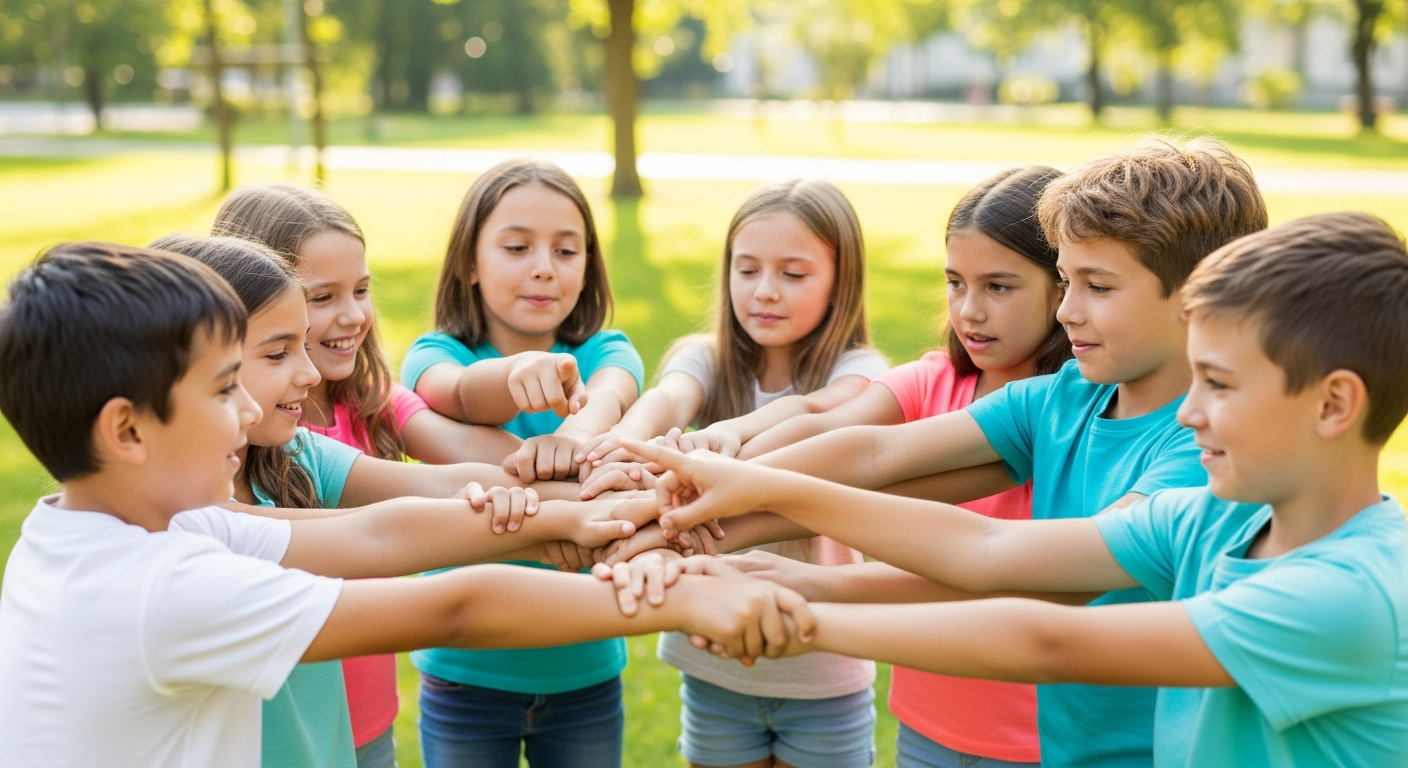
Table of Contents
- The Transformative Power of Team Building for Children
- Connecting Play to Communication Growth with Speech Blubs
- Fun Team Building Games for Kids: A Comprehensive Guide
- The Role of Adults: Guiding the Play
- Nurturing Communication Beyond Games
- Conclusion
- Frequently Asked Questions (FAQ)
Have you ever watched a group of children dive into an imaginative game, seamlessly assigning roles, solving impromptu problems, and communicating without a second thought? This natural ability to connect, collaborate, and create is at the heart of childhood development. Yet, as parents and educators, we know that these vital skills—communication, cooperation, problem-solving, and empathy—don't always blossom on their own. They need nurturing, practice, and the right environment to flourish. This is where the magic of team building games comes in.
This comprehensive guide will explore why team building activities are not just "fun and games" but powerful tools for fostering essential life skills in children of all ages. We’ll delve into the myriad benefits these activities offer, from boosting confidence and improving communication to sparking creativity and resolving conflicts. More importantly, we'll equip you with a treasure trove of engaging, easy-to-implement games for any setting—indoors or outdoors—that will transform playtime into impactful learning experiences. Whether your child is a budding leader, a shy observer, or a busy bee needing to focus, these activities provide opportunities for every personality to grow. And as we champion open communication in children, we at Speech Blubs are here to support every child's journey to speak their minds and hearts, creating a powerful synergy between play and development.

The Transformative Power of Team Building for Children
Team building activities are far more than just time fillers; they are carefully designed experiences that nurture a wide range of developmental skills. When children engage in collaborative play, they step into a dynamic learning environment where they naturally acquire skills crucial for academic success, healthy relationships, and future endeavors.
Developing Essential Communication Skills
Perhaps the most apparent benefit of team building is the boost it gives to communication. Whether it’s negotiating a strategy for a game or explaining an idea, children learn to articulate their thoughts clearly and, just as importantly, to listen actively to others. Effective verbal and non-verbal communication is the bedrock of successful teamwork. Through these games, children learn to interpret cues, understand different perspectives, and ensure their message is received, fostering a greater sense of connection. For a child who might be struggling to articulate their thoughts, these low-pressure, playful scenarios can be incredibly empowering. This kind of active engagement mirrors the approach we take at Speech Blubs, where our "video modeling" technique encourages children to learn communication by imitating their peers in engaging, supportive contexts, making complex skills accessible and fun.
Cultivating Problem-Solving and Critical Thinking
Many team building games present children with challenges or puzzles that they cannot solve alone. This necessity drives them to think creatively, strategize together, and persevere through difficulties. They learn to identify problems, brainstorm solutions, evaluate outcomes, and adapt their approaches. This iterative process builds resilience and teaches children that failure is often just a stepping stone to success. When facing a puzzle that requires multiple viewpoints, a child might realize the value of their classmate's unique idea, expanding their own capacity for innovation.

Fostering Collaboration and Cooperation
In an increasingly interconnected world, the ability to collaborate effectively is paramount. Team building games teach children how to work as a cohesive unit, respecting diverse ideas and perspectives. They learn to compromise, share responsibilities, and contribute actively towards a common goal. This hands-on experience in cooperation helps children understand that collective effort often yields better results than individual pursuits. These activities provide a safe space to practice navigating group dynamics, standing up for their ideas respectfully, and supporting their teammates.
Boosting Confidence and Promoting Leadership
Making a meaningful contribution and achieving a goal as part of a team can be incredibly rewarding for a child, significantly boosting their self-esteem. Team activities also provide natural opportunities for leadership to emerge. A child might take initiative, delegate tasks, or motivate their peers, developing crucial leadership skills in a supportive environment. The success they experience, both individually and as a group, reinforces their belief in their own capabilities and encourages them to take on new challenges. Reducing frustration and building confidence are core values at Speech Blubs, where we create joyful learning moments that empower children.
Promoting Social Inclusion and Friendship
Engaging with new people or stepping out of one's comfort zone can be daunting for children. Team building games provide a structured yet playful environment that encourages interaction among peers who might not otherwise connect. By working together towards a shared objective, children build empathy, understand different social dynamics, and foster a strong sense of belonging, laying the groundwork for lasting friendships.
Teaching Conflict Resolution Skills
In any group setting, conflicts are bound to arise. Team building activities offer invaluable opportunities to teach children constructive ways to resolve disagreements. Under the guidance of an adult, children can learn to express their feelings, listen to opposing viewpoints, and collaboratively find fair solutions. These practical experiences help children develop the emotional intelligence needed to navigate social interactions gracefully.
Connecting Play to Communication Growth with Speech Blubs
At Speech Blubs, our mission is deeply intertwined with these benefits of play: to empower children to speak their minds and hearts. Our company was founded by individuals who personally experienced speech problems in childhood, inspiring us to create the supportive tool we wished we had. We understand that effective communication is about more than just sounds and words; it’s about confidence, connection, and the joy of expression.
Our innovative app offers an immediate, effective, and joyful solution for the 1 in 4 children who need speech support. We blend scientific principles, like the power of mirror neurons, with engaging play to create one-of-a-kind "smart screen time" experiences. Unlike passive viewing of cartoons, Speech Blubs is an active, interactive tool that transforms screen time into a powerful opportunity for family connection and learning. Our unique "video modeling" methodology allows children to learn by watching and imitating their peers, making the learning process natural and fun.
Just as team building games encourage children to step up, speak out, and learn from each other, Speech Blubs provides a similar supportive environment for speech and language development. The confidence a child gains by successfully articulating a word in the app can transfer directly to their participation in a group game, reducing frustration and fostering a love for communication.
Unsure if your child could benefit from a little extra speech support? Take our quick 3-minute preliminary screener to get a simple assessment and a free 7-day trial. It involves just 9 simple questions and provides an assessment along with a next-steps plan. Take the Speech Blubs Screener
Fun Team Building Games for Kids: A Comprehensive Guide
Let's dive into some fantastic activities designed to build teamwork, communication, and confidence in children. We’ve categorized them to help you find the perfect fit for your setting and goals.
Icebreakers and Get-to-Know-You Games
These games are perfect for helping children, especially new groups, feel comfortable, make connections, and learn about each other in a lighthearted way.
1. Birthday Line-Up
- Objective: To arrange themselves in chronological order of birthdays without speaking (or with limited speaking).
- Materials: None.
- Participants: Whole class or groups of 8-15.
- How to Play: Challenge children to line up from January 1st to December 31st using only gestures, facial expressions, or whispers. Once they believe they are in order, have them state their birthdates to check.
- Skills Developed: Non-verbal communication, cooperation, problem-solving, active listening, memory.
2. Human Bingo
- Objective: To find peers who match specific characteristics on a bingo card.
- Materials: Pre-made bingo cards with squares like "Has a pet," "Likes pizza," "Has traveled to another state," "Has a sibling," etc. (Ensure cards have some commonalities).
- Participants: Whole class.
- How to Play: Give each child a bingo card. They walk around, asking peers if a statement on their card applies to them. If it does, that peer signs the square. The goal is to get a "bingo" (five in a row).
- Skills Developed: Verbal communication, asking questions, social interaction, active listening, quick thinking.
3. Storytime Chain
- Objective: To collaboratively create a humorous and imaginative story.
- Materials: None.
- Participants: Small groups (4-8) or whole class in a circle.
- How to Play: The first person starts a story with just four words. The next person adds four more words, and so on. Encourage creativity and silliness.
- Skills Developed: Creativity, verbal communication, active listening, quick thinking, sequential reasoning. This activity directly encourages spontaneous language use and imaginative vocabulary, much like the diverse categories and interactive scenes within our Speech Blubs app, where children are encouraged to build sentences and narrative skills.
4. Common Denominator
- Objective: To find shared traits within a small group.
- Materials: None.
- Participants: Small groups (3-5).
- How to Play: Give groups five minutes to find one unique thing they all have in common (e.g., "We all have brown eyes," "We all like to draw," "We all have a favorite toy that's blue").
- Skills Developed: Communication, observation, active listening, finding common ground, social connection.
Cooperative Problem-Solving Challenges
These activities require groups to work together to overcome a physical or mental obstacle, emphasizing strategic thinking and mutual support.
5. Human Knot
- Objective: To untangle a "knot" of intertwined arms without letting go of hands.
- Materials: None.
- Participants: Small groups (5-10).
- How to Play: Children stand in a circle, facing inwards. Each person reaches across and grabs a hand of two different people. The challenge is to untangle themselves into a single circle (or two smaller circles) without breaking the hand-holds.
- Skills Developed: Problem-solving, spatial reasoning, verbal and non-verbal communication, patience, physical coordination.
6. Flip the Tarp Challenge
- Objective: To flip a tarp or blanket over while everyone remains standing on it.
- Materials: A large tarp, flat sheet, or blanket.
- Participants: Teams of 4-8.
- How to Play: The team stands on the tarp, filling most of the space. They must collectively figure out how to turn the tarp over completely without anyone stepping off or touching the ground.
- Skills Developed: Strategic planning, cooperation, communication, physical coordination, perseverance.
7. Marshmallow and Toothpick Challenge
- Objective: To build the tallest (or strongest, or most creative) free-standing structure using limited materials.
- Materials: Mini marshmallows and toothpicks (or spaghetti).
- Participants: Teams of 3-5.
- How to Play: Give each team a set amount of materials and a time limit (e.g., 15-20 minutes). They must strategize and build their structure.
- Skills Developed: Creativity, structural engineering concepts, planning, resource management, fine motor skills, collaboration.
8. Blind Polygon
- Objective: To form a perfect geometric shape (e.g., a square) using a rope while blindfolded.
- Materials: One long rope (tied into a closed loop), blindfolds for all participants.
- Participants: Groups of 8-15.
- How to Play: All participants are blindfolded and given the rope. They must communicate to arrange themselves and the rope into a specific shape. Only when the group collectively agrees the shape is complete can they remove their blindfolds.
- Skills Developed: Trust, verbal communication, spatial awareness, leadership, active listening, problem-solving under sensory constraints. This game heavily relies on precise verbal instructions and auditory feedback, skills that Speech Blubs actively nurtures through clear auditory prompts and repetitive practice, building a strong foundation for understanding and executing complex directions.
Active and Engaging Outdoor Games
Perfect for burning energy, these outdoor activities combine physical movement with team objectives.
9. Tug-of-War
- Objective: To pull the opposing team across a designated line.
- Materials: A sturdy, long rope with a center mark.
- Participants: Two equal teams.
- How to Play: Teams line up at either end of the rope, with a clear center line on the ground. On "Go!", they pull. Ensure a safe playing area free of obstacles.
- Skills Developed: Physical strength, coordination, teamwork, strategy, encouragement, sportsmanship.
10. Obstacle Course Relay
- Objective: To complete a series of physical challenges as a team in the fastest time.
- Materials: Various playground equipment, cones, hula hoops, ropes, buckets, or natural elements.
- Participants: Two or more teams.
- How to Play: Design a course using available resources. Teams race in a relay format, with each member completing a section or the entire course before the next member starts.
- Skills Developed: Physical agility, speed, strategy, encouragement, communication (cheering), perseverance.
- Variation: Blindfolded Obstacle Course. Pair children up. One is blindfolded and guided verbally by their partner through the course. This builds immense trust and precise communication.
11. Hula Hoop Pass
- Objective: To pass a hula hoop around a circle without breaking hand-holds.
- Materials: One hula hoop.
- Participants: Whole class or large groups forming a circle.
- How to Play: Children stand in a circle, holding hands. A hula hoop is placed over one person's arm. The team must pass the hula hoop around the entire circle, moving their bodies through it, without anyone letting go of their hands.
- Skills Developed: Cooperation, physical coordination, problem-solving, non-verbal communication, patience.
12. Capture the Flag
- Objective: To capture the opposing team's flag from their base and bring it back to your own, while defending your flag.
- Materials: Two flags (bandanas, scarves), designated "bases."
- Participants: Two teams.
- How to Play: Teams have their own territory and a flag. The goal is to retrieve the other team's flag without being tagged. Tagged players might go to "jail" and need to be rescued by a teammate.
- Skills Developed: Strategy, planning, teamwork, agility, communication, defensive and offensive thinking, sportsmanship.
Indoor Creativity and Communication Boosters
Even with limited space, these games foster collaboration, innovative thinking, and clear communication.
13. Leaning Tower of Feetza
- Objective: To build the tallest free-standing tower using only shoes.
- Materials: Each participant's shoes.
- Participants: Small groups (3-8).
- How to Play: Teams are given a time limit (e.g., 3 minutes) to construct the tallest possible self-standing tower using only the shoes of their team members.
- Skills Developed: Creativity, engineering principles, rapid prototyping, teamwork under pressure, communication.
14. Cup Stacking Challenge
- Objective: To stack cups into a pyramid or other structure using only a rubber band and strings.
- Materials: Plastic cups, one rubber band, strings (one per team member).
- Participants: Teams of 4-8.
- How to Play: Each team member holds one string tied to the rubber band. They must work together, pulling their strings to expand or contract the rubber band, to pick up and place cups to build a structure without touching the cups with their hands.
- Skills Developed: Fine motor control, precise communication, coordination, patience, problem-solving. This activity requires children to give and follow very specific directions, which is a fantastic exercise in receptive and expressive language.
15. Name Train
- Objective: To arrange themselves in a line based on a specific, non-obvious criterion, stating their names as they go.
- Materials: None.
- Participants: Groups of 15-30.
- How to Play: A leader gives a criterion (e.g., "Line up by the number of letters in your first name, shortest to longest," or "Line up by the first letter of your favorite animal"). As they find their spot, they state their name clearly.
- Skills Developed: Active listening, problem-solving, quick communication, memory, social interaction.
16. What Animal Am I?
- Objective: To discover the name of the animal written on a sticky note on their forehead by asking yes/no questions.
- Materials: Sticky notes, pen/marker.
- Participants: No limit.
- How to Play: Write an animal name on each sticky note and place it on a child's forehead without them seeing it. Children mingle, asking other players yes/no questions about their own animal (e.g., "Do I have fur?", "Can I fly?"). They cannot ask the same person two questions in a row.
- Skills Developed: Deductive reasoning, question formation, verbal communication, social interaction. For parents whose children are working on question-asking or categorizing skills, this game provides excellent, natural practice that complements activities in the Speech Blubs app aimed at building these exact linguistic structures.
Building Empathy and Connection
These games focus on understanding others' perspectives and working together in unique ways.
17. All Tied Up
- Objective: To complete a task or obstacle course while physically connected to a partner.
- Materials: Scarves or soft ties to tie wrists together.
- Participants: Pairs.
- How to Play: Children are paired, and their adjacent wrists are gently tied together. They then must perform simple tasks like picking up an object, opening a door, or navigating a small obstacle course, using only their free hands and working together.
- Skills Developed: Communication, coordination, empathy, problem-solving, patience, understanding shared movement.
18. Hot Potato (with a twist)
- Objective: To avoid being caught with the "hot potato" when the music stops, fostering quick reflexes and listening.
- Materials: A soft ball or beanbag, music player.
- Participants: Up to 10-15 players in a circle.
- How to Play: Children sit in a circle and pass the "hot potato" around as music plays. When the music stops, the child holding the potato is out. Remove one chair and continue, making the circle smaller, until only one winner remains.
- Skills Developed: Active listening, quick reactions, hand-eye coordination, dealing with elimination gracefully.
19. Group Juggle
- Objective: To establish a pattern of passing a ball, then incorporate more balls without dropping any.
- Materials: 3-5 soft, tossable items (balls, beanbags).
- Participants: Groups of 8-15 in a circle.
- How to Play: Start with one ball. Children pass it around the circle, establishing a clear pattern (e.g., "I pass to Sarah, Sarah passes to Tom," etc.). Once the pattern is learned and the ball successfully passed to everyone, introduce a second, then a third item, challenging the group to maintain the pattern without dropping anything.
- Skills Developed: Memory, coordination, precise communication, rhythm, collaboration, problem-solving under increasing complexity.
20. Team Volunteering or Fundraising
- Objective: To work together for a common cause beyond themselves.
- Materials: Varies depending on the activity (e.g., car wash supplies, donation boxes, art materials for cards).
- Participants: Whole team/class.
- How to Play: Organize an activity where children work together to benefit their community or raise funds. Examples include cleaning up a local park, organizing a donation drive for a charity, making cards for seniors, or hosting a bake sale.
- Skills Developed: Empathy, social responsibility, planning, execution, teamwork, generosity, understanding community impact. This is a powerful way to foster communication and collaborative problem-solving in a real-world context, reinforcing the "speak their minds and hearts" ethos that we uphold at Speech Blubs.
The Role of Adults: Guiding the Play
While these games are inherently fun, the real learning happens with thoughtful adult guidance. As a parent or caregiver, your role is crucial.
- Set Clear Expectations: Explain the game, rules, and objectives clearly before starting.
- Encourage Participation: Gently prompt shy children to join in and ensure everyone feels included.
- Model Good Behavior: Demonstrate active listening, patience, and positive communication.
- Facilitate Reflection: After each game, ask questions like: "What went well?" "What was challenging?" "How did you work together?" "What did you learn?" This helps children internalize the skills they practiced.
- Adapt as Needed: Be flexible! If a game isn't working, modify the rules or switch to another activity. The goal is engagement and learning, not strict adherence to instructions.
Nurturing Communication Beyond Games
At Speech Blubs, we deeply believe that every child deserves the opportunity to communicate effectively and joyfully. Our app is scientifically designed to be a powerful supplement to a child's overall development plan and, when applicable, professional therapy. We offer a screen-free alternative to passive viewing, making screen time productive and engaging. Through our unique "video modeling" method, children learn by watching real kids their age, which activates mirror neurons and makes learning speech and language feel like play.
We are committed to providing an immediate, effective, and joyful solution for families, ensuring children build confidence, reduce frustration, and develop key foundational communication skills. Our mission, born from the personal experiences of our founders who grew up with speech problems, is to empower children to speak their minds and hearts.
For parents looking to provide their child with continuous, expert-backed support, we offer flexible plans. Our Monthly plan is available for $14.99 per month. However, the best value and full experience comes with our Yearly plan at just $59.99 per year, which breaks down to an incredible $4.99/month. By choosing the Yearly plan, you save 66% and unlock exclusive, high-value features.
The Yearly plan includes:
- A 7-day free trial, allowing you to experience the full benefits before committing.
- Access to the extra Reading Blubs app, enhancing literacy skills.
- Early access to new updates and a prioritized 24-hour support response time.
The Monthly plan does not include these valuable benefits. We encourage you to choose the Yearly plan to get the free trial and the full suite of features that will truly empower your child's communication journey.
Ready to see what other parents are saying about their child's success with Speech Blubs? Read our testimonials and discover the impact we've made. Our method is backed by science, placing us in the top tier of speech apps worldwide. You can explore the research behind our effective approach.
Conclusion
Team building games are invaluable tools for child development, fostering crucial skills like communication, problem-solving, confidence, and cooperation. They create an environment where learning is joyful, social bonds are strengthened, and children feel empowered to express themselves. From icebreakers that welcome new friends to complex problem-solving challenges that stretch young minds, these activities lay a strong foundation for success in school, friendships, and life.
As you integrate these fun team building games into your child's routine, remember that every interaction is an opportunity for growth. And for those moments when you're seeking to further nurture your child's communication abilities, Speech Blubs is here to support you. We believe in the power of playful, engaging learning to help every child speak their minds and hearts.
Don't wait to empower your child's communication journey. Get started with Speech Blubs today! Download Speech Blubs on the App Store or Google Play. For the best experience and value, choose the Yearly plan to unlock your 7-day free trial, the Reading Blubs app, and exclusive benefits. Ready to dive in? Create your account and begin your 7-day free trial today!
Frequently Asked Questions (FAQ)
Q1: What age group are these team building games best suited for?
A1: Many of these games are adaptable for a wide range of ages, generally from preschoolers (with simpler rules and more adult guidance) up to pre-teens and early adolescents. The key is to choose games that match the developmental stage and attention span of the children, and to adjust complexity and competition levels accordingly.
Q2: How can I encourage a shy child to participate in team building activities?
A2: Start with low-pressure, familiar games, or activities where individual contributions are less spotlighted. Pair them with a supportive friend, or give them a specific, manageable role within the team. Emphasize cooperation over competition, and celebrate effort and participation rather than just winning. Often, observing for a while before joining is helpful for shy children.
Q3: What if my child gets frustrated or the team isn't working well together?
A3: Frustration is a natural part of learning. When it arises, pause the game and facilitate a discussion. Ask the children what they think isn't working and how they might solve it together. Remind them that teamwork means supporting each other. It's an excellent opportunity to teach conflict resolution and perseverance. Sometimes, simply taking a break or switching to a different game can reset the mood.
Q4: How do team building games connect with speech and language development?
A4: Team building games are rich in natural communication opportunities. Children need to speak, listen, follow instructions, ask questions, explain ideas, and negotiate. This active language use strengthens vocabulary, sentence structure, pragmatic skills (social rules of language), and auditory processing. For targeted speech and language support, tools like Speech Blubs complement these real-world interactions by providing structured, engaging practice for articulation, vocabulary, and early literacy through our video modeling approach.
About the author