
Boost Development with a Fun Toddler Pouring Activity
 By Speech Blubs Team•Feb 23, 2026•14 min.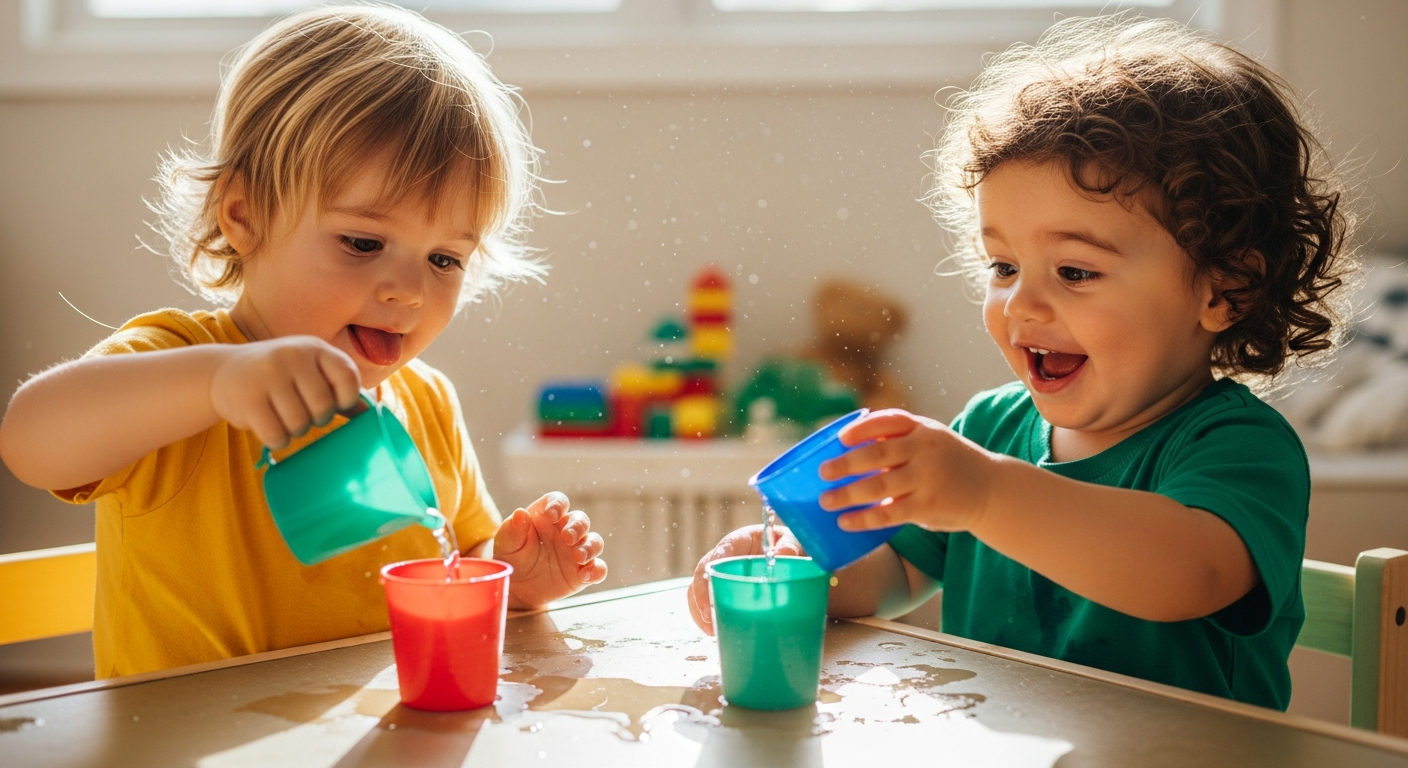
Table of Contents
- Introduction
- The Importance of the Toddler Pouring Activity
- The Montessori Approach: From Dry to Wet
- How to Set Up Your Pouring Station
- Connecting Play to Language Development
- Advanced Challenges for Growing Toddlers
- Why Smart Screen Time Complements Physical Play
- Choosing the Right Path for Your Child
- Practical Scenarios: Connecting Play to Speech Blubs
- Conclusion
- Frequently Asked Questions
Introduction
Have you ever watched your toddler reach for a full pitcher of orange juice with a look of pure, focused determination, only to feel your heart skip a beat as you imagine the sticky, neon-colored disaster about to unfold on your rug? It is a reflex for many of us to jump in, take over, and say, "Let Mommy do that for you." However, that simple, messy impulse your child has is actually a vital developmental milestone in disguise. At Speech Blubs, we believe that these "messy" moments are where the most profound learning happens.
Our mission is to empower children to "speak their minds and hearts," and that empowerment begins with mastery over their own environment. Whether it’s learning to form a new word or learning how to fill a cup without overflowing it, every small victory builds the confidence a child needs to navigate the world. This blog post is designed to guide you through the wonderful world of the toddler pouring activity. We will explore why this life skill is essential, how it builds foundational motor and language skills, and how you can set up a successful "pouring station" at home without losing your mind to the mess.

We will also discuss how physical activities like pouring complement "smart screen time" tools. Our founders, who all navigated speech challenges in their youth, created Speech Blubs to be the joyful, effective solution they wished they had. By the end of this article, you will have a clear roadmap for fostering independence in your child, along with practical tips to turn a simple afternoon of water play into a robust learning experience.
The Importance of the Toddler Pouring Activity
When we talk about childhood development, we often focus on the "big" things: walking, talking, and eventually reading. But "life skills" are the quiet heroes of a child's growth. A toddler pouring activity isn't just about getting water from point A to point B; it’s about the "I can do it" spirit.
At Speech Blubs, we understand that 1 in 4 children will need some form of speech or developmental support. Often, frustration in communication stems from a lack of felt autonomy. When a child learns to pour their own water, they aren't just practicing a physical movement; they are reducing their reliance on an adult for a basic need. This reduces frustration and builds the foundational confidence required for verbal communication.
Building Fine and Gross Motor Skills
Is pouring a fine motor skill or a gross motor skill? The answer is both! Lifting a heavy pitcher involves the larger muscles of the arm and shoulder (gross motor), while the act of tilting, aiming, and stopping the flow requires incredible precision in the wrist and fingers (fine motor).
- Wrist Stability and Rotation: To pour successfully, a child must learn "radial and ulnar deviation"—the technical terms for moving the wrist from side to side.
- Grip Strength: Holding a handle or the body of a cup builds the small muscles in the hand, which are the same muscles your child will eventually use to hold a pencil or use scissors.
- Bilateral Coordination: Often, a child needs to hold the receiving cup with one hand while pouring with the other. This "two-handed" coordination is essential for tasks like buttoning a shirt or cutting paper.
Spatial Awareness and Math Concepts
When your toddler watches water rise in a cup, they are getting a first-hand lesson in physics and math. They are learning about:

- Capacity: How much can this container hold?
- Volume: Why does the water from the wide bowl fill up three small cups?
- Cause and Effect: "If I keep tilting the pitcher, the water keeps coming out until the cup overflows."
For parents who want to see how their child's development is tracking across these various domains, we recommend taking our quick 3-minute preliminary screener. It consists of 9 simple questions and provides a personalized assessment and next-steps plan to support your child’s unique journey.
The Montessori Approach: From Dry to Wet
If you are nervous about the mess, the Montessori method offers a brilliant "staircase" approach to the toddler pouring activity. You don't have to start with a gallon of milk!
Phase 1: Dry Pouring
Before introducing liquids, start with "dry" materials. These are easier to control and much easier to clean up if a spill occurs.
- Materials: Use two identical small creamers or cups and a tray. Fill one with large items like dried pasta or large wooden beads.
- The Goal: Encourage your child to pour the items from the full cup into the empty one.
- Progression: Once they master large items, move to smaller grains like dried beans, then rice, and finally sand. Each step down in material size requires more refined motor control.
Phase 2: Introducing Water
Once your child can transfer rice with minimal spills, they are ready for the "big leagues." Water adds a new sensory element—the sound of the splash, the feeling of wetness, and the speed of the flow.
Our unique approach at Speech Blubs involves "video modeling," where children learn by watching their peers. You can use this same principle at home. Sit with your child and demonstrate the pour slowly. Let them watch your hands. Just as children in our app are motivated by watching other kids succeed, your toddler will be motivated by watching you perform the task with ease. You can learn more about the science behind our video modeling methodology on our research page.
How to Set Up Your Pouring Station
Setting up a dedicated "station" helps define the learning zone and keeps the mess contained. Here is how we recommend doing it:
The Essential Supply List
- A Large Bin: An under-the-bed storage plastic tub is perfect. It acts as a "safety zone" for spills.
- Various Containers: Don't feel like you need to buy a fancy tea set. Use what you have! Measuring cups, empty yogurt containers, small pitchers, and even recycled berry baskets (which create a fun "rain" effect) are excellent.
- A Tray: Placing the cups on a tray inside the bin provides a stable surface.
- Food Coloring (Optional): Adding a drop of blue or red to the water makes it more visible. This helps the child see the water line as it rises, which is a key part of learning "when to stop."
- A Sponge or Rag: This is the most important part! Including a cleanup tool teaches the child that spills are just part of the process, not a "mistake" to be feared.
Tips for a Mess-Free (Mostly!) Experience
- The Towel Trick: Lay down a large beach towel underneath the bin. Any "errant pours" that escape the bin will be soaked up by the towel before they hit your hardwood or carpet.
- The Bathtub Method: If you are really worried about the mess, set the pouring station up in a dry bathtub. It’s the ultimate contained environment!
- The "Half-Full" Rule: Only give your child as much water as you are willing to clean up. Start with just a few ounces in a small pitcher.
Connecting Play to Language Development
At Speech Blubs, we are experts in turning every activity into a "speech moment." A toddler pouring activity is a goldmine for language input. As your child plays, you can narrate their actions to build their vocabulary.
Vocabulary to Practice
- Verbs: Pour, spill, splash, stop, fill, empty, lift, tip.
- Adjectives: Heavy, light, wet, dry, full, empty, fast, slow.
- Prepositions: In, out, over, under.
Imagine a scenario where a parent is playing with their 3-year-old "late talker." As the child pours water into a cup, the parent can say, "Ooh, look! The water is going in. Splash! Now the cup is full. Stop!" This simple narration connects the physical sensation to the word.
For even more targeted practice, our app features sections like "Yummy Time," where children can see other kids interacting with cups, spoons, and food. This peer-to-peer modeling is a powerful tool for family connection and building communication skills. You can download Speech Blubs on the App Store to explore these categories together.
Advanced Challenges for Growing Toddlers
Once your child is a "pro" at basic pouring, keep the engagement high by adding challenges.
Filling to the Line
Take a clear glass and place a rubber band around it or mark a line with a permanent marker. Challenge your child to pour the water exactly to that line. This requires "impulse control"—the ability to stop an action even when it's fun to continue. This is a foundational cognitive skill that helps with self-regulation.
The "Multiple Cup" Sequence
Give your child three small cups and one large pitcher. Ask them to put "a little" in the first cup, "a lot" in the second, and leave the third "empty." This introduces the concepts of quantity and following multi-step directions.
Real-World Application
The ultimate goal of the toddler pouring activity is for them to use the skill in daily life. Start inviting them to pour their own water at dinner or help fill the dog’s water bowl. When a child contributes to the family in a meaningful way, their self-esteem soars. To see how other families have transformed their daily routines into learning opportunities, read through our parent testimonials.
Why Smart Screen Time Complements Physical Play
You might wonder why a speech therapy app provider is encouraging you to play with water and beans. It's because we believe in a holistic approach to development. We provide a screen-free alternative to passive viewing (like mindlessly watching cartoons) by creating "smart screen time" that encourages active participation.
While your child is resting after their "big pour" activity, you can use Speech Blubs to reinforce the concepts they just learned. Our app isn't a "babysitter"; it’s a tool for co-play. By watching other children on the screen mimic the sounds and words associated with their play, your child’s brain is "primed" to learn.
Our method is a powerful supplement to a child's overall development plan and, when applicable, professional therapy. We don't promise that your child will be giving public speeches in a month, but we do promise to provide an immediate, effective, and joyful solution that fosters a love for communication and reduces the frustration that often comes with developmental hurdles.
Choosing the Right Path for Your Child
We know that every family has different needs, which is why we offer flexible options for accessing our tools. However, we want to be transparent about the best value for your child’s development.
Our Pricing Plans:
- Monthly Subscription: $14.99 per month. This is a great way to "dip your toes in" and see how your child responds to the video modeling.
- Yearly Subscription: $59.99 per year. This is the clear best choice for most families, breaking down to just $4.99 per month—a 66% savings compared to the monthly plan.
Why Choose the Yearly Plan?
The Yearly plan is designed to be a comprehensive support system for your child's growth. It includes:
- A 7-day free trial: Test everything out with zero risk.
- Reading Blubs: You get access to our extra app, Reading Blubs, which focuses on early literacy and phonics.
- Priority Support: Enjoy a 24-hour support response time.
- Early Access: Be the first to try new updates and features.
The Monthly plan does not include the free trial or the extra Reading Blubs app. We encourage you to choose the Yearly plan to get the full suite of features and the best possible start for your little one. You can create your account and begin your 7-day free trial today on our website.
Practical Scenarios: Connecting Play to Speech Blubs
Let’s look at how these activities live in the real world.
Scenario A: A parent is worried that their 2-year-old isn't using many words yet. They start the toddler pouring activity in the bathtub. As the child plays, the parent notices the child is very focused on the "splash." Later that day, they open the Speech Blubs app to the "Early Sounds" section. The child sees a peer making a "b-b-b" sound for "bubble" or "p-p-p" for "pop." Because the child just had a joyful sensory experience with water, they are more motivated to try those sounds.
Scenario B: A preschooler struggles with following directions and often gets frustrated when they can't do things "perfectly." The parent uses the "fill to the line" pouring challenge to practice patience and precision. During their Speech Blubs time, they work on the "Living Things" section, where they have to wait and watch the video model before they get to "act out" the animal sound. The physical practice of "waiting for the line" in the pouring activity helps them have the impulse control needed for the app.
Conclusion
A toddler pouring activity is more than just a way to kill twenty minutes on a Tuesday afternoon. It is a fundamental exercise in independence, motor control, and language development. By providing your child with the space to make a little mess and take a few risks, you are teaching them that they are capable, competent, and heard.
At Speech Blubs, we are honored to be a part of your parenting toolkit. Whether you are navigating a diagnosed speech delay or simply want to give your child the best possible start, we are here to support you with a blend of scientific principles and the joy of play.
Remember, the goal isn't a perfectly dry floor; it's a child who smiles because they finally filled their own cup. Embrace the spills, celebrate the "splashes," and watch as your child begins to speak their mind and heart.
Ready to take the next step? Download Speech Blubs on the App Store or Google Play to begin your journey. We highly recommend selecting the Yearly plan during your sign-up to unlock your 7-day free trial, the Reading Blubs app, and the full range of features designed to help your child thrive.
Frequently Asked Questions
1. What age is best to start a toddler pouring activity?
Most children are ready to begin "dry" pouring activities between 15 and 18 months. You’ll know they’re ready when they start mimicking you pouring drinks or showing a strong interest in transferring toys from one container to another. For water pouring, many parents find 22–24 months is the "sweet spot" where the child has enough motor control to enjoy the activity without it becoming overwhelming.
2. Does food coloring stain skin or clothes?
In a pouring station, the food coloring is typically very diluted. While concentrated dye can stain, a few drops in a large bin of water shouldn't cause permanent marks. If you’re concerned, have your child wear an apron or old "play clothes," and if any water gets on their skin, it will usually come off during their next bath.
3. How do I encourage my child to pour if they are afraid of making a mess?
Some children are naturally more "neat" and may be hesitant to spill. For these kids, start with dry materials like large pom-poms or wooden blocks. Praise the effort rather than the result. If they do spill, simply say, "Oops! Let's use our sponge to wipe it up," showing them that a spill is a normal part of the process and easy to fix.
4. What are the main benefits of these activities for speech development?
Pouring activities build the foundational skills necessary for speech: following directions, building vocabulary (full, empty, pour), and increasing confidence. Furthermore, the fine motor control developed in the hands and wrists is neurologically linked to the areas of the brain responsible for speech and language. Using a tool like Speech Blubs alongside these physical activities creates a multi-sensory learning environment that is highly effective for young children.
About the author