
Boost Development with Creative Toddler Craft Boxes
 By Speech Blubs Team•Feb 20, 2026•14 min.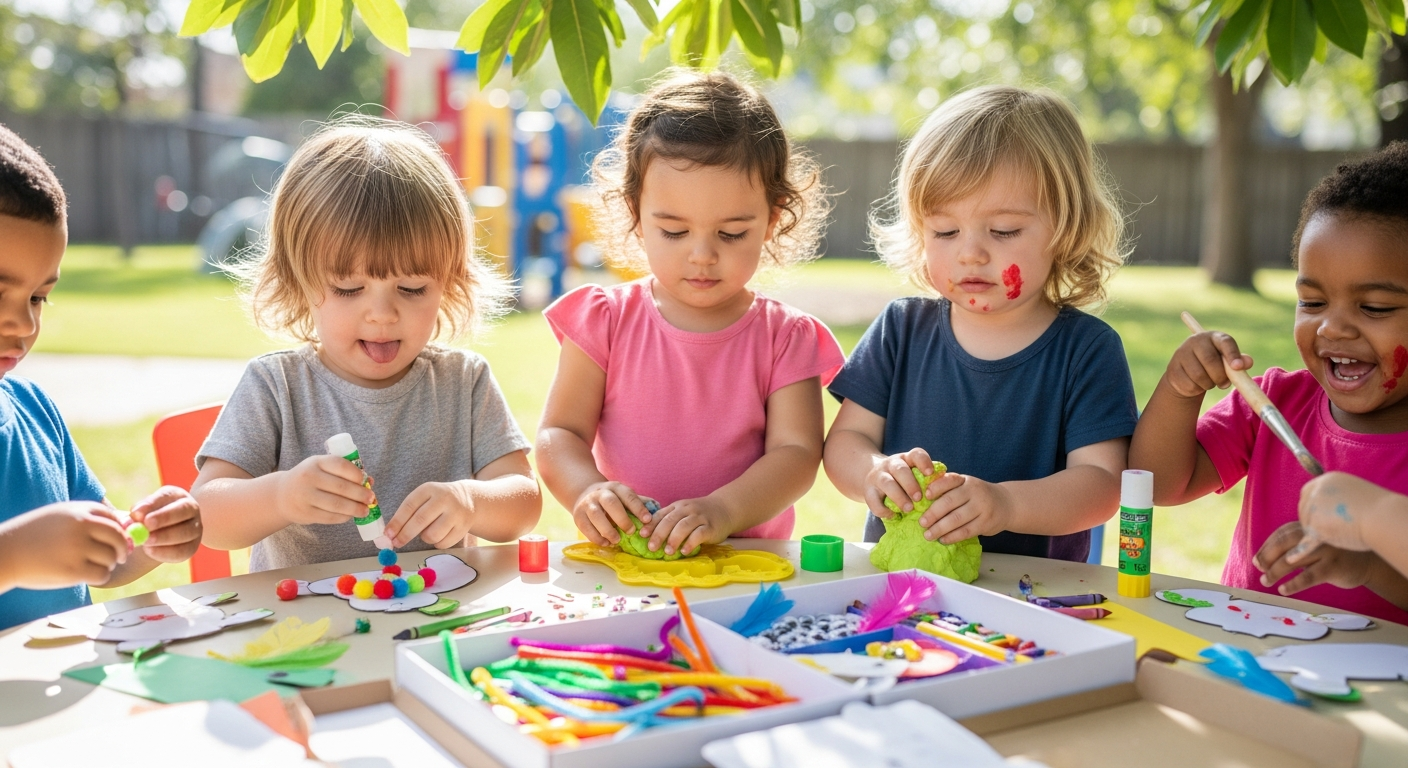
Table of Contents
- Introduction
- The Magic of Hands-On Learning
- How Toddler Craft Boxes Support Speech and Language
- Choosing the Best Kits for Your Child
- The Science of Imitation: From Crafting to Speaking
- Integrating Smart Screen Time with Physical Play
- Building Fine Motor Skills for Future Success
- The Importance of Family Connection
- Understanding the Value of Your Investment
- Setting Realistic Expectations
- Practical Scenarios for Your Next Crafting Session
- Conclusion
- Frequently Asked Questions
Introduction
Have you ever noticed how a simple cardboard box can keep a toddler entertained longer than the expensive electronic toy that came inside it? There is something inherently magical about a child’s ability to turn basic materials into a world of imagination. As parents, we are constantly looking for ways to nurture that spark of creativity while ensuring our little ones are hitting their developmental milestones. This is where toddler craft boxes come into play. These curated kits offer a bridge between play and learning, providing everything a caregiver needs to facilitate meaningful, hands-on experiences without the stress of endless planning or trips to the art supply store.
In this post, we are going to explore why these tactile experiences are so vital for early childhood development. We will dive into how crafting helps build fine motor skills, cognitive abilities, and—most importantly for us at Speech Blubs—foundational communication skills. We’ll also discuss how you can choose the best kits for your child’s specific interests and how to supplement physical play with "smart screen time" to create a holistic learning environment. By the end of this guide, you will understand how to transform a rainy afternoon into a joyful educational session that helps your child "speak their minds and hearts."

Our main message is simple: Play is the work of childhood. Whether it is through a physical craft kit or an interactive speech tool, providing your child with the right resources at the right time is the key to fostering a lifelong love for learning and communication.
The Magic of Hands-On Learning
Toddlers learn best when they can touch, feel, and manipulate the world around them. Physical objects provide sensory feedback that a digital screen alone cannot replicate. When a child reaches into a craft box and pulls out a fuzzy pipe cleaner, a smooth wooden bead, or a sticky piece of felt, they are engaging multiple senses simultaneously. This multi-sensory approach is essential for brain development in the early years.
Hands-on learning through toddler craft boxes encourages "active exploration." Instead of being passive recipients of information, children become the architects of their own tiny projects. This sense of agency builds confidence. When a toddler successfully glues a "googly eye" onto a paper plate to make a monster, they aren't just making art; they are learning that their actions have a direct impact on their environment. This is a foundational step in developing problem-solving skills and emotional resilience.
How Toddler Craft Boxes Support Speech and Language
It might not be immediately obvious, but crafting is a powerhouse for language development. At Speech Blubs, we focus heavily on the connection between physical action and vocalization. When you sit down with your child to open one of their toddler craft boxes, you are entering a "language-rich environment."
Every step of the crafting process is an opportunity for communication. You can describe the materials: "Look at this blue paper. It feels smooth." You can narrate the actions: "First, we squeeze the glue. Then, we press the star down." This type of parallel talk helps toddlers map words to actions and objects in real-time.
For a parent whose 3-year-old "late talker" loves animals, a craft kit focused on the "Animal Kingdom" offers a fun, motivating way to practice sounds. As you build a lion out of a paper plate and orange yarn, you can encourage your child to practice the "roaring" sound or say the word "mane." This mirrors our own approach at Speech Blubs, where we use peer-led video modeling to encourage kids to imitate sounds and words in a joyful, pressure-free way. If you are curious about your child's current communication level, you can take our quick 3-minute preliminary screener to get a simple assessment and a free 7-day trial.

Choosing the Best Kits for Your Child
With so many options on the market, choosing the right toddler craft boxes can feel overwhelming. You want something that is age-appropriate, safe, and engaging enough to hold a toddler's notoriously short attention span. Here are a few things we recommend looking for:
1. Simple, Clear Instructions
For the toddler age group (typically ages 2 to 4), instructions should be heavily visual. Your child might not be reading yet, but they can follow picture-based steps. This helps them understand the concept of sequencing—learning that things happen in a specific order (first, second, third), which is also a critical skill for storytelling and structured speech.
2. High-Quality, Safe Materials
Toddlers explore with their hands and, occasionally, their mouths. Ensure the kit uses non-toxic, eco-friendly materials. Sturdy components are also a plus, as they allow the finished product to be used as a toy long after the "crafting" portion is over.
3. All-Inclusive Convenience
The best boxes are those that include everything you need, down to the glue stick and the paintbrush. As busy parents, we know that the "spark" for a craft often disappears the moment you realize you’ve run out of tape. A truly great kit removes that barrier to entry, allowing you to focus entirely on the bonding experience.
The Science of Imitation: From Crafting to Speaking
The way children learn to craft is very similar to how they learn to speak: through imitation. In the world of child development, we often talk about "mirror neurons." These are specialized brain cells that fire both when an individual performs an action and when they observe someone else performing that same action.
When your child watches you fold a piece of paper, their brain is practicing that fold along with you. This is the scientific principle behind our methodology at Speech Blubs. Our app uses "video modeling," where children watch their peers perform speech exercises. This peer-to-peer connection is incredibly powerful because children are naturally more inclined to imitate other children.
By using toddler craft boxes, you are providing a physical space for this imitation to happen. You do a step, and they copy it. This builds the foundational "imitation muscle" that is required for complex communication. You can read more about the scientific research behind our method to see why this approach is so effective for early learners.
Integrating Smart Screen Time with Physical Play
We are often asked how digital tools fit into a world of physical play. At Speech Blubs, we believe in "smart screen time." This is a screen-free alternative to passive viewing—like sitting quietly in front of a cartoon. Instead, our app encourages children to be active participants.
Imagine a Saturday morning: You and your toddler spend 30 minutes working on a project from one of your favorite toddler craft boxes. Afterward, you use the Speech Blubs app for 10-15 minutes to practice the words and sounds related to what you just built. If you made a space-themed craft, you can head to the "Space" section in the app to learn about planets and rockets. This creates a cohesive learning loop where the digital and physical worlds support each other.
Our founders created Speech Blubs because they all grew up with speech problems and wanted to build the tool they wished they had as kids. Our mission is to provide an immediate, effective, and joyful solution for the 1 in 4 children who need speech support. We don't want to replace physical play; we want to enhance it. You can see how we've helped thousands of families by reading our parent testimonials.
Building Fine Motor Skills for Future Success
Toddler craft boxes are essentially a workout for little fingers. Activities like peeling stickers, using safety scissors, threading beads, and manipulating clay are all excellent for developing fine motor coordination. Why does this matter for speech?
There is a strong correlation between fine motor skills and speech development. Both require precise, coordinated movements—one with the hands, and the other with the "articulators" (the tongue, lips, and jaw). Strengthening the brain's ability to control small movements in the hands often translates to better control over the muscles used for speaking.
Furthermore, the focus required to complete a craft helps extend a child's attention span. Increased "joint attention"—the ability to focus on the same object or task as a caregiver—is a primary predictor of language success. When you are both looking at that craft box, you are building the neurological pathways for better communication.
The Importance of Family Connection
The most valuable thing inside any toddler craft box isn't the glitter or the glue; it’s the time you spend together. In our fast-paced lives, it’s easy to get caught up in the "to-do" list. Crafting forces us to slow down, sit on the floor, and engage in "co-play."
This shared experience reduces frustration for both the parent and the child. For a child who struggles to express themselves, having a shared activity provides a non-verbal way to connect. It creates joyful learning moments that build the child's confidence. When a child feels supported and understood, they are much more likely to take the risks necessary to practice new sounds and words.
We always frame our app's activities with the understanding of adult co-play. While the app is engaging for the child, it is most powerful when used as a tool for family connection. Ready to give it a try? Download Speech Blubs on the App Store or find us on Google Play to begin your journey.
Understanding the Value of Your Investment
When looking at the cost of toddler craft boxes and educational apps, it’s important to consider the long-term value. These aren't just toys; they are investments in your child’s cognitive and emotional future. We want to be transparent about our own pricing to help you make the best decision for your family.
At Speech Blubs, we offer two main paths:
- Monthly Subscription: $14.99 per month. This is a great way to test the waters if you are just starting out.
- Yearly Subscription: $59.99 per year. This is our best value option, breaking down to just $4.99 per month—a 66% saving compared to the monthly plan.
We highly recommend the Yearly plan because it offers much more than just a lower price. When you choose the Yearly subscription, you get:
- A 7-day free trial to explore everything we have to offer.
- Full access to the Reading Blubs app, which helps transition your child from speaking to early reading skills.
- Early access to all our new updates and features.
- Priority 24-hour support response time from our dedicated team.
The Monthly plan does not include these exclusive benefits. By choosing the yearly option, you are ensuring your child has a consistent, high-quality resource as they grow and develop. You can create your account and start your 7-day free trial today to see the difference for yourself.
Setting Realistic Expectations
While we are passionate about the benefits of toddler craft boxes and Speech Blubs, we believe in setting realistic expectations. Every child develops at their own unique pace. Using a craft kit or an app won't result in a child giving public speeches overnight. Instead, these tools are designed to:
- Foster a genuine love for communication.
- Build the foundational skills needed for speech and literacy.
- Reduce the frustration that often comes with speech delays.
- Create a sense of pride and confidence in the child's abilities.
Think of these resources as a powerful supplement to your child’s overall development plan. If your child is already seeing a professional speech therapist, our tool is an excellent way to continue the "play-based therapy" at home in between sessions. We are here to support the process, making every step of the journey a little more joyful for both you and your little one.
Practical Scenarios for Your Next Crafting Session
To give you an idea of how to blend toddler craft boxes with language practice, let's look at a few common scenarios:
Scenario A: The Weather Box
If your craft kit includes making a "rain cloud" or a "sun," use this to teach opposites. While your child is gluing cotton balls (clouds) and yellow paper (sun), you can talk about "hot" and "cold" or "wet" and "dry." In the Speech Blubs app, you can then visit the "Nature" sections to reinforce these concepts with peer videos.
Scenario B: The Transportation Box
For a toddler obsessed with cars and trucks, use the materials to build a "stop" and "go" sign. This is perfect for practicing functional language. "Should the car go? Yes! Now, stop!" These simple, high-frequency words are essential for early talkers to navigate their daily lives.
Scenario C: The Color Sorting Box
Many toddler craft boxes focus on sorting objects by color. As your child moves a red bead into a red cup, encourage them to say the color name. If they aren't ready for words yet, focus on the "R-R-R" sound for red. This repetitive, focused play is exactly what the brain needs to store new information.
Conclusion
The journey of early childhood is filled with milestones, but none are quite as rewarding as the moment your child finds their voice. Toddler craft boxes provide the physical tools to explore, create, and build fine motor strength, while Speech Blubs provides the digital "smart screen time" to turn those experiences into spoken words.
By combining the tactile joy of crafting with our peer-led video modeling methodology, you are giving your child a comprehensive toolkit for success. Our mission is to empower every child to "speak their minds and hearts," and we are honored to be a part of your family’s story.
Remember, the best choice for your child’s development is consistency and engagement. We invite you to choose the Yearly plan to unlock our full suite of features, including the Reading Blubs app and a 7-day free trial. It’s the most cost-effective way to ensure your child has the support they need throughout the year.
Download Speech Blubs on the App Store or Google Play today, or sign up on our website to start creating joyful learning moments together!
Frequently Asked Questions
1. What age is best for toddler craft boxes? Most toddler craft boxes are designed for children between the ages of 2 and 4. At this stage, they are developing the fine motor skills necessary to handle larger craft components and are beginning to follow simple, multi-step directions. Always check the specific age rating on the box to ensure the materials are safe and developmentally appropriate for your child.
2. Can craft boxes help a child with a speech delay? Yes! Craft boxes are excellent for speech development because they provide a natural context for "joint attention" and descriptive language. By narrating what you are doing together, you are helping your child build their vocabulary and understand how words relate to physical actions. When used alongside a tool like Speech Blubs, it creates a powerful environment for language growth.
3. What is the difference between the Speech Blubs Yearly and Monthly plans? The Monthly plan is $14.99 and provides basic access to our speech exercises. The Yearly plan is $59.99 (which is only $4.99/month), saving you 66%. The Yearly plan is the only option that includes a 7-day free trial, access to the Reading Blubs app, early access to new content, and 24-hour support response times.
4. How long should a toddler spend on a craft project? Toddlers have short attention spans, typically ranging from 5 to 15 minutes. The best toddler craft boxes break activities down into small, manageable steps. If your child loses interest, it’s perfectly okay to put the box away and finish it another time. The goal is to keep the experience joyful and stress-free rather than focusing on the finished product.
About the author