
Boosting Development: Fun Park Games for Kids
 By Speech Blubs Team•Jan 19, 2026•21 min.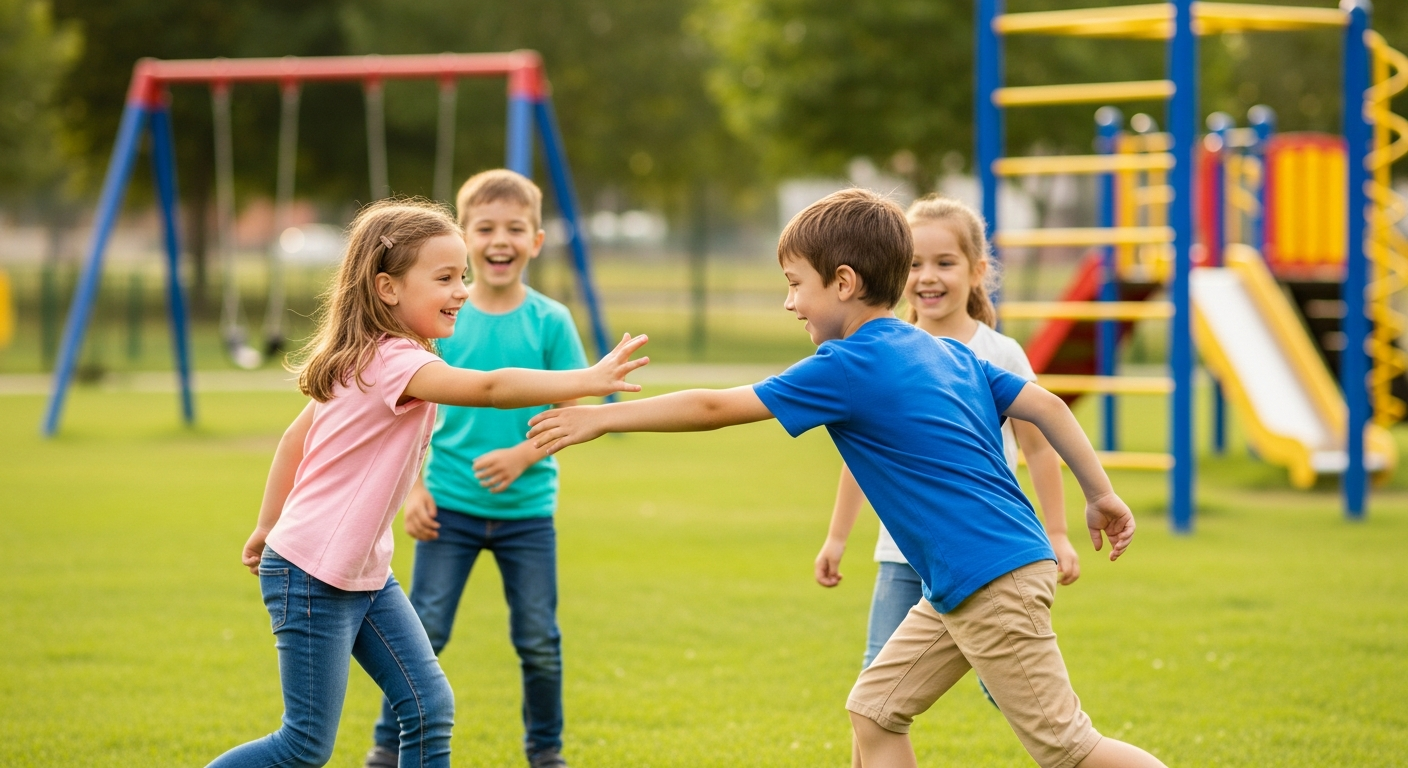
Table of Contents
- Introduction
- The Transformative Power of Park Play
- Why Play Matters for Communication Development
- Classic Park Games: Building Foundational Skills
- Team & Strategic Park Games: Fostering Cooperation and Problem-Solving
- Creative & Expressive Park Games: Unleashing Imagination
- From Park to Progress: How Speech Blubs Supercharges Learning
- Is Your Child Ready for a Communication Boost?
- Unlocking Your Child's Full Potential: Speech Blubs Pricing & Features
- Conclusion
- FAQ
Introduction
In a world increasingly dominated by glowing screens and digital distractions, the simple, timeless joy of outdoor play often takes a backseat. Yet, for children, a trip to the local park is far more than just an escape; it’s a vibrant, multi-sensory classroom where some of the most crucial developmental milestones are met. We've all seen the magnetic pull of a tablet, but imagine the exhilaration of a child chasing butterflies, the concentration of building a sandcastle, or the shared laughter during a game of tag. These moments aren't just fun; they are powerful catalysts for physical, cognitive, social-emotional, and especially, communication growth. This article dives deep into the myriad benefits of embracing park playtime and provides an extensive collection of fun park games for kids that promise to engage, educate, and empower your child, all while laying a strong foundation for them to speak their minds and hearts.

The Transformative Power of Park Play
Stepping into a park offers an immediate antidote to the sedentary habits that can creep into modern childhood. The vast, open spaces, diverse textures of nature, and dynamic playground structures provide a rich environment for holistic development.
Physical Development
Park games are a powerhouse for physical growth. Running, jumping, climbing, and swinging engage major muscle groups, enhancing gross motor skills, balance, and coordination. Fine motor skills are also refined through activities like picking up sticks, drawing with chalk, or manipulating small game pieces. This physical activity is vital not only for healthy bodies but also for developing proprioception and body awareness, which are fundamental for all learning.
Cognitive Development
Beyond the obvious physical benefits, park play sharpens young minds. Games often involve rules, turn-taking, and strategic thinking, fostering problem-solving skills and critical reasoning. A child figuring out the best hiding spot in Hide and Seek, or collaborating to build a fort, is actively engaging their cognitive functions. Imaginative play, sparked by natural elements or open-ended structures, boosts creativity and the ability to think abstractly.
Social-Emotional Development
Perhaps one of the most significant benefits of park play lies in its ability to cultivate social and emotional intelligence. Interacting with peers in an unstructured environment teaches children crucial social cues, negotiation, empathy, and conflict resolution. They learn to share, take turns, and understand the perspectives of others. Managing the excitement of winning or the disappointment of losing builds resilience and emotional regulation. These real-world social interactions are irreplaceable for fostering confident, well-adjusted individuals.
Language and Communication Benefits
Crucially for us at Speech Blubs, park play offers a fertile ground for language development. Every game, every interaction, presents an opportunity to use and understand language. Children are naturally motivated to communicate their ideas, feelings, and intentions when engaged in play. They learn new vocabulary from their environment ("Look at the big tree!"), practice following multi-step directions ("First, run to the slide, then climb up!"), and engage in descriptive language ("My turn!"). Through imaginative play, they explore narratives and roles, further enhancing their expressive and receptive language skills. At Speech Blubs, our mission is to empower children to "speak their minds and hearts," and we see outdoor play as a perfect complement to our innovative approach to communication development. To learn more about our commitment to fostering communication in children, visit our homepage.

Why Play Matters for Communication Development
The ability to communicate effectively is a cornerstone of a child's success in school, relationships, and life in general. For many children, however, this journey presents unique challenges. This is why we are so passionate about blending play with scientific principles. Our company was born from the personal experiences of our founders, who all grew up with speech problems and created the tool they wished they had. They understood firsthand the frustration of not being able to express oneself and the isolating feeling it could bring.
At Speech Blubs, we believe that learning should be immediate, effective, and joyful. Our unique methodology is rooted in the power of "video modeling," where children learn by watching and imitating their peers. This approach taps into the natural human inclination to mimic, supported by neurological research on mirror neurons. Just as children learn to run by watching others, they can learn to form words and sentences by observing children their own age. This "smart screen time" offers a screen-free alternative to passive viewing experiences like cartoons, turning digital engagement into an active, interactive learning session that fosters family connection and communication practice. Our methodology is backed by science, placing us in the top tier of speech apps worldwide. You can explore the research behind our approach on our website.
Classic Park Games: Building Foundational Skills
These tried-and-true park games are cherished for a reason. They require minimal equipment, are easy to learn, and offer a wealth of developmental benefits.
Hide and Seek
A universal favorite, Hide and Seek, is excellent for spatial awareness, counting, turn-taking, and even developing a theory of mind (understanding what others might be thinking or looking for).
- How to Play: One person is "it" and counts to a predetermined number with eyes closed while others find hiding spots. "It" then searches for the hidden players. The first person found often becomes "it" for the next round.
- Developmental Benefits: Counting, number recognition, understanding positional words (behind, under, in), spatial reasoning, waiting, impulse control, and social engagement.
- Speech Blubs Connection: This game encourages children to use directional language and descriptive words to hint at or describe hiding spots. For a child working on early sounds, whispering "shhh" while hiding or exclaiming "found you!" can be great practice.
Variations:
- Sardines: One person hides, and everyone else seeks. When a seeker finds the hider, they quietly join them in the hiding spot. The game continues until everyone is "packed like sardines" in one spot. The last person to find the group becomes the first hider in the next round. This variation emphasizes cooperation and quiet communication.
- Messenger: Combine Hide and Seek with a whisper chain. When the seeker finds a player, they whisper a short message. That player then seeks another and whispers the message, and so on. The last player found returns to home base and whispers the message to the original seeker to see if it matches. This is fantastic for listening skills and auditory memory.
Tag
Simple, exhilarating, and fantastic for gross motor skills.
- How to Play: One player is "it" and chases others, attempting to tag them. The person tagged becomes the new "it."
- Developmental Benefits: Running, agility, quick reflexes, understanding rules, and physical endurance.
- Speech Blubs Connection: Calling out "Tag, you're it!" or "Can't catch me!" provides opportunities for short, high-energy vocalizations and turn-taking in conversation.
Red Light, Green Light
A game that demands listening and impulse control.
- How to Play: One player stands at a distance with their back to the others, calling "Green Light!" The other players run towards them. When "Red Light!" is called, the leader turns around, and all players must freeze. Anyone caught moving is out or sent back to the start. The last player to reach the leader without being caught moving wins.
- Developmental Benefits: Listening skills, impulse control, following directions, gross motor skills (running, stopping), and patience.
- Speech Blubs Connection: This game directly reinforces listening comprehension and the ability to follow instructions, skills that are crucial for language acquisition and are practiced within our app's interactive activities.
Follow the Leader
A fantastic way to encourage mimicry, body awareness, and creative movement.
- How to Play: One person is the leader, and others follow, mimicking their actions exactly. The leader can perform any action – skipping, hopping, crawling, spinning, making silly faces, or even imitating animal sounds. The leader changes periodically.
- Developmental Benefits: Imitation, gross motor coordination, balance, observation skills, creativity, and expressive movement.
- Speech Blubs Connection: Children who practice imitation skills through games like Follow the Leader often show improvement in their ability to mimic sounds and words. This is a foundational skill that our unique video modeling feature nurtures by having children watch and imitate their peers. This direct link between physical imitation and vocal imitation is a powerful learning pathway.
Duck, Duck, Goose
A classic circle game perfect for younger children.
- How to Play: Players sit in a circle. One player walks around the outside, gently tapping each player's head and saying "duck." When they choose, they tap a head and say "goose!" The "goose" then chases the first player around the circle, trying to tag them before they sit down in the "goose's" vacated spot.
- Developmental Benefits: Turn-taking, listening, attention, gross motor skills (running, sitting), and understanding social rules.
- Speech Blubs Connection: Repetitive language patterns ("duck, duck, goose") are excellent for auditory processing and early word recognition. The anticipation and quick response required also stimulate quick verbal reactions.
Hopscotch
A game that combines physical skill with numerical understanding.
- How to Play: Draw a hopscotch grid with chalk (or use natural markers like sticks if no chalk is available). Players take turns throwing a marker into a square, then hopping through the grid, skipping the square with their marker, picking it up on the way back, and returning to start.
- Developmental Benefits: Balance, coordination, number recognition, counting, sequential memory, and problem-solving (where to land, how to retrieve the marker).
- Speech Blubs Connection: Reinforcing number words and sequential thinking, this game complements the structured learning found in sections of our app designed to build early cognitive and linguistic frameworks.
Musical Statues / Freeze Dance
An energetic game that promotes listening and body control.
- How to Play: Play music and have everyone dance. When the music stops, everyone must freeze in place like a statue. Anyone caught moving is out. The last one dancing wins.
- Developmental Benefits: Listening skills, body awareness, impulse control, motor planning, and creative movement.
- Speech Blubs Connection: The game's reliance on auditory cues (music stopping) hones listening skills, while the "freezing" aspect improves body control and awareness—foundational elements for clear articulation.
Simon Says
A superb game for listening comprehension and following instructions.
- How to Play: One person is "Simon" and gives commands. Players must only follow commands that begin with "Simon Says." If Simon gives a command without "Simon Says," and a player follows it, they are out.
- Developmental Benefits: Auditory processing, selective attention, following multi-step directions, memory, and impulse control.
- Speech Blubs Connection: This game is a direct parallel to many activities within Speech Blubs that build receptive language. Children learn to listen carefully and process verbal information, skills vital for understanding and responding in everyday conversations.
I Spy
A quiet game that hones observation and descriptive language.
- How to Play: One player secretly chooses an object visible in the park and says, "I spy with my little eye something…" giving a clue about its color, shape, or first letter. Other players guess until they identify the object.
- Developmental Benefits: Vocabulary expansion, descriptive language (adjectives, adverbs), observation skills, deductive reasoning, and taking turns.
- Speech Blubs Connection: For a child expanding their vocabulary, "I Spy" is a fun way to practice naming objects and using descriptive words. Similarly, our app features numerous categories, like "Early Sounds" or "Animal Kingdom," where children learn to identify and name objects, building a robust lexicon.
Nature Scavenger Hunt
A versatile game that encourages exploration and observation.
- How to Play: Create a list of natural items to find (e.g., a smooth stone, a crinkly leaf, a feather, something red, something soft). Children work individually or in teams to find all the items.
- Developmental Benefits: Vocabulary (naming natural objects, describing textures and colors), observation skills, problem-solving, following directions, and environmental awareness.
- Speech Blubs Connection: For a parent whose child is a "late talker" and loves exploring, a nature scavenger hunt at the park becomes a lively vocabulary lesson. Pointing to a "leaf" or a "rock" while saying its name reinforces understanding, much like how Speech Blubs' "Early Sounds" section introduces new words through engaging video modeling. It helps bridge the gap between concrete objects and their verbal labels.
Team & Strategic Park Games: Fostering Cooperation and Problem-Solving
These games encourage teamwork, strategic thinking, and more complex social interactions, perfect for older children or larger groups.
Tug of War
A test of strength, teamwork, and collective effort.
- How to Play: Divide players into two teams. A long rope is marked in the middle, and a line is drawn on the ground. Each team pulls on an end of the rope, trying to pull the opposing team past the center line.
- Developmental Benefits: Teamwork, physical strength, gross motor skills, problem-solving (how to pull effectively), and sportsmanship.
- Speech Blubs Connection: The cheers, shouts, and encouragement shared during Tug of War provide a natural context for using expressive language and demonstrating social communication skills.
Capture the Flag
A classic team game requiring strategy, communication, and agility.
- How to Play: Divide into two teams, each with a designated "flag" (a bandana, shirt, etc.) and a "jail." The objective is to capture the other team's flag and bring it back to your territory without being tagged. Tagged players go to jail and can only be freed by a teammate.
- Developmental Benefits: Strategic planning, teamwork, communication (calling out opponents, coordinating rescues), running, agility, problem-solving, and negotiation.
- Speech Blubs Connection: This game fosters complex communication skills, as children need to discuss strategies, warn teammates, and call for help. It's a real-world scenario where expressive language is essential for success.
Kick the Can
A dynamic blend of hide and seek and tag, with a strategic twist.
- How to Play: One player is "it" and guards a designated can. All other players hide. "It" searches for hiders. If "it" finds a hider, they race back to the can, call out the hider's name, and kick the can. The hider is then "jailed." Any hider still free can try to sneak up and kick the can before "it" sees them, freeing all jailed players.
- Developmental Benefits: Strategy, problem-solving, spatial awareness, running, hiding, quick reflexes, and teamwork (freeing jailed players).
- Speech Blubs Connection: The need for stealthy communication, quick decisions, and verbal warnings ("Kick the can, save all!") in this game provides an exciting context for speech practice in a dynamic environment.
Spud
A fun game involving counting, aim, and quick reactions.
- How to Play: Players stand in a circle. One player throws a ball high into the air, calling out another player's name (or number if assigned). That player catches the ball while others scatter. Once the ball is caught, the catcher yells "Spud!" and everyone freezes. The catcher then takes four large steps towards the nearest player, spells out "S-P-U-D" as they take each step, and tries to hit them below the waist with the ball. If hit, that player gets a letter. If missed, the thrower gets a letter. The first player to spell "SPUD" is out.
- Developmental Benefits: Hand-eye coordination, counting, quick thinking, strategic aiming, and impulse control.
- Speech Blubs Connection: Calling out names, spelling words, and the rapid-fire "Spud!" provide quick bursts of vocalization and naming practice.
Outdoor Bowling
Bringing the fun of the alley to the open air.
- How to Play: Set up plastic bottles (or purchased bowling pins) as pins. Use a ball (tennis, rubber, small basketball) to roll and try to knock them down. Take turns, keep score, and reset the pins.
- Developmental Benefits: Hand-eye coordination, fine motor skills (setting up pins), counting, numerical understanding, turn-taking, and problem-solving (aiming).
- Speech Blubs Connection: Counting pins, discussing scores, and celebrating strikes are all excellent opportunities for using numerical language, simple sentences, and exclamations of joy.
Creative & Expressive Park Games: Unleashing Imagination
These games emphasize imaginative play, non-verbal communication, and creative expression, offering different avenues for communication development.
Charades
A classic game that relies entirely on non-verbal communication.
- How to Play: Players take turns acting out a word or phrase without speaking, while others guess. Themes can include animals, actions, book titles, or movie names.
- Developmental Benefits: Non-verbal communication, understanding body language, creative thinking, vocabulary (both for the actor and the guessers), and problem-solving.
- Speech Blubs Connection: Charades is a wonderful way to develop non-verbal communication skills, which are crucial for social interaction. It also builds understanding of concepts before children can verbally express them, bridging the gap between thought and language.
Body Spellers
A collaborative game that links physical movement with literacy.
- How to Play: Divide into small teams. The leader calls out a word, and the teams must use their bodies to "spell" the letters of the word. For example, forming an "O" with their arms or lying down to make an "I."
- Developmental Benefits: Teamwork, collaboration, letter recognition, spelling, body awareness, and creative problem-solving.
- Speech Blubs Connection: This game reinforces letter-sound correspondence and spelling in a fun, active way, laying a foundation for early literacy which is further supported by our Reading Blubs app, included with our Yearly plan.
Animal Races
Igniting imagination through movement and sound.
- How to Play: Designate a start and finish line. Children choose an animal to imitate (e.g., crab, bunny, bear) and race to the finish line using that animal's movements and sounds.
- Developmental Benefits: Gross motor skills, imaginative play, animal identification, and sound imitation.
- Speech Blubs Connection: Imitating animal sounds and movements is an excellent pre-speech activity, helping children explore vocalizations and articulation in a playful, low-pressure environment. Our "Animal Kingdom" section in Speech Blubs provides a perfect digital complement to this game, allowing children to practice specific animal sounds through video modeling.
From Park to Progress: How Speech Blubs Supercharges Learning
While park games offer invaluable opportunities for development, combining them with targeted, expert-designed resources can amplify a child's progress. At Speech Blubs, we believe in a holistic approach to communication development, where diverse experiences contribute to a child's growth. Our app serves as a powerful supplement, turning screen time into "smart screen time" that actively engages children rather than just passively entertaining them.
Imagine a child who has just learned to say "moo" while playing an animal-themed game at the park. They can then come home and reinforce that learning with the "Animal Kingdom" section in Speech Blubs, watching real children pronounce the sound, practicing alongside them, and gaining confidence. This blend of real-world experience and guided digital practice creates a reinforced learning loop that is both effective and enjoyable.
We are committed to providing an immediate, effective, and joyful solution for the 1 in 4 children who need speech support. Our app is not just about speech; it's about fostering a love for communication, building confidence, reducing frustration, and developing key foundational skills. Many parents have shared their success stories, witnessing their children blossom into more confident communicators. You can read testimonials from other families who have embarked on this journey with us.
Is Your Child Ready for a Communication Boost?
As parents, it's natural to wonder if your child could benefit from additional support. We understand that every child develops at their own pace, but recognizing potential areas for growth early on can make a significant difference. If you're unsure if your child could benefit from targeted speech and language development activities, we invite you to take a simple step. Our quick 3-minute preliminary screener involves just 9 simple questions and provides an assessment and next-steps plan. It’s a helpful tool to gain clarity and guide your child's communication journey. Take our quick 3-minute preliminary screener today to get a simple assessment and a free 7-day trial.
Unlocking Your Child's Full Potential: Speech Blubs Pricing & Features
We're transparent about our pricing because we believe in providing exceptional value to families. We offer two main subscription plans designed to fit your needs:
- Monthly Plan: For $14.99 per month, you get access to all the core Speech Blubs activities.
- Yearly Plan: For $59.99 per year, which breaks down to just $4.99/month. This is our most popular and recommended option for incredible value. You save 66% compared to the monthly plan!
Why the Yearly Plan is the Best Choice
The Yearly plan isn't just cheaper; it's packed with exclusive, high-value features designed to give your child the most comprehensive support:
- 7-Day Free Trial: Only with the Yearly plan can you unlock a full 7-day free trial to experience everything Speech Blubs has to offer before committing.
- Reading Blubs App: Gain full access to our extra Reading Blubs app, fostering early literacy alongside speech development.
- Early Access & Priority Support: Enjoy early access to new updates and features, plus a guaranteed 24-hour response time for customer support.
The Monthly plan does not include these fantastic benefits. We highly encourage you to choose the Yearly plan to get the free trial and the full suite of features that will truly empower your child's communication journey.
Ready to provide your child with joyful, effective, and scientifically-backed speech and language support? Download Speech Blubs on the App Store or Google Play to begin your 7-day free trial today. If you prefer to sign up via our website, create your account and start your trial here.
Conclusion
The magic of a park lies in its simplicity and its boundless opportunities for growth. From the exhilarating chase of Tag to the strategic thinking of Capture the Flag, fun park games for kids are invaluable tools for nurturing physical prowess, cognitive agility, social-emotional intelligence, and most importantly, communication skills. By stepping away from screens and into the vibrant world of outdoor play, we offer our children the freedom to explore, learn, and express themselves in ways that are both natural and profound.
At Speech Blubs, we champion the power of play, whether it's in the park or through our "smart screen time" experiences. We are dedicated to providing parents with effective, joyful, and scientifically-backed tools that complement these real-world adventures. Our mission is to empower every child to "speak their minds and hearts," fostering confidence and reducing frustration on their unique communication journey.
Don't let another day pass without experiencing the transformative power of purposeful play. Ready to give your child the gift of confident communication? Start your 7-day free trial today by signing up for our Yearly plan. It’s the best way to unlock all our features, including the Reading Blubs app and priority support, ensuring your child gets the most comprehensive and joyful learning experience possible.
FAQ
Q1: Why are park games particularly good for a child's overall development?
Park games offer a unique blend of physical activity, social interaction, and cognitive challenges in an open, natural environment. They promote gross and fine motor skills, enhance problem-solving and critical thinking, and teach crucial social-emotional skills like turn-taking, empathy, and conflict resolution. This holistic development creates a strong foundation for a child's physical and mental well-being, directly contributing to their readiness for complex learning, including communication.
Q2: How can Speech Blubs enhance the benefits children get from playing park games?
Speech Blubs complements park play by providing targeted, engaging activities that reinforce communication skills learned in the real world. For instance, if a child practices animal sounds at the park, they can reinforce these sounds in the app's "Animal Kingdom" section using our video modeling technique. Our "smart screen time" transforms passive viewing into active learning, helping children develop pronunciation, vocabulary, and sentence structure through imitation and interactive exercises. This synergy between outdoor exploration and guided app activities creates a powerful, integrated learning experience.
Q3: What if my child is shy or a late talker? Can park games still help them?
Absolutely! Park games can be incredibly beneficial for shy children or late talkers. Unstructured play in a low-pressure environment allows them to observe and gradually participate at their own pace. Games like "Follow the Leader" encourage imitation without the need for verbal responses initially, building confidence. Activities like "I Spy" can be played one-on-one with a parent, gently encouraging descriptive language. The natural motivation to communicate during play provides organic opportunities for verbal attempts, and positive reinforcement from parents can foster a love for speaking. Our app offers a safe, encouraging space to practice sounds and words, further boosting their confidence before engaging more verbally in social settings.
Q4: How do I get the most value from a Speech Blubs subscription?
To get the most value, we strongly recommend choosing our Yearly plan. Not only does it offer significant savings (66% compared to the monthly plan), but it also includes exclusive high-value features. With the Yearly plan, you receive a 7-day free trial, full access to our Reading Blubs app, early access to new updates, and 24-hour priority customer support. These additional benefits ensure a comprehensive and continuously supported learning journey for your child, maximizing their potential for communication growth.
About the author