
Christmas Party Fun: Engaging Kids' Activities
 By Speech Blubs Team•Dec 19, 2025•26 min.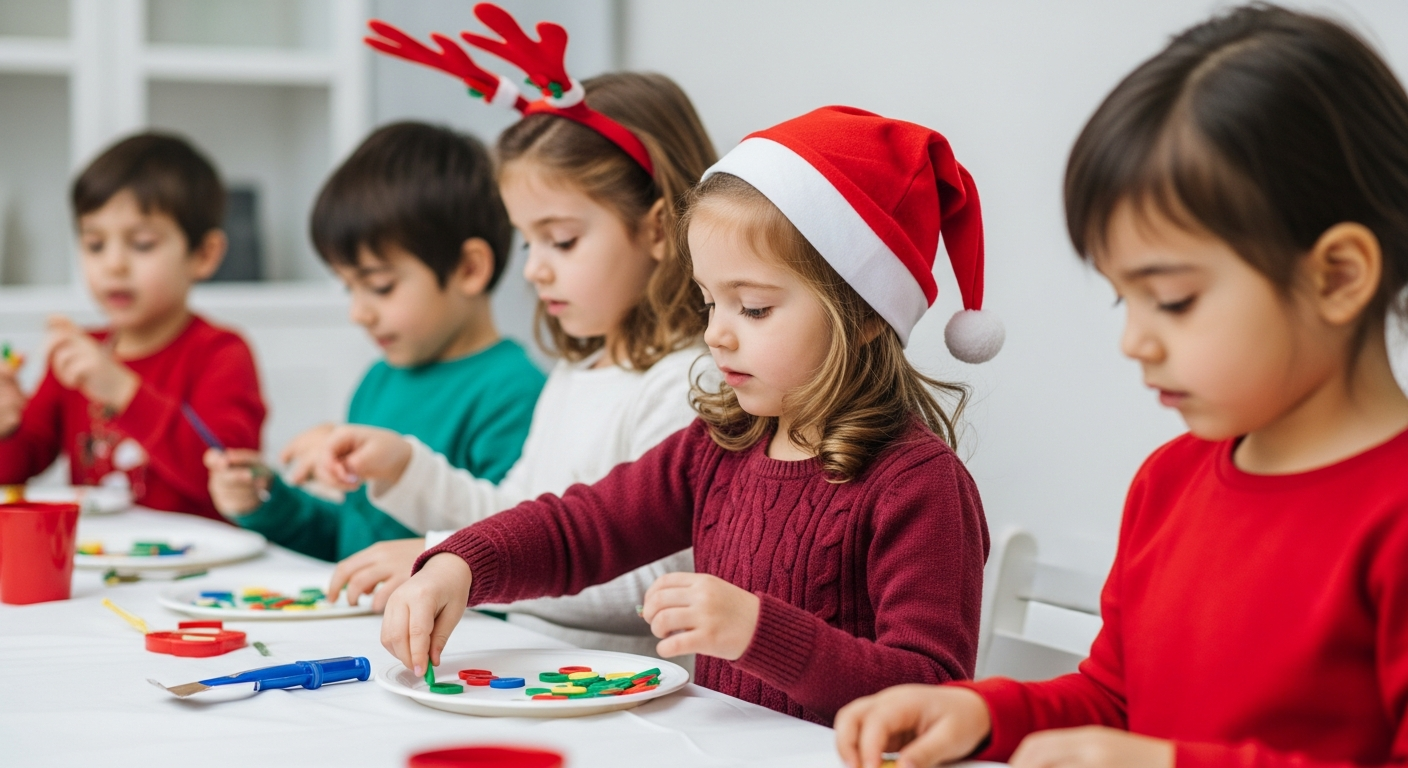
Table of Contents
- Introduction
- The Magic of Christmas Parties for Kids: More Than Just Fun
- Planning Your Festive Fun: Key Considerations
- Classic Christmas Party Games with a Twist (and a Communication Boost!)
- Creative & Sensory Christmas Activities
- Team Challenges & Collaborative Play
- Incorporating Speech Blubs into Holiday Play: Smart Screen Time
- Beyond the Party: Sustaining Communication Growth
- Ready to Empower Your Child's Voice? Discover Speech Blubs!
- Conclusion
- FAQ
The air crackles with anticipation, tiny eyes sparkle with wonder, and the scent of gingerbread fills the kitchen. Christmas parties for kids are a highlight of the holiday season, a time for joyous celebration, heartwarming traditions, and unforgettable memories. Yet, amidst the excitement, planning engaging activities that captivate young minds and foster meaningful interactions can sometimes feel like a daunting task. We’ve all been there: a room full of eager children, and a sudden lull in the festivities. But what if these precious holiday gatherings could be more than just fun and games? What if they were also powerful opportunities to nurture communication, social skills, and developmental growth in a truly joyful way?
This post dives deep into a treasure trove of creative, easy-to-implement Christmas party activities designed not only to bring cheer but also to subtly boost essential skills in children of all ages. From classic games with a communicative twist to imaginative craft stations and collaborative challenges, we'll explore how to transform your holiday gathering into a rich learning environment. We’ll guide you through planning considerations, offer practical tips, and even show you how tools like Speech Blubs can extend the magic of learning and connection beyond the party itself, empowering your child to express their unique voice with confidence. Get ready to sprinkle some extra developmental sparkle on your festive celebrations this year, creating an environment where every child feels seen, heard, and ready to speak their minds and hearts.

Introduction
The holiday season is a whirlwind of magic, cheer, and, let's be honest, sometimes a little chaos, especially when young ones are involved. For children, Christmas parties are a high point, bursting with sparkling lights, delicious treats, and the thrilling prospect of festive fun. But as parents and caregivers, we often seek to do more than just entertain; we want to create experiences that are not only joyful but also enriching. The good news is that holiday parties offer a unique, vibrant backdrop for fostering crucial developmental skills, particularly in communication and social interaction.
This guide is crafted to help you plan and execute truly engaging Christmas party activities for kids that go beyond mere distraction. We'll explore a range of ideas designed to encourage listening, speaking, problem-solving, and creative expression. Our goal is to equip you with strategies to make your festive gatherings memorable for their warmth, connection, and the gentle nudge they give toward your child's growth. By embracing thoughtful, interactive play, you can transform a simple holiday party into a powerful opportunity for every child to develop their voice and connect with others, reinforcing the true spirit of the season.
The Magic of Christmas Parties for Kids: More Than Just Fun
Christmas parties are more than just an annual gathering; they are fertile ground for children's holistic development. The festive atmosphere naturally encourages interaction, sparking curiosity and creativity. In this unique setting, children are often more open to new experiences and group activities, making it an ideal time to subtly integrate developmental support.
Beyond Entertainment: A Developmental Playground
Consider the inherent benefits:
- Social Skill Building: Children learn to share, take turns, negotiate, and empathize as they interact with peers and adults in a relaxed, joyful environment. These are foundational social skills that pave the way for successful relationships throughout life.
- Communication Enhancement: Structured games and creative tasks naturally prompt children to use language. They'll describe, explain, ask questions, respond to prompts, and tell stories, all of which are vital for language acquisition and fluency. For children who might be a little shy or experiencing speech delays, the playful context can lower inhibitions and make speaking more appealing.
- Cognitive Development: Many activities involve problem-solving, memory, pattern recognition, and following instructions. These mental exercises are crucial for cognitive growth and academic readiness.
- Emotional Regulation: Learning to win graciously, lose gracefully, manage excitement, and deal with unexpected turns are all part of the emotional landscape of party games. These experiences build resilience and self-regulation.
- Motor Skills: From decorating cookies to crafting ornaments, many party activities involve fine motor skills. Gross motor activities, like dancing or active games, improve coordination and body awareness.
By intentionally selecting and facilitating Christmas party activities, parents can harness this festive energy to provide rich, multi-faceted learning opportunities. It's about recognizing that every laugh, every shared task, and every moment of imaginative play contributes to a child's expanding world.

Planning Your Festive Fun: Key Considerations
Before diving into specific activities, a little thoughtful planning can ensure your Christmas party is a resounding success for all the children involved. Taking these factors into account will help you tailor your activity choices to create an inclusive and engaging experience.
Age Appropriateness
This is paramount. What thrills a toddler will bore a pre-teen, and vice-versa.
- Toddlers (1-3 years): Focus on sensory play, simple imitation games, and activities that require minimal instructions. Think bright colors, textures, sounds, and short attention spans.
- Preschoolers (3-5 years): They love imaginative play, storytelling, and simple rules. Activities that involve naming, describing, and taking turns are perfect.
- School-Aged (6-9 years): Kids in this age group enjoy more structured games, team challenges, and creative projects that allow for some independence. They can follow multi-step instructions and enjoy a bit of friendly competition.
- Pre-Teens (10-12 years): They appreciate activities that are more complex, collaborative, or involve strategy. They also enjoy opportunities for leadership and self-expression.
Group Size and Dynamics
The number of children attending and their individual personalities will influence your choices.
- Smaller Groups (4-8 kids): More intimate games, detailed crafts, and activities requiring closer supervision are feasible. This allows for more individual attention and deeper engagement.
- Larger Groups (9+ kids): Opt for activities that allow for many participants simultaneously, or those that can be easily split into smaller teams. Games with simple rules that don't require much equipment are ideal. Consider having multiple activity stations running concurrently to manage larger numbers.
Space and Resources
Take a realistic look at your environment.
- Indoor vs. Outdoor: Most Christmas parties are indoors, so consider space for movement. Will you need to move furniture? Do you have a designated "quiet zone" for crafts?
- Available Materials: Do you have art supplies, music players, a large open floor, or table space? Plan activities around what you already possess or what is easy and inexpensive to acquire. Don't feel pressured to buy elaborate supplies; often, simple household items can be transformed into engaging party props.
Balancing Structured vs. Free Play
While structured activities are great for direction and skill-building, allow for moments of free play. Children also benefit from self-directed exploration, where they can choose what they want to do, leading to spontaneous imaginative games and conversations. A mix ensures everyone has a chance to shine and relax.
- Designated Activity Time: Schedule specific times for organized games or crafts.
- Open Play Zones: Have a corner with building blocks, dress-up clothes, or a quiet reading nook for children who might need a break from high-energy activities.
By considering these points, you can curate a Christmas party experience that is not only fun but also thoughtfully designed to support the growth and happiness of every child present.
Classic Christmas Party Games with a Twist (and a Communication Boost!)
Many traditional party games can be easily adapted with a Christmas theme to become fantastic tools for speech and language development. The key is to think about how each game encourages children to listen, speak, describe, and interact.
1. "Pin the Nose on Rudolph" (and other Festive Characters)
This classic gets a festive makeover! Instead of a donkey, use a large printout of Rudolph, Santa, an elf, or a gingerbread person. Blindfold children, spin them gently, and have them try to pin the missing feature (Rudolph's nose, Santa's beard, an elf's hat).
- Communication Boost:
- Descriptive Language: Before or after their turn, ask children to describe where they think they're pinning the item ("It's near his ear!").
- Spatial Concepts: Use words like "up," "down," "left," "right," "closer," "further." Encourage other children to give verbal directions.
- Vocabulary: Reinforce names of body parts or clothing items for the character.
- Turn-Taking & Waiting: A simple but vital social skill practiced in this game.
- Practical Scenario: For a child who is learning prepositions, asking them, "Where did you put Rudolph's nose? Is it on his face or above his head?" helps solidify their understanding in a fun, tangible way. This kind of guided interaction supports foundational language learning.
2. Christmas Charades or Pictionary
Divide children into teams. Prepare slips of paper with Christmas-themed words or phrases (e.g., "decorating the tree," "singing carols," "Santa Claus," "opening presents," "gingerbread man," "sleigh ride"). For charades, children act out the phrase; for Pictionary, they draw it.
- Communication Boost:
- Non-Verbal Communication (Charades): Children learn to convey meaning through gestures, facial expressions, and body language.
- Expressive Language: Guessers use vocabulary and sentence structure to articulate their guesses.
- Receptive Language: Children must understand the prompt and process how to act/draw it.
- Vocabulary Expansion: Introduces and reinforces a wide range of Christmas-related words and concepts.
- Teamwork & Negotiation: Encourages children to work together and listen to each other's ideas.
- Adaptation for Younger Kids: Use pictures instead of words for them to act out or draw. Focus on single words like "elf," "present," "star."
3. Holiday Bingo
Create Bingo cards with Christmas-themed pictures (Santa, snowman, tree, reindeer, present, candy cane) or simple words. Call out the names of the pictures/words, and children mark them off. The first to get Bingo wins a small prize.
- Communication Boost:
- Listening Skills: Children must actively listen for the called-out items.
- Vocabulary Recognition: Reinforces visual-auditory association for festive words.
- Attention & Focus: Helps develop sustained attention.
- Matching & Identification: Important pre-literacy skills.
- Practical Scenario: If you have a child who struggles with auditory processing, calling out the words slowly and clearly, and perhaps showing a picture of the item after calling it, provides crucial support. This multi-sensory approach can make language comprehension more accessible.
4. Musical Statues (Christmas Edition)
Play upbeat Christmas music. Children dance until the music stops, at which point they must freeze like a statue. Anyone who moves is out, or simply sits down for a moment before rejoining.
- Communication Boost:
- Following Instructions: Children must listen for the "stop" cue and act accordingly.
- Body Awareness: Encourages awareness of their body in space and control over movement.
- Self-Regulation: Practicing impulse control by freezing.
- Descriptive Language: Ask children to describe their "statue pose" (e.g., "I'm a reindeer flying!" or "I'm a sleepy elf!").
5. Gift Guessing Game
Wrap several common household items or toys in festive paper. Children feel the packages without opening them and guess what's inside.
- Communication Boost:
- Descriptive Language: Encourage children to describe what they feel: "It's bumpy," "It feels soft," "It's long and thin."
- Deductive Reasoning: They use clues to make educated guesses.
- Vocabulary: Introduces words related to texture, shape, and weight.
- Questioning & Answering: Children can ask "yes/no" questions to get more clues.
These adapted classic games prove that holiday fun and developmental growth can go hand-in-hand, creating enriching experiences that children will remember long after the tinsel is put away.
Creative & Sensory Christmas Activities
Engaging children's senses and creative instincts can unlock wonderful opportunities for communication and learning. These activities are often less competitive and allow for individual expression.
1. Ornament Decorating Station
Set up a table with plain ornaments (clear plastic fillable, ceramic bisque, or wooden shapes), glitter, paint, markers, sequins, glue, and brushes. Let children unleash their creativity.
- Communication Boost:
- Descriptive Language: As children decorate, encourage them to describe their choices: "I'm using sparkly green glitter because it looks like a Christmas tree!"
- Color & Shape Identification: "What color is that star?" "Is your ornament round or pointy?"
- Following Directions: Simple instructions like "First, choose your ornament; then, pick your paint."
- Storytelling: "Tell me about your ornament. What makes it special?" This builds narrative skills.
- Practical Scenario: For a child who might be a "late talker" and interested in art, this activity provides a natural context for introducing new vocabulary. You can model words like "smooth," "shiny," "blob," "mix," and encourage imitation.
2. Cookie Decorating Extravaganza
Bake or buy plain sugar cookies in Christmas shapes (stars, trees, gingerbread men). Provide bowls of icing in different colors, sprinkles, mini candies, and edible glitter.
- Communication Boost:
- Following Multi-Step Instructions: "First, spread the white icing. Next, add sprinkles. Finally, put a candy button on top."
- Counting & Quantifying: "How many sprinkles did you use?" "Do you want a little or a lot of red icing?"
- Sharing & Negotiation: Important social skills when sharing limited supplies.
- Sensory Vocabulary: Describing tastes ("sweet," "minty"), textures ("crunchy," "smooth"), and smells ("ginger," "vanilla").
- Practical Scenario: If a child needs to work on requesting, this is ideal. "What do you want?" can prompt "more sprinkles" or "blue icing," gradually building sentence complexity.
3. DIY Snow Globes or Sensory Bottles
Gather clear plastic bottles or jars. Provide water, glitter, small plastic Christmas figurines (tiny trees, reindeer, snowmen), and glycerin or clear glue (to make glitter float slowly). Children fill their bottles, create a scene, and seal them.
- Communication Boost:
- Descriptive Language: "Look at the glitter! It's so shimmery." "The snowman is hiding behind the tree."
- Cause and Effect: "What happens when you shake it? The snow falls!"
- Calming & Focus: These can be great for children who need a quiet moment, offering a visual focal point that can be discussed calmly.
- Vocabulary: Introduce words like "float," "sink," "swirl," "sparkle."
4. Christmas Story Time & Puppet Show
Read a classic Christmas story aloud. Afterward, provide simple craft supplies (paper bags, markers, felt scraps) for children to create finger puppets or paper bag puppets of characters from the story or their own festive creations. Then, encourage them to put on a spontaneous puppet show.
- Communication Boost:
- Listening Comprehension: Children must understand the narrative of the story.
- Narrative Skills: Re-telling the story with puppets, or inventing new ones, builds their ability to sequence events and develop characters.
- Voice Modulation & Character Play: Encourages imaginative use of voice.
- Vocabulary Expansion: Encountering new words in context.
- Turn-Taking in Conversation: Puppets can facilitate dialogue between shy children.
These creative and sensory activities not only provide hands-on fun but also create natural, low-pressure environments for children to practice and expand their communication skills. The joy of creation becomes the catalyst for expression.
Team Challenges & Collaborative Play
Encouraging children to work together fosters vital social skills, problem-solving abilities, and a different kind of communication—negotiation, planning, and mutual support.
1. "Build a Snowman" Challenge (Indoors)
Divide children into small teams. Provide various "building materials" (toilet paper rolls, cotton balls, scarves, hats, construction paper, glue sticks). Each team must build a snowman or snow-person within a time limit.
- Communication Boost:
- Collaborative Language: Children must communicate to plan, assign roles, and solve problems together ("You hold the scarf, I'll put on the hat!").
- Negotiation & Compromise: Learning to work with different ideas within the team.
- Descriptive Feedback: Teams describe their snowman and how they worked together.
- Problem-Solving Vocabulary: Words like "attach," "secure," "balance," "support."
- Practical Scenario: For a child who tends to be solitary in play, a structured team activity like this encourages interaction. You can prompt, "What does your team need next?" or "How can you help your friend with that part?" This guides them into collaborative communication.
2. Christmas Scavenger Hunt
Create a list of Christmas-themed items for children to find around the party area (e.g., "something red," "a sparkly ornament," "a picture of Santa," "a candy cane," "something that smells like pine"). Provide visual clues for younger children and written clues for older ones.
- Communication Boost:
- Following Directions: Children must listen to or read the clues carefully.
- Spatial Prepositions: Clues can incorporate "under," "behind," "next to," "on top of."
- Vocabulary Reinforcement: Naming and identifying festive items.
- Questioning: Children might ask for clarification or clues.
- Team Communication: If done in teams, children communicate strategies and share findings.
- Adaptation: For younger children, hide pictures of items rather than actual objects, or use a "seek and find" board where they mark off items as they see them, rather than collecting them.
3. "Pass the Parcel" (Christmas Version)
Wrap a small prize in multiple layers of festive paper, with a small challenge or instruction written on each layer. Children sit in a circle and pass the parcel while music plays. When the music stops, the child holding the parcel unwraps one layer, reads the challenge (or an adult helps), completes it, and then passes the parcel again. Challenges could be "sing Jingle Bells," "tell a Christmas joke," "name three reindeer."
- Communication Boost:
- Turn-Taking: Fundamental for conversational and social skills.
- Listening & Responding: Children must listen to the challenge and respond appropriately.
- Expressive Language: Encourages speaking, singing, and creative expression.
- Anticipation & Impulse Control: Managing excitement while waiting for their turn.
- Social Interaction: Direct engagement with peers and adults during the challenge.
These collaborative games foster a sense of belonging and achievement, while naturally weaving in opportunities for children to strengthen their communication and social skills in a supportive, festive environment.
Incorporating Speech Blubs into Holiday Play: Smart Screen Time
While holiday parties are wonderful for face-to-face interaction, we understand that sometimes a screen time moment is needed – whether for a quick brain break, to manage overstimulation, or to wind down. This is where Speech Blubs offers a unique and valuable approach, transforming passive viewing into "smart screen time" that actively supports speech and language development.
At Speech Blubs, our mission is to empower children to "speak their minds and hearts," a principle born from the personal journeys of our founders who faced speech challenges themselves. They created the tool they wished they had: an immediate, effective, and joyful solution for the 1 in 4 children who need speech support. We blend scientific principles with play, and our approach aligns perfectly with the communicative goals of holiday activities.
"Smart Screen Time" for Brain Breaks
Imagine a child feeling overwhelmed by the party buzz. Instead of a passive cartoon that isolates them, Speech Blubs offers an interactive experience. For a parent whose 3-year-old "late talker" loves animals, the Animal Kingdom section offers a fun, motivating way to practice sounds like 'moo' and 'baa'. The app isn't just showing animals; it's prompting vocalizations and imitations. This provides a calming, yet productive, brain break that continues to build their speech skills.
Video Modeling & Peer Learning: The Heart of Our Method
Our unique methodology is rooted in "video modeling," where children learn by watching and imitating their peers. This is incredibly powerful because children are naturally inclined to imitate other children. When they see a peer confidently making a sound or saying a word, it feels more achievable and less intimidating than imitating an adult. This approach, backed by extensive research into mirror neurons, creates an empathetic learning environment where children gain confidence and reduce frustration.
Targeting Specific Holiday Vocabulary and Concepts
While Speech Blubs isn't explicitly "Christmas-themed," its diverse categories can be easily linked to holiday conversations:
- "Yummy Time": After decorating cookies, use this section to practice words related to food, describing tastes, or requesting more.
- "My Body": If you played a game like "Pin the Nose on Rudolph," reinforce body parts with our "My Body" section, identifying eyes, nose, and mouth.
- "Animals": Perfect for talking about Rudolph, Santa’s reindeer, or pets that might be part of holiday stories.
- "Getting Dressed": Discussing warm winter clothes, Santa's outfit, or festive attire.
Consider this scenario: A family is enjoying a Christmas party, and a child struggles to express their excitement about a new toy. Later, during a calm moment, using Speech Blubs' Guess the Word section can help them practice descriptive words or action verbs related to the toy. This bridges the gap between a real-world experience and targeted language practice, making learning relevant and engaging.
A Powerful Tool for Family Connection
Speech Blubs is designed to be a tool for family connection, not just independent screen time. Parents and caregivers play a crucial role in co-playing and supporting their child through the app. This shared experience fosters bonding, creates joyful learning moments, and reinforces the idea that communication is a shared journey. Imagine sitting together, laughing as your child imitates funny faces, and celebrating every new sound they make. This collaborative engagement with the app supports your child's overall development plan and can be a powerful supplement to professional speech therapy.
For parents who are unsure if their child could benefit from extra support, we offer a quick 3-minute preliminary screener. It involves 9 simple questions and provides an assessment and next-steps plan, often including a free 7-day trial of Speech Blubs. It’s a low-pressure way to gain insight and discover how we can help.
Beyond the Party: Sustaining Communication Growth
The joyous buzz of a Christmas party, with all its communication-rich activities, might fade, but the journey of language development is ongoing. The energy and engagement sparked during festive play can be carried forward, making communication practice a regular, cherished part of your family's routine.
The Importance of Consistent Practice
Just like any skill, consistent and varied exposure to language-rich environments is key to sustained growth. A single party, while impactful, is a springboard. Regular, short bursts of focused interaction and play are far more effective than sporadic, long sessions. This consistency builds momentum, reinforces learned concepts, and helps children internalize new words, sounds, and social cues.
Think about how a child learns to ride a bike; it's not one big lesson, but many small, consistent practices. The same applies to speech and language. Continuing to engage in conversations, read together, and play interactive games—even simple ones like "I Spy" during car rides—keeps the communication muscles strong.
How Speech Blubs Supports Ongoing Development
Speech Blubs is specifically designed to provide that consistent, accessible support. Our app is a powerful supplementary tool that can seamlessly integrate into your daily life, offering daily opportunities for children to practice and reinforce their communication skills.
- Diverse Activities: With hundreds of activities covering sounds, words, sentences, and social skills, the app keeps learning fresh and exciting. It adapts to your child’s needs, offering new challenges as they progress.
- Structured Yet Playful Learning: The "smart screen time" approach means that every minute spent on Speech Blubs is a moment of active engagement, promoting imitation and vocalization through our video modeling technology. It’s a productive alternative to passive entertainment.
- Reinforcement at Home: What children learn and practice on Speech Blubs can be brought into real-world interactions. For example, if they've practiced animal sounds in the app, you can reinforce those sounds when you see animals in books or real life, strengthening the connection.
- Confidence Building: The app's supportive, peer-led environment helps children build confidence in their voice, reducing the frustration often associated with speech challenges. This newfound confidence can then spill over into their interactions at school, with friends, and within the family.
We believe in celebrating every milestone, no matter how small. From the first babble to complex sentences, every step is a victory. Speech Blubs is here to support those steps, making the journey joyful and effective. You can read what other parents are saying about their child's success with Speech Blubs and how it integrates into their daily lives by visiting our testimonials page.
A Powerful Supplement to Professional Therapy
It's crucial to understand that Speech Blubs is a powerful supplement to a child's overall development plan. For children receiving professional speech therapy, the app can be an incredible resource for practicing skills learned in sessions, reinforcing concepts, and maintaining progress between appointments. It extends the therapist's work into the home in an engaging and accessible way. We always recommend consulting with a speech-language pathologist for personalized guidance and support for your child's unique needs. Speech Blubs is designed to work in harmony with expert advice, providing daily practice that feels like play.
By embracing both intentional interactive play and smart, supplementary tools like Speech Blubs, you can ensure that the communication growth ignited during the holidays continues to flourish year-round.
Ready to Empower Your Child's Voice? Discover Speech Blubs!
The joy of seeing your child confidently express themselves is one of life's greatest rewards. At Speech Blubs, we are dedicated to making that journey as effective, engaging, and joyful as possible. We’ve designed our app to be the tool our founders wished they had when they were growing up with speech challenges, providing immediate, science-backed support for children who need a little extra help to speak their minds and hearts.
We believe in transparency and providing exceptional value. That's why we offer two clear subscription options for Speech Blubs:
- Monthly Plan: For just $14.99 per month, you get access to our core Speech Blubs features, helping your child on their communication journey.
- Yearly Plan: Our most popular and highly recommended option, priced at an incredible $59.99 per year. This breaks down to just $4.99 per month, allowing you to save 66% compared to the monthly plan!
The Yearly plan is not just about savings; it unlocks a full suite of premium benefits designed to maximize your child's progress and your family's experience:
- 7-Day Free Trial: Experience the full power of Speech Blubs completely free for a week. See firsthand how our video modeling and peer-to-peer learning engages your child. (Note: The Monthly plan does not include a free trial.)
- Extra Reading Blubs App: Gain exclusive access to our companion Reading Blubs app, designed to further support early literacy skills, reading comprehension, and phonics development. This is a fantastic bonus for comprehensive learning! (This is exclusive to the Yearly plan.)
- Early Access to New Updates: Be the first to enjoy new features, activities, and improvements as we continuously enhance the Speech Blubs experience. (Exclusive to the Yearly plan.)
- 24-Hour Support Response Time: Our dedicated customer support team prioritizes Yearly subscribers, ensuring you get quick answers and assistance whenever you need it. (Exclusive to the Yearly plan.)
Choosing the Yearly plan isn't just a smart financial decision; it's an investment in your child's long-term communication confidence and overall development, providing them with a complete and enhanced learning experience.
Ready to see the magic unfold? We invite you to choose the Yearly plan today to start your 7-day free trial and unlock the full suite of Speech Blubs and Reading Blubs features. Your child's voice is waiting to be heard!
Download Speech Blubs on the App Store or get it on Google Play to begin this exciting journey with us.
Conclusion
Christmas parties offer a unique and joyful stage for children to not only celebrate the festive season but also to significantly boost their communication, social, and cognitive skills. By thoughtfully planning activities that encourage interaction, creative expression, and collaborative play, we can transform simple holiday gatherings into powerful learning opportunities. From classic games with a communicative twist to engaging sensory crafts and team challenges, every activity holds the potential to nurture a child's ability to express themselves and connect with the world around them.
The journey of developing a strong, confident voice doesn't end when the last piece of tinsel is packed away. Consistent practice and a supportive environment are crucial year-round. Tools like Speech Blubs provide a "smart screen time" solution that complements these real-world interactions, offering science-backed video modeling that empowers children to imitate and learn from their peers. It's a powerful way to reinforce skills, build confidence, and ensure that every child can speak their minds and hearts.
This holiday season, let's commit to fostering not just fun, but also profound growth. We encourage you to weave these engaging Christmas party activities into your celebrations and discover the difference intentional play can make.
Ready to empower your child's voice and bring joyful, effective speech and language development into your home? Start your 7-day free trial today by signing up for the Yearly plan on our website to unlock all premium features, including the Reading Blubs app! Or, download Speech Blubs from the App Store or Google Play Store and select the Yearly subscription to begin your child’s journey toward confident communication.
FAQ
Q1: How can I make Christmas party activities inclusive for children with varying communication levels?
A1: Adapt activities to suit different abilities. For example, for charades, use pictures instead of words for younger children or those with limited vocabulary. For crafts, focus on the process rather than a perfect end product, allowing for self-expression at any level. Always encourage participation in a non-pressured way, celebrating effort and engagement. Using visual aids, offering choices, and having adults model the activity first can also be very helpful.
Q2: What's the best way to handle gift-opening at a party to maximize language development?
A2: Instead of a rapid-fire opening, try "one gift at a time" where each child gets a moment in the spotlight. Encourage them to describe what they see, feel, and how they feel about the gift. Ask open-ended questions like, "What do you think it is?" or "What will you do with it?" This slows down the process, creates anticipation, and provides ample opportunity for descriptive language and conversation.
Q3: How does Speech Blubs specifically help children improve communication skills through its app?
A3: Speech Blubs utilizes a unique "video modeling" approach where children learn by imitating real children on screen. This peer-to-peer learning is highly engaging and less intimidating than imitating adults. The app offers hundreds of activities across various categories (e.g., sounds, words, sentences, social skills), designed by speech-language pathologists. It encourages vocalizations, builds vocabulary, practices articulation, and supports social pragmatics, all within a playful and interactive environment, acting as powerful "smart screen time."
Q4: Is Speech Blubs a replacement for professional speech therapy?
A4: No, Speech Blubs is a powerful supplement to a child's overall development plan and can be a fantastic complement to professional speech therapy. It provides consistent, engaging practice at home, reinforcing skills learned in therapy sessions and offering additional exposure to language-rich activities. We always recommend consulting with a speech-language pathologist for personalized diagnosis and treatment plans for your child's specific communication needs.
About the author