
Classic & Creative Kids' Birthday Party Games
 By Speech Blubs Team•Jan 28, 2026•26 min.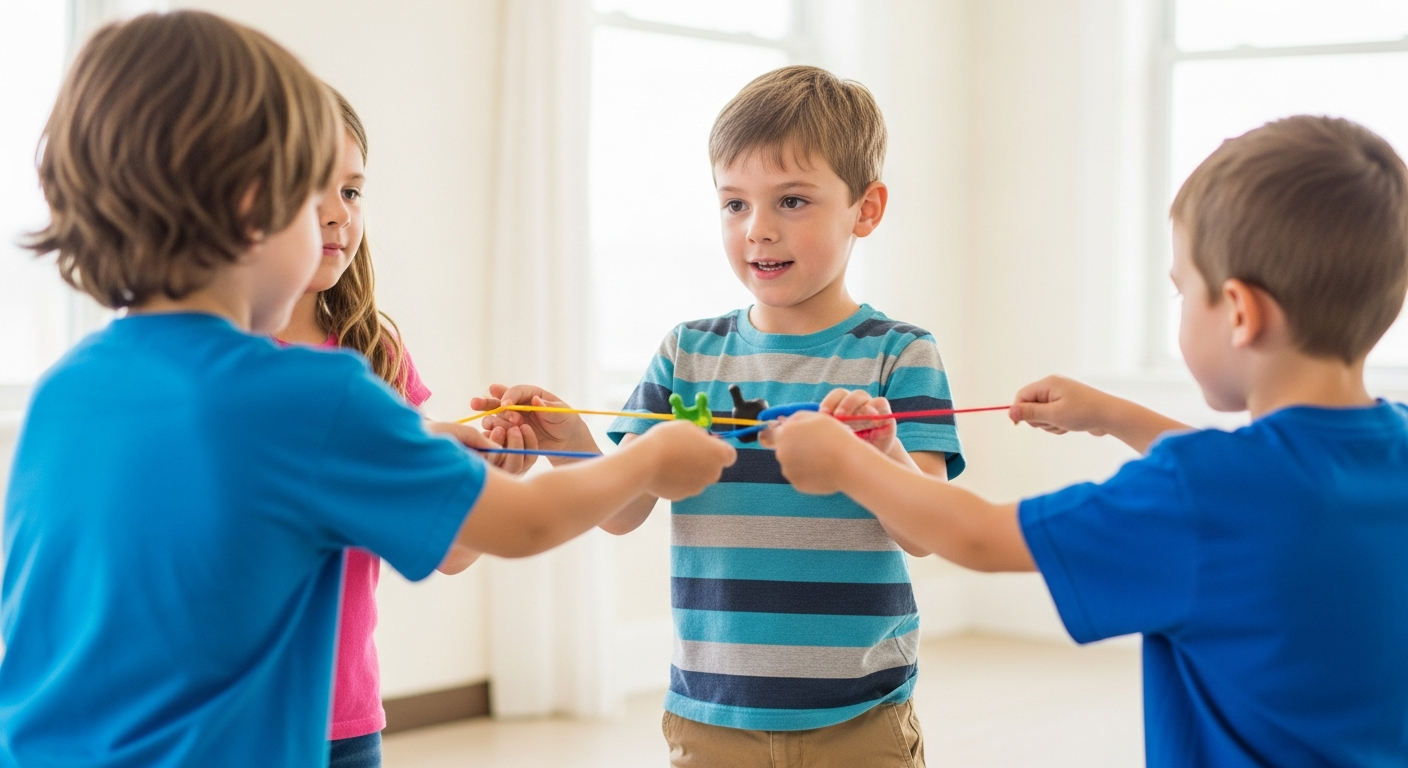
Table of Contents
- Introduction
- The Power of Play: More Than Just Fun
- Planning Your Party Game Extravaganza
- Icebreakers & Warm-Up Games (Getting Everyone Groovin')
- Active & Energetic Games (On Your Mark, Set, Go!)
- Cooperative & Team Games (Circle of Fun & Team Challenges)
- Brain-Boosting & Imaginative Games
- Outdoor & Water Fun (Seasonal/Space Dependent)
- Making Learning Fun: The Speech Blubs Way
- Supporting Your Child's Communication Journey
- Choosing Your Speech Blubs Plan: Value Beyond Play
- Conclusion
- FAQ
Introduction
Planning a child's birthday party is a delightful blend of excitement and, let's be honest, a touch of panic. The vision of happy children laughing and playing might quickly give way to worries about keeping a dozen or more energetic youngsters engaged for hours in your home, especially if it's your first time hosting such a lively gathering. It’s a common scenario: the invitations are out, the RSVPs are rolling in, and suddenly, the living room feels a lot smaller than it did yesterday. The truth is, while bouncy castles and themed entertainment parks are fantastic, there’s a unique magic in a home-based party, a charm rooted in simplicity and genuine connection. The key to transforming potential chaos into cherished memories lies in a well-thought-out plan of games.

Beyond just passing the time, well-chosen party games are incredible tools for fostering critical developmental skills, from social interaction and problem-solving to emotional regulation and communication. They provide structure, ignite imagination, and create a shared experience that makes every child feel included and celebrated. At Speech Blubs, we passionately believe in the power of play to unlock a child's full potential, especially when it comes to communication. Our mission is to empower children to speak their minds and hearts, and we understand that every giggle, every cheer, and every collaborative moment in a game is a stepping stone on that journey. This post will guide you through a treasure trove of classic and creative birthday party games, offering practical tips and showing how these activities naturally support your child's growth, ensuring their special day is not just fun, but truly unforgettable.
The Power of Play: More Than Just Fun
Games are often seen as mere entertainment, especially at a birthday party, but their impact on a child's development is profound and far-reaching. When children engage in play, particularly structured games, they are actively building a foundation for lifelong skills. These aren't just about winning or losing; they're about learning to cooperate, negotiate, share, and express themselves.
- Communication Skills: Almost every game, whether it involves shouting instructions, cheering on a teammate, or describing an action, requires communication. Children practice listening skills, learn to articulate their thoughts, and understand non-verbal cues. They learn to ask clarifying questions ("Whose turn is it?"), explain rules ("You have to freeze when the music stops!"), and express feelings ("That was so fun!"). For children who might be a little shy or still developing their verbal fluency, the low-pressure, joyful environment of a game can be an incredible motivator to use their voice.
- Social & Emotional Development: Games teach children empathy as they consider others' feelings when winning or losing. They learn turn-taking, patience, and the importance of following rules – crucial elements for harmonious social interactions. Dealing with frustration, celebrating successes, and offering encouragement to peers are all vital emotional lessons learned through play.
- Cognitive Abilities: Many games require strategic thinking, problem-solving, and quick decision-making. A scavenger hunt demands logic, while a relay race needs planning and coordination. These activities enhance memory, attention span, and critical thinking in a natural, engaging way.
- Motor Skills: From the gross motor movements of running and jumping in a sack race to the fine motor control needed to balance an egg on a spoon, games provide excellent physical exercise. They improve coordination, balance, and spatial awareness, which are all integral to a child's overall development.
At Speech Blubs, our commitment to blending scientific principles with play stems from a deep understanding of these benefits. We know that children learn best when they are engaged, motivated, and having fun. Our unique "video modeling" methodology, where children learn by watching and imitating their peers, taps into the natural human inclination to learn through observation and interaction. This isn't just theory; our approach is backed by science, placing us in the top tier of speech apps worldwide, as validated by research. Learn more about the research behind our methodology here. Just like a well-structured game, our app provides a joyful, interactive environment where children can build confidence and develop essential communication skills, helping them speak their minds and hearts.

Planning Your Party Game Extravaganza
Before diving into specific game ideas, a little thoughtful planning can make all the difference. Considering a few key factors will help you curate a game list that ensures maximum fun and engagement for all your young guests.
Key Considerations:
- Age Range: Are you hosting preschoolers, early elementary kids, or a mix? Games should be adaptable and appropriate for the youngest attendee, with variations for older children to keep them challenged. Simple instructions are always best.
- Space Available: Whether you have a sprawling backyard or a cozy living room, choose games that fit your environment. Indoor games often require less running, while outdoor games can embrace more expansive movement. Clear any breakables or potential hazards beforehand!
- Number of Guests: With a larger group, opt for games that can accommodate many players simultaneously, or those that allow for quick turns to keep everyone involved. Smaller groups can enjoy more intricate, cooperative games.
- Party Theme: If you have a theme (e.g., superheroes, pirates, princesses), integrate it into your games! A superhero obstacle course or a pirate treasure hunt adds an extra layer of magic.
- Mix of Activities: Balance energetic games with calmer, brain-focused activities. Kids need breaks from running around, and a good mix prevents overstimulation and boredom. Include cooperative games alongside competitive ones to foster teamwork and avoid too much focus on winning.
- Adult Involvement: While children can often self-organize, adult supervision and active participation are crucial for explaining rules, mediating disputes, and keeping the energy flowing. Parents, be ready to get involved and show them how it's done!
Remember, the goal is not perfection, but participation and joy. Be flexible, read the room, and don't be afraid to adjust games on the fly if something isn't working as planned.
Icebreakers & Warm-Up Games (Getting Everyone Groovin')
These games are perfect for getting the party started, breaking the ice, and easing everyone into the festive mood. They encourage movement, laughter, and often require minimal props.
1. Freeze Dance
A timeless classic that gets everyone moving and giggling.
- How to Play: Put on a playlist of upbeat, kid-friendly tunes. Children dance freely while the music plays. When the music suddenly stops, everyone must freeze in place! Anyone caught moving (or wobbling too much) is playfully out, but can still dance on the sidelines or become a "freeze judge."
- Why it's Great for Communication: Encourages listening skills (to the music stopping), non-verbal expression (silly poses), and following instructions.
- Speech Blubs Connection: This game can be a fun way to encourage vocalizations like "Stop!" or "Go!" or to cheer on friends. For a child working on action words, describing their dance moves ("spinning," "jumping," "shaking") can be a motivating activity.
2. Musical Chairs
Another popular game that combines movement with quick thinking.
- How to Play: Arrange chairs in a circle, one less than the number of players. Play music as children walk around the chairs. When the music stops, everyone scrambles for a seat. The player left standing is out. Remove one chair each round until only one player remains.
- Why it's Great for Communication: Teaches following multi-step instructions, spatial awareness, and dealing with disappointment in a lighthearted way.
- Speech Blubs Connection: This game helps reinforce concepts like "stop," "go," "sit," and "up." Children might spontaneously use phrases like "I got it!" or "Next time!"
3. Hula Hoop Contest
A fantastic way to encourage movement and friendly competition.
- How to Play: Provide an assortment of hula hoops. Challenge kids to hula hoop for the longest time, or try creative tricks like spinning it on different body parts. You can also do a "Hoop-de-Loop" relay where teams pass a hoop along a line without breaking linked hands.
- Why it's Great for Communication: Encourages cheering, counting (how long someone can hula), and describing actions ("twisting," "wobbling").
- Speech Blubs Connection: Great for action verbs and descriptive words. "Twirl the hoop!" "Can you spin it fast?" "Watch me!" These simple commands and exclamations are fantastic for practicing early communication.
4. Limbo
How low can you go? A bending, twisting, laughter-filled adventure.
- How to Play: Use a broomstick or pool noodle as the limbo bar, held by two adults. Start at shoulder height and play music as children take turns bending backward to go under the bar without touching it. Lower the bar slightly after each round.
- Why it's Great for Communication: Promotes physical vocabulary ("bend," "reach," "duck"), following simple rules, and expressing excitement.
- Speech Blubs Connection: Practice words like "low," "high," "under," and action words like "bend" and "stretch." "Can you go under?" is a great preposition practice.
Active & Energetic Games (On Your Mark, Set, Go!)
These games are perfect for burning off some energy and encouraging enthusiastic participation. They're often best played outdoors, but many can be adapted for a spacious indoor area.
1. Sack Race
Hop into hilarity with this classic party game.
- How to Play: Mark a festive starting and finish line. Provide each child with a burlap sack or large pillowcase. On "Go!", children step into their sacks, hold them up, and hop to the finish line.
- Why it's Great for Communication: Encourages cheering, counting (who's in the lead), and action words ("hop," "jump," "race").
- Speech Blubs Connection: Perfect for using comparative words like "faster" and "slower," or directional words like "forward." "Hop, hop, hop!" repetition is great for articulation.
2. Obstacle Course
Transform your space into a playground of possibilities.
- How to Play: Design a simple course using household items or outdoor elements. Ideas include: crawling under a blanket draped over chairs, walking on a line of tape, doing five jumping jacks, weaving through pool noodles stuck in the ground, or tossing a beanbag into a basket.
- Why it's Great for Communication: Promotes following multi-step directions, describing actions, and problem-solving through movement.
- Speech Blubs Connection: Excellent for practicing prepositions ("under," "over," "through"), action verbs ("crawl," "jump," "weave"), and sequencing ("first, then, next"). For a child whose 3-year-old 'late talker' loves animals, you could create an "Animal Adventure" obstacle course where they have to "roar like a lion" at one station or "crawl like a bear" at another. This integrates thematic language and movement.
3. Egg and Spoon Race
A wobbly, giggly adventure that challenges balance.
- How to Play: Create a starting and finish line. Arm each racer with a spoon and an egg (hard-boiled for beginners, plastic for mess-free fun, or raw for daring older kids). The goal is to walk/run the course balancing the egg on the spoon. If the egg falls, they go back to the start.
- Why it's Great for Communication: Teaches patience, careful movement, and expressing frustration or success.
- Speech Blubs Connection: Use words like "careful," "slow," "oops!" and "almost!" Great for practicing the "s" sound in "spoon" or "slow."
4. Relay Races
A whirlwind of joy and teamwork.
- How to Play: Divide children into teams. Examples include:
- Egg-cellent Adventure: Same as the Egg and Spoon Race, but players tag a teammate after completing their leg.
- Sweet Sprint Skittles Relay: Teams line up, and the first player races to scattered Skittles, grabs one of their team's color, drops it into a matching cup, and tags the next player.
- Puzzle Pursuit: Teams race to collect scattered puzzle pieces (from a simple name puzzle) and then work together to assemble it.
- Why it's Great for Communication: Encourages teamwork, cheering, strategizing, and sharing success.
- Speech Blubs Connection: Promotes phrases like "Go, go, go!", "Your turn!", "We did it!" and "Help me!" For a child who needs encouragement in combining words, a relay race is perfect for spontaneous two-word phrases.
5. Red Light, Green Light
A classic game of movement and quick stops.
- How to Play: One person is the "stoplight" and stands facing away from the other players (the "traffic"). The stoplight calls out "Green light!" and traffic moves forward. When the stoplight yells "Red light!" and turns around, everyone must freeze. Anyone caught moving is out or sent back to the start.
- Why it's Great for Communication: Excellent for listening skills, following commands, and impulse control.
- Speech Blubs Connection: Directly reinforces color words ("red," "green") and commands ("stop," "go"). Repeating these words in a fun context helps children internalize them.
These active games are fantastic for developing expressive language as children call out instructions, cheer for friends, and describe their actions. For more engaging and interactive ways to boost your child's communication skills, why not give our app a try? You can download Speech Blubs on the App Store or Google Play to explore a world of playful learning.
Cooperative & Team Games (Circle of Fun & Team Challenges)
These games emphasize working together, sharing, and ensuring everyone feels like part of the group. They are excellent for fostering social bonds and reducing competition.
1. Hot Potato
A timeless favorite that combines musical fun with anticipation.
- How to Play: Children sit or stand in a circle. Play music as they quickly pass a "hot potato" (a soft toy or beanbag) around the circle. When the music stops, the child holding the potato is out. The last child remaining wins.
- Why it's Great for Communication: Teaches turn-taking, quick responses, and expressing excitement or surprise.
- Speech Blubs Connection: Promotes directional words ("pass it," "to me"), action words ("throw," "catch"), and sound effects ("ooh, hot!").
2. Pass the Parcel
A beloved classic that creates suspense and joy.
- How to Play: Wrap a small prize (or several small treats) in many layers of wrapping paper. As music plays, children pass the parcel around the circle. When the music stops, the child holding the parcel unwraps one layer. The game continues until the last layer is unwrapped and the prize is revealed.
- Why it's Great for Communication: Encourages anticipation, patience, and expressing delight. To ensure everyone gets a turn, you can add a small sticker or mini treat to each layer, so every child gets a little something as they unwrap.
- Speech Blubs Connection: Great for repetitive phrases ("pass it," "unwrap"), asking questions ("Who has it?"), and expressing emotions ("Yay!", "Oh!").
3. Parachute Games
Big fun with a colorful parachute (or even a large sheet!).
- How to Play: Gather children around a parachute. They hold onto the edges and work together to wave it up and down, making "waves" or a "mushroom" shape. You can place lightweight balls on top and try to keep them from falling off, or have children take turns running underneath when the parachute is held high.
- Why it's Great for Communication: Fosters teamwork, synchronized movements, and verbal cues ("Up!", "Down!", "Run!").
- Speech Blubs Connection: Excellent for practicing prepositions ("up," "down," "under"), action words ("wave," "shake," "run"), and cooperative language ("Let's do it together!").
4. Keep It Up!
How long can a team keep a balloon in the air?
- How to Play: The goal is for a group of children to keep one or more balloons from touching the ground by batting them into the air. They must work together to prevent it from falling.
- Why it's Great for Communication: Encourages teamwork, calling out to teammates, and verbal warnings ("Watch out!", "Over here!").
- Speech Blubs Connection: Promotes spatial awareness words ("high," "low," "over there") and cooperative phrases.
Brain-Boosting & Imaginative Games
These games engage children's minds, encourage creativity, and help develop essential cognitive and linguistic skills.
1. Scavenger Hunt
A thrilling adventure that sparks curiosity and encourages teamwork.
- How to Play: Hide a series of clues around your party space, with each clue leading to the next, until the final clue reveals a prize. You can make it themed (e.g., pirate map, fairy tale quest). For younger children, hide visual clues or objects they need to find.
- Why it's Great for Communication: Boosts problem-solving, following instructions, descriptive language (as they talk about what they're looking for), and teamwork.
- Speech Blubs Connection: Perfect for practicing descriptive language ("It's under the big chair," "It's near the red ball"), prepositions, and asking clarifying questions. For example, a clue might say, "Find something that goes 'moo' in the kitchen," leading them to a toy cow. This builds both language and association skills.
2. Simon Says / Opposites
Classic games for listening and quick responses.
- How to Play (Simon Says): One person is "Simon" and gives instructions. Players only follow instructions if "Simon Says" precedes them (e.g., "Simon says touch your nose"). If Simon just says "Touch your nose," and a player does it, they're out.
- How to Play (Opposites): Similar to Simon Says, but players must do the opposite of the instruction (e.g., if you say "Jump up," they jump down).
- Why it's Great for Communication: Sharpens listening comprehension, impulse control, and understanding complex commands.
- Speech Blubs Connection: Excellent for reinforcing action verbs, body parts, and prepositions. For a child working on understanding two-step directions, these games provide fun, repetitive practice.
3. Charades
A fun way to practice non-verbal communication and expand vocabulary.
- How to Play: Write a bunch of words or phrases (animals, actions, movie titles) on slips of paper. One child picks a slip and acts out what's written without making a sound. The first player to guess correctly gets to act next.
- Why it's Great for Communication: Enhances non-verbal communication, expressive language (when guessing), and expands vocabulary as children think of words to describe the actions.
- Speech Blubs Connection: Great for encouraging children to think about actions and objects and describe them. "Is it an animal?" "Are you jumping?" For a child whose expressive language is developing, this is a wonderful way to connect concepts with words.
4. I Spy
A simple yet effective game for observation and descriptive language.
- How to Play: One person says, "I spy with my little eyes something..." and then gives a descriptive clue (e.g., "something green," "something shiny"). Others guess what it is.
- Why it's Great for Communication: Boosts observation skills, descriptive language (colors, shapes, textures), and question-asking.
- Speech Blubs Connection: Directly helps practice adjectives and object naming. For a child working on expanding vocabulary, it's a natural and engaging way to use new words. "I spy something that starts with /b/!" can also be a fun phonological awareness game.
These games not only entertain but also actively contribute to your child's communication and cognitive growth. If you're looking for an immediate way to assess your child's communication development and get personalized next steps, take our quick 3-minute preliminary screener. It involves 9 simple questions and provides an assessment along with a plan for support, including a free 7-day trial of Speech Blubs.
Outdoor & Water Fun (Seasonal/Space Dependent)
If you have outdoor space and the weather permits, these games can add an extra layer of excitement and physical activity to the party.
1. Slip and Slide
A classic for hot weather fun!
- How to Play: Lay out a plastic tarp or a dedicated slip-and-slide on a grassy area. Wet it down with water and maybe a little dish soap (kid-safe!). Kids take turns running and sliding.
- Why it's Great for Communication: Encourages exclamations of joy, describing sensations ("wet," "slippery"), and turn-taking.
- Speech Blubs Connection: "Whee!", "Splash!", "Fast!" are all excellent words to practice during this joyful activity.
2. Water Balloon Toss / Water Blaster Fight
Refreshing fun on a warm day.
- How to Play:
- Toss: Partners stand facing each other and gently toss a water balloon back and forth, stepping further apart after each successful catch. If the balloon breaks, they're out.
- Fight: Arm kids with water blasters or a bucket of water balloons and let them have a fun, supervised splash battle.
- Why it's Great for Communication: Promotes coordination, teamwork (in the toss), and excited shouts.
- Speech Blubs Connection: Words like "catch," "throw," "wet," "splash!" are key. Instructions like "Aim for me!" or "Ready, set, squirt!" reinforce receptive language.
3. Sprinkler Tag
Simple, refreshing, and energetic.
- How to Play: Turn on a sprinkler in the yard. Kids run through it, trying to avoid getting tagged by the "chaser," or simply play tag within the sprinkler's spray.
- Why it's Great for Communication: Encourages running and chasing, with associated sounds and words.
- Speech Blubs Connection: Great for action words like "run," "chase," "splash," and descriptive words like "cold," "wet."
4. Mini Golf
Create a homemade course for putting practice.
- How to Play: Use cups as holes, and small toys or household objects as obstacles. Kids use pool noodles or plastic clubs to hit plastic golf balls through the course.
- Why it's Great for Communication: Teaches counting, spatial awareness ("near," "far"), and turn-taking.
- Speech Blubs Connection: Concepts like "in," "out," "next," "your turn." "Hit it soft!" or "Almost!" are great phrases to practice.
5. NERF Wars
An exciting, active game for older kids (with eye protection!).
- How to Play: Gather NERF blasters and darts, setting up obstacles and hiding places in your yard. Divide into teams and have a friendly battle.
- Why it's Great for Communication: Encourages strategizing, calling out to teammates, and action words ("run," "hide," "shoot").
- Speech Blubs Connection: "Ready, aim, fire!" or "Reload!" are fun phrases. Discussing strategy uses complex sentence structures.
Making Learning Fun: The Speech Blubs Way
At Speech Blubs, we understand that every child's journey to confident communication is unique, and sometimes, a little extra support can make a world of difference. Our app was born from the personal experiences of our founders, who all grew up facing speech challenges and recognized the need for an accessible, effective, and joyful solution. We are dedicated to providing a tool they wished they had—a tool that empowers children to "speak their minds and hearts."
We stand apart by offering an immediate and engaging solution for the 1 in 4 children who need speech support, right from the comfort of their home. Our unique approach focuses on "smart screen time," transforming passive viewing experiences (like cartoons) into active, interactive learning. We achieve this through our proven "video modeling" methodology, where children learn by watching and imitating their peers. This natural form of learning is deeply engaging, activating mirror neurons in the brain and making the process of acquiring new sounds, words, and phrases feel like play.
Our app provides a screen-free alternative to passive entertainment and, more importantly, a powerful tool for family connection. Parents and caregivers are encouraged to co-play with their children, turning learning into a shared, joyful experience. Whether your child is working on specific sounds, expanding their vocabulary, or building foundational communication skills, Speech Blubs offers a rich library of activities designed by speech therapists to be both educational and incredibly fun. You can discover more about our mission and what makes us unique by visiting the Speech Blubs homepage.
Supporting Your Child's Communication Journey
As parents, we are our children's first and most important teachers. The games and activities we share, including those within the Speech Blubs app, are powerful supplements to a child's overall development plan. It's important to approach these tools with empathy, understanding, and realistic expectations.
When using any resource to support communication, remember:
- Co-Play is Key: Active adult involvement makes any activity, digital or traditional, far more effective. Sit with your child, engage in the games, model good communication, and celebrate their efforts. This makes learning a shared, positive experience.
- Focus on the Process, Not Just the Outcome: Our goal isn't to guarantee that your child will be giving public speeches in a month. Instead, it's about fostering a love for communication, building confidence, reducing frustration, and developing key foundational skills. Every small step is a victory.
- Patience and Encouragement: Learning takes time, and every child progresses at their own pace. Be patient, offer plenty of praise for effort, and create an environment where they feel safe to experiment with their voice without fear of judgment.
- Consistency Matters: Regular, short bursts of engagement are often more effective than infrequent, long sessions. Incorporate communication-rich activities into your daily routine, including playtime.
Many parents have found incredible success and joy using Speech Blubs to support their children's communication. Hearing their stories reinforces our belief in the power of our approach. See what other parents are saying about their child's success with Speech Blubs. We're here to provide a supportive hand on your child's communication journey, turning challenges into opportunities for growth and connection.
Choosing Your Speech Blubs Plan: Value Beyond Play
We believe in making our empowering tools accessible to every family. That's why we offer transparent pricing with options designed to fit your needs, while providing clear benefits for long-term engagement.
Our primary plans are:
- Monthly Plan: For $14.99 per month, you get access to our core Speech Blubs app. This is a good option if you want to try it out for a shorter period, but it's important to note that this plan does not include the 7-day free trial, the Reading Blubs app, early access to new updates, or our expedited 24-hour support response time.
- Yearly Plan: For just $59.99 per year, this plan offers significantly superior value. It breaks down to only $4.99 per month, which means you save 66% compared to paying monthly!
The Yearly Plan is truly the best choice, as it includes a full suite of high-value features designed to maximize your child's learning and your family's support:
- A 7-day free trial: Experience the full potential of Speech Blubs before committing.
- The extra Reading Blubs app: Double the fun and learning with a dedicated reading companion.
- Early access to new updates: Be among the first to explore exciting new features and content.
- 24-hour support response time: Get quick, dedicated assistance whenever you need it.
We strongly encourage you to choose the Yearly plan to unlock all these exclusive benefits and gain access to the 7-day free trial. It's the most comprehensive and cost-effective way to support your child's communication development with Speech Blubs. Ready to get started? You can create your account and begin your 7-day free trial today by selecting the Yearly plan.
Conclusion
A child's birthday party is more than just a celebration; it's an opportunity to create joyful memories, foster meaningful connections, and support crucial developmental milestones through the magic of play. From energetic relay races and imaginative scavenger hunts to cooperative parachute games, the right selection of activities can transform any space into a vibrant hub of learning and laughter. These games not only provide entertainment but also lay strong foundations for communication, social-emotional growth, and cognitive development.
As you plan your next birthday bash, remember the incredible power of play to empower your child. And as they grow, Speech Blubs is here to support their communication journey every step of the way, offering scientifically-backed, play-based learning that helps children speak their minds and hearts. Our commitment is to provide an immediate, effective, and joyful solution for families, turning screen time into smart, interactive learning.
Don't let party planning stress overshadow the excitement. Embrace the power of games, encourage every giggle and every word, and watch your child's confidence soar. Ready to embark on a journey of playful learning and communication growth with your child? We invite you to experience the full potential of Speech Blubs. To get the best value and access our complete suite of features, including a 7-day free trial and the Reading Blubs app, choose our Yearly plan. Download Speech Blubs on the App Store or Google Play today and start your free trial by selecting the Yearly plan to unlock a world of communication possibilities.
FAQ
Q1: How do I choose the best games for a mixed age group at a birthday party?
A1: When catering to a mixed age group, prioritize games with simple rules that can be easily adapted. For example, in a "Freeze Dance," younger children can simply dance, while older ones might try more complex moves. Offer variations like providing different-sized hula hoops or letting older kids help explain rules to younger ones. Also, include a mix of active and quieter games to accommodate different energy levels and attention spans.
Q2: My child is a "late talker." Can party games help with their communication development?
A2: Absolutely! Party games provide a natural, low-pressure environment for communication practice. Games encourage turn-taking, listening to instructions, and expressing emotions and needs. Even non-verbal children can benefit by observing, imitating actions, and using gestures. Activities like "I Spy" or a themed scavenger hunt encourage vocabulary expansion and descriptive language in a fun context. For more targeted support, the Speech Blubs app offers play-based activities specifically designed to boost communication skills.
Q3: How can I keep all the kids engaged during party games, especially with a large group?
A3: With a large group, focus on games that allow for many players simultaneously or have quick turnover. Ensure you have clear, concise instructions and demonstrate the game first. Have enthusiastic adult helpers involved to supervise and encourage. If a child is eliminated from a game, give them a new role, like being a judge, scorekeeper, or DJ, to keep them involved. A mix of energetic and calmer activities can also prevent overstimulation and maintain interest.
Q4: What makes Speech Blubs different from other educational apps for kids?
A4: Speech Blubs is unique in its focus on "video modeling," where children learn by observing and imitating their peers, a method scientifically proven to activate mirror neurons and enhance learning. Our app transforms passive screen time into interactive, speech-boosting experiences designed by speech therapists. It's born from the personal experiences of our founders who faced speech challenges, ensuring our approach is rooted in empathy and effectiveness. We're committed to empowering children to "speak their minds and hearts" by blending scientific principles with joyful, engaging play.
About the author