
Creative Toddler Activities With Dot Stickers to Try
 By Speech Blubs Team•Feb 23, 2026•14 min.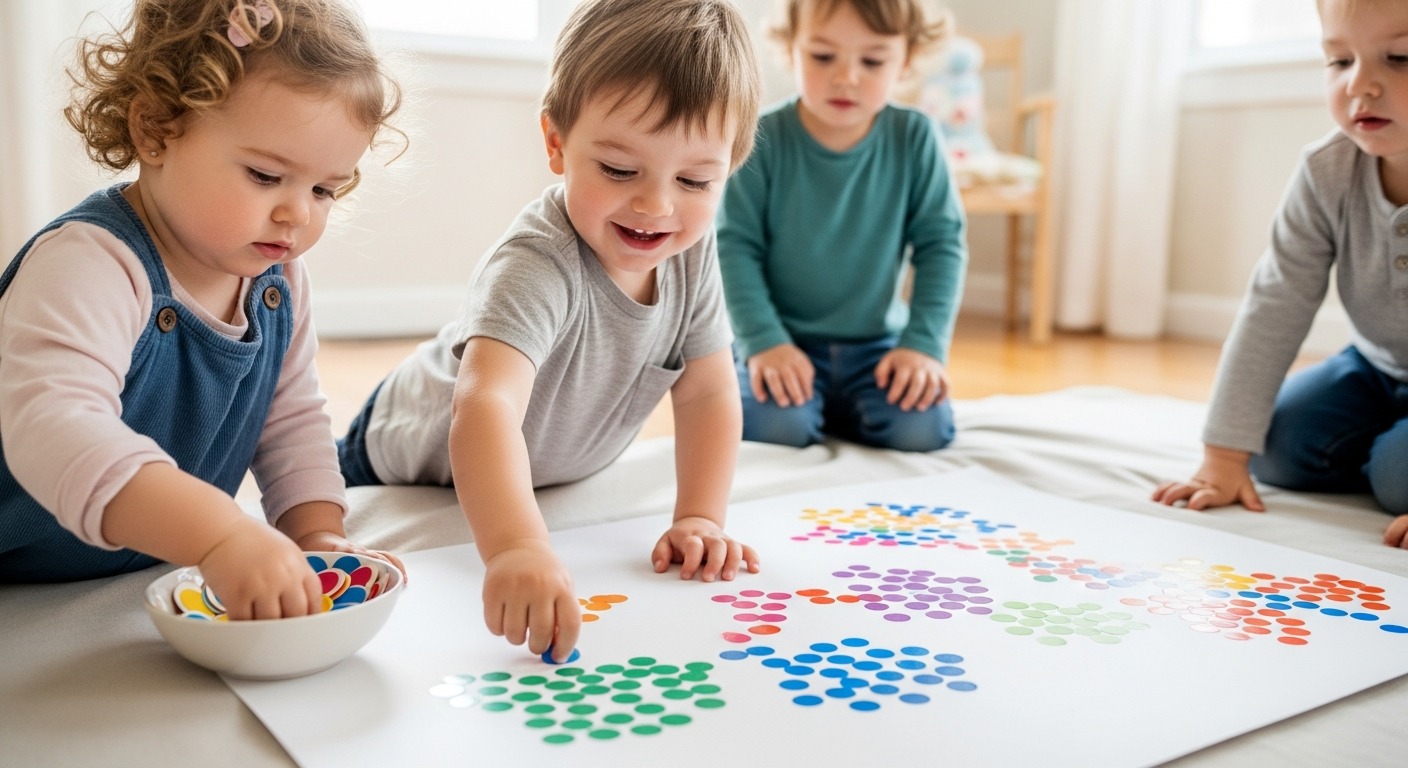
Table of Contents
- Introduction
- The Magic of Dot Stickers and Fine Motor Skills
- Literacy and Language Activities with Dot Stickers
- Math and Counting Activities
- Color and Shape Recognition
- Creative Art and Science Projects
- Speech Blubs: The Perfect Partner for Play-Based Learning
- Choosing the Right Plan for Your Family
- Fostering a Love for Communication
- Practical Tips for Success with Dot Stickers
- Conclusion
- Frequently Asked Questions
Introduction
Have you ever found yourself staring at a pack of simple office supply dot stickers and wondered how something so basic could be the key to a quiet, focused, and educational afternoon? It is a scene many of us know well: you are trying to prep dinner or finish a quick email, and your toddler is buzzing with energy, looking for something to do. You don't want to just turn on a passive cartoon, but you need an activity that is easy to set up and genuinely engaging. Enter the humble dot sticker. These colorful little circles are frequently the unsung heroes of early childhood development, offering a bridge between simple play and the complex fine motor skills required for writing and communication.
At Speech Blubs, we understand that every moment is an opportunity for a "smart" learning experience. We believe in empowering children to "speak their minds and hearts," a mission that began when our founders, who all navigated speech challenges as children, decided to build the tool they wished they had. We see activities like those involving dot stickers as the perfect physical companion to our digital tools. While our app uses video modeling to help children learn communication skills from their peers, physical activities like sticker play help build the hand strength and coordination that form the foundation of a child's overall development.

In this guide, we will explore why dot stickers are a staple in the world of "smart screen time" and active play. We will cover creative ways to use them for math, literacy, and fine motor development, and we will show you how to integrate these activities into your daily routine to foster joy and confidence in your little learner. Our goal is to provide you with a toolkit of ideas that turn a $2 pack of stickers into hours of educational fun, supporting the 1 in 4 children who need a little extra boost in their developmental journey.
The Magic of Dot Stickers and Fine Motor Skills
When we talk about toddler development, we often focus on milestones like walking or first words. However, the development of fine motor skills—specifically the pincer grasp—is just as critical. The pincer grasp is the ability to use the thumb and index finger to pick up and manipulate small objects. It is the same skill your child will eventually use to hold a pencil, button a shirt, or use a fork.
Dot stickers are uniquely suited for this. The act of peeling a thin sticker off a sheet and precisely placing it on a target requires focus, hand-eye coordination, and bilateral integration (using both sides of the body together). At Speech Blubs, we are deeply committed to the scientific methodology behind child development. Our research shows that when children engage in activities that require multi-sensory input—seeing the color, feeling the sticker, and hearing the name of the object they are labeling—their brains create stronger neural connections.
The Life-Changing Sticker Hack
Before you dive into the activities, there is one professional tip you must know. Nothing kills the momentum of a learning session faster than a frustrated toddler who can’t get the sticker off the page. To make dot stickers 100% toddler-friendly, simply peel off the white "background" or "matrix" of the sticker sheet. This leaves only the colorful dots on the waxy paper. This small adjustment allows children as young as 18 or 19 months to work independently, building their confidence and reducing the need for constant adult intervention.

Literacy and Language Activities with Dot Stickers
Language development is at the heart of everything we do. We often suggest that parents use dot stickers to make abstract concepts like letters and names feel tangible. For a child who might be a "late talker," seeing their name in bright colors can be a powerful motivator.
1. The Name Rainbow
This is a classic for a reason. Take a large piece of paper and write your child’s name in big, bold block letters. You can also draw a rainbow shape and write the letters along the arcs. Give your child a sheet of dot stickers and ask them to "trace" the letters of their name by placing stickers along the lines.
- Speech Connection: As they place each sticker, encourage them to say the letter or the sound it makes. This mimics the peer-led video modeling found in our app, where children learn by watching and imitating.
2. Spotty Snakes for the "S" Sound
If your child is working on specific sounds, like the "S" in "snake," draw a long, winding snake on a piece of paper. Write the letter "S" or "s" multiple times along its body. Have your child cover the letters with stickers. This is a great way to reinforce phonics in a playful, low-pressure way.
- Real-World Scenario: For a parent whose 3-year-old loves animals but struggles with specific consonant sounds, the "Animal Kingdom" section of our app provides a fun way to practice "S-S-Snake" sounds, which you can then reinforce with this sticker activity.
3. Letter Matching Hunt
Write various uppercase letters on a piece of paper and the corresponding lowercase letters on individual dot stickers. Ask your child to find the "mommy" letter (uppercase) and give it a "baby" sticker (lowercase). This promotes letter recognition and cognitive matching.
To see how these activities can be part of a broader plan to help your child find their voice, you can read our parent success stories to see how other families have combined play and technology.
Math and Counting Activities
Math for toddlers isn't about equations; it's about "number sense"—understanding that a symbol (the number 3) represents a quantity (three dots).
4. Caterpillar Counting
Draw a simple caterpillar head on a piece of paper. Next to it, write the numbers 1 through 10 in a row. Ask your child to give the caterpillar a body by placing the correct number of stickers behind each number. Number 1 gets one sticker; number 2 gets two stickers, and so on. By the time they reach 10, they have a very long, very colorful caterpillar!
5. Number Monster Eyes
This is a favorite in our "smart screen time" philosophy because it involves humor and creativity. Draw several "monster" faces on a page and write a number on each monster's forehead. Your child’s job is to give the monster the correct number of "eyes" using dot stickers. A "5" monster gets five eyes! This helps with one-to-one correspondence, a vital math skill where a child counts each object once.
6. Dot Sticker Graphing
Create a simple grid on a piece of paper. At the bottom of each column, place a different colored dot (red, blue, green, yellow). Give your child a mixed sheet of stickers and ask them to sort the colors into the correct columns. This introduces the concept of data visualization and sorting, which are foundational for logical thinking.
Color and Shape Recognition
Recognizing patterns and shapes is a precursor to reading and complex problem-solving.
7. Shape Tracing
Draw large shapes—triangles, squares, circles—and ask your child to line the perimeter with stickers. This helps them internalize the "corners" of a square or the "roundness" of a circle. After they finish, have them trace the path with their finger. The "bumps" of the stickers provide a sensory cue that helps the brain remember the shape.
8. Sticker Symmetry
Draw a line down the middle of a piece of paper. On the left side, place five or six stickers in a random pattern. Challenge your child to "mirror" the pattern on the right side. This is an advanced activity for older toddlers or preschoolers that builds spatial awareness.
If you are unsure where your child stands with these milestones, you can take our 3-minute preliminary screener. It involves 9 simple questions and provides a personalized assessment and next-steps plan to support your child’s development.
Creative Art and Science Projects
Dot stickers aren't just for learning "academics"; they are also excellent tools for process art and sensory exploration.
9. Dot Sticker Paper Chains
Instead of using glue (which can be messy and frustrating), use dot stickers to secure loops of paper together. Have your child decorate strips of construction paper with stickers first, then help them form the chain. This is a fantastic way to work on bilateral coordination—holding the paper with one hand and sticking with the other.
10. The Adhesion Experiment (Science)
Gather different materials from around the house: foil, wax paper, a piece of felt, a bumpy rock, and regular paper. Ask your child to try and stick a dot sticker to each one. Which one does it stick to best? Which one does it fall off of? This is a simple, hands-on introduction to the scientific method and the concept of textures.
Speech Blubs: The Perfect Partner for Play-Based Learning
At Speech Blubs, our mission is to provide an immediate, effective, and joyful solution for children who need speech support. We believe that learning should never feel like a chore. That is why we designed our app to be a screen-free alternative to passive viewing. When your child uses Speech Blubs, they aren't just watching a screen; they are actively participating, imitating their peers, and building confidence.
We advocate for a balanced approach to development. A morning spent with dot sticker activities builds fine motor strength and cognitive skills, while a 15-minute session with Speech Blubs focuses on articulation, vocabulary, and communication. Together, these tools create a powerful environment for your child to thrive.
Our methodology is rooted in the concept of "mirror neurons." When children see other children—their peers—performing a task or saying a word, their brains fire in a way that makes them want to imitate that behavior. This is why our "video modeling" is so effective. It turns the screen into a mirror of possibility. You can start this journey today by downloading the app on the Apple App Store or the Google Play Store.
Choosing the Right Plan for Your Family
We want to be transparent about how you can best access our resources. To build trust and provide the most value, we offer two main subscription paths. While both give you access to our core speech therapy tools, the Yearly plan is designed to be the ultimate support system for your child's growth.
- Monthly Plan: $14.99 per month. This is a great way to test the waters if you are looking for a short-term boost.
- Yearly Plan: $59.99 per year. This is our best value, breaking down to just $4.99 per month—a 66% savings compared to the monthly rate.
Why the Yearly Plan is the Best Choice
The Yearly plan isn't just about saving money; it is about providing a comprehensive learning experience. When you choose the Yearly plan, you receive:
- A 7-Day Free Trial: Plenty of time to explore all the features with your child before committing.
- The Reading Blubs App: An exclusive addition that helps transition your child from speaking to reading, ensuring they have the literacy skills they need for school.
- Priority Support: You get a 24-hour support response time and early access to all our new updates and features.
The Monthly plan does not include the free trial or the Reading Blubs app. We encourage families to create an account and start a free trial on the Yearly plan to ensure they have every tool available to help their child succeed.
Fostering a Love for Communication
It is important to remember that progress isn't always a straight line. Some days, your child might perfectly match 20 stickers to 20 letters. Other days, they might just want to stick all the dots on their own forehead. Both are okay! The goal of these activities—and of the Speech Blubs app—is to foster a love for communication, build confidence, and reduce the frustration that often comes with developmental leaps.
We don't promise that your child will be giving public speeches in a month. What we do promise is a way to create joyful family learning moments. Whether you are sitting on the floor together working on a "Sticker Snake" or laughing along with the kids in our app, you are building the foundational skills your child needs to "speak their mind and heart."
Our approach is a supplement to your child's overall development. While these activities are powerful, they are most effective when framed with adult co-play and support. Your encouragement and participation are the "secret sauce" that makes these activities work. For more information about our history and our heart, visit the Speech Blubs homepage.
Practical Tips for Success with Dot Stickers
To get the most out of your dot sticker sessions, keep these final tips in mind:
- Keep it accessible: Store your stickers and paper in a specific "busy bin" that your child can ask for.
- Follow their lead: If they start making their own "art" instead of the activity you planned, go with it! Process art is just as valuable for development as structured tasks.
- Talk through it: Use descriptive language. "I see you are using a round, red sticker for the apple." This builds vocabulary in real-time.
- Combine with technology: After a focused sticker activity, reward the effort with a session of "smart screen time." You can download the app on the Apple App Store to get started.
Conclusion
Dot stickers are a reminder that the best educational tools don't have to be expensive or complicated. They are a simple, joyful way to help your toddler develop the fine motor, math, and literacy skills they will use for the rest of their lives. By combining these physical activities with the peer-led, scientifically-backed methodology of Speech Blubs, you are providing your child with a holistic environment that encourages them to find their voice.
We invite you to join our community of parents who are choosing "smart screen time" and active play. Our Yearly plan offers the most comprehensive suite of tools, including the Reading Blubs app and a 7-day free trial, to support your child’s journey from their first words to their first books.
Ready to see the difference for yourself? Sign up today and begin your 7-day free trial. Remember to choose the Yearly plan to unlock the full suite of features and provide your child with the immediate, joyful support they deserve. Let's work together to help your little one speak their mind and heart!
Frequently Asked Questions
1. At what age can my child start doing dot sticker activities?
Most toddlers can start engaging with dot stickers around 18 to 19 months old. This is typically when they begin to develop the manual dexterity required to peel and place stickers. If you use the "background removal" hack mentioned in this article, it makes it much easier for younger toddlers to participate independently.
2. My child gets frustrated because they can't peel the stickers. What should I do?
The best solution is to remove the white outer matrix of the sticker sheet so only the circles remain. If they are still struggling, you can slightly peel the edge of a few stickers for them to get them started. Remember, the goal is to build confidence, so providing a little bit of "scaffolding" or help at the beginning is perfectly fine and encouraged!
3. How do these activities specifically help with speech development?
While dot stickers primarily focus on fine motor skills, they are excellent for "incidental language learning." By labeling the colors, counting the dots, and naming the shapes or letters, you are providing a rich linguistic environment. Combining these activities with Speech Blubs' video modeling creates a multi-sensory experience that reinforces the connection between physical objects and spoken words.
4. Why should I choose the Yearly plan for Speech Blubs instead of just doing free activities?
While free activities like dot stickers are fantastic, Speech Blubs provides a structured, scientifically-validated curriculum designed specifically for speech and language milestones. The Yearly plan offers the best value ($4.99/month), a 7-day free trial, and the Reading Blubs app, which ensures your child has a continuous path of development from speech to literacy, supported by early access to new content and 24-hour support.
About the author