
Creative Toddler New Years Crafts for a Joyful Start
 By Speech Blubs Team•Feb 20, 2026•15 min.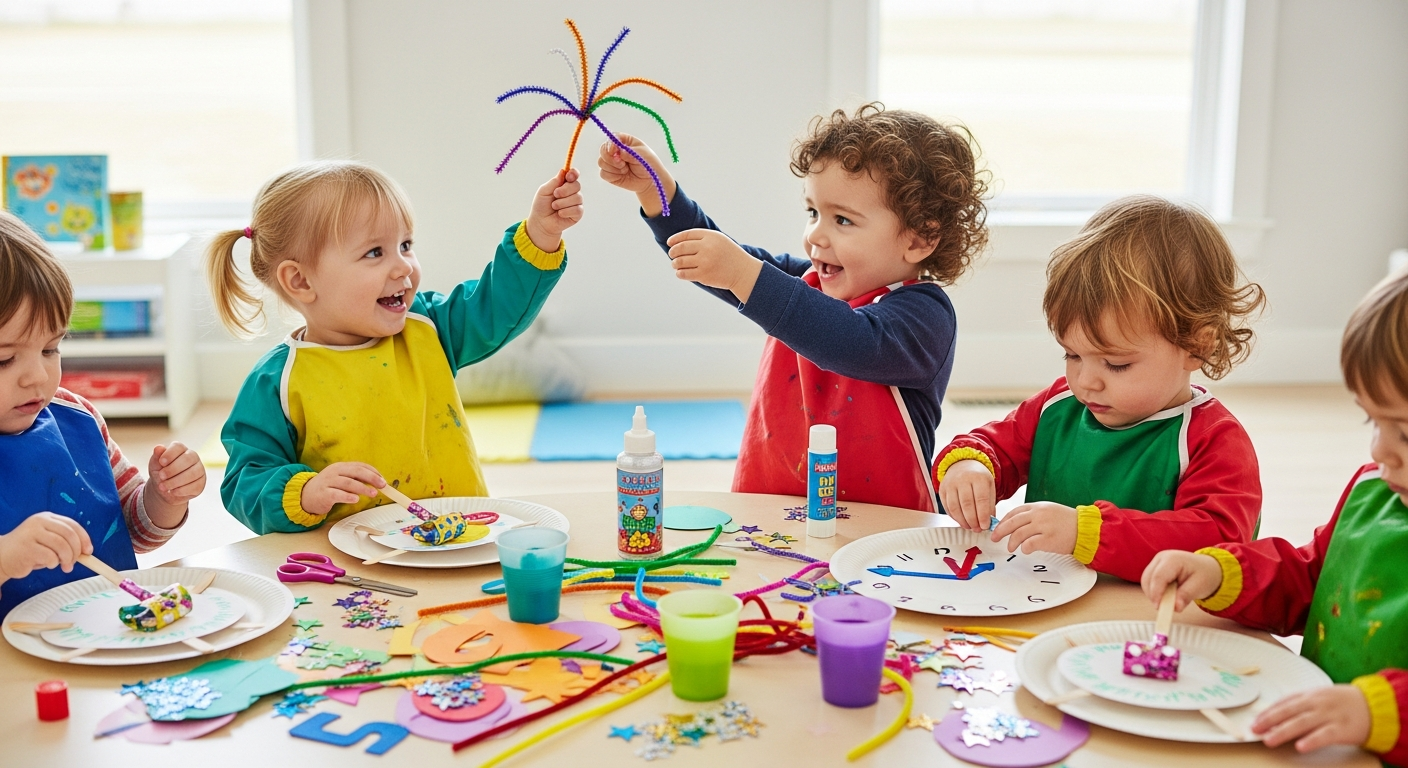
Table of Contents
- Introduction
- The Developmental Power of Holiday Crafting
- 1. Firework Salt Painting: A Sensory Explosion
- 2. Toilet Paper Roll Firework Stamps
- 3. DIY Noisemakers: Raising the Roof Responsibly
- 4. The "Noon Year" Countdown Clock
- 5. Sparkly Wishing Wands
- 6. Personalizing Party Hats
- Making the Most of New Year’s with Speech Blubs
- 7. Confetti Poppers (The "Messy-Fun" Resolution)
- 8. Mirror Neuron "Disco Ball" Craft
- 9. Fingerprint "Fireworks" in the City
- 10. The "Peaceful" New Year Banner
- Conclusion
- FAQs
Introduction
Have you ever wondered why toddlers are so fascinated by the concept of "midnight," even if they are sound asleep by 8:00 PM? To a three-year-old, New Year’s Eve isn't just about a calendar flip; it’s about the bright lights, the funny hats, and the contagious excitement of the adults around them. It is a time of transition, and for little ones building their first sentences and exploring their world, it is an incredible opportunity for language development. At Speech Blubs, we believe every celebration is a chance to empower children to speak their minds and hearts.
Our founders started this journey because they grew up with speech challenges themselves. They created the tool they wished they had—one that blends scientific principles with the pure joy of play. This blog post is designed to help you navigate the holiday with a collection of engaging toddler new years crafts that do more than just decorate your home. These activities are designed to foster fine motor skills, encourage new vocabulary, and create those "smart screen time" moments that bridge the gap between digital learning and physical play.

In the following sections, we will explore a variety of DIY projects ranging from sensory firework paintings to handmade noisemakers. We’ll also discuss how to use these activities to support your child’s communication milestones, all while keeping the atmosphere light, fun, and stress-free. Whether you are hosting a "Noon Year’s Eve" party or just looking for a way to occupy a rainy December afternoon, these crafts will help your child ring in 2025 with confidence and a smile.
The Developmental Power of Holiday Crafting
Before we dive into the glitter and glue, it’s helpful to understand why crafting is such a powerhouse for development. When a toddler holds a paintbrush or sprinkles salt over a sticky surface, they aren't just making a mess—they are refining their fine motor coordination. These small movements are the precursors to writing and even certain speech mechanics.
Furthermore, crafting provides a rich "language environment." As we work on these toddler new years crafts together, we use descriptive words like "shimmer," "sticky," "bright," and "loud." We practice sequencing—"first we glue, then we sparkle." For a child who might be struggling with specific sounds, these activities offer a low-pressure way to practice. For example, a parent whose child is working on labial sounds like "p" might find the "Party Popper" craft a perfect time to practice saying "pop, pop, pop!" as the confetti flies.
At Speech Blubs, we focus on a "video modeling" methodology. In our app, children see their peers performing activities and making sounds, which triggers their mirror neurons and encourages imitation. You can replicate this at home by modeling the crafting steps first and using enthusiastic language. When your child sees you having fun and speaking clearly, they are naturally inclined to follow suit.
1. Firework Salt Painting: A Sensory Explosion
Firework crafts are a New Year’s staple, but traditional painting can sometimes feel a bit "flat" for a sensory-seeking toddler. Salt painting adds a 3D element that is mesmerizing to watch and touch.

What You’ll Need:
- Cardstock (black or dark blue works best)
- White school glue
- Table salt
- Watercolors or food coloring mixed with water
- Droppers or small brushes
How to Do It:
- The Design: Use the glue to draw firework shapes (spirals, bursts, or stars) on the dark paper.
- The "Snow": Have your child pour a generous amount of salt over the wet glue. This is a great time to practice the word "pour" or "shake."
- The Reveal: Shake off the excess salt to reveal the textured glue lines.
- The Magic: Use a dropper to place a tiny bit of colored water onto the salt. Watch as the color travels along the salt lines like magic!
Speech Tip: As the color spreads, narrate the action. "Look, the red is running! Go, red, go!" This helps children connect verbs with live actions. If your child is using the Speech Blubs app, you might notice similar visual rewards in our "Color Therapy" or "Art House" sections, where digital colors come to life.
2. Toilet Paper Roll Firework Stamps
If your toddler prefers a more "hands-on" (and slightly messy) approach, toilet paper roll stamps are an easy, eco-friendly way to create a sky full of fireworks.
What You’ll Need:
- Empty toilet paper or paper towel rolls
- Scissors
- Brightly colored acrylic or tempera paint
- Paper
How to Do It:
- Prep the Stamp: Cut thin slits about halfway up the toilet paper roll, then fan them out so it looks like a sun or a flower.
- Dip and Stamp: Place different colors of paint on flat plates. Let your child dip the "fanned" end into the paint and stamp it firmly onto the paper.
- Layering: Encourage them to use multiple colors on top of each other to create "exploding" fireworks.
This craft is excellent for practicing the "boom" sound. Every time the stamp hits the paper, say "Boom!" in a playful voice. This type of sound-association play is a foundational element of early communication. If you're unsure where your child stands with their speech milestones, you can take our quick 3-minute preliminary screener. It involves 9 simple questions and provides a personalized assessment to help you plan your next steps.
3. DIY Noisemakers: Raising the Roof Responsibly
New Year’s Eve wouldn't be complete without a bit of noise. Instead of buying plastic store-bought horns, making your own allows your child to explore different sounds and volumes.
What You’ll Need:
- Two paper plates or clear plastic cups
- Dried beans, rice, or small pasta
- Stickers, markers, and glitter
- Stapler or strong tape
How to Do It:
- Decorate: Let your child go wild decorating the "outside" of the plates or cups.
- Fill: Add a handful of the "noise" material (rice for a soft sound, beans for a loud sound).
- Seal: Secure the two plates or cups together. If using plates, staple around the edges (ensure staples are flat so they don't poke little fingers).
- Shake: Practice shaking them "fast," "slow," "loudly," and "quietly."
This activity is perfect for children who love the "Musical Instruments" section of our app. In the app, they see kids playing drums and whistles; in real life, they get to become the musician. This helps bridge the gap between what they see on the "smart screen" and their physical environment. You can see how this integrated approach has helped thousands of families by reading our parent testimonials.
4. The "Noon Year" Countdown Clock
Since midnight is usually past a toddler's bedtime, many families celebrate "Noon Year’s Eve" at 12:00 PM. A countdown clock is a great way to introduce the concept of time and numbers.
What You’ll Need:
- A paper plate
- A brass fastener (brad)
- Construction paper (for the clock hands)
- Markers or number stickers
How to Do It:
- The Face: Help your child place numbers 1 through 12 around the edge of the plate. If they are learning their numbers, call them out as you go.
- The Hands: Cut two "hands" from the construction paper.
- Assemble: Poke a small hole in the center of the plate and the ends of the hands, then secure them with the brass fastener.
- Practice: Move the hands and count down from 10 to 1 together.
Counting backward is a complex cognitive skill, but doing it in a fun, celebratory way makes it feel like a game. For a child who loves animals, you might even pretend the clock hands are an elephant’s trunk or a bird’s beak, linking the activity back to the "Animal Kingdom" section of Speech Blubs to keep them motivated and engaged.
5. Sparkly Wishing Wands
New Year’s is a time for wishes. While a toddler might not understand "resolutions," they certainly understand "wishes." These wands are perfect for imaginative play and practicing "W" sounds.
What You’ll Need:
- Cardboard or heavy cardstock
- A stick or a sturdy straw
- Ribbons, tinsel, or yarn
- Glue and glitter
How to Do It:
- The Star: Cut a star shape out of the cardboard.
- Decorate: Cover the star in glue and glitter. This is a "sticky" and "shiny" experience!
- Attach: Tape or glue the star to the top of the stick.
- Tails: Tie ribbons or tinsel to the base of the star so they flutter when the wand is waved.
Encourage your child to make a "wish" for a friend or a pet. "I wish for a cookie!" or "I wish for a puppy!" This helps build sentence structure and encourages them to express their "minds and hearts," which is the core of our mission here at Speech Blubs.
6. Personalizing Party Hats
Why wear a generic hat when you can wear a masterpiece? Personalizing party hats is a fantastic way to encourage self-expression.
What You’ll Need:
- Plain paper party hats (or cardstock rolled into a cone)
- Pom-poms
- Sequins
- Markers
How to Do It: Let your child lead the way. If they want a blue hat with pink pom-poms, help them make it happen. As they work, ask choice-based questions: "Do you want the big pom-pom or the small one?" Giving children choices empowers them to use their words to exert control over their environment, which is a huge confidence booster.
Our methodology is rooted in this kind of joyful, empowering interaction. By using video modeling, we show children that communication isn't a chore—it’s a way to connect and share their unique personalities. You can learn more about the science behind our approach on our dedicated research page.
Making the Most of New Year’s with Speech Blubs
While crafting is a wonderful physical activity, we know that modern parents often need a "digital tool" in their kit to keep progress moving forward during travel or busy holiday prep. This is where Speech Blubs comes in as your "smart screen time" partner.
Unlike passive cartoons that can lead to "zoning out," our app is designed for co-play. We encourage you to sit with your child while they interact with the peer models in the app. If your child sees a peer in the app wearing a digital "New Year’s" filter and saying "Happy New Year," they are far more likely to try saying it themselves.
Choosing the Right Plan for Your Family
To get the full experience and support your child’s journey through the new year and beyond, we offer two simple pricing options:
- Monthly Plan: For $14.99 per month, you get full access to our library of 1,500+ activities and the video modeling tools that have helped over 5 million families.
- Yearly Plan (Best Value): For $59.99 per year, which breaks down to just $4.99 per month, you receive a massive 66% savings.
The Yearly plan is our most popular choice for a reason. Not only is it more cost-effective, but it also includes exclusive benefits that aren't available on the monthly plan:
- A 7-Day Free Trial: Try everything risk-free before committing.
- The Reading Blubs App: A companion app designed to help your child transition from speech to reading.
- Priority Support: Get a 24-hour response time from our support team.
- Early Access: Be the first to try new updates and themes.
Ready to give your child the gift of communication? Download Speech Blubs on the App Store or Google Play to begin your journey today. If you'd prefer to sign up via our website, you can create your account and start your free trial here.
7. Confetti Poppers (The "Messy-Fun" Resolution)
If you can handle a little bit of cleanup, confetti poppers are the highlight of any toddler’s New Year celebration.
What You’ll Need:
- An empty toilet paper roll
- A balloon
- Packing tape
- Confetti (purchased or made from scrap paper)
How to Do It:
- The Mechanism: Tie the end of an uninflated balloon, then cut off the top inch. Stretch the open end of the balloon over one end of the toilet paper roll and secure it with tape.
- The Load: Fill the roll with confetti.
- The Blast: Have your child pull back on the knotted end of the balloon and let go!
This is a great activity for teaching cause and effect. "When I pull and let go, the paper flies!" It also provides a great opportunity to practice the "f" sound in "fly" or "fall."
8. Mirror Neuron "Disco Ball" Craft
Toddlers love things that shine. A DIY disco ball is a great way to talk about reflections.
What You’ll Need:
- A Styrofoam ball or a round piece of cardboard
- Aluminum foil
- Glue
How to Do It:
- Prep: Cut the aluminum foil into small squares.
- Glue: Have your child glue the "shiny squares" onto the ball until it’s covered.
- Reflect: Shine a flashlight on it and watch the lights dance on the walls.
As the lights bounce around, you can talk about the "mirror" effect. This is a perfect metaphor for our video modeling technique. Just as the disco ball reflects light, children reflect the behaviors and sounds they see in their peers. Our app harnesses this natural biological drive to help them learn complex communication skills in a way that feels like a game.
9. Fingerprint "Fireworks" in the City
This craft combines art with a sense of place, helping toddlers understand that people all over the world are celebrating together.
What You’ll Need:
- Black paper
- Construction paper in various colors (to cut into rectangles for "buildings")
- Neon or metallic paint
How to Do It:
- The Skyline: Glue the rectangular "buildings" to the bottom of the black paper.
- The Fireworks: Let your child dip their fingertips into the paint and "dot" fireworks into the sky above the buildings.
- Narrate: "One blue firework, two yellow fireworks!" Practice counting as you go.
This craft is excellent for tactile learners. The sensation of the paint on their fingers is a strong sensory input that helps keep them grounded in the activity.
10. The "Peaceful" New Year Banner
Finally, after all the noise and excitement, it’s nice to create something calm. A "Family Wish Banner" can be a collaborative project.
What You’ll Need:
- A long piece of ribbon or string
- Paper triangles (bunting style)
- Crayons or stickers
How to Do It: On each triangle, have a family member draw something they are thankful for or something they want to do in the new year. For a toddler, this might be "Go to the park" or "Eat strawberries." String them together and hang them up as a reminder of the joyful moments you’ll share.
Conclusion
As the clock ticks toward the new year, remember that the most important part of these toddler new years crafts isn't the finished product—it's the time you spend together. Whether your fireworks look like professional art or just colorful smudges, the laughter, the shared vocabulary, and the building of confidence are what truly matter.
At Speech Blubs, we are honored to be a part of your family’s journey. Our mission is to provide you with the tools to help your child find their voice, one "pop," "boom," and "Happy New Year" at a time. We don't promise overnight miracles, but we do promise a research-backed, joyful way to foster a love for communication and reduce the frustration that often comes with speech delays.
Let’s make 2025 the year of "speaking minds and hearts." We encourage you to choose the Yearly Plan to unlock the full suite of features, including the Reading Blubs app and your 7-day free trial. It’s the best way to ensure your child has a consistent, engaging, and "smart" companion on their developmental path.
Download Speech Blubs now and start your 7-day free trial!
FAQs
1. Are these crafts safe for toddlers who still put things in their mouths?
Safety is our top priority. For toddlers who are still exploring with their mouths, we recommend using taste-safe paints (like those made from yogurt and food coloring) and avoiding small beads or sequins. Always supervise your child during crafting, especially when using glue, salt, or small parts.
2. My child has a short attention span. How can I keep them engaged?
Toddlers naturally have short attention spans (usually 3–5 minutes per year of age). To keep them engaged, break the craft into small steps. Do the "decorating" in the morning and the "assembling" after nap time. You can also use the Speech Blubs app as a "hook"—watch a 2-minute video about colors or sounds to get them excited before starting the physical craft.
3. How do these crafts specifically help with speech delay?
Crafting helps with speech delay by creating a "functional communication" environment. When a child wants a specific color of glitter or needs help with the glue, they are motivated to use gestures, sounds, or words to communicate their needs. By narrating the process and using sound-association (like saying "boom" for fireworks), you are providing the linguistic building blocks they need.
4. Why is the Yearly Plan better than the Monthly Plan?
The Yearly Plan is designed for families committed to seeing long-term progress. At $59.99/year ($4.99/month), it is 66% cheaper than the Monthly Plan ($14.99/month). Most importantly, it includes the Reading Blubs app, which supports the next stage of your child's development, along with a 7-day free trial and faster support response times. It’s a comprehensive tool for your child’s entire communication journey.
About the author