
Deal Out the Fun: Engaging Card Games for Kids That Boost Skills
 By Speech Blubs Team•Jan 19, 2026•18 min.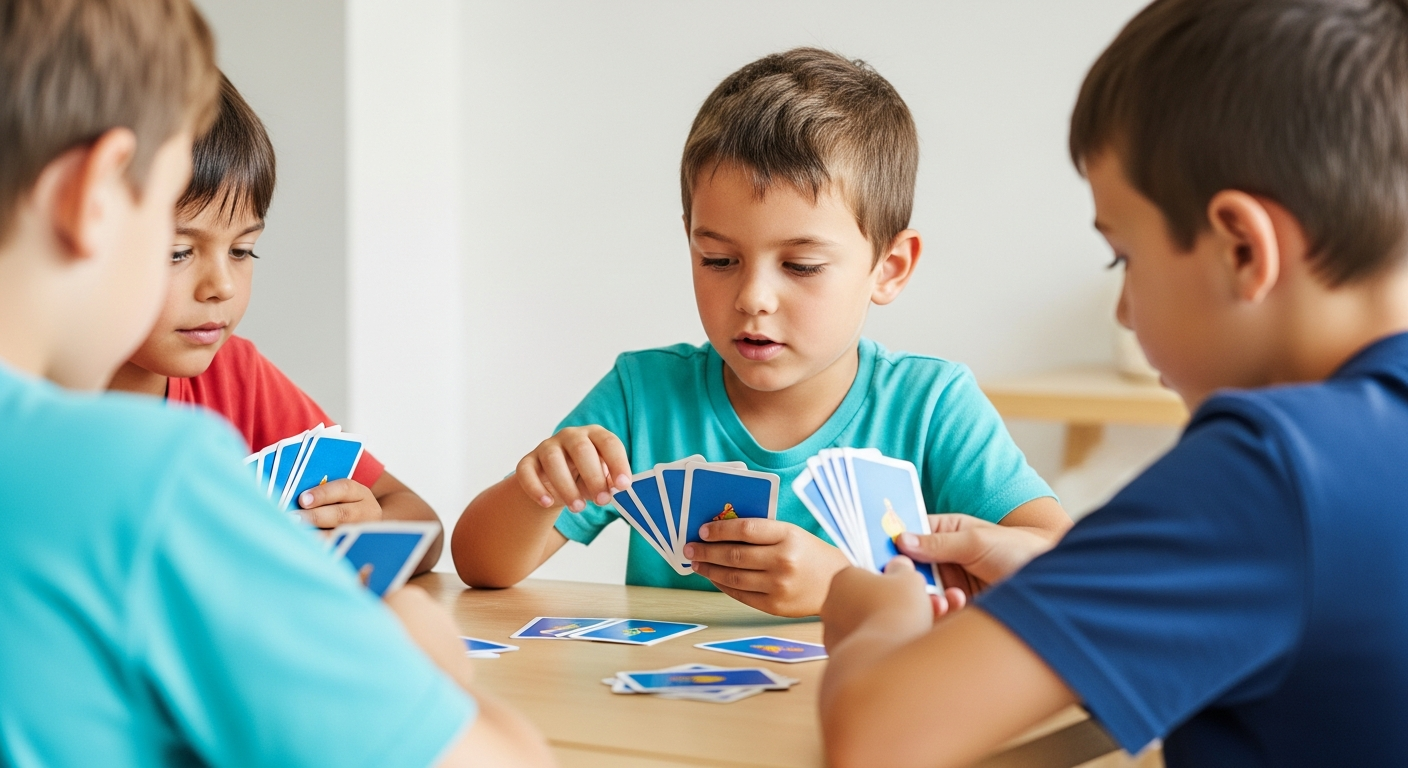
Table of Contents
- The Enduring Magic of a Simple Deck of Cards
- Classic Card Games for Kids (Ages 3+)
- Engaging Card Games for Developing Skills (Ages 6+)
- Lesser-Known Gems and Unique Card Games
- Integrating Card Games into a Holistic Learning Approach
- Choosing Your Next Adventure: Value and Pricing
- Conclusion
- Frequently Asked Questions
Ever found yourself yearning for screen-free moments that captivate your child's attention and spark genuine laughter? In a world increasingly dominated by digital distractions, the simple magic of a deck of cards remains a timeless treasure. What if we told you that these humble rectangles of paper could unlock a world of learning, connection, and pure, unadulterated fun for your child?
This post isn't just about shuffling and dealing; it's about discovering how a fun card game for kids can be a powerful tool for development. We’ll dive into a rich collection of card games, from classic favorites to exciting new discoveries, perfect for family game nights, rainy afternoons, or even quiet one-on-one time. More than just entertainment, these games subtly build crucial skills in communication, math, strategy, and social interaction. Join us as we explore how a simple deck of cards can become a gateway to smarter, more connected play, and how tools like Speech Blubs complement this journey by empowering children to speak their minds and hearts.

The Enduring Magic of a Simple Deck of Cards
For generations, card games have brought people together, transcending age barriers and creating cherished memories. They are wonderfully democratic, requiring minimal setup and offering endless replayability. Beyond the obvious entertainment value, card games are stealth educators, refining a child's cognitive, social, and emotional landscape in profound ways.
Consider the focused attention required to remember which cards have been played in Concentration, or the quick thinking needed to call "Snap!" in a timely manner. These seemingly simple actions are building blocks for crucial executive functions. Furthermore, card games naturally encourage turn-taking, patience, and the ability to win—and lose—gracefully. These social-emotional lessons are invaluable, teaching children empathy and resilience in a low-stakes, playful environment.
At Speech Blubs, we deeply appreciate the power of play to foster development. Our mission is to empower children to "speak their minds and hearts," and we believe that engaging, interactive experiences, both on and off-screen, are key to this. Just as our app provides "smart screen time" that encourages imitation and active participation through video modeling, card games offer a hands-on, interactive alternative that nurtures communication and connection. They are truly a screen-free way to build foundational skills that complement a child's speech and language journey.
Why Card Games Are More Than Just Child's Play
- Cognitive Boosters: From memory recall in "Memory" to strategic planning in "Rummy," card games sharpen minds. They introduce concepts like probability, pattern recognition, and numerical order in an intuitive, fun way.
- Social Skill Builders: Games like "Go Fish" and "Crazy Eights" necessitate verbal requests, negotiation, and understanding social cues. They teach children to articulate their thoughts, listen to others, and navigate group dynamics.
- Emotional Resilience Training: Winning is wonderful, but losing is inevitable. Card games provide a safe space for children to experience both, learning to manage frustration, celebrate others' successes, and bounce back from defeat.
- Communication Catalysts: Every game involves communication, whether it's asking for a specific card, explaining a rule, or expressing excitement (or mock exasperation!). This constant verbal exchange strengthens expressive and receptive language skills.
- Family Connection: Perhaps most importantly, card games create a shared experience, fostering laughter, conversation, and a sense of togetherness that strengthens family bonds. They offer dedicated, quality time away from individual screens.
For parents with children who might be a little shy or struggling with verbal expression, these games can be a gentle way to encourage interaction. The structured nature of a game provides a clear framework for communication, making it less intimidating than open-ended conversation. If you're wondering if your child could benefit from more targeted speech support, consider taking our quick 3-minute preliminary screener. It involves 9 simple questions and provides an assessment along with a next-steps plan.

Classic Card Games for Kids (Ages 3+)
Some games are classics for a reason – they're easy to learn, universally loved, and provide a fantastic foundation for younger players. These are the go-to games that introduce basic concepts like matching, counting, and turn-taking.
Concentration / Memory
- Age: 3+
- Players: 2+
- Skills Developed: Memory, pattern recognition, focus, visual discrimination.
- How to Play: Shuffle a standard deck (or a dedicated memory deck) and spread the cards face down in a grid. Players take turns flipping over two cards. If the cards match (e.g., two 7s), the player keeps the pair and takes another turn. If they don't match, they turn them back over, trying to remember their locations. The game continues until all pairs are found, and the player with the most pairs wins.
- Speech Blubs Connection: This game encourages descriptive language ("I found the red four!", "It's the queen of spades!"). For a child working on object naming or recalling details, describing the cards can be a great exercise. Our app features engaging categories like "Animal Kingdom" or "Yummy Time" that also promote memory and naming skills in a playful, interactive format, much like finding pairs in Memory.
Go Fish!
- Age: 7+ (can be simplified for younger children)
- Players: 2+
- Skills Developed: Asking questions, auditory memory, number/suit recognition, patience.
- How to Play: Deal 5-7 cards to each player (more players, fewer cards). The remaining cards form the "fish pond." Players take turns asking another player for a specific rank of card (e.g., "Do you have any Kings?"). If the asked player has them, they must hand them over. If not, they say "Go Fish!", and the asker draws a card from the pond. The goal is to collect "books" of four matching cards. The player with the most books wins.
- Speech Blubs Connection: "Go Fish!" is a fantastic exercise in forming clear questions and understanding responses. It directly encourages verbal interaction. For children working on articulation or question formation, the repetitive nature of "Do you have...?" provides excellent practice. At Speech Blubs, we use a technique called "video modeling" where children learn by watching and imitating their peers, much like they might imitate the phrasing in a card game. This scientifically-backed approach helps build strong communication foundations.
Old Maid
- Age: 5+
- Players: 3+
- Skills Developed: Social interaction, observation, accepting outcomes, visual matching.
- How to Play: Remove one Queen from a standard deck, leaving one unpaired Queen (the "Old Maid"). Deal all cards. Players sort their hands into pairs and lay them face up. The player to the left of the dealer then offers their hidden hand to the player on their left, who randomly draws a card. If the drawn card creates a new pair, that player lays it down. This continues until all pairs are made, and the player left holding the "Old Maid" loses (or wins, depending on your family's interpretation!).
- Speech Blubs Connection: This game is great for turn-taking and expressing anticipation or surprise. It also helps children understand social dynamics in a fun, lighthearted way. Our commitment at Speech Blubs is to make learning joyful, and games like Old Maid perfectly embody that spirit of playful engagement.
War
- Age: 6+
- Players: 2
- Skills Developed: Number comparison, sequence, patience, accepting chance.
- How to Play: Deal the entire deck evenly, face down, to two players. Both players simultaneously flip their top card. The player with the higher card takes both. If cards of the same value are played, it's "War!" Each player then places two cards face down, followed by one face up. The player with the higher face-up card wins all six cards. The goal is to collect all cards.
- Speech Blubs Connection: "War" is excellent for reinforcing number recognition and the concept of "greater than/less than." The repeated action offers a predictable structure that can be comforting for some children. While the game relies on chance, the excitement it generates can encourage verbal exclamations and declarations, boosting expressive language.
Engaging Card Games for Developing Skills (Ages 6+)
As children grow, their capacity for strategic thinking, complex problem-solving, and nuanced social interaction expands. These games introduce a bit more depth while remaining highly enjoyable.
Crazy Eights
- Age: 5+
- Players: 2-4
- Skills Developed: Matching (suit/rank), strategy, quick decision-making, visual attention.
- How to Play: Deal 5-7 cards depending on the number of players. Place the remaining deck face down with the top card turned up to start the discard pile. Players take turns discarding a card that matches the top card of the discard pile by either suit or rank. Eights are wild and can be played on any card, allowing the player to change the active suit. The first player to play all their cards wins.
- Speech Blubs Connection: "Crazy Eights" requires verbalizing actions ("I'm playing a red seven!") and understanding instructions. It also offers opportunities to practice explaining strategy. For a child working on sequencing or following multi-step directions, the rules of Crazy Eights provide an engaging context. Our app’s guided activities, often involving multi-step tasks, are designed to build these same cognitive and linguistic skills.
Snap
- Age: 6+
- Players: 2+
- Skills Developed: Speed, observation, reaction time, pattern recognition, attention.
- How to Play: Deal all cards face down to players. Players take turns flipping their top card into a central face-up pile. The moment two consecutive cards are identical in rank (e.g., two Queens), the first player to shout "Snap!" wins both piles and adds them to their face-down stack. If two players shout at the same time, the cards go into a "snap pool" that anyone can win later. The player with all the cards wins.
- Speech Blubs Connection: "Snap" is fantastic for encouraging quick verbal responses and auditory processing. The excitement of the game often leads to spontaneous exclamations. For children needing to practice quick word retrieval or responding to visual cues, this game is a high-energy option.
Rummy (and Gin Rummy)
- Age: 7+
- Players: 2-6
- Skills Developed: Strategic thinking, pattern recognition, numerical sequencing, planning ahead, deduction.
- How to Play: The goal is to form "melds" – sets of three or four cards of the same rank (e.g., three 7s) or "runs" of three or more consecutive cards of the same suit (e.g., 4, 5, 6 of hearts). Players are dealt a hand (number varies by players). On a turn, a player draws a card (from the discard pile or stock pile), then discards one. They can lay down any complete melds. The first player to get rid of all their cards by forming melds wins the round.
- Speech Blubs Connection: Rummy demands a great deal of internal monologue and strategic planning, which can translate into better verbal reasoning skills. It's a great game for discussing "if-then" scenarios ("If I pick up this card, then I can make this meld"). Such complex thinking is a hallmark of the advanced communication skills we aim to nurture at Speech Blubs. We believe in providing tools that encourage children to develop their full cognitive and linguistic potential, offering a "smart screen time" alternative to passive viewing.
Lesser-Known Gems and Unique Card Games
Beyond the classics, there's a world of card games waiting to be discovered that can add fresh excitement to your family game nights and introduce new skill sets.
Baloney (or "I Doubt It")
- Age: 6+
- Players: 3-6
- Skills Developed: Bluffing, deduction, social cues, memory, observation, managing risk.
- How to Play: Deal all cards. The first player (often to the left of the dealer) starts by placing one or more cards face down in the center, announcing they are "Aces." The next player must then play "Twos," and so on, cycling through the ranks. Players can lie about the cards they are playing. If someone suspects a player is lying, they can call "Baloney!" or "I Doubt It!" If the player was indeed lying, they pick up the entire discard pile. If they were telling the truth, the accuser picks up the pile. The first player to get rid of all their cards wins.
- Speech Blubs Connection: This game is a masterclass in reading facial expressions and body language, and it's full of opportunities for playful accusations and justifications. It encourages expressive language, persuasive communication, and understanding non-verbal cues.
Speed Card Game
- Age: 8+
- Players: 2
- Skills Developed: Rapid processing, quick decision-making, visual scanning, pattern recognition.
- How to Play: This is a fast-paced game where players race to get rid of their cards. Each player starts with a hand and a pile of cards. Two central discard piles are started. Players simultaneously try to play cards from their hand onto the central piles, but the card played must be one rank higher or lower than the top card of the pile. No turns, just speed! The first player to empty their hand and piles wins.
- Speech Blubs Connection: "Speed" requires quick verbalizations and rapid comprehension. The high-energy nature can be very motivating for children, encouraging them to speak out loud as they play their cards.
Spoons
- Age: 6+
- Players: 3-12 (need one less spoon than players)
- Skills Developed: Observation, quick reaction, pattern recognition, social cues.
- How to Play: Arrange spoons in the center of the table (one less than the number of players). Each player receives four cards. The dealer takes cards from the deck, discards one, and passes it to the next player. Players keep passing cards around the circle, trying to collect four of a kind. Once a player gets four of a kind, they discreetly grab a spoon. As soon as one player grabs a spoon, all other players must grab one too. The player left without a spoon is out.
- Speech Blubs Connection: "Spoons" is a riot of laughter and quick actions. It encourages subtle communication and fast reactions. The element of surprise and urgency can be fantastic for engaging children and encouraging vocalizations and exclamations.
Integrating Card Games into a Holistic Learning Approach
While card games are incredibly valuable, they are just one piece of a larger puzzle when it comes to a child's development. We, at Speech Blubs, understand that comprehensive support often involves a blend of different learning methods. Just as a diverse diet nourishes the body, a varied approach to learning nurtures a child's growing mind and communication abilities.
Our app was born from the personal experiences of our founders, who all grew up with speech problems and created the tool they wished they had. We are committed to providing an immediate, effective, and joyful solution for the 1 in 4 children who need speech support, blending scientific principles with play. We believe in "smart screen time" that actively engages children, rather than passive viewing.
How Speech Blubs Enhances Communication Skills
- Video Modeling: Our unique methodology uses real kids as "peer models" in short, engaging videos. Children learn by watching and imitating their peers, activating mirror neurons in the brain for effective learning. This is different from passive cartoons; it's active, imitative learning.
- Interactive Learning: The app provides a range of activities that target specific speech sounds, vocabulary, and language concepts, turning learning into a playful adventure.
- Family Connection: Speech Blubs is designed to be used with parents or caregivers, creating a shared learning experience. It's a powerful tool for family connection, much like a good card game.
- Scientifically Backed: Our methods are backed by extensive research, placing us in the top tier of speech apps worldwide. You can learn more about the science behind our approach on our research page.
For a parent whose 3-year-old 'late talker' loves animals, the "Animal Kingdom" section within Speech Blubs offers a fun, motivating way to practice "moo" and "baa" sounds, reinforcing early vocalizations with delightful video models. Similarly, a child struggling with articulation might find the "Wild Animals" section of the app a perfect complement to their in-person therapy, practicing specific consonant sounds in an engaging context. These scenarios highlight how the app can supplement a child’s overall development plan.
We've seen countless families integrate Speech Blubs into their daily routines with amazing results. Don't just take our word for it; see what other parents are saying about their child's success with Speech Blubs.
Choosing Your Next Adventure: Value and Pricing
We are dedicated to making effective speech and language support accessible to every family. That's why we offer transparent and flexible pricing options for Speech Blubs.
- Monthly Plan: For those who prefer flexibility, our Monthly plan is available at $14.99 per month.
- Yearly Plan: The Best Value! We highly recommend our Yearly plan at $59.99 per year, which breaks down to just $4.99/month. This plan offers exceptional value, allowing you to save 66% compared to the monthly option.
The Yearly plan isn't just cheaper; it's packed with exclusive, high-value features designed to give your child the most comprehensive support:
- 7-Day Free Trial: Try out the full Speech Blubs experience completely free for a week to see the difference for yourself.
- Extra Reading Blubs App: Gain access to our Reading Blubs app, further enhancing your child's literacy skills.
- Early Access to New Updates: Be among the first to explore new features and content.
- 24-Hour Support Response Time: Get your questions answered quickly and efficiently.
The Monthly plan does not include these fantastic benefits. We encourage you to choose the Yearly plan to get the free trial and unlock the full suite of features, providing your child with the best possible tools for communication development.
Conclusion
From the simple joy of calling "Snap!" to the strategic thinking of "Rummy," a fun card game for kids offers so much more than just entertainment. These games are powerful, screen-free tools that foster critical cognitive, social, and emotional skills, all while strengthening family bonds through shared laughter and learning. They build confidence, reduce frustration, and develop key foundational abilities that serve children well beyond the game table.
Just as these interactive games nurture development, Speech Blubs is committed to providing a joyful, scientifically-backed solution for children's speech and language needs. Our mission is to empower children to speak their minds and hearts, using innovative "smart screen time" through video modeling to make learning engaging and effective. Together, card games and Speech Blubs create a powerful, holistic approach to helping your child thrive.
Ready to deal out the fun and empower your child's communication journey? Don't wait to discover the magic. Download Speech Blubs on the App Store or Google Play to begin your 7-day free trial today! Make sure to select the Yearly plan to unlock all the premium features and get the best value for your family. Alternatively, you can create your account on our website to start your free trial.
Frequently Asked Questions
Q1: What age should my child be to start playing card games?
A1: Many card games can be adapted for very young children, starting around age 3. Simple matching games like "Concentration" or "Go Fish" (simplified with fewer cards) are excellent for introducing basic concepts like numbers, colors, and turn-taking. As children grow, they can progress to more complex games like "Crazy Eights" and "Rummy."
Q2: How can card games help with my child's speech development?
A2: Card games naturally encourage verbal interaction, which is fantastic for speech development. Children practice asking and answering questions ("Do you have a King?"), describing cards ("It's the red seven!"), following instructions, and articulating thoughts and strategies. These interactions foster expressive and receptive language skills in a fun, low-pressure environment. The playful context also often encourages more spontaneous vocalizations.
Q3: My child struggles with losing. How can card games help with this?
A3: Card games provide a safe and repeatable environment for children to learn about winning and losing gracefully. Start with games where outcomes are largely based on chance (like "War") to minimize the feeling of personal failure. Emphasize the fun of playing together over the outcome. Model good sportsmanship yourself, and gently guide your child through their emotions, reminding them that everyone wins and loses sometimes. Over time, this consistent exposure builds resilience and emotional regulation.
Q4: How does Speech Blubs fit in with playing card games?
A4: Speech Blubs is a powerful complement to hands-on activities like card games. While card games offer valuable screen-free social and cognitive engagement, Speech Blubs provides targeted, scientifically-backed "smart screen time" for speech and language development. Our app uses engaging video modeling to help children with articulation, vocabulary, and communication skills. Many of the cognitive and linguistic skills developed through card games – such as memory, asking questions, and understanding sequences – are also foundational to the activities within the Speech Blubs app, creating a holistic approach to your child's growth.
About the author