
Easy Christmas Crafts for Elementary Kids & Speech Fun
 By Speech Blubs Team•Dec 22, 2025•17 min.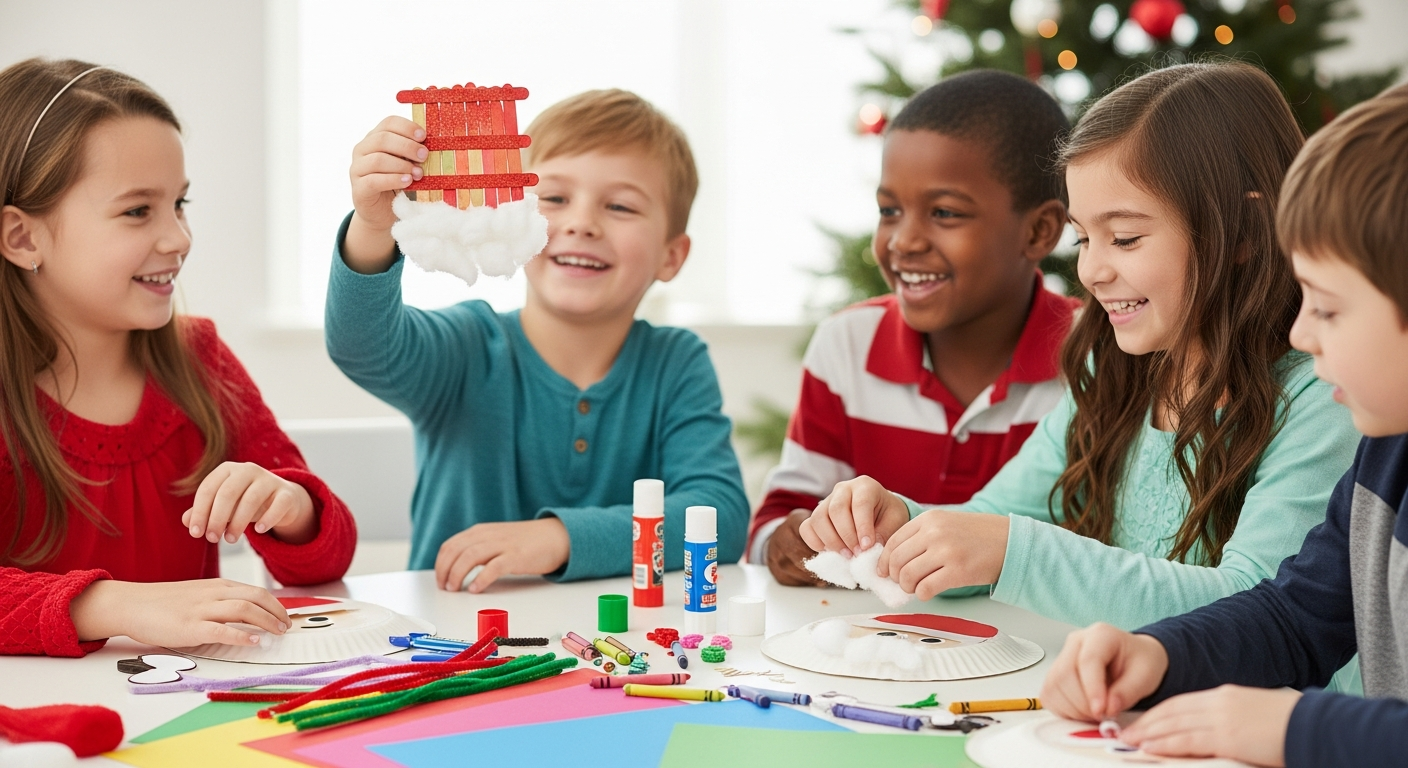
Table of Contents
- Introduction
- Why Christmas Crafts Are More Than Just Fun
- Speech Blubs: Empowering Communication Through Play (and Crafts!)
- Our Top Christmas Crafts for Elementary Kids (with Speech & Language Tips!)
- Maximizing the Language Learning in Crafting
- Partnering with Speech Blubs on Your Child's Journey
- Conclusion
- FAQ
Introduction
The holiday season brings a special kind of magic, a time when homes are filled with the scent of pine, twinkling lights, and the joyful anticipation of celebration. For many parents, it's also a time to create lasting memories with their children, often through shared activities like crafting. But what if those glittering, glue-covered moments could also be powerful opportunities for developing crucial communication skills? It's easy to see a craft as just a fun pastime, but for elementary-aged children, every snip, glue, and sparkle can be a stepping stone towards stronger speech and language development.
At Speech Blubs, we believe that every interaction is a chance for a child to "speak their minds and hearts." We know firsthand the challenges some children face, as our company was born from the personal experiences of our founders, who all grew up with speech problems and created the tool they wished they had. That's why we're committed to turning ordinary moments into extraordinary learning adventures. This post isn't just about sharing a list of festive crafts; it's about transforming holiday crafting into engaging, language-rich experiences that foster creativity, build confidence, and strengthen family bonds. We'll explore a variety of simple Christmas crafts perfect for elementary kids and show you how to weave in rich language opportunities, making this holiday season a time of growth, connection, and joyful communication.

Why Christmas Crafts Are More Than Just Fun
Beyond the sheer delight of creating something festive, crafting offers a treasure trove of developmental benefits for elementary children. It's a holistic activity that engages multiple senses and skills, many of which are foundational to speech and language development.
Developing Fine Motor Skills
Think about all the actions involved in crafting: cutting shapes, gluing small pieces, drawing lines, molding clay, or threading beads. These aren't just idle movements; they are essential exercises for developing fine motor skills – the coordination of small muscles, especially in the hands and fingers. Strong fine motor skills are closely linked to a child's readiness for handwriting, but they also play a subtle yet significant role in speech development. The precision and control required for intricate hand movements share neural pathways with the articulators used for speech, such as the tongue, lips, and jaw. Improving one often supports the other, laying a robust foundation for clearer, more confident communication.
Boosting Language and Communication
Crafting is inherently a communicative activity. From discussing materials and colors to following instructions and describing the finished product, children are constantly using and processing language.
- Vocabulary Expansion: Introducing new words like "tinsel," "holly," "garland," "sparkle," "texture," "smooth," "rough," "sticky," and "glisten."
- Following Multi-Step Directions: "First, cut the red paper, then glue it here, and finally, add glitter." This is crucial for auditory processing and comprehension.
- Expressive Language: Encouraging children to describe what they are doing, how they feel about their creation, or even narrate a story about their craft.
- Pragmatic Language: Learning to share materials, ask for help, negotiate for a specific color, or explain their vision to others. These social communication skills are vital for successful interactions.
Fostering Creativity and Problem-Solving
When children craft, they're not just following directions; they're problem-solving. "What if I don't have green paper? Can I use blue and call it a 'winter tree'?" Or "How can I make this reindeer stand up?" These moments ignite creative thinking and encourage children to find solutions, adapt ideas, and express themselves uniquely. This process mirrors the dynamic nature of communication, where children learn to adapt their message, choose the right words, and express complex ideas effectively.

Building Family Bonds (and Our Mission)
Perhaps one of the most heartwarming benefits of crafting is the opportunity for shared experiences and connection. Sitting side-by-side, creating something together, talking and laughing – these moments are invaluable for strengthening family bonds. This deep connection is at the heart of our mission at Speech Blubs. We believe that family involvement is paramount in a child's speech journey. Our founders, having experienced speech difficulties themselves, understood the importance of creating a tool that not only blended scientific principles with play but also fostered these precious family connections. We provide "smart screen time" experiences designed not for passive viewing, but for active engagement and interaction, often encouraging co-play between children and their caregivers. This allows families to learn and grow together, making communication a joyful, shared adventure.
Speech Blubs: Empowering Communication Through Play (and Crafts!)
At Speech Blubs, we are dedicated to helping every child find their voice. Our app is more than just a tool; it's a testament to the power of combining expert methodology with engaging play.
Our Story: From Personal Struggles to Joyful Solutions
Our journey began with a deeply personal mission. Our founders, having faced speech challenges during their own childhoods, understood the profound impact of communication difficulties on a child's confidence and ability to connect with the world. They envisioned a solution that was immediate, effective, and, most importantly, joyful – the very tool they wished they had growing up. This personal commitment drives everything we do, ensuring that our app is designed with empathy and a true understanding of children's developmental needs. We are here to empower the 1 in 4 children who need speech support, providing a unique blend of learning and play.
The Science of Learning: Video Modeling and Mirror Neurons
Our unique approach is rooted in solid scientific principles. We leverage what's known as "video modeling," a highly effective technique where children learn by watching and imitating their peers. This method naturally activates "mirror neurons" in the brain – specialized brain cells that fire both when we perform an action and when we observe someone else performing that same action. It's how we learn empathy, social skills, and, crucially, how to imitate speech sounds and mouth movements. When children see other children speaking and making sounds in our app, their brains are hardwired to want to copy them, making learning intuitive and engaging. This innovative method sets us apart, making complex communication skills accessible and fun. To delve deeper into the research backing our methods and our high MARS scale rating, explore our dedicated Research page.
Smart Screen Time: How Speech Blubs Complements Hands-On Learning
In a world saturated with passive viewing options like cartoons, Speech Blubs offers a refreshing alternative. We believe in "smart screen time" – interactive, educational experiences that turn screen time into active learning. While crafting offers invaluable screen-free opportunities, Speech Blubs seamlessly complements these hands-on activities. For instance, after making an animal-themed craft, a child can immediately transition to the "Animal Kingdom" section within the Speech Blubs app to practice animal sounds and names, reinforcing newly learned vocabulary and sounds. Our app provides a powerful tool for family connection, encouraging parents and children to engage together, transforming learning into a shared adventure. If you're wondering if your child could benefit from this unique approach, take our quick 3-minute preliminary screener. It involves 9 simple questions and provides an assessment and a next-steps plan, including a free 7-day trial of our app.
Our Top Christmas Crafts for Elementary Kids (with Speech & Language Tips!)
Here are some of our favorite Christmas crafts, designed to be fun, accessible, and rich with opportunities for speech and language development. Remember to engage with your child, narrate your actions, and ask open-ended questions throughout the process!
1. Paper Plate Christmas Characters
Transform simple paper plates into festive characters like Santa, Rudolph, or an elf! This craft is fantastic for targeting vocabulary, descriptive language, and following multi-step directions.
Materials:
- Paper plates
- Construction paper (red, green, brown, white, pink)
- Cotton balls
- Googly eyes
- Red pom-poms (for Rudolph's nose)
- Glue, scissors, markers
Instructions & Speech Tips:
- Choose a Character: "Which character do you want to make? Santa, Rudolph, or an elf?" (Target: Naming, choice-making)
- Facial Features: "Let's cut out shapes for Santa's hat. What shape is this? A triangle!" (Target: Shape recognition, naming, articulation of "t" and "s" sounds). "Where should Santa's eyes go? Above his nose!" (Target: Prepositions – above, below, on).
- Adding Texture: "Now, let's glue cotton balls for Santa's beard. How does the cotton feel? Soft and fluffy!" (Target: Sensory vocabulary, descriptive words).
- Narrate the Process: "First, we put glue on the plate. Then, we stick the hat on top." (Target: Sequencing, temporal concepts – first, then, next).
2. Pinecone Christmas Trees
Bring a bit of nature indoors with these adorable mini Christmas trees! This craft is excellent for exploring textures, colors, and spatial concepts.
Materials:
- Pinecones (collected from outdoors, or purchased)
- Green paint and brushes
- Small pom-poms, glitter, beads, sequins (for "ornaments")
- Small star stickers or foam stars (for the top)
- Glue
Instructions & Speech Tips:
- Nature Hunt (Optional): "Let's go outside and find some pinecones! What else do we see? Leaves, sticks, stones." (Target: Nature vocabulary, observation).
- Painting: "We're painting the pinecone green to make it look like a tree. What color are real Christmas trees?" (Target: Color naming, comparing/contrasting, "gr" blend for "green").
- Decorating: "Now for the tiny ornaments! Let's put a red pom-pom here, and a blue sequin there." (Target: Color vocabulary, size concepts – tiny, small, big, spatial concepts – here, there). "The glitter is sparkly!" (Target: Descriptive adjectives).
- Counting: "How many pom-poms did you put on your tree?" (Target: Counting, number concepts).
3. Handprint/Footprint Ornaments
These personalized ornaments make wonderful keepsakes and gifts, perfect for discussing body parts, family, and emotions.
Materials:
- Salt dough (recipe below) OR air-dry clay
- Christmas cookie cutters (optional)
- Straw or toothpick (to make a hole for hanging)
- Paint, glitter, markers
- Ribbon or string
Salt Dough Recipe:
- 1 cup flour
- 1/2 cup salt
- 1/2 cup water (add gradually)
Instructions & Speech Tips:
- Making the Dough: "We're mixing the flour, salt, and water. What does the dough feel like? Squishy, soft, cold!" (Target: Action verbs – mix, roll, knead, sensory vocabulary).
- Making the Print: "Press your hand down hard! Wiggle your fingers. There's your handprint!" (Target: Action verbs, body parts, understanding "hard" vs. "soft" pressure).
- Drying/Baking: Explain the process. "Now we wait for it to dry/bake. It needs to get hard." (Target: Time concepts, descriptive words).
- Decorating & Gifting: "What color should we paint your handprint? Who will you give this special ornament to? Grandma will love it!" (Target: Naming colors, discussing family members, expressing emotions – love, happy).
4. Popsicle Stick Sleds/Snowflakes
Simple popsicle sticks can turn into charming winter decorations, great for practicing patterns, shapes, and construction language.
Materials:
- Popsicle sticks
- Glue (craft glue works best)
- Paint or markers
- Glitter, sequins, small beads
- String or yarn
Instructions & Speech Tips:
- Arrangement: "Let's arrange the popsicle sticks. We can make a star shape for a snowflake, or lines for a sled." (Target: Shape naming, directional words – arrange, line up).
- Gluing: "We need to put glue on the ends. Be careful not to use too much!" (Target: Concepts – ends, too much, not enough).
- Patterning (Snowflakes): "Can we make a pattern with the colors? Red, green, red, green." (Target: Pattern recognition, color naming).
- Purpose: "This sled is for a tiny toy! Where will it go? Down the hill!" (Target: Imaginative play, prepositions, action verbs).
5. Recycled Cardboard Gingerbread Houses
Instead of baking, construct a gingerbread house using cardboard! This is fantastic for planning, spatial reasoning, and descriptive storytelling.
Materials:
- Empty cardboard boxes (cereal boxes, tissue boxes, etc.)
- White paint
- Puffs of cotton, white pom-poms (for "snow")
- Colorful candy-like embellishments (buttons, small beads, cut-out paper shapes)
- Glue, scissors
- Glitter, markers
Instructions & Speech Tips:
- Building the Structure: "First, we need walls for our house. How many walls does a house have? Four!" (Target: Counting, basic structural vocabulary). "This is the roof. It goes on top." (Target: Prepositions).
- Decorating: "Let's make snow on the roof with cotton balls. This makes it look like a winter wonderland." (Target: Descriptive vocabulary, imaginative language). "What kind of candies should we put on our gingerbread house? Lollipops, gumdrops, candy canes!" (Target: Naming food items, describing colors).
- Storytelling: "Who lives in this gingerbread house? What do they do for Christmas?" (Target: Narrative skills, character development, open-ended questions). "The gingerbread man is running fast!" (Target: Action verbs, articulation of "r" sound).
Maximizing the Language Learning in Crafting
To truly transform crafting into a powerful language development opportunity, parents and caregivers play a crucial role. Here are some key strategies to enhance the linguistic richness of your crafting sessions:
- Narrate Everything: Talk about what you're doing, what your child is doing, and what you see. "I'm cutting the red paper. You're carefully gluing the eyes. Look, the glitter is sparkling!" This provides a rich language model.
- Ask Open-Ended Questions: Instead of questions that require a "yes" or "no" answer, encourage more elaborate responses. "What do you like most about your creation?" "How did you decide on those colors?" "What do you think will happen if we try this?"
- Encourage Storytelling: Once the craft is complete, encourage your child to tell a story about it. Who is the character? Where do they live? What adventures will they have? This fosters imagination and narrative skills.
- Practice Following Directions: Give multi-step instructions and break them down if needed. "First, get the glue. Next, put a dot on the back of the star. Then, stick it on top of the tree." Reinforce listening and comprehension skills.
- Embrace Mistakes: If a craft doesn't turn out "perfectly," view it as an opportunity for problem-solving and flexible thinking. "Oh, the glitter went everywhere! How can we clean it up? Or maybe it's a super sparkly snowman!" This teaches resilience and creativity in communication.
Remember, the goal isn't just a perfect craft, but a meaningful interaction. Every shared smile, every spoken word, every sound imitated, builds a stronger foundation for communication.
Partnering with Speech Blubs on Your Child's Journey
We understand that supporting a child's speech and language development is an ongoing journey. That's why at Speech Blubs, we strive to be your trusted partner, providing immediate, effective, and joyful solutions for children needing speech support. Our commitment is to empower children to "speak their minds and hearts," helping them build the confidence to express themselves clearly and joyfully.
For parents whose children need a bit of extra support or those simply looking to enrich their child's language environment, Speech Blubs offers a dynamic, interactive experience. Our app is designed to complement real-world interactions and even professional therapy, making speech practice engaging and accessible right from your home. We're proud to offer a screen-free alternative to passive viewing experiences and a powerful tool for family connection, turning learning into a collaborative and fun adventure. Read what other parents are saying about their child's success with Speech Blubs on our testimonials page.
Value and Pricing: Choose the Best for Your Child
We believe in transparency and providing value to our families. When you choose Speech Blubs, you're investing in your child's future, their confidence, and their ability to connect with the world around them. We offer two main subscription plans to fit your family's needs:
- Monthly Plan: Priced at $14.99 per month. This plan provides access to our core features, allowing you to support your child's speech development on a month-to-month basis.
- Yearly Plan: Our most popular and highly recommended option, priced at just $59.99 per year. This breaks down to an incredible value of only $4.99 per month, allowing you to save 66% compared to the monthly subscription!
The Yearly Plan isn't just more affordable; it's packed with exclusive, high-value features designed to give your child the most comprehensive support:
- 7-Day Free Trial: Experience the full power of Speech Blubs before committing. This trial is exclusively available with the Yearly Plan.
- The Extra Reading Blubs App: Get access to our companion app, Reading Blubs, designed to complement your child's literacy journey.
- Early Access to New Updates: Be among the first to explore new activities, features, and content as we continuously enhance the app.
- 24-Hour Support Response Time: Get priority assistance from our dedicated support team whenever you need it.
We truly believe the Yearly Plan offers the superior value and the most complete set of tools for your child's developmental journey.
Conclusion
This Christmas season, let's look beyond the glitter and bows and see the incredible opportunities for growth and connection that holiday crafts provide. These simple, joyful activities are powerful catalysts for developing fine motor skills, expanding vocabulary, encouraging expressive language, and fostering the social communication skills essential for your child to thrive. By consciously engaging with your child, narrating the process, asking thoughtful questions, and encouraging storytelling, you transform every crafting session into a rich language lesson.
And as you embark on these festive learning adventures, remember that Speech Blubs is here to support you. Our app, built on scientific principles like video modeling, offers a "smart screen time" solution that complements your hands-on efforts, providing immediate, effective, and joyful ways for your child to practice and grow. We are committed to helping every child discover the confidence to speak their minds and hearts.
Ready to make this holiday season a time of unforgettable memories and incredible progress? Start your journey today and explore the magic of communication. We encourage you to choose the Yearly Plan to unlock a 7-day free trial, access the Reading Blubs app, and enjoy all the exclusive benefits that provide the best value for your child's development.
Download Speech Blubs on the Apple App Store or Google Play to begin your free trial. Or, if you prefer, you can create your account on our website to get started immediately!
FAQ
Q1: How do Christmas crafts specifically help with speech development?
A1: Christmas crafts boost speech development in several ways. They enhance fine motor skills, which are linked to the mouth movements needed for speech. They also provide natural opportunities for vocabulary expansion, following multi-step directions, using descriptive language, and engaging in social communication (asking for materials, sharing ideas), all of which are crucial for language acquisition.
Q2: What age group are these crafts best suited for?
A2: These crafts are primarily designed for elementary-aged children, typically between 5 and 10 years old. However, many can be adapted for younger children with more adult assistance or for older children with added complexity and detail. The key is to tailor the level of support and the language expectations to your child's individual developmental stage.
Q3: How can Speech Blubs integrate with our family's crafting time?
A3: Speech Blubs can complement your crafting time by providing interactive, targeted speech practice that reinforces skills learned during hands-on activities. For instance, after making animal crafts, you can use the "Animal Kingdom" section in the app to practice animal sounds and names. Our app offers "smart screen time" that encourages active engagement, making learning both fun and effective when used alongside creative, screen-free play.
Q4: Why should I choose the Yearly Plan for Speech Blubs?
A4: The Yearly Plan offers superior value and features compared to the Monthly Plan. For just $59.99 per year (saving you 66%), it includes a 7-day free trial, access to our companion Reading Blubs app, early access to new updates, and 24-hour support response time. These benefits are not available with the Monthly Plan, making the Yearly Plan the best choice for comprehensive and long-term support for your child's speech and language development journey.
About the author