
Easy Christmas Crafts for Kids: Holiday Fun for All
 By Speech Blubs Team•Dec 22, 2025•18 min.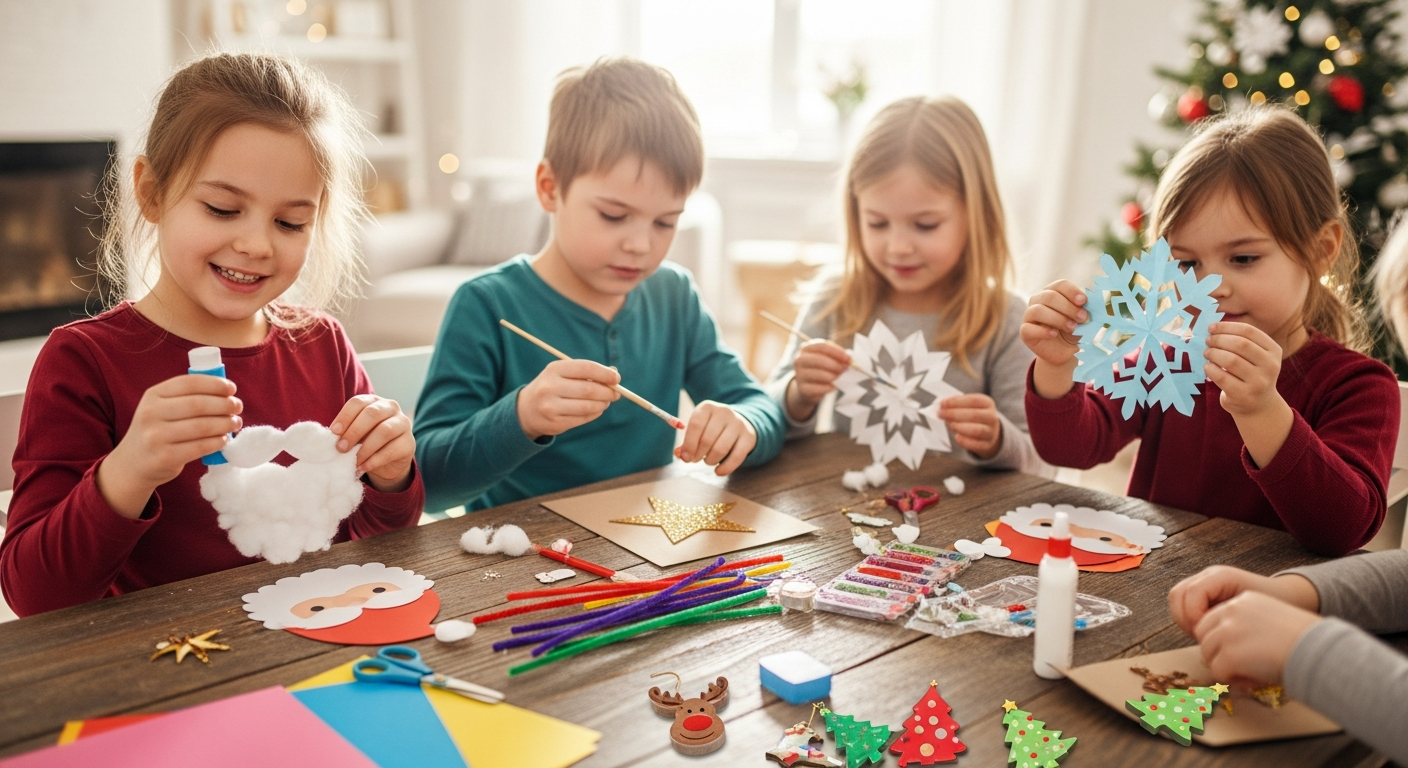
Table of Contents
- Why Christmas Crafts Are More Than Just Fun
- Preparing for Craft Time: Tips for Success
- Our Favorite Easy Christmas Crafts for Kids (with Developmental Twists)
- Enhancing Communication Skills Through Play with Speech Blubs
- Making the Most of Your Speech Blubs Experience: Pricing & Value
- More Tips for a Language-Rich Holiday Season
- Conclusion
- FAQ
The festive season is a whirlwind of twinkling lights, cozy carols, and the exciting anticipation of gifts. Amidst the cheerful chaos, have you ever noticed how a simple activity, like crafting a glittery ornament, can transform a child's entire demeanor? The holidays offer a unique opportunity to slow down, connect, and engage in meaningful activities with our little ones. While the joy of creating something beautiful is evident, the true magic of easy Christmas crafts for kids lies in their profound developmental benefits, especially for communication.
This holiday season, we invite you to discover how crafting can be a powerful tool for nurturing your child’s growth, from fine motor skills to imaginative thinking, and most importantly, their ability to express themselves. We'll dive into a sleigh-load of simple, engaging Christmas craft ideas perfect for children of all ages, offering practical tips to make craft time a breeze. We’ll also explore how these joyful moments, combined with scientifically-backed resources like Speech Blubs, can create a truly enriching experience, empowering your child to "speak their minds and hearts."

Why Christmas Crafts Are More Than Just Fun
Engaging in arts and crafts during the holidays isn't just about creating decorations; it’s a holistic learning experience. Every snip of the scissors, every dab of glue, and every choice of color contributes to a child’s development in multiple, interconnected ways.
Developing Fine Motor Skills and Hand-Eye Coordination
Many easy Christmas crafts require precise movements that are crucial for developing fine motor skills. Holding a paintbrush, cutting shapes with scissors, peeling stickers, or even twisting pipe cleaners all strengthen the small muscles in the hands and fingers. These skills are foundational for everyday tasks like dressing themselves, eating with utensils, and eventually, writing. Hand-eye coordination also improves as children learn to direct their movements to achieve a specific outcome, like placing a pom-pom exactly where they want it on a snowman.
Boosting Creativity and Imagination
Craft time is a blank canvas for a child’s imagination. There's no single "right" way to decorate a paper plate Santa or a salt dough ornament. This freedom allows children to experiment with colors, textures, and designs, fostering their unique creative expression. As they imagine what their finished product will look like, they develop problem-solving skills, thinking through how to translate their ideas into a tangible craft. This imaginative play is vital for cognitive flexibility and innovative thinking, traits that will serve them well throughout their lives.
Enhancing Cognitive Development and Problem-Solving
Following instructions, even simple ones, is a significant cognitive exercise. Craft recipes require sequencing (first cut, then glue, then decorate), understanding concepts (e.g., "put the star on top"), and making choices. When a material doesn't quite work as expected, children learn to adapt and find alternative solutions, sharpening their problem-solving abilities. This practical application of critical thinking helps them understand cause and effect in a fun, low-stakes environment.

Fostering Communication and Language Skills
Perhaps one of the most exciting benefits of crafting, especially from our perspective at Speech Blubs, is the incredible boost it gives to communication and language development. As children craft, they naturally engage in conversations:
- Vocabulary Expansion: Naming colors, shapes, materials ("glitter," "ribbon," "pipe cleaner"), and actions ("cut," "glue," "decorate," "bend," "twist").
- Descriptive Language: Describing their choices ("My snowflake is sparkly blue"), the process ("I'm carefully cutting the paper"), or the finished product ("Look, my reindeer has big antlers!").
- Following Directions: Listening to and understanding multi-step instructions from a caregiver.
- Requesting and Questioning: Asking for materials ("Can I have the red marker?"), clarifying steps ("What do I do next?"), or expressing needs ("I need help with this part").
- Storytelling: Creating narratives around their crafts (e.g., "This is Santa’s sleigh, and he’s flying to deliver presents!").
These interactive dialogues are incredibly rich opportunities for language learning. At Speech Blubs, we understand the power of play-based learning to unlock communication potential. Our app seamlessly integrates with these real-world scenarios, reinforcing vocabulary and concepts in an engaging way.
Building Family Bonds and Creating Lasting Memories
Beyond the developmental benefits, Christmas crafting offers invaluable time for family bonding. Sharing laughter, collaborating on a project, and seeing the pride on a child's face as they complete their creation builds strong, positive relationships. These handmade treasures become cherished mementos, imbued with the memories of shared joy, patience, and creativity. These are the moments that truly make the holidays special.
Preparing for Craft Time: Tips for Success
To ensure your Christmas crafting experience is joyful and stress-free, a little preparation goes a long way.
Setting Up a Safe and Organized Space
Choose an area that’s easy to clean, like a kitchen table protected with a tablecloth or old newspaper. Ensure good lighting and enough space for all materials and for your child to move comfortably. Having everything laid out beforehand minimizes interruptions and keeps focus on the activity.
Gathering Materials: Easy-to-Find, Affordable Fun
The best crafts for kids use materials you likely already have or can easily purchase at a dollar store or craft supply shop. Think:
- Paper (construction paper, cardstock, paper plates)
- Cotton balls, pipe cleaners, googly eyes, pom-poms
- Glue sticks, school glue, child-safe scissors
- Crayons, markers, paint (washable!), glitter (if you dare!)
- Natural elements: pinecones, leaves (collected from outside)
Managing Expectations: It's About the Process, Not Perfection
Remember, the goal is engagement and exploration, not a Pinterest-perfect masterpiece. Encourage your child’s unique approach and celebrate their effort. The crooked cutout or the mismatched colors are perfect because they made them. Focus on the joy of creating together.
Encouraging Independence (Age-Appropriate Tasks)
Offer tasks suitable for your child's age and skill level. A toddler might enjoy tearing paper or gluing large pieces, while an older child can manage cutting intricate shapes or more complex assembly. Provide just enough help to prevent frustration, but allow them the satisfaction of doing it themselves.
The Power of Co-Play and Conversation
This is where the magic happens for communication! Sit with your child, participate in the craft, and engage in conversation. Ask open-ended questions like, "What color should we use next?" or "Tell me about your snowflake." Describe your own actions ("I'm carefully cutting the circle"). These interactions provide rich language models and opportunities for your child to practice their emerging communication skills.
Our Favorite Easy Christmas Crafts for Kids (with Developmental Twists)
Here are some truly easy, engaging Christmas crafts that are perfect for little hands and big imaginations, each with a focus on their developmental and communicative benefits.
Paper Plate Christmas Tree
This classic craft is fantastic for targeting basic shapes, colors, and sequencing.
- Materials: Green paper plates (or paint white ones green), brown construction paper, glue, child-safe scissors, various small decorations (pom-poms, glitter, sequins, stickers).
- Steps:
- Cut a paper plate into a triangle shape for the tree.
- Cut a small rectangle from brown paper for the trunk and glue it to the bottom of the tree.
- Let your child decorate the tree with glue and various embellishments.
- Developmental Benefits: Scissor skills (cutting lines), gluing (fine motor control), color recognition, shape identification (triangle, rectangle, circles for ornaments), counting, and choice-making.
- Speech Blubs Integration: This craft is a perfect opportunity to practice descriptive adjectives and spatial concepts. As you craft, ask: "What color is this pom-pom?" "Where should the star go – on top or in the middle?" For a parent whose child is learning to use descriptive adjectives, the "Colors and Shapes" section of Speech Blubs offers interactive games that reinforce words like 'green,' 'shiny,' and 'round.' After decorating their paper plate tree, they can use Speech Blubs to practice describing their creations, saying "My tree is green," "The star is yellow," or "I glued on many sparkly circles."
Cotton Ball Santa
A wonderfully tactile craft that introduces concepts like textures and facial features.
- Materials: Red construction paper (for Santa's hat and body), peach or light pink paper (for face), cotton balls, glue, googly eyes or markers.
- Steps:
- Cut a large red triangle for Santa's hat and a round peach circle for his face.
- Glue the face circle to the bottom of the hat.
- Help your child glue cotton balls around the edges of the hat and to create Santa's beard, mustache, and eyebrows.
- Add googly eyes or draw them with markers.
- Draw a nose and a jolly smile!
- Developmental Benefits: Sensory exploration (soft cotton), fine motor skills (picking up and gluing cotton balls), body part identification (eyes, nose, mouth, beard), and imaginative play (who is Santa? where does he live?).
- Speech Blubs Integration: This craft is excellent for practicing naming facial features and expressing emotions. Ask, "What part is this?" as you point to Santa's beard. "How does Santa look? Happy? Jolly?" For a child learning to identify and express emotions, our "My Face" section within the Speech Blubs app helps them practice making faces and naming feelings, which can then be applied to describing Santa's "jolly" expression.
Handprint or Footprint Reindeer Ornaments
A sentimental craft that makes a lovely keepsake and promotes body awareness.
- Materials: Brown washable paint, cardstock or thick paper, red pom-pom (for Rudolph’s nose), googly eyes, glitter (optional), ribbon or string.
- Steps:
- Paint your child's hand (fingers together, thumb out) or foot brown.
- Press firmly onto the paper to make a print. Let it dry completely.
- Once dry, turn the handprint upside down (fingers become antlers, thumb becomes the nose/mouth area) or the footprint (heel is head, toes are antlers).
- Glue on a red pom-pom for Rudolph’s nose and googly eyes.
- Add details with markers or glitter. Punch a hole at the top and thread with ribbon.
- Developmental Benefits: Sensory experience (paint), body awareness (identifying hand/foot, fingers/toes), following simple instructions, and storytelling.
- Speech Blubs Integration: This craft naturally encourages naming body parts and animal sounds. "Whose hand is this?" "What sound does a reindeer make?" For a child who loves animals, Speech Blubs' "Animal Kingdom" offers a fun and engaging way to practice animal sounds and names, which can then be enthusiastically applied to their handprint reindeer. You can easily download Speech Blubs from the Google Play Store to get started.
Pipe Cleaner Candy Canes/Stars
Excellent for fine motor skills, bending, and understanding patterns.
- Materials: Red and white pipe cleaners (for candy canes), various colors for stars.
- Steps:
- Candy Cane: Twist one red and one white pipe cleaner together. Bend one end into a hook shape.
- Star: Take one pipe cleaner and bend it into five points, connecting the ends to form a star. Or, twist several pipe cleaners together to form a chunkier star.
- Developmental Benefits: Fine motor dexterity (twisting, bending), color identification, counting (how many twists, how many points on a star), and spatial reasoning.
- Speech Blubs Integration: Use this craft to practice action verbs and counting. "Twist the red and white together." "Bend it around." "How many points does your star have?" For a child developing pre-writing skills or fine motor control, our app's interactive games help practice these foundational skills. They can then apply them directly to manipulating the pipe cleaners, associating the verbal commands with physical actions.
Q-tip Snowflakes
A simple, elegant craft that teaches about patterns and symmetry.
- Materials: Q-tips, white glue, blue or black construction paper.
- Steps:
- Pour a small puddle of glue onto the construction paper.
- Help your child arrange Q-tips into snowflake patterns, dipping the ends into the glue. They can break Q-tips into smaller pieces for more intricate designs.
- Developmental Benefits: Fine motor control (picking up and placing Q-tips), pattern recognition, pre-math skills (symmetry, counting Q-tips), and vocabulary related to winter.
- Speech Blubs Integration: This craft is perfect for expanding vocabulary related to seasons and descriptive words. "What does snow feel like?" "Is your snowflake big or small?" For a child learning about seasons, they can explore related vocabulary in Speech Blubs' "My Day" activities, then use this craft to reinforce understanding of words like 'snow,' 'cold,' and 'winter.'
Salt Dough Ornaments
A sensory-rich craft that allows for endless creativity and lasts for years.
- Materials: 1 cup flour, 1/2 cup salt, 1/2 cup water (adjust as needed), cookie cutters, baking sheet, string, paint/markers for decorating.
- Steps:
- Mix flour, salt, and water to form a dough. Knead until smooth.
- Roll out the dough (about 1/4 inch thick).
- Use Christmas cookie cutters to make shapes.
- Punch a hole at the top of each ornament with a straw.
- Bake at 250°F (120°C) for 2-3 hours until hard, or air dry for 2-3 days.
- Once cooled and hardened, let your child paint and decorate them. Thread with string.
- Developmental Benefits: Sensory play (touching, kneading dough), fine motor skills (rolling, cutting, decorating), cause and effect (baking makes it hard), planning and sequencing, color mixing.
- Speech Blubs Integration: This craft provides abundant opportunities for practicing action verbs and descriptive words. "Roll the dough." "Cut out a star." "Is it smooth or bumpy?" "What color will you paint it?" For a child with a limited vocabulary for actions, the "Action Verbs" section in Speech Blubs can help them expand their repertoire, allowing them to use those new words enthusiastically during the dough-making and decorating process.
Enhancing Communication Skills Through Play with Speech Blubs
At Speech Blubs, we believe every child deserves the chance to express themselves fully, to "speak their minds and hearts." Our company was born from the personal experiences of our founders, who all grew up with speech problems and were driven to create the very tool they wished they had as children. We are deeply committed to providing an immediate, effective, and joyful solution for the 1 in 4 children who need speech support.
We achieve this by blending scientific principles with play into one-of-a-kind "smart screen time" experiences. Unlike passive viewing like cartoons, Speech Blubs provides a screen-free alternative that is interactive and engaging, serving as a powerful tool for family connection. Our unique approach teaches complex communication skills through our "video modeling" methodology, where children learn by watching and imitating their peers. This technique leverages the power of mirror neurons, making learning natural and highly effective.
Imagine a child who is delighted by their handprint reindeer. With Speech Blubs, they can then watch other children make animal sounds or talk about animals, reinforcing their understanding and encouraging them to vocalize. For a parent whose 3-year-old "late talker" loves animals, the "Animal Kingdom" section in Speech Blubs offers a fun, motivating way to practice "moo" and "baa" sounds, which can then be reinforced during creative play with animal crafts.
Our innovative approach, backed by extensive research, places us in the top tier of speech apps worldwide (as rated by the MARS scale). We focus on fostering a love for communication, building confidence, reducing frustration, developing key foundational skills, and creating joyful family learning moments. Speech Blubs is a powerful supplement to a child's overall development plan and, when applicable, professional therapy, providing valuable support right at your fingertips.
Unsure if your child could benefit from a little extra speech support? Take our quick 3-minute preliminary screener. It involves 9 simple questions and provides an assessment and a next-steps plan, along with a free 7-day trial of Speech Blubs to see the difference for yourself. But don't just take our word for it—read heartwarming testimonials from parents whose children have blossomed with Speech Blubs.
Making the Most of Your Speech Blubs Experience: Pricing & Value
We believe in transparency and providing exceptional value to families. Understanding our subscription options will help you choose the best path for your child's communication journey.
Our plans are designed to be flexible, but we strongly encourage the Yearly plan for its superior value and comprehensive features.
- Monthly Plan: $14.99 per month
- Provides access to the Speech Blubs app.
- Does not include a free trial.
- Does not include the extra Reading Blubs app.
- Offers standard support response time.
- Yearly Plan: $59.99 per year
- Breaks down to just $4.99 per month!
- You save a significant 66% compared to the monthly plan.
- Includes a full 7-day free trial so you can experience everything Speech Blubs has to offer before committing.
- Includes the extra Reading Blubs app, offering an even broader spectrum of educational content.
- Provides early access to new updates and a priority 24-hour support response time.
The Yearly plan is undeniably the best choice, offering incredible savings and a richer, more supportive experience. We want to empower you with all the tools necessary for your child's success, and the Yearly plan delivers just that.
Ready to explore the full potential and get the most value for your family? Create your account and begin your 7-day free trial today! Be sure to select the Yearly plan to unlock all the exclusive features and benefits.
More Tips for a Language-Rich Holiday Season
Beyond crafting and Speech Blubs, there are countless ways to make the holidays a language-rich environment:
- Read Christmas Stories: Snuggle up and read holiday books together. Ask questions about the pictures, predict what might happen next, and talk about the characters' feelings.
- Sing Carols: Singing is a fantastic way to develop rhythm, rhyme, and memory skills, all of which are important for language development.
- Involve Kids in Holiday Planning: Talk about what you're doing: "We need to write our grocery list for Christmas dinner," or "Let's decide who gets which present." This uses functional language.
- Describe Decorations: As you decorate the house or see festive displays, talk about what you see. "Look at the shiny red ornaments!" "That Santa is so big!"
- Talk About Traditions: Share family traditions and stories from your own childhood holidays. This builds narrative skills and a sense of belonging.
Every interaction is an opportunity for language growth.
Conclusion
The holiday season is a magical time, filled with opportunities to create not just beautiful decorations, but also invaluable memories and developmental milestones for our children. Easy Christmas crafts offer a delightful pathway to enhance fine motor skills, spark creativity, boost cognitive abilities, and critically, foster robust communication and language development. When we engage in these activities with empathy and intention, we provide a rich environment for our children to explore, learn, and grow.
By embracing the joy of crafting and supplementing these experiences with innovative tools like Speech Blubs, we offer our children the best chance to thrive. Speech Blubs, with its unique video modeling and play-based learning, is designed to support and empower children on their communication journey, turning screen time into smart time. This holiday season, let's make a conscious effort to blend festive fun with purposeful play, creating moments that resonate and build foundational skills for a lifetime.
Ready to light up your child's world with the gift of communication? Download Speech Blubs today from the Apple App Store or Google Play, and choose the Yearly plan to unlock all the benefits, including a 7-day free trial and the Reading Blubs app. Let's make this Christmas a season of joyful connection and confident communication!
FAQ
What age group are these crafts suitable for?
These crafts are generally suitable for toddlers (with significant adult supervision and simplified tasks) up through early elementary school children. Each craft can be adapted; for younger children, focus on the sensory experience and simpler steps like tearing paper or sticking large items. Older children can handle more complex cutting, detailed decorating, and multi-step instructions, fostering greater independence.
How can crafts help with my child's speech development?
Crafting provides a natural, low-pressure environment for language practice. Children learn new vocabulary (colors, shapes, textures, actions), practice following directions, develop descriptive language, and engage in conversations about their creations. These interactions stimulate language acquisition and encourage expressive communication, making learning fun and meaningful.
What if my child isn't interested in crafting?
Every child is different! If your child isn't immediately drawn to crafts, try to make it an inviting, no-pressure activity. Offer a choice of materials, allow them to lead the creative process, or connect it to something they already love (e.g., a craft about their favorite character or animal). Sometimes just having you sit alongside them and model enthusiasm can make a difference. Remember, the goal is connection and exploration, not a perfect craft.
How does Speech Blubs fit into our holiday crafting routine?
Speech Blubs can beautifully complement your crafting routine by reinforcing vocabulary and concepts learned during creative play. For example, after making an animal-themed craft, you can open Speech Blubs to the "Animal Kingdom" section to practice animal sounds and names. Or, after using many different colors in a craft, engage with the app's "Colors & Shapes" activities. It provides an interactive, structured way to build upon the language exposure gained during crafting, making the learning continuous and engaging.
About the author