
Easy Paper Crafts for Kids: Fun, Speech & Family Bonds
 By Speech Blubs Team•Jan 13, 2026•16 min.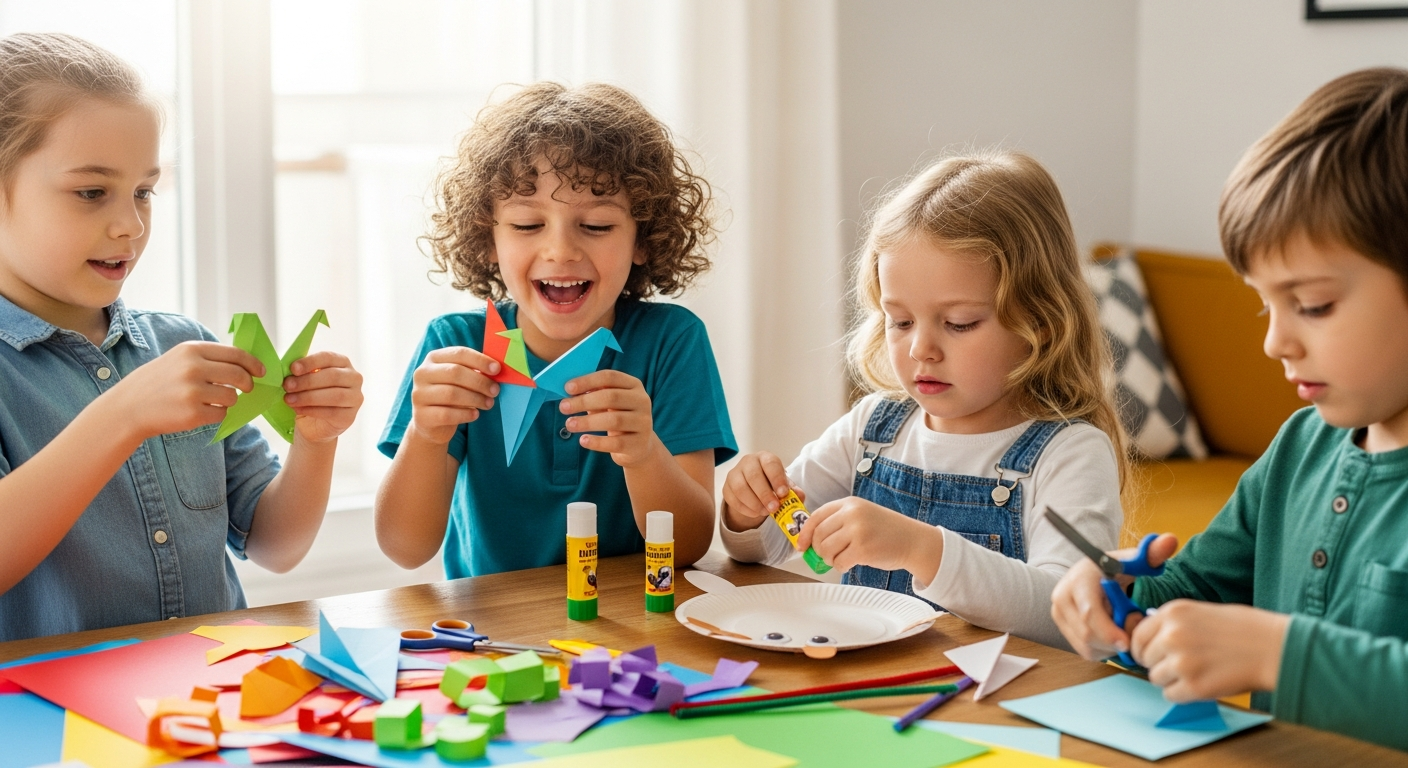
Table of Contents
- Introduction
- The Developmental Magic of Paper Crafts
- How Paper Crafts Boost Speech and Language Skills
- Getting Started: Essential Materials for Easy Paper Crafts
- Dive In: Easy Paper Craft Ideas with a Language Twist
- Seamlessly Integrating Speech Blubs for Enhanced Learning
- Choosing Your Speech Blubs Plan: Value and Features
- Conclusion
- FAQ
Introduction
Imagine a simple sheet of paper. What do you see? For many children, it's a blank canvas, a world of potential waiting to be shaped, folded, or cut into something magical. But for parents and caregivers, that same sheet of paper represents an incredibly accessible and powerful tool for more than just creative play; it's a doorway to critical developmental milestones, especially in speech and language. In a world increasingly dominated by screens, the tactile joy of crafting offers a refreshing, hands-on experience that stimulates minds, hones fine motor skills, and, perhaps most importantly, sparks conversation. This post will delve into the wonderful world of easy paper crafts for kids, exploring not just how to make them, but how these delightful activities foster essential communication skills, build confidence, and strengthen family connections, all while complementing the "smart screen time" experiences we champion at Speech Blubs.

The Developmental Magic of Paper Crafts
Paper crafts are far more than just a way to pass the time; they are a multi-faceted developmental powerhouse. From the moment a child picks up a pair of safety scissors or a glue stick, they are engaging a range of cognitive and physical skills crucial for growth.
Fine Motor Skill Development
Working with paper naturally encourages the development of fine motor skills. Cutting along lines, folding precisely, tearing paper for collages, or carefully applying glue all require hand-eye coordination and dexterity. These skills are foundational for tasks like writing, dressing, and self-feeding. As children manipulate paper, their small hand muscles become stronger and more agile, preparing them for future academic and life challenges.
Cognitive Growth and Problem-Solving
Every paper craft project, no matter how simple, involves a degree of problem-solving. Children learn to follow instructions, sequence steps, and understand spatial relationships ("put this on top," "fold it in half"). They experiment with cause and effect—what happens if I cut here? How do I make this stand up? This engagement with process and outcome builds critical thinking and encourages persistence.
Sparking Creativity and Imagination
With just a few sheets of paper, a child's imagination can soar. A plain piece of paper can become a roaring lion, a soaring bird, a secret message, or a fantastical mask. Crafts offer an open invitation for children to express their unique ideas, make choices about colors and designs, and see their visions come to life. This creative outlet is vital for emotional expression and self-discovery.
Emotional Development and Confidence
Completing a craft project, even with assistance, gives children a profound sense of accomplishment. The pride they feel in showing off their paper masterpiece boosts self-esteem and encourages them to try new things. Learning to be patient through a multi-step project and overcoming small challenges also builds resilience and frustration tolerance—qualities that serve them well in all areas of life.

How Paper Crafts Boost Speech and Language Skills
This is where the true magic happens, especially for parents interested in supporting their child's communication journey. Paper crafts are an unparalleled opportunity for natural, joyful language development.
Vocabulary Expansion
Every step of a craft project introduces new words. Naming materials (paper, scissors, glue, marker, string, cardstock, tissue paper), actions (cut, fold, glue, draw, tear, press, stick), colors (red, blue, green), shapes (circle, square, triangle, strip), and textures (smooth, rough, crinkly) naturally expands a child's lexicon. When making a "paper python," you can talk about it being "long" or "slithery." For a "bouncing bunny," discuss "fluffy" tails and "hopping" movements.
Following Directions and Sequencing
Crafts are perfect for practicing multi-step instructions. "First, get the blue paper. Next, cut a big circle. Then, glue it here." Breaking down tasks into smaller, manageable steps helps children understand sequential language, a crucial skill for listening comprehension and later, for storytelling. This aligns perfectly with the structured yet playful approach we take at Speech Blubs, where children learn through clear, imitative steps in our "video modeling" activities.
Expressing Ideas and Storytelling
As children create, they often narrate their process or tell stories about their creations. A paper puppet can become a character in an elaborate play, or a paper boat can embark on an imaginary ocean adventure. These opportunities for spontaneous language generation strengthen narrative skills, sentence structure, and descriptive language. Encouraging them to talk about "what they made" and "how they made it" empowers them to articulate their thoughts and feelings. This foundational communication is at the heart of our mission at Speech Blubs: to empower children to "speak their minds and hearts."
Social Communication and Connection
Crafting together fosters vital social communication skills. Children learn to share materials, take turns, ask for help, and comment on each other's work. It’s a powerful tool for family connection, creating shared experiences and memories. These are moments where parents can model language, engage in back-and-forth conversations, and simply enjoy being present with their child. We understand the importance of this connection, which is why Speech Blubs is designed as a powerful tool for family engagement, turning "screen time" into shared learning.
Articulation Practice
Specific crafts can even be tailored to practice particular sounds. Making a "spectacular snowflake" offers chances to practice "s" sounds. Crafting a "feathered friends beak mask" can inspire "quack" or "caw" sounds. Turning a paper square into a "star" can reinforce "st" blends. Integrating these sounds naturally into play makes practice fun and less like a chore. For deeper, targeted articulation practice, Speech Blubs provides a supportive environment where children can learn by watching and imitating their peers, a methodology backed by science and proven effective.
Getting Started: Essential Materials for Easy Paper Crafts
One of the greatest benefits of paper crafts is their accessibility. You likely have most of what you need already!
Types of Paper to Stock Up On:
- Printer paper: Your everyday go-to.
- Cardstock: Thicker and sturdier, great for 3D projects or cards.
- Construction paper: Comes in a vibrant array of colors, perfect for collages and visual appeal.
- Kraft paper: Earthy tones, good for a natural look.
- Origami paper: Thin and crisp, designed for intricate folds.
- Scrapbook paper: Patterns and designs for extra flair.
- Tissue paper: Translucent and delicate, wonderful for layering and light effects.
- Recycled packaging: Newspapers, magazines, paper bags, wrapping paper, cereal boxes – an eco-friendly way to craft and teach about sustainability!
Basic Tools You'll Need:
- Safety Scissors: Essential for developing cutting skills. Choose child-friendly versions.
- Glue Stick/Liquid Glue: Glue sticks are less messy for younger children, while liquid glue offers a stronger hold for more complex projects.
- Markers/Crayons/Colored Pencils: For adding details, coloring, and personalization.
- Pencil: For drawing outlines and tracing.
- Ruler: For measuring and making straight lines (great for early math concepts!).
- Googly Eyes: A fun addition that instantly brings characters to life!
Dive In: Easy Paper Craft Ideas with a Language Twist
Here are some fantastic, easy paper crafts that double as wonderful opportunities for speech and language development. We've chosen ideas that are simple to execute but rich in potential for communication.
1. Animal Kingdom Creations
Animals are always a hit with kids and provide a wealth of language-rich opportunities.
- Paper Python Project:
- How to Make It: Cut strips of paper and glue them into a chain, or cut a spiral shape. Add googly eyes and draw a tongue.
- Language Focus: "S-s-s-s-snake!" Practice "s" sounds. Use descriptive words like "long," "slithery," "green," "wiggly." Talk about actions: "The snake is sliding," "It slithers on the ground." You can even count the segments of your paper chain.
- Bouncing Bunny:
- How to Make It: Fold paper to create a basic bunny shape, or roll a paper strip into a cylinder for the body and add ears. Use markers for facial features.
- Language Focus: Practice "h" sounds with "hop, hop, hop!" Describe the bunny: "fluffy," "cute," "white," "long ears." What does a bunny eat? "Carrots!" What sound does it make? (Encourage animal sounds, even if not strictly accurate, for vocal play).
- Feathered Friends Beak Mask:
- How to Make It: Cut out a simple mask shape from cardstock. Fold a triangular piece of paper for the beak and attach it. Decorate with feathers or colored paper strips. Add elastic for wearing.
- Language Focus: Role-play! "Quack, quack!" or "Chirp, chirp!" Identify colors of feathers. Talk about birds that "fly," "sing," "peck." This can inspire imaginative play and dialogue about where birds live or what they do.
- Froggy Flips:
- How to Make It: Fold a square of paper into a jumping frog. Add eyes and a smile with a marker.
- Language Focus: "Ribbit, ribbit!" "Jump, jump, jump!" Talk about the frog's color, "green." Describe its actions: "It hops high!" or "It lands softly."
2. Nature & Seasonal Wonders
These crafts connect children to the world around them and introduce seasonal vocabulary.
- Spectacular Snowflakes:
- How to Make It: Fold a square piece of paper several times and then cut intricate designs along the edges. Unfold to reveal a unique snowflake.
- Language Focus: Discuss "winter," "cold," "snow," "ice." Describe the shapes you see in the snowflake: "points," "lines," "holes." Use words like "fragile," "delicate," "symmetrical." Practice "s" sounds in "snowflake" and "scissors."
- Blooming Beautiful Flowers / 3D Tulip Bouquet:
- How to Make It: Cut out petal shapes and layer them, or roll strips of paper for a 3D effect. Glue them onto a stem.
- Language Focus: Name different types of "flowers." Identify "colors" of petals. Discuss where flowers "grow" and what they "need" (sun, water). Practice words like "petal," "stem," "leaf," "grow," "smell."
- Pretty Pinwheel:
- How to Make It: Cut a square of paper, then cut from each corner toward the center. Fold alternate points to the center and secure with a pin.
- Language Focus: Talk about the "wind," "spin," "fast," "slow." Use action words: "blow," "turn." Describe the colors as they "blur."
3. Everyday & Functional Crafts
These projects help children understand objects' purposes and encourage practical language use.
- Origami Organizer / Bespoke Basket / DIY Desk Organizer:
- How to Make It: Fold or cut and glue paper to create simple boxes or compartments.
- Language Focus: Use prepositions: "Put the pencils in the box," "The paper is on the desk." Discuss function: "This is for holding crayons," "We can store our treasures here." Practice size comparisons: "big," "small," "wide," "narrow."
- Tiny Tales Mini Notebooks:
- How to Make It: Fold and staple small sheets of paper together to create a tiny book. Design a cover.
- Language Focus: Encourage storytelling! "What will your story be about?" Practice sequencing: "First, the bunny hopped... then..." Use descriptive words to describe characters and settings. "Tell me about your favorite part."
- Cute Corner Bookmarks:
- How to Make It: Fold a square of paper into a corner bookmark shape. Decorate it as an animal face or fun character.
- Language Focus: Talk about "reading," "books," "pages." Ask, "What's your favorite book?" or "Who is your favorite character?" Use words like "mark," "save," "remember."
Seamlessly Integrating Speech Blubs for Enhanced Learning
While paper crafts offer incredible hands-on language opportunities, we understand that sometimes parents need targeted, expert-designed support to help their child "speak their minds and hearts." This is where Speech Blubs shines, acting as a powerful companion to your crafting adventures. Our mission, born from our founders' personal experiences with speech problems, is to provide an immediate, effective, and joyful solution for the 1 in 4 children who need speech support.
Imagine this scenario: you've just crafted a "bouncing bunny." Your child is excited, making "hop" sounds and talking about its "fluffy" tail. Now, you can transition to Speech Blubs. In our "Animal Kingdom" section, your child can watch real kids model the sounds and words for "bunny" or other animals, reinforcing vocabulary and articulation through our unique "video modeling" methodology. Children learn best by imitating their peers, and our app makes this scientific principle playful and engaging.
We design our app to be "smart screen time," a purposeful and interactive alternative to passive viewing like cartoons. Instead of just consuming content, children actively participate, mirroring the actions and sounds of their peers. This active engagement enhances their ability to articulate, expand vocabulary, and understand concepts, much like the active learning fostered by crafts.
Here’s how Speech Blubs can complement your craft time:
- Targeted Sound Practice: If your child struggles with the "s" sound, make a paper "snake" then open Speech Blubs to practice "s" words like "star," "sun," or "see" with our peer models.
- Vocabulary Reinforcement: After making a "paper flower," explore the "Nature" section of the app to learn and practice names of different flowers and related descriptive words.
- Following Directions: The app's clear, step-by-step activities mirror the sequencing skills practiced in crafts, reinforcing understanding of instructions.
- Emotional Expression: Crafting a card for a loved one, then using Speech Blubs to practice saying "I love you" or expressing other emotions can bridge creative play with confident verbalization.
Our commitment is to blend scientific principles with play, ensuring every experience is one-of-a-kind. With over 4,500 activities and exercises, Speech Blubs helps foster a love for communication, builds confidence, and reduces frustration, creating joyful family learning moments.
Unsure if your child could benefit? Take our quick 3-minute preliminary screener to get a simple assessment and a free 7-day trial. You can also read what other parents are saying about their child's success with Speech Blubs by visiting our testimonials page.
Choosing Your Speech Blubs Plan: Value and Features
We believe in providing an immediate, effective, and joyful solution for your child's speech and language development. To make our comprehensive tool accessible, we offer flexible subscription plans, though one stands out for its incredible value and additional features.
Our Monthly plan is available at $14.99 per month. It provides access to our core features, allowing your child to engage with our extensive library of activities.
However, for the most comprehensive experience and significant savings, we highly recommend our Yearly plan at $59.99 per year. This breaks down to just $4.99 per month, allowing you to save a remarkable 66% compared to the monthly subscription!
The Yearly plan isn't just about cost savings; it's about unlocking the full potential of Speech Blubs with exclusive, high-value features designed to support your child's communication journey even further:
- 7-Day Free Trial: Only with the Yearly plan can you access a 7-day free trial, giving you ample time to explore all the amazing features and see the difference Speech Blubs can make.
- The Extra Reading Blubs App: This fantastic companion app is included exclusively with the Yearly plan, providing additional support for early literacy skills and complementing the speech development your child experiences with Speech Blubs.
- Early Access to New Updates: Be the first to enjoy new content and features as soon as they are released, keeping your child's learning experience fresh and exciting.
- 24-Hour Support Response Time: Our dedicated support team is available to assist you promptly, ensuring any questions or concerns are addressed quickly and efficiently.
The Monthly plan, unfortunately, does not include these valuable benefits. We encourage you to choose the Yearly plan to get the free trial and the full suite of features that will empower your child to blossom.
Ready to provide your child with "smart screen time" that truly makes a difference? Download Speech Blubs on the App Store or Google Play to begin your 7-day free trial today! Or, if you prefer, you can create your account and start your trial on our website.
Conclusion
Easy paper crafts for kids are a timeless, budget-friendly, and profoundly impactful way to support a child's holistic development. From strengthening fine motor skills and boosting creativity to, crucially, fostering robust speech and language abilities, the simple act of cutting, folding, and gluing holds immense power. These hands-on activities provide natural, joyful opportunities for vocabulary growth, following directions, storytelling, and social communication, all while building confidence and creating cherished family memories.
When combined with the targeted, engaging support of Speech Blubs, your child's communication journey becomes even more comprehensive and exciting. We believe in the power of blending scientific methodologies with playful, interactive experiences, ensuring that every child has the opportunity to unlock their full potential and communicate with confidence. Just as paper transforms into countless creations, your child's communication skills can blossom and thrive with consistent support and engaging practice.
Don't wait to empower your child's voice. Take the first step towards a brighter, more communicative future. Start your 7-day free trial of Speech Blubs today by selecting the Yearly plan and unlock all the premium features, including the Reading Blubs app and priority support. Download Speech Blubs on the Apple App Store or Google Play Store and begin a joyful journey of learning and discovery with your child.
FAQ
Q1: What age are easy paper crafts suitable for? A1: Paper crafts are wonderfully versatile and can be adapted for almost any age! Toddlers can enjoy tearing paper and gluing simple shapes with supervision. Preschoolers can practice cutting and folding simple items. Older children can tackle more complex origami, weaving, or 3D models. Always ensure age-appropriate tools, like safety scissors, are used, and provide plenty of adult supervision, especially with younger children.
Q2: How specifically can paper crafts help with speech and language development? A2: Paper crafts inherently create opportunities for conversation. They help expand vocabulary by naming materials, colors, actions (cut, fold, glue), and objects created. Following multi-step instructions during a craft project improves comprehension and sequencing skills. Crafts also encourage descriptive language, storytelling about the creations, and social communication through sharing and turn-taking, all vital for robust language development.
Q3: What if my child gets frustrated during a paper craft project? A3: Frustration is a natural part of learning! When your child gets frustrated, take a deep breath together. Simplify the steps, offer more hands-on help, or suggest a simpler project. Focus on the effort and the process, not just the perfect outcome. Reassure them that it's okay to make mistakes and try again. The goal is joyful engagement, not perfection. You can also take a break and return to it later, perhaps even using a Speech Blubs activity for a fresh, engaging boost.
Q4: How does Speech Blubs complement the benefits of paper crafts for language development? A4: Paper crafts provide valuable hands-on, generalized language practice and fine motor skill development. Speech Blubs complements this by offering targeted, interactive "smart screen time" experiences that reinforce specific speech sounds, vocabulary, and language concepts through our unique "video modeling" method. While crafts encourage natural conversation, Speech Blubs provides a structured environment where children learn by imitating peers, strengthening articulation and language comprehension in a joyful, engaging way. Together, they create a comprehensive approach to communication growth.
About the author