
Easy STEM Crafts for Kids: Hands-On Learning & Fun
 By Speech Blubs Team•Jan 13, 2026•20 min.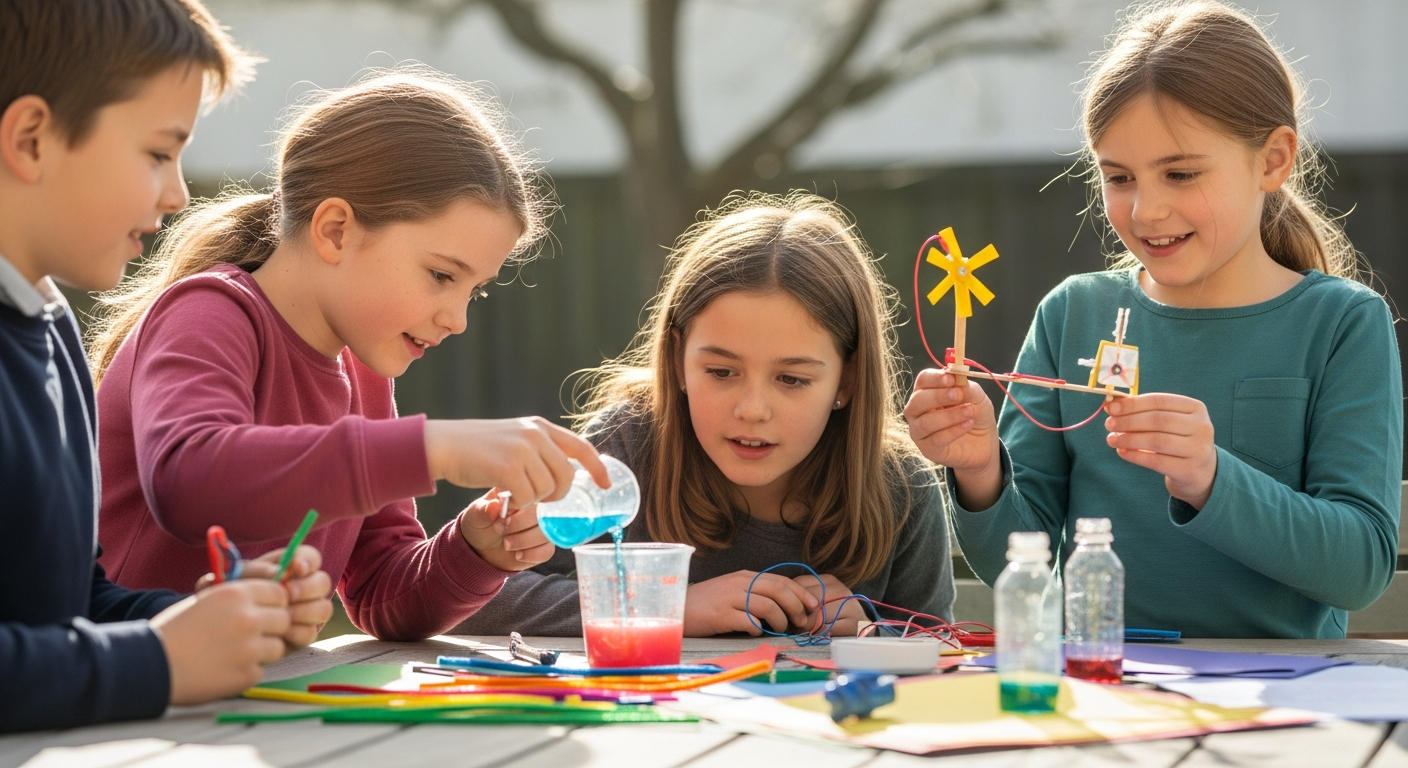
Table of Contents
- Introduction
- Why STEM Crafts are More Than Just Play
- The Communication Connection: Sparking Language Through STEM
- Our Favorite Easy STEM Crafts for Kids
- Making STEM Learning a Family Adventure
- Ready to Empower Your Child's Communication Journey?
- Conclusion
- Frequently Asked Questions
Introduction
Imagine a world where learning isn't a chore but a joyful exploration, where every experiment sparks curiosity and every creation builds confidence. For many parents, the idea of "STEM" (Science, Technology, Engineering, and Mathematics) can sound intimidating, conjuring images of complex equations or intricate lab setups. However, the truth is far more delightful: STEM activities for kids are simply hands-on ways to explore how the world works, fostering natural curiosity and critical thinking from a young age.
At Speech Blubs, we passionately believe that learning should be an adventure, blending fun, education, and meaningful interaction. This blog post will demystify STEM, showing you how incredibly easy it is to integrate these powerful concepts into your child's daily life using simple household items. We’ll explore a treasure trove of easy STEM crafts for kids, demonstrating how these engaging activities not only introduce foundational scientific and mathematical principles but also naturally foster crucial speech and language development. Our goal is to make learning a truly holistic and joyful family experience, empowering your child to not only understand the world around them but also to confidently "speak their minds and hearts."

Why STEM Crafts are More Than Just Play
The Power of Hands-On Exploration
STEM is far more than just an acronym; it's a framework for understanding and interacting with the world. When children engage in STEM crafts, they're not just making things; they're becoming active participants in their learning journey. They’re observing, questioning, experimenting, and problem-solving – skills that are fundamental for success in school and in life.
- Cognitive Benefits: STEM activities are brain boosters! They foster curiosity, encourage logical reasoning, and help children understand cause and effect. When a child builds a paper bridge, they're learning about structural integrity. When they mix ingredients for magnetic slime, they're exploring chemical reactions and properties of matter. These experiences lay the groundwork for complex cognitive processes later on.
- Motor Skills Development: From cutting and gluing paper to manipulating small objects, STEM crafts are excellent for developing both fine and gross motor skills. These actions strengthen hand muscles, improve dexterity, and enhance hand-eye coordination – all vital for tasks like writing, drawing, and even self-care.
- Emotional Growth: The process of creating and experimenting also cultivates important emotional traits. Children learn patience as they wait for crystals to grow or slime to set. They develop resilience when an experiment doesn't go as planned, prompting them to try again or modify their approach. And the pride they feel when a project succeeds or a new concept is understood? That boosts self-esteem and encourages a love for learning.
The Communication Connection: Sparking Language Through STEM
One of the most profound benefits of hands-on STEM crafts is their inherent ability to spark conversation and significantly boost language development. When children are actively engaged in building, mixing, or observing, they have a natural context for verbal expression, asking questions, and following instructions.
Parents play a crucial role in facilitating this language growth during craft time. By simply engaging in conversation, you can turn a fun activity into a powerful speech and language lesson:

- Descriptive Language: Encourage your child to describe what they see, feel, smell, or hear. "What color is the liquid?" "Does the slime feel sticky or smooth?" "What sound does the paper make when you cut it?" These questions prompt the use of adjectives, adverbs, and sensory vocabulary.
- Sequencing: Many crafts involve multiple steps. Narrate the process: "First, we pour the water. Next, we add the salt. Then, we stir." Ask your child to recall the steps or predict what comes next. This helps develop narrative skills and the use of temporal words.
- Open-Ended Questions: Instead of questions with a simple yes/no answer, ask questions that encourage thought and elaboration. "What do you think will happen if we add more water?" "Why did your bridge fall down, and how can we make it stronger?"
- Vocabulary Expansion: Introduce new words naturally within the context of the craft. Words like "viscous," "perimeter," "circuit," "dissolve," "hypothesis," and "structure" become meaningful when tied to a tangible experience.
Seamless Speech Blubs Integration
At Speech Blubs, our mission is to empower children to "speak their minds and hearts," and we believe that engaging activities like these crafts are fundamental building blocks for robust communication. We understand the challenges parents face, and our company was born from the personal experiences of our founders, who all grew up with speech problems and created the tool they wished they had.
For a parent whose child is learning new action verbs, describing the steps of building a paper helicopter ("cut," "fold," "clip," "spin") becomes an interactive language lesson. After the hands-on fun, Speech Blubs’ "Action Verbs" section can reinforce these words through engaging video modeling, showing friendly peers performing these very actions. This connection between the craft and the word makes the learning even stronger and more memorable.
Our unique approach provides an immediate, effective, and joyful solution for the 1 in 4 children who need speech support, blending scientific principles with play into one-of-a-kind "smart screen time" experiences. We provide a screen-free alternative to passive viewing (like cartoons) and a powerful tool for family connection. Our method is backed by science, placing us in the top tier of speech apps worldwide, as you can learn about the science behind our method here.
Our Favorite Easy STEM Crafts for Kids
Get ready to transform your kitchen table into a vibrant learning lab! These crafts use everyday materials and offer fantastic opportunities for both STEM discovery and rich language interaction.
Science Experiments That Wow
Cloud in a Jar: The Water Cycle in Miniature
Bring the magic of the weather indoors! This simple experiment visually demonstrates the water cycle and states of matter.
- Concepts: Evaporation, condensation, precipitation, water cycle.
- Materials: Glass jar, warm water, a few matches (adult supervision essential) or hairspray, ice cubes or a balloon.
- Simplified Steps:
- Pour warm water into the jar (about half full).
- Carefully light a match, blow it out, and drop it into the jar, letting the smoke gather for a few seconds. Quickly remove it. (Alternatively, a quick spray of hairspray works too).
- Immediately cover the mouth of the jar tightly with ice cubes on a lid, or stretch a balloon over the opening and push it down gently.
- Watch as a cloud forms inside!
- Language & Learning Focus: Use words like "evaporation," "condensation," "misty," "foggy," "warm," "cold." Ask, "What do you see happening?" "Why do you think the cloud is forming?" "What happens to clouds in the sky?" This is an excellent opportunity to introduce "cause and effect" vocabulary.
Rainbow in a Jar: Exploring Density
Create a colorful masterpiece that teaches a fundamental principle of physics.
- Concepts: Density, viscosity, layering.
- Materials: Tall glass jar or clear bottle, various liquids with different densities (e.g., honey, corn syrup, dish soap, water, vegetable oil, rubbing alcohol), food coloring.
- Simplified Steps:
- Color each liquid a different color (e.g., honey purple, corn syrup blue, dish soap green, water red, oil yellow, alcohol orange).
- Slowly pour the densest liquid (honey) into the jar first.
- Carefully layer each subsequent liquid from densest to least dense, pouring gently down the side of the jar or over the back of a spoon to prevent mixing.
- Observe the beautiful layers of your rainbow.
- Language & Learning Focus: Compare and contrast the liquids: "Which liquid is thickest/thinnest?" "Which one sinks to the bottom?" "Why do some liquids stay separate?" Introduce "dense," "viscous," "layer," "separate," "float," and "sink."
Crystal Sun Catchers: Growing Beautiful Chemistry
Witness the wonder of crystallization with this sparkling craft.
- Concepts: Crystallization, solutions, saturation.
- Materials: Glass jar, hot water, salt (or borax for larger crystals), string, pipe cleaner (optional, for shaping).
- Simplified Steps:
- Boil water and pour it into the jar (adult supervision). Add as much salt as you can, stirring until no more dissolves (creating a "saturated solution").
- Tie one end of a string to a pencil and the other end to a pipe cleaner shaped into a star or coil. Place the pencil across the jar's opening so the pipe cleaner hangs into the solution without touching the bottom or sides.
- Place the jar in a quiet spot and wait. Crystals will start to form over hours or days.
- Language & Learning Focus: Practice words like "dissolve," "evaporate," "grow," "sparkle," "solution." Discuss the concept of "waiting" and "patience." "What do you think will happen overnight?" "Look how the crystals are growing!"
Magnetic Slime: The Wonders of Magnetism
Add a scientific twist to a favorite sensory activity.
- Concepts: Magnetism, fluid properties.
- Materials: White glue, liquid starch, iron oxide powder (available online), strong magnet.
- Simplified Steps:
- Mix ¼ cup white glue with 2 tablespoons of iron oxide powder in a bowl.
- Slowly add ⅛ cup of liquid starch, stirring until the mixture starts to pull away from the sides.
- Knead the mixture with your hands until it forms a slimy texture.
- Now, bring a strong magnet close to the slime and watch it react!
- Language & Learning Focus: Engage senses: "How does it feel?" (slimy, cool, gooey). Introduce "attract," "repel," "magnetic," "pull," "push." Ask, "What happens when you put the magnet closer?"
"CandyNA" – Make A Candy DNA Model: Sweet Biology
Explore the building blocks of life with a delicious model!
- Concepts: Basic genetics, molecular structure (simplified).
- Materials: Gummy bears or other colorful candies, toothpicks, long gummy worms or licorice sticks.
- Simplified Steps:
- Use toothpicks to connect pairs of gummy bears (e.g., yellow to yellow, green to green) to represent matching "bases."
- Attach the ends of these toothpick "rungs" to the long gummy worms/licorice sticks, forming the sides of the ladder.
- Gently twist the entire structure to create the famous "double helix" shape of DNA.
- Language & Learning Focus: Use terms like "build," "connect," "twist," "structure," "pattern." Explain (simply) that DNA is like a "blueprint" for our bodies. "What colors did you choose?" "How many candies did you use?"
Engineering Challenges for Little Builders
Paper Chains: Longest Link Challenge
A classic craft with an engineering twist!
- Concepts: Design, measurement, optimization, material constraints.
- Materials: One sheet of paper, scissors, glue stick or tape.
- Simplified Steps:
- Challenge your child: "Can you make the longest paper chain possible from this one sheet of paper?"
- Encourage planning: "How will you cut the strips? How thin can they be?"
- Cut strips and loop them, securing with glue or tape.
- Measure the final chain!
- Language & Learning Focus: This is fantastic for comparative language ("longer," "shorter," "thinner," "wider"), measurement vocabulary ("inch," "foot"), and problem-solving dialogue ("What worked best?" "What if we tried...").
Can You Fit Through an Index Card? Exploring Perimeter
A seemingly impossible trick that teaches about geometry and creative problem-solving.
- Concepts: Geometry, perimeter, spatial reasoning.
- Materials: An index card, scissors.
- Simplified Steps:
- Ask, "Can you fit your head (or even your whole body!) through this index card?" (The answer will likely be no).
- Provide scissors and challenge them to find a way.
- Hint: Fold the card in half lengthwise. Make small, alternating cuts from the folded edge, stopping just before the open edge. Then, cut along the folded edge between the cuts. Carefully unfold.
- Language & Learning Focus: Discuss "perimeter," "fold," "cut," "stretch," "impossible/possible." This sparks great "how did you do that?" and "what did you observe?" conversations.
Paper Columns: Structural Strength
Discover which shapes make the strongest supports.
- Concepts: Structural engineering, weight distribution, geometry.
- Materials: 3 sheets of paper, tape, a stack of books.
- Simplified Steps:
- Challenge: "Which paper shape can hold the most books – a circle, a triangle, or a square?"
- Hypothesize: Have your child guess which will be strongest and why.
- Roll and tape each sheet of paper into a column shape (cylinder, triangular prism, square prism).
- Test by stacking books on top of each column until it collapses.
- Language & Learning Focus: Introduce "strong," "weak," "support," "balance," "collapse," "shape," "predict," "test." Compare the results: "Why was the circular column strongest?"
Build-a-Bridge: Mastering Design & Stability
Engineer a bridge that can hold weight across a gap.
- Concepts: Structural integrity, load bearing, engineering design.
- Materials: Various household items (spaghetti, marshmallows, toothpicks, cardboard, paper towel rolls), small weights (toy cars, coins).
- Simplified Steps:
- Set up two "towers" (e.g., books) with a gap between them.
- Challenge your child to build a bridge across the gap using the provided materials.
- Test its strength by placing weights on top.
- Discuss what worked and what didn't, encouraging redesign.
- Language & Learning Focus: Use engineering terms like "span," "arch," "beam," "stable," "design," "test," "support." Engage in problem-solving dialogue: "How can we make it more stable?" "What's wrong with this design?"
Hand Crank Winch: Simple Machines in Action
Explore the power of simple machines with this working winch.
- Concepts: Pulleys, simple machines, mechanical advantage.
- Materials: Recycled long toilet rolls or paper towel rolls, string, straw, empty thread spool (or tape string to straw), small basket/cup.
- Simplified Steps:
- Tape two toilet rolls upright onto a flat surface, parallel to each other.
- Cut slits near the top of each roll to insert a straw horizontally through them.
- Attach string to the spool and slide the spool onto the straw (or tape string directly to straw).
- Attach a small basket or cup to the other end of the string.
- Turn the straw to raise and lower the basket, demonstrating a winch!
- Language & Learning Focus: Action verbs: "pull," "lift," "turn," "raise," "lower." Explain "machine," "effort," "heavy," "light." "Is it easier to lift with the winch?"
Build a Balloon Car: Harnessing Air Power
Race into physics with a car powered by air!
- Concepts: Newton's laws of motion (action-reaction), air pressure, kinetic and potential energy.
- Materials: Empty plastic bottle, 4 bottle caps, 2 skewers, 2 straws, balloon, tape, rubber band.
- Simplified Steps:
- Tape two straws parallel to each other on the bottom of the bottle (these are the axles).
- Push skewers through the straws. Poke holes in bottle caps and attach them to the skewers as wheels.
- Poke a hole in the bottle's side or top. Insert one end of another straw into this hole and secure it. Attach the balloon to the other end of this straw with a rubber band.
- Inflate the balloon through the straw, pinch the straw to hold the air, then release to watch the car zoom!
- Language & Learning Focus: Use verbs like "inflate," "release," "push," "move," "race." Explain "air pressure," "fast," "slow," "direction." "What makes the car move?"
Paper Helicopter Project: Aerodynamics Fun
Craft simple choppers that demonstrate the principles of flight.
- Concepts: Aerodynamics, lift, drag, gravity.
- Materials: Paper, scissors, paper clips (different weights/sizes optional).
- Simplified Steps:
- Take a rectangular piece of paper. Cut a slit down the middle from one short end, stopping about halfway.
- Fold the two resulting "flaps" in opposite directions to form the rotor blades.
- Fold the bottom half of the paper in half lengthwise twice to create a narrow "body."
- Attach a paper clip to the bottom to add weight.
- Hold it high and drop it, watching it spin to the ground! Experiment with different paper clip weights.
- Language & Learning Focus: Use words like "spin," "fly," "fall," "propeller," "gravity," "fast," "slow." Compare results with different paper clip weights: "Which one spins faster?"
Paper Rocket: Blast Off with Physics!
Design and launch your own paper rockets.
- Concepts: Aerodynamics, thrust, stability, force.
- Materials: Card paper, scissors, tape, drinking straw (launch mechanism).
- Simplified Steps:
- Roll a small piece of card paper tightly around a pencil to form a tube, taping it securely. This is your rocket body.
- Create a cone for the nose and fins for stability, taping them onto the rocket body.
- Remove the pencil. Slide the rocket over a drinking straw.
- Blow sharply into the straw to launch your rocket!
- Language & Learning Focus: Verbs like "launch," "blast off," "soar," "fly." Discuss "fast," "far," "high," "low." "What made the rocket go so far?"
Light-up Postcard: Circuits for Creativity
Combine art and basic electricity to make a glowing greeting.
- Concepts: Basic circuits, electricity, conductors, insulators.
- Materials: Card paper, coin battery, small LED light, copper tape, decorative items.
- Simplified Steps:
- Design a picture or message on your postcard.
- Poke the two "legs" of the LED through the card where you want the light to appear (note which leg is longer/positive).
- On the back, use copper tape to create a simple circuit, connecting one LED leg to one side of the coin battery and the other LED leg to the other side of the battery, leaving a small gap for a "switch."
- Use another piece of copper tape as a switch to bridge the gap and light up your LED!
- Language & Learning Focus: Introduce "light up," "connect," "switch," "power," "circuit," "battery." Discuss "positive" and "negative." "Why isn't the light turning on?" (troubleshooting helps language!).
Making STEM Learning a Family Adventure
Adapting Activities for Different Ages
The beauty of STEM crafts is their adaptability. You can tailor them to suit your child's developmental stage, ensuring they are challenging but not overwhelming.
- Toddlers (1-3 years): Focus on sensory exploration and simple actions. Let them help stir ingredients, press tape, or name colors and shapes. The language focus is on single words, simple commands, and pointing.
- Preschoolers (3-5 years): Encourage sequencing, simple predictions, and descriptive words. They can follow two-step instructions and begin to explain their observations. Introduce new vocabulary more explicitly.
- Early Elementary (5-8+ years): Introduce concepts more explicitly, encourage independent problem-solving, and ask for detailed explanations. They can record observations and hypothesize.
The Power of Co-Play
While the crafts themselves are educational, the real magic happens when you engage in co-play. Your presence, encouragement, and interaction are invaluable. It’s about the shared experience and dialogue, not just the finished product.
For a child who is shy about speaking up, practicing animal sounds with a "Cloud in a Jar" activity can be gently transitioned to the Speech Blubs "Animal Kingdom" section, where imitating friendly peers builds confidence in a non-judgmental environment. This is just one example of how Speech Blubs acts as a powerful supplement to a child's overall development plan.
Ready to Empower Your Child's Communication Journey?
While STEM crafts build a fantastic foundation for curiosity, critical thinking, and incidental language learning, consistent and targeted support for speech and language development is invaluable. That’s where Speech Blubs comes in.
We are deeply committed to providing an immediate, effective, and joyful solution for the 1 in 4 children who need speech support. Our innovative approach, rooted in our founders' personal experiences with speech challenges, empowers children to "speak their minds and hearts." We blend scientific principles with play, creating one-of-a-kind "smart screen time" experiences.
Our unique "video modeling" methodology is at the heart of our success, where children learn by watching and imitating their peers. This active engagement offers a powerful alternative to passive viewing experiences like cartoons, transforming screen time into a dynamic tool for family connection and learning.
For a child who struggles with specific articulation sounds, practicing those sounds while building a paper rocket—like saying "blast off!" or "ready, set, go!"—can be a fun, low-pressure way to engage. Our app offers specific sections focused on articulation practice, where children can visually and audibly imitate peers, making sound production clear and engaging.
Our Plans: Unbeatable Value for Your Family
We believe in transparency and value, making it easy for you to choose the best option for your child’s development.
- Monthly Plan: For just $14.99 per month, you can access our core features.
- Yearly Plan: The Ultimate Value! At only $59.99 per year, this plan breaks down to an incredible $4.99 per month. That's a 66% savings compared to the monthly plan!
Why the Yearly Plan is the Smart Choice:
Choosing the Yearly Plan doesn't just save you money; it unlocks a full suite of benefits designed to accelerate your child's progress:
- 7-Day Free Trial: Exclusively available with the Yearly plan, giving you a full week to explore all our features without commitment.
- Includes the Extra Reading Blubs App: Double the learning with our companion app focused on early literacy skills.
- Early Access to New Updates: Be the first to enjoy new content and features as soon as they're released.
- 24-Hour Support Response Time: Get priority assistance whenever you need it.
The Monthly plan does not include these exclusive benefits, making the Yearly plan the clear best choice for comprehensive support and maximum value.
Conclusion
Easy STEM crafts for kids are more than just fun activities; they are a gateway to exploration, critical thinking, and robust communication. By embracing these hands-on projects, you're not only introducing foundational scientific and engineering concepts but also creating invaluable opportunities for your child to develop language, build confidence, and truly speak their minds and hearts. Every stir, cut, and observation becomes a chance to learn, question, and connect.
Give your child the gift of discovery and clear, confident communication. Experience firsthand how our scientifically-backed approach, combined with playful learning, can transform your child’s speech and language journey.
Ready to get started? Download Speech Blubs today on the App Store or Get Speech Blubs on Google Play, or create your account for a 7-day free trial through our website. Remember to select the Yearly plan to unlock all features, including the Reading Blubs app, and receive the best value!
Frequently Asked Questions
Q1: What exactly is STEM and why is it important for young children? A1: STEM stands for Science, Technology, Engineering, and Mathematics. For young children, it represents a hands-on approach to learning about the world through exploration, problem-solving, and creative thinking. It's crucial because it fosters critical thinking, curiosity, and adaptability – skills essential for navigating our complex world.
Q2: How can I integrate language practice into STEM crafts? A2: Integrating language is simple! Narrate each step, ask open-ended questions ("What do you think will happen?"), encourage descriptive language ("How does it feel?"), teach new vocabulary related to the craft ("density," "circuit"), and allow your child to explain their process and observations. These interactions naturally build vocabulary, sequencing skills, and confidence in verbal expression.
Q3: Are these crafts suitable for children with speech delays? A3: Absolutely! Hands-on activities like STEM crafts are incredibly beneficial for children with speech delays. They provide a concrete context for language, making new words and concepts easier to understand and remember. The sensory engagement and clear steps offer multiple avenues for learning and communication, reducing pressure while increasing opportunities for interaction. Speech Blubs, with its video modeling and targeted exercises, can perfectly complement these activities to reinforce learned vocabulary and sounds. If you’re unsure about your child's speech development, take our quick 3-minute preliminary screener for an assessment and next-steps plan.
Q4: What is the best way to get started with Speech Blubs? A4: The best way to get started with Speech Blubs is by choosing our Yearly Plan. This plan includes an exclusive 7-day free trial, allowing you to explore all features, plus you get the bonus Reading Blubs app, early access to updates, and priority customer support. You can download Speech Blubs on the App Store or Google Play, or create your account directly on our website to begin your free trial and unlock all the benefits.
About the author