
Endless Joy: Fun Games to Play Outside for Kids
 By Speech Blubs Team•Jan 19, 2026•18 min.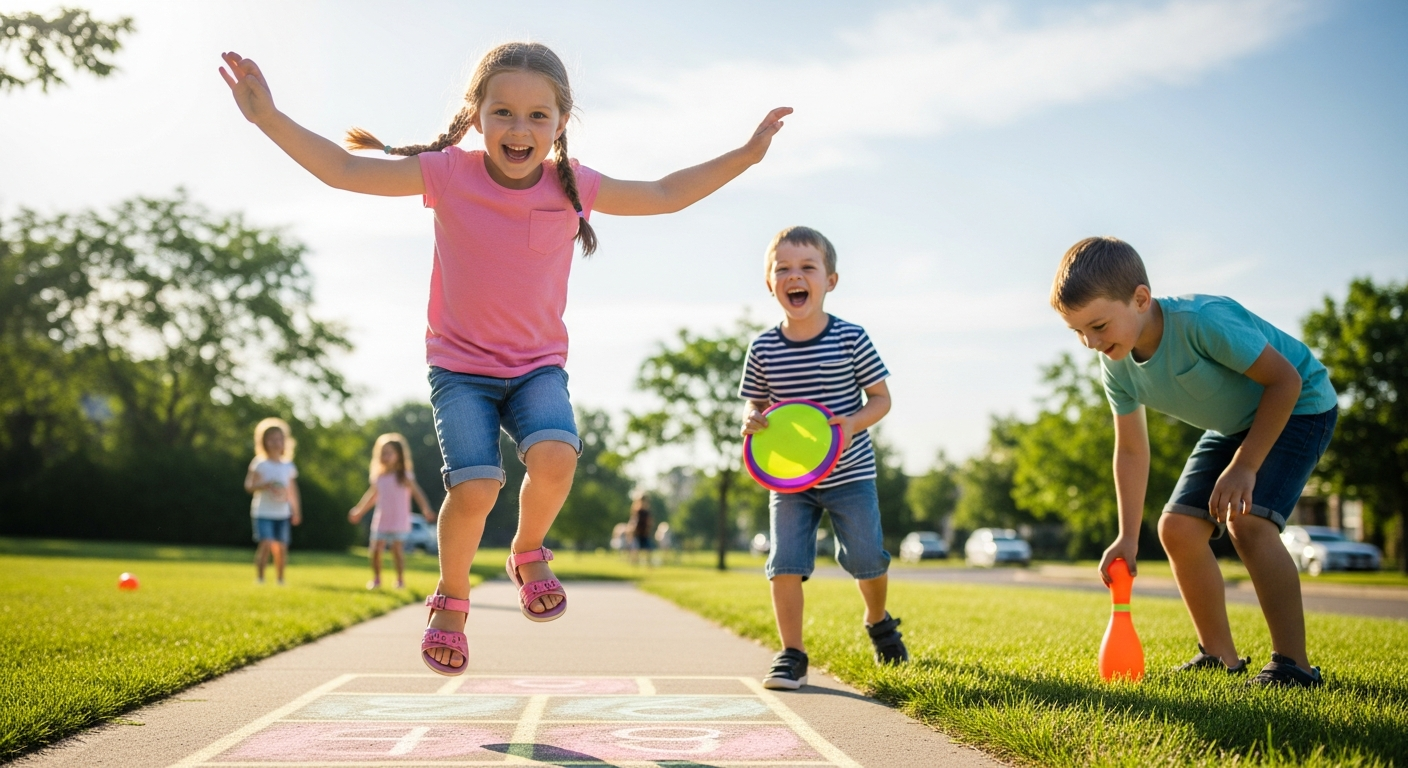
Table of Contents
- Introduction
- The Unrivaled Power of Outdoor Play for Development
- Classic Outdoor Games: Timeless Fun & Skill Building
- Creative & Structured Games for Enhanced Learning
- Integrating Speech Blubs into Outdoor Play
- Why Choose Speech Blubs for Your Family's Communication Journey?
- Conclusion
- FAQ
Introduction
Do you remember those long, sun-drenched days of childhood, where the only limit to play was the fading light or a parent’s call for dinner? The kind of days filled with laughter, scraped knees, and the pure, unadulterated thrill of outdoor games? In an age where screens often capture our children's attention, the magic of outside play remains as vital as ever. Beyond the sheer joy, outdoor games are powerful catalysts for holistic development, nurturing everything from physical coordination and social skills to crucial communication abilities.
This post will journey through a treasure trove of classic and creative outdoor activities, highlighting not just the fun, but also the incredible developmental benefits each game offers. We’ll explore how these seemingly simple pastimes can build confidence, foster teamwork, and significantly enhance your child’s speech and language skills. Prepare to rediscover the simple pleasures of the outdoors and learn how to transform everyday moments into powerful learning opportunities for your child, perhaps even with a little help from innovative tools like Speech Blubs.

The Unrivaled Power of Outdoor Play for Development
Outdoor play is far more than just "running around"; it's a multi-sensory gymnasium for growing minds and bodies. It offers a unique environment where children can explore, experiment, and develop in ways that indoor settings simply cannot replicate.
Physical Prowess and Sensory Exploration
When children play outside, they engage their entire physical being. Running, jumping, climbing, and throwing are all critical for developing gross motor skills, balance, and coordination. These activities build strong muscles and improve cardiovascular health. The uneven terrain, varying textures, and open spaces provide rich sensory input—the feel of grass between their toes, the smell of damp earth after rain, the sound of birdsong, the sight of a leaf fluttering in the wind. This sensory exploration is fundamental for brain development, helping children process and understand their environment.
Cognitive Growth and Problem-Solving
Outdoor environments naturally encourage problem-solving. How do I get over that log? How can I make this stick float down the stream? What's the best strategy to tag someone without being caught? These challenges spark creativity, critical thinking, and planning skills. Whether they're building a fort, navigating an impromptu obstacle course, or strategizing in a game of Capture the Flag, children are constantly honing their cognitive abilities. They learn about cause and effect, spatial reasoning, and adaptability in real-time, dynamic situations.
Social-Emotional Intelligence and Confidence
Outdoor games are a masterclass in social interaction. Children learn to negotiate rules, take turns, resolve conflicts, and understand different perspectives. They practice empathy as they encourage a friend, or learn resilience when they don't win. The shared experience of play fosters friendships, builds teamwork, and teaches the value of cooperation. Successfully mastering a physical challenge or contributing to a team's victory boosts self-esteem and confidence, empowering children to take on new challenges and "speak their minds and hearts" with greater assurance. This is a core value we embrace at Speech Blubs, believing every child deserves the confidence to express themselves fully.

Crucial Communication and Language Development
Perhaps one of the most significant, yet often overlooked, benefits of outdoor play is its profound impact on speech and language development. Every game, every interaction, presents opportunities for communication:
- Following Instructions: "Run to the tree!" "Hide behind the big bush!"
- Expressive Language: Shouting "You're IT!" or calling out "Ready or not, here I come!"
- Descriptive Language: Describing hiding spots ("It's tall and green!") or objects found on a scavenger hunt ("I found a bumpy rock!").
- Negotiation and Rule-Making: Discussing how to play a game or resolve a disagreement ("No, that's not fair! We said the line was here.").
- Turn-Taking and Conversation: Engaging in back-and-forth dialogue during play.
- Prepositional Concepts: Using words like "over," "under," "through," "behind," and "in front of."
These natural communication opportunities are invaluable. For children who may need extra support, these playful contexts can make learning new words and phrases feel effortless and fun. To get a better understanding of your child's communication needs and a personalized plan for their next steps, consider taking our quick 3-minute preliminary screener. It involves 9 simple questions and provides an assessment to guide you.
Classic Outdoor Games: Timeless Fun & Skill Building
Let’s dive into some beloved classics that have stood the test of time, and explore how they contribute to your child's development.
Tag Variations
Tag is the quintessential game of chase, offering a fantastic cardio workout and honing agility. But its variations add layers of strategic thinking and social interaction:
- Freeze Tag: When tagged, a player must "freeze" in place until unfrozen by a teammate. This teaches teamwork and quick decision-making.
- Blob Tag: Tagged players join hands with the "it" person, forming a growing "blob" that works together to tag others. This emphasizes cooperation and spatial awareness.
- Shadow Tag: Players are tagged by having their shadow stepped on. Best played on a sunny day, it adds a unique challenge to agility and observation.
- Everyone-is-it Tag: A chaotic and fun variation where everyone is both a chaser and a runner. Players lie down when tagged, getting back in if the person who tagged them also gets tagged. This teaches resilience and complex tracking.
These games are excellent for practicing following instructions and responding to cues, skills that directly transfer to language comprehension. For instance, children can practice saying "You're frozen!" or "I'm free!" strengthening expressive communication in a playful context.
Hide and Seek & Its Twists
A global favorite, Hide and Seek develops spatial awareness, strategic thinking, and patience.
- Classic Hide and Seek: One seeker counts while others hide. This game helps children understand concepts like "in," "out," "behind," and "under," as well as practicing counting aloud.
- Sardines: A reverse Hide and Seek. One person hides, and as others find them, they hide with them until everyone is crammed into one spot like sardines. This builds close social interaction and silent communication.
- Kick the Can: A dynamic mix of tag and Hide and Seek. A "can" (or a stick, ball, etc.) acts as a central base. If a hider gets to the can and kicks it before being tagged by the seeker, everyone in "jail" is freed! This game demands strategy, quick reflexes, and vocal communication like shouting "Kick the can, save all!"
Hopscotch
Drawing a hopscotch grid with chalk (or sticks in the dirt) is a simple invitation to play. This game is fantastic for:
- Balance and Coordination: Hopping on one or two feet.
- Number Recognition and Sequencing: Calling out numbers as they hop through the squares.
- Following Rules: Understanding the specific pattern of jumps and marker tosses.
- Patience and Turn-Taking: Waiting for their turn and refining their technique.
For younger children, simply hopping and counting the squares is enough fun and a great way to reinforce early math and language skills.
Simon Says / Mother May I?
These games are phenomenal for building listening comprehension and expressive language.
- Simon Says: One player (Simon) gives commands, but only those preceded by "Simon Says" should be followed. It’s a powerful tool for developing selective listening and impulse control. If Simon says, "Simon says touch your nose," everyone does it. If Simon just says, "Touch your nose," those who do are out!
- Mother May I?: A child asks "Mother, may I take three giant steps forward?" and Mother replies "Yes, you may" or "No, you may not, but you may take two baby steps." This game is superb for practicing asking polite questions, following multi-step commands, and understanding directional language.
These games naturally encourage children to listen carefully, process instructions, and respond verbally. For parents with a child working on following directions or expanding their vocabulary, these are perfect ways to practice in a fun, natural setting. Our app, Speech Blubs, uses video modeling to help children learn new words and phrases by imitating their peers, much like how they might imitate "Simon" or "Mother" in these games.
Red Light, Green Light
A high-energy game that teaches impulse control and quick reactions.
- One player is the "stop light," standing with their back to the others. They yell "Green Light!" and players run forward. When they yell "Red Light!" and turn around, all players must freeze. Anyone caught moving is sent back to the start.
- This game hones a child's ability to stop and start on verbal cues, an important pre-linguistic skill for modulating speech and listening.
What's the Time Mr. Wolf?
This simple game builds anticipation, encourages counting, and develops listening skills.
- One player is Mr. Wolf, standing with their back to the others. The other players ask, "What's the time, Mr. Wolf?" Mr. Wolf replies with a time (e.g., "Two o'clock!"), and the players take that many steps forward.
- Eventually, Mr. Wolf replies, "It's dinner time!" and chases the players back to the starting line. This game offers practice with numbers, listening for specific phrases, and understanding sequencing.
Duck, Duck, Goose
A classic circle game perfect for younger children, fostering social interaction and auditory discrimination.
- Children sit in a circle. One player walks around tapping heads, saying "Duck, duck, duck..." until they choose someone and say "Goose!"
- The "Goose" then chases the first player around the circle. This teaches turn-taking, listening for specific words, and responding quickly. It's a joyful way to encourage social engagement and playful communication.
Creative & Structured Games for Enhanced Learning
Beyond the classics, there's a world of creative outdoor games that can be adapted to any setting and provide rich learning opportunities.
Obstacle Courses
Transform your backyard or park into an adventure zone!
- Use household items like pool noodles (crawl through arches, jump over lines), blankets (fabric tunnels), stools (agility tests), or even natural elements like logs and rocks.
- Benefits: Excellent for planning, problem-solving, gross motor skills, and following sequential instructions.
- Language Focus: Encourage children to describe their actions ("I'm crawling under the blanket!", "I'm jumping over the stick!"), reinforcing prepositions and action verbs. For a parent whose child is a 'late talker' and loves to move, setting up an obstacle course and narrating their actions can be a motivating way to practice words like "up," "down," "over," and "through," much like our app encourages specific word usage in engaging video-modeled activities.
Nature Scavenger Hunts
Connect children with their environment in a meaningful way.
- Create a list of things to find: "something green," "a smooth rock," "a feather," "a heart-shaped leaf," "something that smells sweet."
- Benefits: Boosts observation skills, vocabulary (descriptive adjectives, nouns), sensory awareness, and classification.
- Language Focus: Children practice asking questions ("Is this green enough?"), describing their finds, and following multi-step directions. This active, discovery-based learning aligns perfectly with our mission at Speech Blubs to provide an immediate, effective, and joyful solution for children's speech support. It's a "screen-free alternative to passive viewing" that fosters exploration and communication.
Water-Based Outdoor Games
On a hot day, water games are a refreshing way to learn and play.
- Water Balloon Toss: Stand in a circle and take a step back after each successful toss. The last pair to keep their balloon intact wins.
- Slip 'n Slide: Pure, exhilarating fun!
- Benefits: Sensory stimulation, gross motor skills, cause and effect (popping balloons), and lots of joyful expressive sounds and laughter.
- Language Focus: Anticipatory language ("Ready, set, go!"), describing sensations ("It's cold!", "It's splashy!"), and expressing excitement.
Giant Tic-Tac-Toe
Take a classic paper-and-pencil game and supersize it with chalk.
- Draw a large tic-tac-toe grid on a sidewalk or patio. Use beanbags, stones, or even leaves as markers for X's and O's.
- Benefits: Develops strategic thinking, turn-taking, and spatial reasoning.
- Language Focus: Children practice verbalizing their moves ("X in the middle square!"), negotiating who goes first, and understanding concepts like "row," "column," and "diagonal."
Spud
A fun, active ball game that combines running and aiming.
- One child throws a ball in the air, calling out another child's name. Everyone else scatters. The named child catches the ball and yells "Spud!" Everyone freezes.
- The child with the ball takes four steps towards the nearest player and tries to tag them by throwing the ball below the waist. If they get hit, they get an "S." The game continues until someone spells "SPUD."
- Benefits: Number recognition (for steps), aiming skills, quick reactions, and learning to follow complex rules.
- Language Focus: Calling out names, yelling "Spud!", and understanding sequential instructions.
Capture the Flag
For larger groups and older children, this strategic team game is a fantastic workout.
- Divide into two teams, each with a "flag" (a bandana, T-shirt). The goal is to capture the opposing team's flag from their territory without getting tagged.
- Benefits: Teamwork, strategy, negotiation, physical endurance, and leadership.
- Language Focus: Extensive communication is needed—planning strategy, calling out warnings, celebrating victories, and negotiating rules.
Musical Statues / Freeze Dance
All you need is music and an open space.
- Play music and everyone dances. When the music stops, everyone freezes like a statue. Anyone caught moving is out.
- Benefits: Listening skills, body awareness, creative movement, and impulse control.
- Language Focus: Understanding cues (music starts/stops), describing movements, and expressing creativity through dance.
Integrating Speech Blubs into Outdoor Play
While outdoor play offers invaluable screen-free time, technology, when used mindfully, can be a powerful complement to your child's communication journey. At Speech Blubs, we believe in "smart screen time" that actively engages children, rather than just passively entertains them.
Our app was born from a deeply personal mission: our founders all grew up with speech problems and created the tool they wished they had. We are committed to empowering children to "speak their minds and hearts" by providing an immediate, effective, and joyful solution for the 1 in 4 children who need speech support. We blend scientific principles with play, using a unique "video modeling" methodology where children learn by watching and imitating their peers. This direct, relatable approach helps children build confidence and develop complex communication skills.
Here’s how Speech Blubs can seamlessly integrate with and enhance your outdoor play experiences:
- Pre-Play Vocabulary Boost: Before a nature scavenger hunt, spend a few minutes in Speech Blubs exploring categories like "Animals," "Nature," or "Colors." Your child can learn and practice words like "tree," "flower," "bird," "red," "blue," "green" through engaging video models. Then, take these words outside! "Can you find a green leaf like the one in Speech Blubs?"
- Action Word Practice for Obstacle Courses: Use Speech Blubs' sections focusing on verbs or prepositions. Practice "jump," "climb," "over," "under." Then, as you create an outdoor obstacle course, encourage your child to use these words as they navigate it: "I will jump!" "I'm going under the blanket!" This hands-on application solidifies language learning.
- Social Scripting for Group Games: If your child struggles with initiating interaction in games like Duck, Duck, Goose or Tag, Speech Blubs can help. Practice simple phrases like "My turn!" or "You're it!" within the app's interactive context. Then, when playing outside, gently prompt them to use these phrases. This reduces frustration and builds confidence in social settings.
- Storytelling and Imagination: After an imaginative outdoor play session—perhaps pretending to be pirates on a treasure hunt—use Speech Blubs to encourage storytelling. Find sections with characters or actions and prompt your child to recount their adventure using newly learned words and phrases. This reinforces narrative skills.
Remember, Speech Blubs is a powerful tool for family connection, designed for active adult co-play and support. It's not about replacing outdoor fun, but enriching it, providing a foundation for communication that can then be practiced and perfected in the vibrant, open-ended world outside. We're proud to be backed by science, ranking in the top tier of speech apps worldwide for our effectiveness.
Why Choose Speech Blubs for Your Family's Communication Journey?
We understand that as a parent, you want the best for your child, and choosing the right resources can be overwhelming. At Speech Blubs, we’ve made it our mission to offer a comprehensive, engaging, and scientifically sound solution for speech and language development. Our unique approach of video modeling, coupled with a vast library of activities, makes learning fun and effective.
Don't just take our word for it; see what other parents are saying about their children's incredible progress and confidence thanks to Speech Blubs.
We believe in transparency and providing exceptional value to our families. Here’s a breakdown of our pricing and what you get:
- Monthly Plan: For just $14.99 per month, you get access to our core features.
- Yearly Plan: The Best Value! This is our most popular and recommended option. For only $59.99 per year, it breaks down to an incredible $4.99/month – allowing you to save 66% compared to the monthly plan!
The Yearly Plan isn't just cheaper; it unlocks a full suite of premium benefits designed to give your child the ultimate learning experience:
- A 7-day free trial: Experience the full power of Speech Blubs before committing.
- The extra Reading Blubs app: Enhance literacy skills alongside speech development.
- Early access to new updates: Be the first to try our latest features.
- 24-hour support response time: Get prompt assistance whenever you need it.
The Monthly Plan, on the other hand, does not include these exclusive benefits, making the Yearly Plan the clear choice for comprehensive support and savings.
Conclusion
The great outdoors offers an unparalleled classroom for children, nurturing their bodies, minds, and spirits through the simple joy of play. From classic games like Tag and Hide and Seek to creative adventures like obstacle courses and nature scavenger hunts, these activities build essential physical, cognitive, social-emotional, and, crucially, communication skills. Every shout, every giggle, every negotiation during outdoor play is a step forward in your child’s development, helping them grow into confident communicators.
And when you're looking for an extra boost in their speech and language journey, remember that tools like Speech Blubs are here to support you. Our app offers "smart screen time" that complements outdoor play, providing targeted, engaging activities that empower children to "speak their minds and hearts" with clarity and confidence.
Ready to embark on this exciting journey of outdoor fun and communication growth? Choose our best-value Yearly plan to unlock all features, including the 7-day free trial and the Reading Blubs app! Download Speech Blubs on the Apple App Store or Google Play Store to get started, or create your account and begin your free trial today! Your child's voice is waiting to be heard.
FAQ
Q1: What age group are these outdoor games best suited for?
A1: Many of these games are adaptable for a wide range of ages. Simple games like Duck, Duck, Goose and basic Tag are great for toddlers and preschoolers (ages 2-5). Classics like Hide and Seek, Hopscotch, and Red Light, Green Light engage elementary school children (ages 5-10). More complex, strategic games like Capture the Flag or elaborate obstacle courses are ideal for older kids and tweens (ages 8+). The beauty of outdoor play is that rules can always be simplified or made more challenging to suit the group.
Q2: How can I encourage my child to play outside if they prefer screens?
A2: Start by making outdoor time a routine and modeling enthusiasm yourself. Offer choices of activities from this list, letting them pick what sounds fun. Begin with shorter sessions and gradually increase duration. Sometimes, inviting a friend over specifically for outdoor play can be a great motivator. Consider integrating their interests; if they love superheroes, create a "superhero training course" outside. Remember, apps like Speech Blubs can also be a bridge, helping them learn communication skills that then empower them to engage more confidently in outdoor social play.
Q3: What if I don't have a big backyard or a nearby park?
A3: You don't need a huge space to have fun! Many games can be adapted. Sidewalk chalk can transform a small patch of pavement into a hopscotch court or giant tic-tac-toe. Even a small balcony or patio can host activities like Musical Statues or a mini obstacle course with household items. Nature scavenger hunts can happen on a short walk around the block, looking for specific colors, shapes, or sounds. The key is creativity and embracing the space you have.
Q4: How does Speech Blubs specifically help with communication skills developed through outdoor play?
A4: Speech Blubs acts as a powerful complement by providing structured practice for the foundational skills used in outdoor play. For example, our app helps children learn new words (nouns, verbs, adjectives), practice following instructions, imitate sounds and phrases, and understand social communication through our unique video modeling technology. These skills then directly transfer to outdoor settings, enabling your child to express themselves more clearly during games, follow game rules, describe their surroundings during a scavenger hunt, and interact more confidently with peers. It supports their journey to "speak their minds and hearts" in all aspects of life.
About the author