
Energizing Fun PE Activities for Kids: Move, Grow, Connect
 By Speech Blubs Team•Jan 13, 2026•18 min.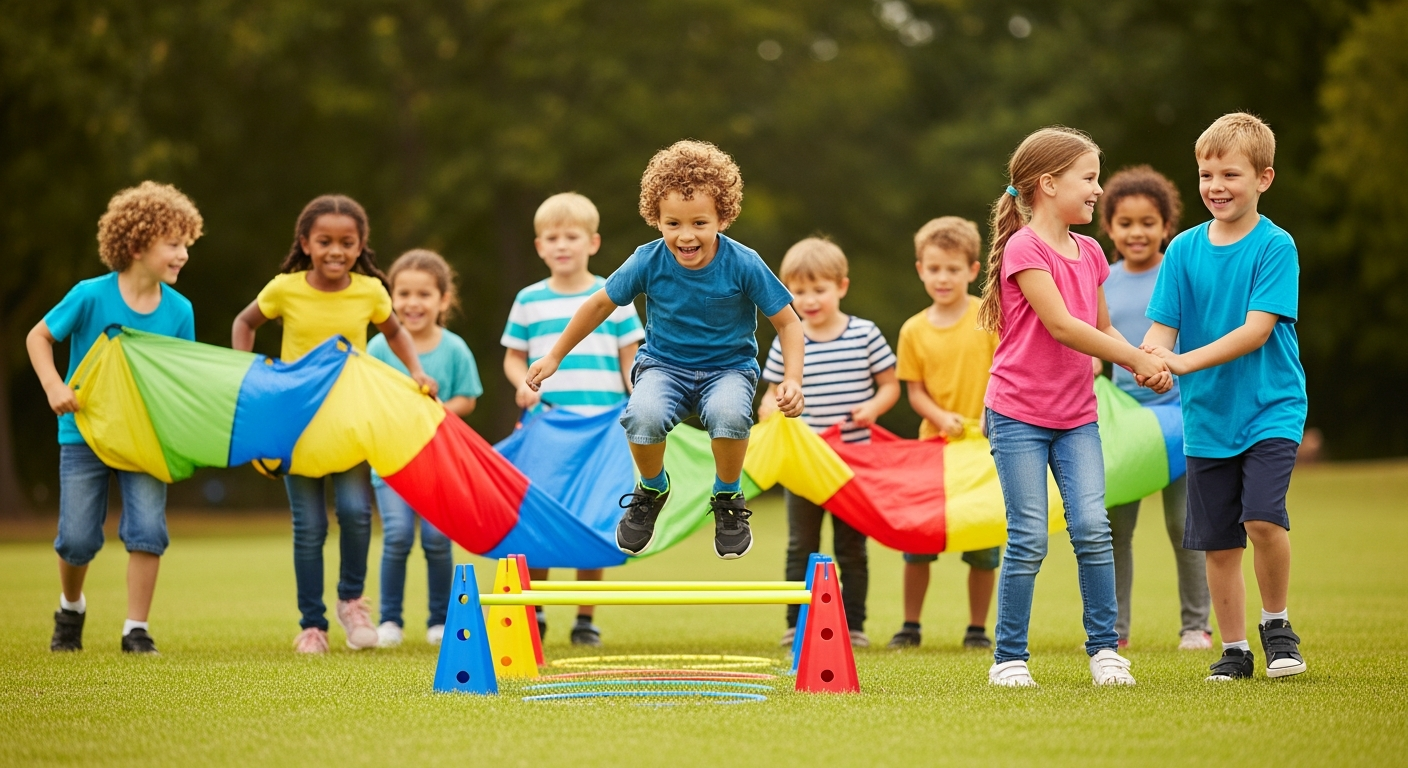
Table of Contents
- Introduction
- The Power of Play: Why Fun PE Activities Matter
- Top Fun PE Activities for Kids: Unleashing Joy and Learning
- Nurturing Holistic Development: The Speech Blubs Approach
- Making Speech Blubs Part of Your Child's Journey
- Conclusion
- Frequently Asked Questions (FAQ)
Introduction
Have you ever noticed how a child’s eyes light up when they're running, jumping, or playing a game with their friends? That unrestrained joy isn't just about having fun; it's a profound declaration of their innate need to move, explore, and learn through physical interaction. In a world increasingly dominated by screens and sedentary pursuits, the importance of physical education (PE) activities for children's holistic development has never been more critical. It’s not merely about staying fit; it’s about nurturing the entire child—their body, mind, and spirit.
This post will delve into a vibrant world of fun PE activities for kids, showcasing how movement contributes to far more than just muscle development. We'll explore how active play enhances cognitive functions, builds crucial social-emotional skills, and even lays groundwork for better communication. We believe that by integrating diverse and engaging physical activities into daily routines, parents and caregivers can foster a lifelong love for movement, build confidence, and create unforgettable family learning moments. We’ll also share how tools like Speech Blubs complement these active experiences by empowering children to "speak their minds and hearts" through a unique blend of scientific principles and playful learning.

The Power of Play: Why Fun PE Activities Matter
Physical activity for children goes far beyond the playground; it’s a cornerstone of their developmental journey. Each jump, run, and throw isn't just burning energy; it's actively building a robust foundation for learning and thriving. These activities are powerful engines for holistic growth, touching every aspect of a child's being.
Gross Motor Skills and Coordination
At the most fundamental level, PE activities hone gross motor skills—the movements involving large muscles of the arms, legs, and torso. Running, jumping, hopping, skipping, and climbing are essential for developing balance, agility, and overall coordination. For instance, a game of "Crab Soccer" requires children to move their bodies in an unconventional way, strengthening their core and limbs while challenging their coordination. "Wheelbarrow Races" build upper body strength and teach children to work in tandem. These foundational physical skills are crucial for everything from handwriting to sports participation, impacting their confidence in both academic and social settings.
Fine Motor Skills and Dexterity
While gross motor skills take center stage in PE, many activities subtly enhance fine motor skills and dexterity. Think about a child throwing a beanbag into a target during "Throw Archery" or precisely placing a cone in "Volcanoes and Ice Cream Cones." These actions require hand-eye coordination, precision, and control over smaller muscles. The ability to manipulate objects and execute controlled movements is vital for tasks like writing, drawing, and even articulate speech, as it involves the coordination of intricate muscle groups in the mouth and tongue.
Cognitive Benefits: A Brain-Body Connection
The link between physical activity and cognitive development is profound. When children move, their brains become more active, enhancing blood flow and stimulating neural connections. PE activities are rich in opportunities for:
- Problem-Solving and Strategy: Games like "Tic-Tac-Toe Relay" or "Connect 4 Relay" demand quick thinking, strategic planning, and adapting to changing situations. Children must decide the best move, anticipate an opponent's action, and cooperate with teammates.
- Spatial Awareness: Navigating an obstacle course, understanding positions in "Monster Ball," or judging distances in throwing games all build spatial awareness—the understanding of where one's body is in space and relation to other objects. This skill is critical for reading comprehension, math, and even understanding conversational cues.
- Following Instructions and Memory: Most PE games require children to listen carefully, remember rules, and follow multi-step instructions. "Head, Shoulders, Knees, and Cones" is a fantastic example of a game that sharpens listening skills and reaction time.
- Focus and Attention: Engaging physical tasks can improve a child's ability to concentrate and sustain attention, which directly benefits classroom learning and their capacity to engage in focused activities, including language practice.
Social-Emotional Learning: Growing Together
Perhaps one of the most significant benefits of fun PE activities is the development of vital social-emotional skills. Group games are miniature societies where children learn:

- Teamwork and Cooperation: Activities like "Parachute Tug-of-War" or "Fleas Off the Parachute" inherently teach children to work together towards a common goal, to support each other, and to understand collective effort.
- Communication: Whether it’s calling out to a teammate, negotiating rules, or expressing frustration in a healthy way, PE environments are fertile ground for practicing communication. Children learn to articulate their needs, listen to others, and use language to collaborate.
- Emotional Regulation: The ups and downs of winning and losing, the frustration of a missed catch, or the excitement of a successful play all provide opportunities for children to learn to manage their emotions, develop resilience, and practice sportsmanship.
- Confidence and Self-Esteem: Mastering a new physical skill, contributing to a team’s success, or simply enjoying active play can significantly boost a child's self-confidence. This newfound belief in their abilities can then ripple into other areas of their life, including their willingness to try new communication skills.
For a child who might be hesitant to join in group games due to communication struggles, practicing expressive language can build the confidence needed to speak up and participate more fully. At Speech Blubs, we understand that nurturing communication goes hand-in-hand with overall development, empowering children to "speak their minds and hearts." You can learn more about our mission and approach on our homepage.
Top Fun PE Activities for Kids: Unleashing Joy and Learning
The beauty of PE activities is their versatility. With minimal equipment and a dash of creativity, you can transform any space into an arena for active learning and fun. Here are some of our favorite categories of activities, perfect for kids of all ages and abilities.
Classic Tag Games with a Twist
Tag games are a timeless favorite, offering simple rules and endless energy release. By adding creative twists, you can enhance their developmental impact.
- Blob Tag / Chain Tag: Start with one or two "its" (the blob). When they tag someone, that person joins the blob, linking arms to create a growing chain. This encourages cooperation among the "blob" members and strategic running for those trying to escape.
- Bridge Tag: This variation starts like regular tag, but when a player is tagged, they must freeze in a "bridge" position (hands and feet on the ground, hips raised). They can only be freed when another player crawls underneath their bridge. This promotes helping behavior and spatial reasoning.
- Freeze Tag / Monster Tag: In Freeze Tag, a tagged player must freeze in place until unfrozen by another player. Monster Tag might involve specific movements for the "monster" or "no bones" rules, adding an element of imaginative play and quick reactions.
- Animal Races / Star Wars Tag: Call out different animals, and children must race across the area moving like that animal (e.g., crab walk, bunny hop, bear crawl). "Star Wars Tag" can use pool noodles as lightsabers, encouraging imaginative duels and dodging. These activities are fantastic for mimicking movements, which directly ties into how children learn to mimic sounds and words. Just as children mimic animal movements in "Animal Races," they learn to form sounds and words by observing and imitating peers in Speech Blubs' video modeling activities. Our research backs the effectiveness of this approach.
Dynamic Relay Races and Obstacle Courses
Relay races and obstacle courses combine speed, strategy, and teamwork, making them incredibly engaging.
- Tic-Tac-Toe Relay / Connect 4 Relay: Set up a grid of Hula-Hoops or marked squares. Teams race to place beanbags or colored scarves, trying to get three or four in a row. This sharpens strategic thinking and reinforces teamwork under pressure.
- Rob the Nest: Divide children into teams, each with a "nest" (Hula-Hoop or designated area). Place "eggs" (balls, beanbags) in a central zone. Teams race to retrieve eggs and bring them back to their nest. Add obstacles for an extra challenge. This game develops agility, quick decision-making, and understanding personal space.
- Obstacle Course Adventure (Indoor PE Fun): Turn your living room or backyard into an adventure! Use pillows to hop over, chairs to crawl under, and tape lines to balance on. For a child who struggles with following multi-step instructions, designing and completing an obstacle course can be a great way to practice. This foundational skill of sequential processing is also crucial for language development, which Speech Blubs enhances through structured activities. If you're wondering if your child could benefit from speech support, take our quick 3-minute preliminary screener to get a simple assessment and a free 7-day trial.
Creative Movement & Imaginative Play
These activities encourage self-expression, rhythm, and body awareness, often tapping into a child's natural imagination.
- Crab Soccer / Crab Kickball: Play a game of soccer or kickball while only moving in a crab walk position. This builds core strength, challenges coordination, and brings a lot of laughs.
- Balloon Volleyball / Continuity Ball: Use a balloon and a piece of string (or a couch) as a net for indoor volleyball. For "Continuity Ball," the goal is simply to keep one or more beach balls from touching the ground, fostering cooperation and quick reactions. These games are excellent for hand-eye coordination and collaborative play without intense competition.
- Dance Party Challenge / Freeze Dance: Put on upbeat music and let kids dance freely. For "Freeze Dance," pause the music periodically, and everyone must freeze in place. This improves listening skills, rhythm, and self-expression. To make it even more engaging, use an "exercise dice" with different dance moves on each side.
- Movement Dice / Jenga Fitness: Create a large die with different movements (e.g., "10 jumping jacks," "5 frog jumps"). Roll the die, and everyone performs the action. "Jenga Fitness" combines the classic block-stacking game with physical challenges; each colored block corresponds to a different exercise. These activities are fantastic for incorporating varied exercises and decision-making. These activities foster creativity and expression, much like Speech Blubs empowers children to "speak their minds and hearts" by providing a joyful platform for communication.
Parachute Games and Group Dynamics
Parachute games are incredibly effective for teaching cooperation, timing, and following instructions in a fun, large-group setting.
- Parachute Tug-of-War / Fleas Off the Parachute: Divide children into two teams around a large parachute. In "Tug-of-War," teams pull the parachute to try and make the other side cross a line. In "Fleas Off the Parachute," one team tries to keep lightweight balls ("fleas") on the parachute while the other team tries to shake them off. Both require significant teamwork and coordinated effort.
- Parachute Change / Parachute Volleyball: In "Parachute Change," call out a category (e.g., "everyone wearing blue") and those children must run under the parachute to switch places with someone else before the parachute falls. "Parachute Volleyball" involves trying to launch a beach ball over a makeshift net using the parachute, requiring precise timing and collective power. These activities are excellent for developing motor planning, spatial awareness, and strong communication skills.
Ball Games and Target Practice
Ball games are fundamental to PE, developing critical skills in throwing, catching, and strategic play.
- Spider Ball / Monster Ball / Crazy Ball: These are often variations of dodgeball or kickball with imaginative twists. "Spider Ball" might have players who are hit become "spiders" who can also tag others. "Monster Ball" could involve a large exercise ball that teams try to move across a boundary by hitting it with smaller balls. These games hone throwing, catching, dodging, and strategic thinking.
- Striker Ball / Racket Whack-It: "Striker Ball" is an engaging game that works on reaction time and strategic planning with minimal setup. "Racket Whack-It" involves students with rackets trying to hit or dodge balls launched by a teacher or other students. Both focus on hand-eye coordination and quick reflexes.
- Throw Archery / Bounce into Buckets: Set up jump ropes at various distances, assigning points to each zone. Children throw beanbags, trying to land them past the ropes. "Bounce into Buckets" involves bouncing balls into buckets from increasing distances. These activities build aiming skills, precision, and focus.
Indoor PE Fun: Keeping Active Rain or Shine
Don't let bad weather stop the fun! Many engaging PE activities can be adapted for indoor spaces, ensuring children stay active year-round.
- Indoor Scavenger Hunt Workout: Hide clues around the house, each leading to the next and requiring a physical challenge (e.g., "Do 10 jumping jacks before finding the next clue"). This combines active learning with problem-solving. If a child is a "late talker" and struggles with active vocabulary or descriptive words, a scavenger hunt where they describe what they're looking for or what they found can be an excellent language-building exercise. Paired with Speech Blubs' themed categories, like "What Am I Doing?", this creates a rich vocabulary environment that encourages them to download Speech Blubs on the App Store or Google Play today!
- Head, Shoulders, Knees, and Cones: As described earlier, this fast-paced game is perfect for indoors, requiring quick reflexes and sharp listening.
- Wheelbarrow Race: An oldie but a goodie, this classic can be played in a hallway or open room, building strength and coordination without much equipment.
- Volcanoes and Ice Cream Cones: Spread cones (some right-side up, some upside down) around the room. Divide kids into "Volcanoes" and "Ice Cream" teams, racing to flip cones to their designated orientation. This is a simple yet energetic game for any space.
Nurturing Holistic Development: The Speech Blubs Approach
At Speech Blubs, we fundamentally understand that a child's development is beautifully interconnected. Just as engaging in fun PE activities builds physical prowess, cognitive agility, and social grace, nurturing clear and confident communication is paramount to empowering children to "speak their minds and hearts." Our company was born from the personal experiences of our founders, who all grew up with speech problems and created the tool they wished they had—a testament to our deep commitment to every child's potential.
We recognize that for the 1 in 4 children who need speech support, finding an immediate, effective, and joyful solution can be life-changing. This is why we've meticulously blended scientific principles with play, creating one-of-a-kind "smart screen time" experiences. Unlike passive viewing like cartoons, Speech Blubs provides an active, engaging alternative that fosters development through our unique video modeling methodology.
Imagine a child learning to talk by watching and imitating their peers. This is the core of our approach, leveraging the power of mirror neurons in the brain, which fire not only when we perform an action but also when we observe someone else performing it. This natural imitative process, so evident in children learning physical movements, is harnessed by Speech Blubs to teach complex communication skills. Our app turns screen time into a powerful tool for family connection, where children learn alongside their parents, making communication a shared, joyful adventure.
While we never make unsubstantiated claims or promise guaranteed outcomes like "your child will be giving public speeches in a month," we are committed to providing a robust process that yields significant benefits: fostering a love for communication, building confidence, reducing frustration, developing key foundational speech and language skills, and creating those invaluable family learning moments. Speech Blubs is designed to be a powerful supplement to a child's overall development plan and, when applicable, professional therapy, always thriving with adult co-play and support. We are proud of our high MARS scale rating and the positive impact we've had on countless families. See what other parents are saying about their child's success with Speech Blubs.
Making Speech Blubs Part of Your Child's Journey
Investing in your child's communication journey is one of the most impactful decisions you can make. We've designed Speech Blubs to be an accessible, high-quality resource for families, offering flexible plans to suit your needs.
Our Monthly Plan is available at $14.99 per month, offering a convenient way to access our engaging content.
However, for the best value and to unlock the full potential of our platform, we highly recommend our Yearly Plan at just $59.99 per year. This breaks down to an incredible value of just $4.99 per month, allowing you to save 66% compared to the monthly option!
The Yearly Plan isn't just about significant savings; it's about a complete, enhanced experience that includes exclusive, high-value features:
- A 7-day free trial: Experience the full Speech Blubs app before making a commitment.
- The extra Reading Blubs app: Double the fun and learning with our companion reading app.
- Early access to new updates: Be among the first to explore our latest features and content.
- 24-hour support response time: Get prompt assistance whenever you need it.
The Monthly Plan, while flexible, does not include these fantastic benefits.
We are committed to providing an immediate, effective, and joyful solution for the 1 in 4 children who need speech support. Empowering your child's voice is a journey, and we want to ensure you have all the tools and support you need every step of the way. Start your 7-day free trial today by creating your account and choosing the Yearly plan to get all these incredible features!
Conclusion
The vibrant world of fun PE activities for kids offers an incredible landscape for growth, far beyond just physical fitness. From developing gross and fine motor skills to enhancing cognitive abilities like problem-solving and spatial awareness, and fostering crucial social-emotional intelligence, active play is indispensable for a child's holistic development. These moments of joyous movement build confidence, reduce frustration, and create lasting memories for the entire family.
Just as physical activity strengthens the body and mind, nurturing clear and confident communication empowers a child's voice. At Speech Blubs, we are dedicated to complementing these active experiences by providing a unique "smart screen time" solution that supports speech and language development through engaging, scientifically-backed methods like video modeling. We aim to help every child speak their minds and hearts, connecting physical vitality with communicative prowess.
Ready to empower your child's communication journey and unlock a world of active, joyful learning? Dive into the enriching experiences offered by Speech Blubs. Take the first step towards a brighter, more confident future for your child. Download Speech Blubs on the App Store or Google Play today! Remember to select the Yearly plan to access your 7-day free trial and unlock a full suite of exclusive features, including the extra Reading Blubs app. Give your child the gift of confident communication and joyful movement – they deserve nothing less.
Frequently Asked Questions (FAQ)
Q1: Why is physical activity so crucial for young children?
Physical activity is vital for young children because it supports holistic development, not just physical health. It builds gross and fine motor skills, enhances balance and coordination, and strengthens muscles and bones. Beyond the physical, it boosts cognitive functions like problem-solving, spatial awareness, and memory. Crucially, it fosters social-emotional skills such as teamwork, communication, emotional regulation, and self-confidence, all of which are essential for a child's overall well-being and success in life.
Q2: How can I make PE activities accessible for children with varying abilities?
Making PE activities accessible involves flexibility and creativity. Adapt rules, modify equipment (e.g., use lighter balls, larger targets), and provide plenty of encouragement. Focus on participation and effort rather than perfect execution. For instance, in a relay race, a child with mobility challenges could complete a modified "station" activity or act as the "timer" or "cheerleader." Incorporating imaginative play can also help, as children often forget their perceived limitations when immersed in a fantasy game. Emphasize cooperation over competition, ensuring every child feels valued and included.
Q3: Can physical activities support my child's speech development?
Absolutely! Physical activities indirectly support speech development in several ways. They enhance overall body awareness and motor control, which are foundational for the intricate muscle movements involved in speech production. Games that require following multi-step instructions, listening to cues, and communicating with peers directly strengthen cognitive and social skills vital for language acquisition. For instance, "Animal Races" encourage mimicking, a key learning mechanism for both physical actions and verbal sounds. Paired with targeted tools like Speech Blubs, which uses video modeling to encourage imitation of sounds and words, physical play creates a rich, multi-sensory environment for comprehensive development.
Q4: What makes Speech Blubs a valuable tool for my child's development, and how can I try it?
Speech Blubs is a valuable tool because it offers a unique "smart screen time" solution, blending scientific principles with engaging play to support speech and language development. It uses a video modeling methodology, where children learn by imitating their peers, fostering natural communication and building confidence. It's designed to be an active alternative to passive screen time, creating joyful family learning moments. To try it, you can download Speech Blubs on the App Store or Google Play. We highly recommend choosing the Yearly Plan, which includes a 7-day free trial, the Reading Blubs app, early access to updates, and 24-hour support, all for a significantly lower monthly cost than the Monthly Plan. Create your account today to begin your journey!
About the author