
Engaging Christmas Classroom Games for Kids
 By Speech Blubs Team•Dec 24, 2025•20 min.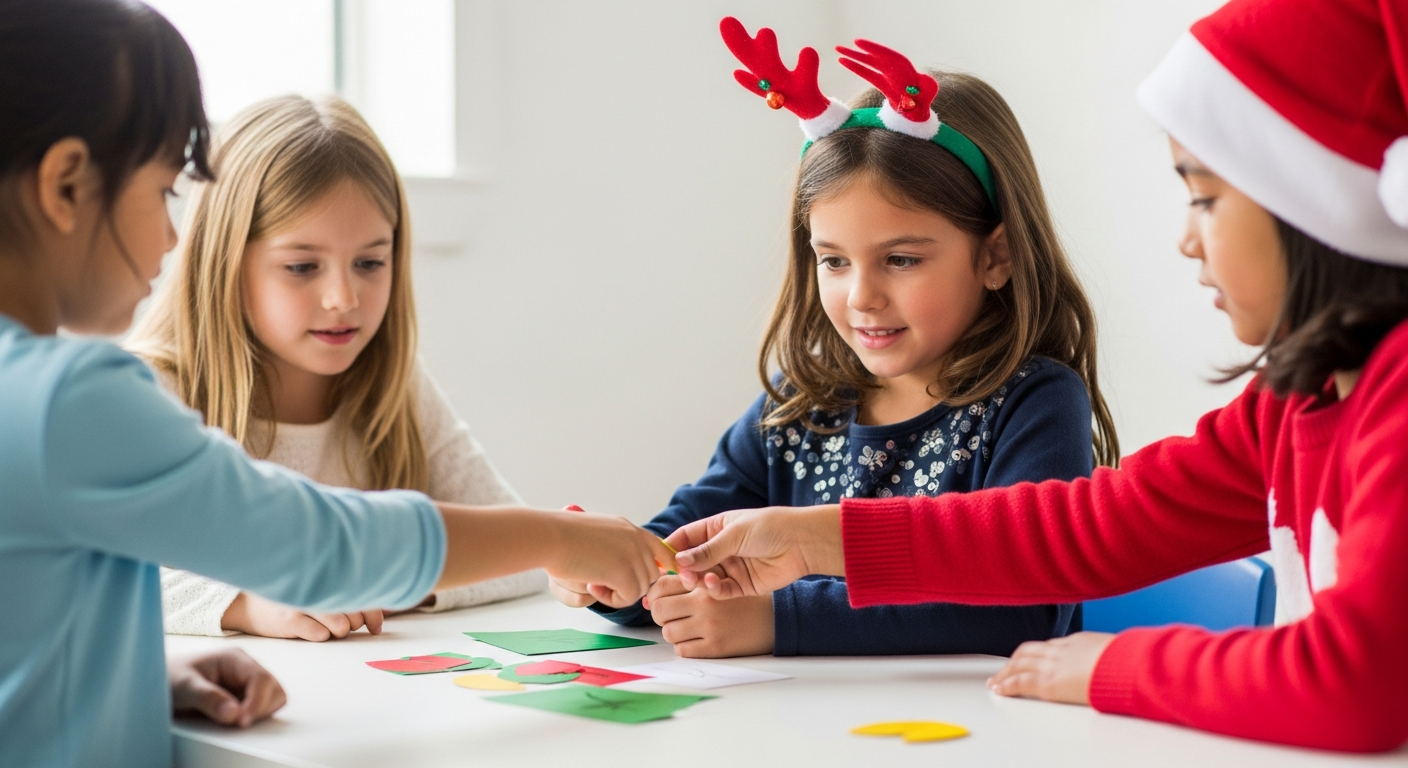
Table of Contents
- Introduction
- Why Play Matters: Beyond the Merriment
- Classic Christmas Classroom Games with a Festive Twist
- Educational & Skill-Building Christmas Games
- Active & Team-Building Christmas Challenges
- Creative & Crafty Christmas Corner
- Making Festive Fun Inclusive and Educational
- Elevate Learning and Fun with Speech Blubs
- Conclusion
- Frequently Asked Questions
As the festive season approaches, a palpable energy buzzes through classrooms everywhere. Children, alight with holiday anticipation, often find it challenging to focus, and that's perfectly normal! Instead of fighting this seasonal excitement, why not channel it into joyful, educational experiences? Incorporating Christmas classroom games for kids isn't just about filling time; it's a powerful pedagogical tool that fosters social skills, boosts cognitive development, and, crucially, keeps the spirit of learning alive amidst the holiday cheer. These activities transform a potentially chaotic period into a memorable and constructive time, turning seasonal excitement into opportunities for growth and connection.
Introduction
The classroom during the holidays often feels like a bubbling cauldron of excitement, and while the spirit is infectious, maintaining focus can be a real challenge for both students and teachers. Instead of battling the festive fervor, imagine harnessing that energy into engaging activities that are both fun and profoundly beneficial. This post will explore a diverse array of Christmas classroom games designed for kids of all ages, from preschoolers to older students. We’ll delve into why play is not just a break from learning, but a critical component of development, and how these festive activities can enhance communication, problem-solving, and social-emotional skills. Get ready to discover creative ways to bring joy, learning, and connection into your classroom this holiday season, ensuring every child feels empowered to participate and thrive.

Why Play Matters: Beyond the Merriment
The idea of "play" in the classroom might sometimes be seen as a deviation from serious learning, but modern educational research strongly emphasizes the profound impact of play-based learning. For children, play is the natural language of development. It’s where they experiment with social roles, test boundaries, solve problems, and practice vital communication skills. The pedagogy of play recognizes that structured, purposeful play nurtures cognitive flexibility, emotional regulation, and creativity in ways traditional rote learning cannot.
During the holidays, when children's natural inclination is towards excitement and imagination, integrating games into the curriculum becomes even more potent. These aren't just time-fillers; they are carefully designed experiences that encourage active listening, turn-taking, expressing ideas, and understanding social cues. For example, a child engaged in a team-based game learns to negotiate, collaborate, and articulate their thoughts under mild pressure – skills that are fundamental to both academic success and life beyond the classroom. At Speech Blubs, we deeply understand and champion this principle, believing that the most effective learning happens when it's wrapped in joy and meaningful interaction. Our mission is to empower children to "speak their minds and hearts," and we see how play in any setting, including the classroom, provides the perfect environment for this essential development.
Classic Christmas Classroom Games with a Festive Twist
Timeless games get a holiday makeover, bringing familiar fun with a seasonal sparkle. These activities are excellent for building classroom community and encouraging basic social and communication skills.
Santa Says
This is a beloved classic that seamlessly transforms into a holiday favorite. Much like "Simon Says," one person acts as "Santa" and gives commands, but only commands prefaced with "Santa Says" are to be followed.
- Benefits: Excellent for practicing active listening, following multi-step directions, and self-regulation. Children learn to differentiate between instructions and react appropriately, boosting their auditory processing skills.
- Relatable Scenario: For a child who struggles with auditory processing, "Santa Says" can be a gentle, fun way to practice listening carefully to multi-step instructions, perhaps starting with simpler commands like "Santa says clap your hands" before moving to "Santa says touch your nose and then hop twice." The playful context reduces anxiety and increases engagement, making the learning stick.
- Tips: Incorporate holiday-themed actions like "Santa says fly like a reindeer," "Santa says decorate the tree," or "Santa says wrap a present."
Pin the Nose on Rudolph
A festive spin on "Pin the Tail on the Donkey," this game is perfect for developing spatial awareness and teamwork.

- Benefits: Enhances fine motor skills, hand-eye coordination, and spatial reasoning. When played in teams, it fosters communication as blindfolded players rely on verbal cues from their classmates.
- Materials: A large picture of a reindeer (Rudolph), red pom-poms or sticky red noses, and a blindfold.
- Tips: Create a large reindeer face on poster board. For an added challenge, have players spin gently three times before attempting to place the nose.
Christmas Charades or Headbands
This game gets kids moving and thinking creatively about how to express holiday concepts without words.
- Benefits: Develops non-verbal communication, expressive language skills (when guessing), vocabulary, and kinesthetic learning. It encourages empathy as children try to understand the actions of others.
- Tips: Prepare cards with holiday-themed words or phrases like "decorate a tree," "singing carols," "Santa Claus," "opening presents," or "making a snowman." For younger children, use pictures. For older children, add more complex ideas or Christmas movie titles. This kind of expressive play is a fantastic complement to how we approach communication at Speech Blubs. Our app utilizes "video modeling" where children learn by watching and imitating their peers, a process that inherently strengthens their ability to understand and produce both verbal and non-verbal communication.
Merry Musical Chairs / Frosty Freeze Dance
Bring the festive tunes into the classroom with these energetic games.
- Benefits: Boosts gross motor skills, listening comprehension (stopping when music pauses), and impulse control. Children learn to manage excitement and respond to cues.
- Tips: Play popular Christmas carols or holiday-themed songs. For musical chairs, ensure enough space and review ground rules for safety. For freeze dance, encourage creative "frozen" poses related to holiday themes like "a snowman melting" or "an elf wrapping a gift."
Elf, Elf, Santa
A delightful variation of "Duck, Duck, Goose," this game adds holiday excitement to a familiar circle game.
- Benefits: Promotes gross motor skills, quick thinking, and social interaction within a group setting. It's great for burning off some energy!
- Tips: Students sit in a circle. One student walks around tapping heads, saying "Elf, elf..." until they tap someone and say "Santa!" The "Santa" then chases the first student around the circle to try and tag them before they sit in the "Santa's" empty spot.
White Elephant / Gift Exchange
This classic holiday tradition can be adapted for the classroom to teach valuable social lessons.
- Benefits: Teaches children about giving, receiving, and managing expectations. It promotes social interaction, negotiation (if trades are allowed), and good sportsmanship.
- Tips: Set a small budget (e.g., dollar store items, handmade crafts) or have students bring in a wrapped book from home. Emphasize that the game is about fun and surprise, not just getting a specific gift. Discuss rules for taking turns and gracious receiving.
Educational & Skill-Building Christmas Games
Beyond just fun, these games integrate academic skills, helping children practice literacy, critical thinking, and vocabulary in a festive context.
Holiday Twenty Questions / Guess Who? Christmas Edition
This game challenges students to think critically and use descriptive language.
- Benefits: Enhances deductive reasoning, critical thinking, and the ability to formulate strategic questions. It also expands vocabulary as students use descriptive adjectives to narrow down possibilities.
- Relatable Scenario: Consider a child who is expanding their vocabulary. Playing "Holiday Twenty Questions" with Christmas characters like "reindeer" or "Santa" encourages them to use descriptive words and formulate questions, strengthening their expressive language in a fun, contextual way. This practice is vital, and our app offers engaging ways to build vocabulary and question-formation skills, complementing classroom activities beautifully.
- Tips: Assign a holiday-themed person, place, or thing (e.g., Santa, a Christmas tree, a snowflake, an elf, a candy cane). Students ask yes/no questions to guess the item. For "Guess Who?," use sticky notes with characters on foreheads.
Twinkling Tongue Twisters
A silly yet effective way to work on pronunciation and articulation.
- Benefits: Improves articulation, phonological awareness, and vocabulary. It's also a fantastic way to introduce new words and build confidence in speaking clearly, which is a core value at Speech Blubs.
- Examples: "Blitzer bobbles a billion brilliant bells." "Crazy kids clamor for candy canes and Christmas cookies." "Santa's super sleigh slips so swiftly through the snow."
- Tips: Write them on the board, recite them, and have students try them individually or in groups. The laughter itself creates a positive learning environment.
Christmas Crosswords & Word Searches / Winter Word Scramble
These quiet activities are perfect for independent work or as a brain break.
- Benefits: Boosts vocabulary, spelling, memory, and critical thinking. Word searches are particularly good for students of all English language levels, including English Language Learners.
- Materials: Ready-made or self-created puzzles. Many online generators can help create custom puzzles.
- Tips: Offer a mix of difficulty levels. For scrambles, use common Christmas words like "mtcsshiar" (Christmas), "rnedeeir" (reindeer), "sanat" (Santa).
Blitzen Bingo / Snowman Bingo
Bingo is always a hit, and a holiday version makes it even more engaging.
- Benefits: Enhances listening skills, focus, vocabulary recognition, and number or picture identification. It’s a low-pressure way to encourage participation from all students.
- Materials: Custom bingo cards with holiday images or words, and small markers (candy, buttons).
- Tips: Call out holiday words, descriptions, or numbers. Use candy or small festive erasers as markers for extra fun.
Christmas Movie Trivia / Holiday Mad Libs
Engage older students with activities that tap into their holiday pop culture knowledge and creative writing skills.
- Benefits: Trivia encourages comprehension, memory recall, and cultural literacy. Mad Libs develop understanding of parts of speech, vocabulary, and creative storytelling, leading to hilarious outcomes.
- Tips: For trivia, create questions about popular Christmas movies. For Mad Libs, use holiday-themed stories. Have students read their completed Mad Libs aloud for shared laughter.
Active & Team-Building Christmas Challenges
These games get students moving and working together, promoting physical activity and cooperative problem-solving.
Build a Christmas Tree Challenge (Gumdrops & Toothpicks)
A delicious and engaging engineering challenge.
- Benefits: Develops fine motor skills, problem-solving, strategic planning, and teamwork. Students learn about structural integrity in a hands-on way.
- Materials: Gumdrops (or other soft candies), rounded toothpicks, a timer, and a yardstick.
- Tips: Give each group the same amount of materials. Challenge them to build the tallest freestanding tree in a set time. Emphasize that only standing trees will be measured.
No Hands, Stacking Cups Christmas Tree Challenge
This cooperative challenge requires precision and communication without touch.
- Benefits: Fosters intense cooperation, delicate fine motor control, and strategic planning. Children learn to communicate verbally to coordinate actions.
- Materials: Green plastic or paper cups, rubber bands, and yarn or string.
- Tips: Tie three pieces of string to a rubber band. Students use the strings to maneuver the rubber band to pick up and stack cups into a pyramid shape, creating a "Christmas tree." Watch a demonstration video to grasp the setup fully.
Snow Shoveling Challenge (Ping Pong Balls & Spoons)
A fun relay race that tests coordination and speed.
- Benefits: Enhances hand-eye coordination, patience, and friendly competition. It's a great way to get energy out while practicing careful movements.
- Materials: Ping pong balls (snowballs), plastic containers, and plastic spoons.
- Tips: Set up two containers per team, one empty and one with "snowballs." Students use a spoon to transfer balls from one container to the other over a set distance.
Trim the Tree with Garland (Streamer Wrap)
A hilarious, fast-paced team challenge.
- Benefits: Encourages rapid teamwork, careful handling, and a lot of laughter. It's a good way to practice following rules under pressure.
- Materials: Rolls of festive streamers.
- Tips: Each group chooses one person to be the "tree." The rest of the team races to wrap the "tree" in a streamer (garland) as quickly as possible without tearing it.
Build a Candy Cane (Beads & Pipe Cleaners)
A fine motor activity that introduces patterns.
- Benefits: Develops fine motor skills, hand-eye coordination, and pattern recognition. It's a calming activity that requires focus and precision.
- Materials: Red and white beads, pipe cleaners.
- Tips: Challenge students to thread alternating red and white beads onto a pipe cleaner to create a candy cane pattern. Set a timer to see who can make the longest candy cane in a minute.
Christmas Obstacle Course / Minute to Win It Games
These high-energy challenges are perfect for active kids and parent volunteers.
- Benefits: Boosts gross motor skills, agility, problem-solving under pressure, and teamwork. These games are fantastic for releasing pent-up energy in a structured, fun way.
- Examples:
- Jinglebell Mug Toss: Students toss jingle bells into mugs from a distance.
- Cup Stacking: Race to stack and unstack cups into specific pyramids.
- Snowman Slam: Use soft balls to knock down cups decorated as snowmen.
- Hit the Grinch Game: Aim Nerf guns at green balloons or a Grinch cutout.
- Reindeer Antler Ring Toss: Players wear inflatable antlers and try to catch rings.
- Tips: Set up stations for "Minute to Win It" games, allowing students to rotate. For an obstacle course, use gym equipment or simple classroom items like chairs, hoops, and tunnels, all with a festive theme (e.g., "crawl through Santa's chimney," "sleigh ride" across a mat).
Creative & Crafty Christmas Corner
Encourage artistic expression and fine motor development with these festive craft ideas.
Christmas Cards / Decorate an "Oh, Christmas Tree"
Give students a chance to express their creativity and create something tangible.
- Benefits: Enhances fine motor skills, creativity, and personal expression. Making cards fosters thoughtfulness towards others. Decorating a collaborative tree builds a sense of community.
- Materials: Construction paper, markers, crayons, glitter, glue, stickers for cards. For a tree, a large paper tree outline on a wall, with various craft supplies for students to create "ornaments."
- Tips: Encourage students to personalize their cards with messages for friends or family. For the "Oh, Christmas Tree," discuss different ornament ideas and have students contribute to a shared classroom decoration.
Gingerbread House / Cookie Decorating
A delicious and delightful way to engage fine motor skills and creativity.
- Benefits: Develops fine motor control, creativity, following instructions, and sensory engagement. It's a fantastic activity for fostering patience and sharing materials.
- Relatable Scenario: For a child working on following sequences, a cookie decorating activity can be a perfect fit. "First, we frost the cookie. Next, we add sprinkles. Last, we put on a candy button!" This practice with sequential language is crucial for developing clear communication, and activities like this reinforce the structured learning children experience through our app.
- Materials: Pre-baked gingerbread cookies or plain sugar cookies, various colored frostings, sprinkles, candies, and small spatulas or knives.
- Tips: Divide students into small groups. Provide clear instructions on how to decorate, or let their creativity run wild. This is a great opportunity to talk about colors, shapes, and textures.
Snow Paint / Snowman Building Competition (If Outdoors)
Take the festive fun outside if the weather permits!
- Benefits: Encourages outdoor play, gross motor skills (especially building), creativity, and sensory exploration. It allows children to engage with their environment in a unique way.
- Materials: Spray bottles filled with water and food coloring for snow paint. Carrots, scarves, buttons, and other accessories for snowman building.
- Tips: For snow paint, mix food coloring with water in spray bottles. For snowman building, provide traditional items but also encourage imaginative use of natural materials or classroom props.
Making Festive Fun Inclusive and Educational
When planning Christmas classroom games for kids, remember that every child is unique. Adapting activities to accommodate different ages, abilities, and communication styles ensures that everyone can participate and enjoy the festive spirit. For instance, for children who may be less verbal, providing visual aids or allowing non-verbal responses can make a huge difference. Encouraging turn-taking, asking open-ended questions during play, and describing actions aloud are simple yet powerful ways to build communication skills in a natural setting.
This is precisely where Speech Blubs comes in. We understand that effective communication is a cornerstone of confidence and connection. Our app offers "smart screen time" that is anything but passive. Instead of mindlessly watching cartoons, children engage in active learning through our unique "video modeling" methodology. They watch and imitate real children their age, making the learning experience relatable and incredibly motivating. This scientifically backed approach, designed by experts and born from our founders' personal experiences with speech problems, is a powerful supplement to classroom activities, fostering early sounds, words, and complex communication skills.
Whether your child is a "late talker," has articulation challenges, or simply needs a boost in their language development, Speech Blubs provides an immediate, effective, and joyful solution. Our app has earned a high MARS scale rating for its quality and effectiveness, making it a trusted resource for parents and educators worldwide. By blending scientific principles with play, we offer a screen-free alternative to passive viewing and a powerful tool for family connection, truly empowering children to speak their minds and hearts.
Elevate Learning and Fun with Speech Blubs
While classroom games lay a fantastic foundation for social and communication skills, consistent, structured practice can truly accelerate your child's progress. This is where Speech Blubs shines, offering a dynamic and engaging platform that complements every learning environment. Our app is designed to make speech practice fun, transforming screen time into a powerful tool for language development.
At Speech Blubs, we believe that every child deserves the opportunity to communicate confidently. Our app empowers children to "speak their minds and hearts" by providing a joyful and scientifically grounded approach to speech therapy. We understand the challenges parents face because our founders personally experienced speech difficulties, inspiring them to create the tool they wished they had. We are committed to providing an immediate, effective, and engaging solution for the 1 in 4 children who need speech support. Our unique "video modeling" method, where children learn by watching and imitating their peers, is backed by science and recognized for its high quality. It’s an interactive experience that fosters foundational communication skills, from early sounds to complex sentences, turning screen time into smart, active learning.
Ready to see the difference Speech Blubs can make? We encourage you to explore our app and join our community of families who are already experiencing the joy of confident communication. Start your journey today and discover the fun and effective way to support your child's speech development.
We offer flexible plans to suit your family's needs:
- Monthly Plan: Get started for just $14.99 per month.
- Yearly Plan: Our best value! For only $59.99 per year, you save a significant 66% (breaking down to just $4.99/month). The Yearly plan includes exclusive, high-value features:
- A 7-day free trial to experience the full range of activities.
- Access to our extra Reading Blubs app, enhancing literacy skills alongside speech.
- Early access to new updates and a priority 24-hour support response time.
- Please note: The Monthly plan does not include these additional benefits.
We highly recommend choosing the Yearly plan to unlock all these amazing features and give your child the most comprehensive support. Begin your 7-day free trial and experience the full potential of Speech Blubs! You can also download Speech Blubs directly from the Apple App Store or Google Play Store to get started immediately. Unsure if Speech Blubs is right for your child? Take our quick 3-minute preliminary screener to receive a simple assessment and a personalized next-steps plan, along with access to a free 7-day trial.
Conclusion
The holiday season offers a unique opportunity to infuse classrooms with joy, creativity, and meaningful learning through engaging Christmas games for kids. From classic adaptations like "Santa Says" to collaborative challenges and creative crafts, these activities not only celebrate the festive spirit but also lay crucial groundwork for cognitive, social, and emotional development. By prioritizing play, we empower children to practice vital communication skills—listening, turn-taking, expressing themselves, and collaborating—in a way that feels natural and exciting.
Embracing these games means fostering a vibrant classroom community where every child feels seen, heard, and excited to participate. And as you enrich your classroom with these festive experiences, remember that consistent support for your child's communication journey can be found with Speech Blubs. Our app provides an engaging, scientifically backed platform that complements these playful learning moments, helping children confidently "speak their minds and hearts."
Ready to empower your child's communication journey? Download Speech Blubs today from the Apple App Store or Google Play Store. We highly recommend choosing the Yearly plan for the best value, including a 7-day free trial, the Reading Blubs app, and priority support. Make this holiday season not just merry, but a milestone in your child's developmental journey!
Frequently Asked Questions
Q1: How can I adapt these Christmas games for different age groups in my classroom?
A1: Many games are easily adaptable! For younger children, simplify rules, use more visual cues, and focus on basic concepts like color or shape recognition. For older children, add layers of complexity, introduce strategic thinking, or incorporate academic challenges like vocabulary building or complex trivia. For instance, "Christmas Charades" can use pictures for preschoolers and movie titles for older kids. Emphasize teamwork over individual competition to make activities more inclusive for diverse age ranges and abilities.
Q2: What are the main benefits of incorporating play-based learning and games into holiday classroom activities?
A2: Incorporating play and games offers numerous benefits beyond just entertainment. They foster social-emotional development by encouraging turn-taking, cooperation, and empathy. Cognitively, games enhance problem-solving, critical thinking, and memory. Physically, they promote fine and gross motor skills. Crucially, they create a positive and engaging learning environment, reducing stress and increasing motivation, especially during an exciting time like the holidays. This aligns with our values at Speech Blubs, where we believe joyful engagement is key to effective learning and communication development.
Q3: How can Speech Blubs complement these classroom games to support a child's communication development?
A3: Speech Blubs acts as a powerful supplement by providing structured, engaging practice that reinforces skills children use in classroom games. For example, a child practicing articulation with our "Twinkling Tongue Twisters" feature will gain confidence for classroom "Twinkling Tongue Twisters." Our "video modeling" approach encourages imitation and verbal expression, directly supporting the communication skills needed for successful participation in group activities. By providing "smart screen time" with scientifically backed methods, Speech Blubs ensures that practice continues at home, creating a cohesive learning experience. See what other parents are saying about their child's success on our testimonials page.
Q4: Are there any low-cost or no-cost Christmas classroom games that are still highly engaging?
A4: Absolutely! Many engaging games require minimal or no materials. "Santa Says," "Elf, Elf, Santa," "Twinkling Tongue Twisters," and "Christmas Charades" are all free to play. Games like "Holiday Twenty Questions" only require imagination. For crafts, using recycled materials or items found in nature (like pinecones for decorating) can keep costs down while boosting creativity. The key is often in the teacher's enthusiasm and facilitation, making even simple activities exciting for children.
About the author