
Engaging Cut and Paste Toddler Activities for Fine Motor Fun
 By Speech Blubs Team•Mar 18, 2026•15 min.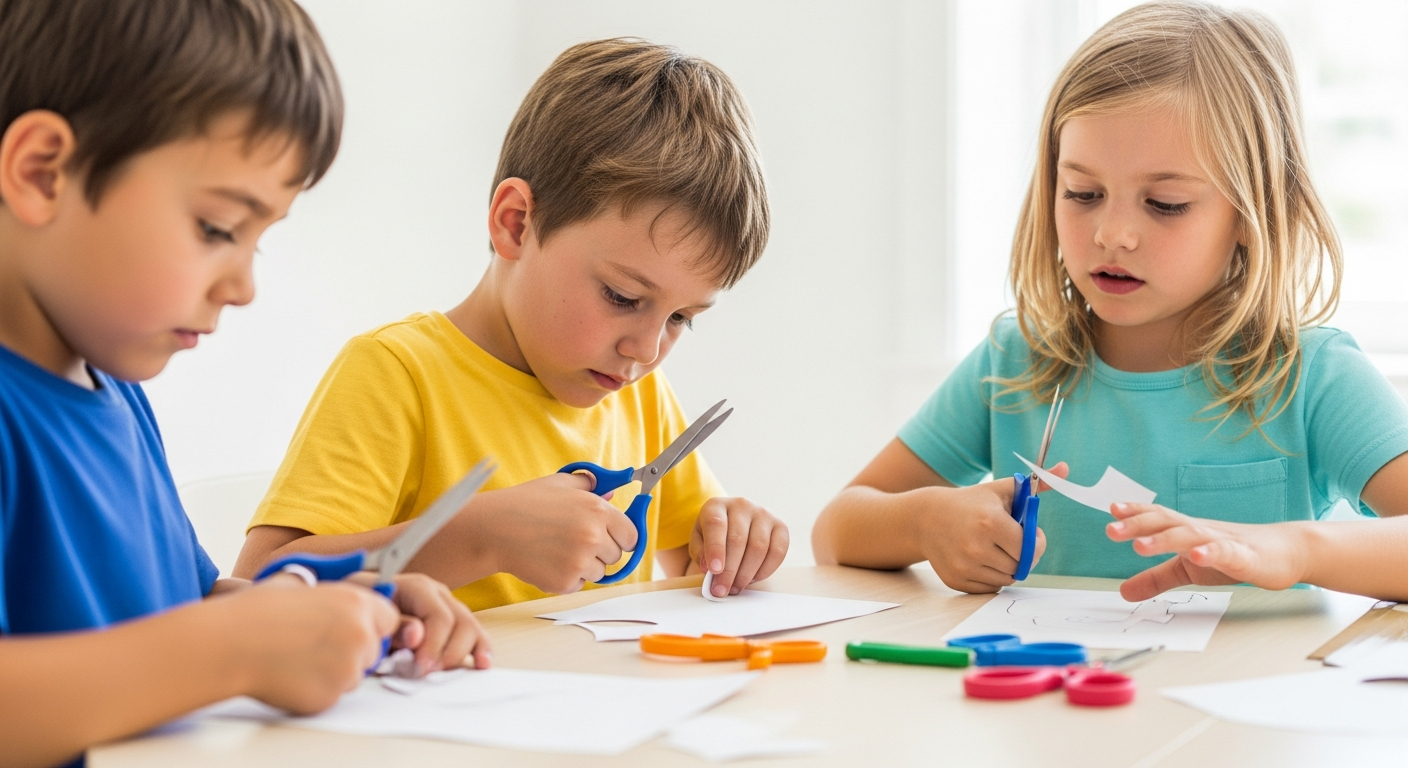
Table of Contents
- Introduction
- The Developmental Power of Scissors and Glue
- Getting Started: Scissor Safety and Progression
- Creative Cut and Paste Toddler Activities
- Why Hands-On Activities Beat Passive Screen Time
- Making the Most of Your "Art Session"
- How Speech Blubs Supports Your Child's Journey
- Integrating Crafting with Speech Blubs
- Setting Realistic Expectations
- Advanced Cut and Paste: For Older Toddlers and Preschoolers
- The Role of "Smart Screen Time" in Modern Parenting
- Conclusion
- Frequently Asked Questions
Introduction
Have you ever watched a toddler try to use a pair of safety scissors for the first time? There is a specific kind of magic in that level of concentration. You might see their little tongue poking out the corner of their mouth, their brow furrowed in deep thought, and their small hands working with intense purpose. While it might look like they are just making a mess with scraps of paper and sticky glue, they are actually hard at work building the foundational pathways for writing, self-care, and even speech.
At Speech Blubs, we believe that every moment of play is an opportunity for a child to find their voice. Our mission is to empower children to "speak their minds and hearts," and often, that journey starts with the physical development of the hands. In this post, we are going to dive deep into the world of cut and paste toddler activities. We will explore why these activities are essential for fine motor development, how they support cognitive growth like sorting and sequencing, and how you can use them to foster a love for communication in your little one.

Whether you are looking for ways to keep a busy three-year-old occupied or searching for supplements to your child's speech therapy, these hands-on activities provide a "smart" alternative to passive screen time. By the end of this article, you will have a toolkit of creative ideas and a better understanding of how these simple crafts bridge the gap between physical coordination and expressive language.
The Developmental Power of Scissors and Glue
Before we jump into the activities, it’s important to understand the "why" behind the craft. Many parents are surprised to learn that the same brain regions responsible for fine motor control are often closely linked to the areas responsible for speech and language. When a child practices the "open-close" motion of scissors, they aren't just cutting paper; they are training their brain for precision and rhythm.
Building Fine Motor Strength
Fine motor skills involve the use of the small muscles in the hands and wrists. These are the muscles your child will eventually use to hold a pencil, button their shirt, and use a fork. Cut and paste activities are essentially a "gym workout" for these tiny muscles.
- Hand Strength: Squeezing scissors helps build the muscles in the palm.
- Finger Isolation: Learning to put the thumb in one hole and the fingers in the other helps with "digital autonomy."
- Hand-Eye Coordination: Following a line with scissors requires the eyes and hands to work in perfect synchronization.
Developing Bilateral Coordination
Bilateral coordination is the ability to use both sides of the body at the same time in a coordinated way. Think about cutting a circle out of paper. One hand is busy operating the scissors (the "doing" hand), while the other hand is rotating the paper (the "helping" hand). This is a complex skill that is vital for almost every daily task. If your child is struggling with these movements, you can get a better sense of their developmental milestones by taking our quick 3-minute preliminary screener, which involves 9 simple questions to help you understand where your child stands.

Getting Started: Scissor Safety and Progression
It is completely normal to feel a little nervous about handing a toddler a pair of scissors. However, with the right tools and a step-by-step approach, you can make this a safe and joyful learning experience.
Choosing the Right Tools
Start with plastic "training" scissors that only cut paper, not hair or skin. As your child gains confidence, you can move to blunt-tipped metal safety scissors. For the "paste" portion, glue sticks are generally easier for toddlers to manage than liquid glue, which can quickly become a sticky lake on your kitchen table!
The Natural Progression of Cutting
Children don't start by cutting out intricate stars. They follow a predictable path of skill development:
- Snipping: This is the first stage. Give your toddler thin strips of paper (about one inch wide) and let them "snip" them into small squares.
- Straight Lines: Once they can snip, move to longer pieces of paper with thick, straight lines drawn on them.
- Zig-Zags and Curves: These require the "helping hand" to start turning the paper.
- Shapes: Finally, they will move on to circles, squares, and eventually more complex figures.
Creative Cut and Paste Toddler Activities
Now, let's explore some specific activities that you can try at home today. These are designed to be low-prep but high-impact.
1. The "Alphabet Soup" Collage
Literacy begins long before a child starts to read. It starts with letter recognition and the understanding that symbols have meaning.
The Activity: Collect old magazines, junk mail, or newspapers. Ask your child to look for a specific letter (for example, "A"). Help them cut out every "A" they find and paste it onto a large piece of construction paper.
The Speech Connection: As they find each letter, practice the sound the letter makes. If they find an "S," you can both make a "sss" sound like a snake. This mimics the video modeling methodology we use at Speech Blubs, where children learn by watching and imitating. By seeing you make the sound and then trying it themselves while engaging in a tactile activity, the learning becomes multi-sensory and much more likely to stick.
2. Animal Habitat Match-Up
Sorting is a fundamental cognitive skill that helps children organize the world around them. It requires them to identify characteristics and find commonalities.
The Activity: Print out (or draw) two different environments, like an ocean and a jungle. Then, provide pictures of animals like sharks, whales, monkeys, and tigers. Your child will cut out the animals and paste them into the correct home.
The Practical Scenario: For a parent whose 3-year-old "late talker" loves animals, this activity is a goldmine. While your child pastes the monkey in the jungle, you can use the Speech Blubs app to open the "Animal Kingdom" section. Your child can watch a peer make a monkey sound, and then they can practice that sound as they glue their monkey down. This bridges the gap between the digital "smart screen time" and the physical world.
3. The Number Garden
This activity combines counting, number recognition, and fine motor skills.
The Activity: Draw several flower stems on a piece of paper and write a number (1 through 5) at the bottom of each stem. Provide a sheet of colorful paper "petals" for your child to cut out. Their task is to paste the correct number of petals on each flower.
The Educational Value: This reinforces one-to-one correspondence—the idea that one object represents the number one, two objects represent the number two, and so on.
4. Color Matching Gumball Machine
Color recognition is a major milestone for toddlers and preschoolers.
The Activity: Draw a large, simple gumball machine. Provide strips of paper in different colors (red, blue, yellow, green). Have your child snip these into small "gumballs" and paste them into the machine. You can even challenge them to "fill the machine with only red gumballs" to practice more specific sorting.
5. Seasonal "Family Tree"
This is a wonderful way to talk about family connections and the changing of the seasons.
The Activity: Draw a large brown tree trunk with bare branches. In the fall, have your child cut out red, orange, and yellow leaf shapes to paste on the tree. In the spring, use green leaves and pink flowers. You can even cut out small photos of family members and "nestle" them into the branches.
Pro Tip: If your child gets frustrated with cutting complex leaf shapes, let them tear the paper instead! Tearing paper is also a fantastic fine motor exercise that builds hand strength.
Why Hands-On Activities Beat Passive Screen Time
We live in a world where it is very easy to hand a child a tablet and let them watch cartoons. However, passive viewing doesn't require the child to do anything. At Speech Blubs, we advocate for "smart screen time." Our app is designed to be an interactive tool that encourages children to respond, imitate, and participate.
When you combine the digital learning of our app with physical cut and paste toddler activities, you are creating a comprehensive learning environment. You aren't just letting them watch a screen; you are using the screen as a springboard for real-world play. This approach is backed by extensive research into how mirror neurons and imitation drive language development.
Making the Most of Your "Art Session"
To turn a simple craft into a powerful learning moment, follow these tips:
- Narrate the Action: Use "self-talk." Say things like, "I am opening the scissors... now I am closing them. Snip! Look at that green square."
- Focus on the Process, Not the Product: It doesn't matter if the "cat" they pasted together looks like a blob. What matters is that they used their hands and had fun doing it.
- Encourage Choices: "Do you want to use the blue paper or the red paper?" Giving a child choices empowers them and encourages them to use their words to express their preferences.
- Adult Co-Play: These activities are most effective when done together. Sit on the floor, get messy, and celebrate their "masterpieces."
How Speech Blubs Supports Your Child's Journey
At Speech Blubs, we know that 1 in 4 children will face speech or language delays. We were founded by people who grew up with speech problems themselves, so we understand the frustration that comes when a child can't communicate what they are thinking or feeling. Our tool was created to be the joyful, effective solution we wish we had as kids.
Our app uses peer-to-peer video modeling. When a child sees another child (not an adult or a cartoon) making a sound or saying a word, they are much more likely to try it themselves. This builds the confidence needed to "speak their minds and hearts."
If you’re ready to see how our science-backed method can help your child, you can create your account and begin your 7-day free trial today. We offer two main plans to fit your family’s needs:
- Monthly Plan: $14.99 per month. This is a great way to test the waters.
- Yearly Plan: $59.99 per year. This is our best value plan, breaking down to just $4.99 per month—a 66% savings compared to the monthly option!
Why Choose the Yearly Plan? Beyond the significant cost savings, the Yearly Plan is the only one that includes:
- A 7-day free trial to explore everything we offer.
- Access to our Reading Blubs app, which focuses on early literacy skills.
- Early access to new updates and features.
- Priority 24-hour support response time.
The Monthly plan does not include these bonus features, making the Yearly plan the clear choice for families committed to their child's long-term development.
Integrating Crafting with Speech Blubs
You can easily tie your cut and paste activities back to the lessons in the app. For example, if you are working on the "Yummy Time" section of the app, which focuses on food words and mouth movements, you could do a cut and paste activity where your child "builds a pizza."
- Cut out a large brown circle for the crust.
- Cut out red "sauce" shapes.
- Cut out yellow strips for cheese.
- As you paste each item, use the app to practice saying "Pizza," "Cheese," and "Mmm!"
This kind of integrated play is what we mean by creating "joyful family learning moments." It turns a therapy-based concept into a fun afternoon activity. Don't just take our word for it—read through our parent testimonials to see how other families have used these strategies to see real progress.
Setting Realistic Expectations
It is important to remember that every child develops at their own pace. Using cut and paste activities and the Speech Blubs app is a powerful way to support development, but it isn't a "magic wand." Our goal is to foster a love for communication, build confidence, and reduce the frustration that comes with speech delays.
Think of these activities as building blocks. One day your child is snipping a piece of paper; the next, they are identifying a letter; soon after, they are imitating a sound they saw in a video. Each small step is a victory worth celebrating.
Advanced Cut and Paste: For Older Toddlers and Preschoolers
As your child's skills grow, you can introduce more complex activities that challenge their problem-solving abilities.
Pattern Matching
Create a pattern on a strip of paper (e.g., Red Square, Blue Circle, Red Square...). Provide a pile of cut-out shapes and ask your child to "finish the pattern" by pasting the correct shapes in order.
Puzzle Recreation
Take a simple picture from a coloring book or a magazine and cut it into 3 or 4 large pieces. Ask your child to "solve the puzzle" by pasting the pieces back together on a blank sheet of paper. This is excellent for visual perception and spatial reasoning.
Scissor Mazes
Draw a wavy or zig-zag path across a piece of paper and put a sticker at the end. Tell your child the "scissors need to find the sticker." They will have to carefully navigate the turns and angles to reach the goal.
The Role of "Smart Screen Time" in Modern Parenting
We understand that modern parenting is a balancing act. You want the best for your child, but you also have a million things to do. This is why we designed Speech Blubs to be a tool for connection, not just a way to keep a child quiet.
When you use the app together, you are engaging in co-play. You are laughing at the fun filters, imitating the kids on screen, and then taking those lessons to the craft table for some cut and paste fun. This creates a rich, interactive environment that helps your child thrive.
For parents who are unsure where to start, we highly recommend our preliminary screener. It provides an assessment and a next-steps plan tailored to your child’s specific needs, which can be incredibly reassuring if you have concerns about their progress.
Conclusion
Cut and paste toddler activities are much more than just a way to pass the time on a rainy afternoon. They are vital developmental tools that build hand strength, bilateral coordination, and the cognitive skills necessary for literacy and numeracy. Most importantly, when paired with the right resources, they can be a significant boost to your child’s communication journey.
By engaging in these tactile activities, you are helping your child develop the physical and mental foundations they need to eventually "speak their minds and hearts." Whether you are snipping junk mail, matching animals to their habitats, or building a "number garden," you are creating joyful moments of connection that your child will carry with them.
We invite you to join the Speech Blubs family and discover the power of smart screen time. Our method is trusted by parents worldwide and is backed by the science of peer-to-peer imitation.
Ready to unlock your child's potential? Download Speech Blubs on the App Store or Google Play to begin. Remember to choose the Yearly plan to take advantage of our 7-day free trial, the Reading Blubs app, and the best overall value for your family's journey!
Frequently Asked Questions
1. At what age should I start cut and paste toddler activities? Most toddlers are ready to begin very simple "snipping" activities around the age of two. Always start with plastic safety scissors and provide constant supervision. If they aren't ready for scissors yet, they can practice "pasting" pre-cut shapes or tearing paper with their fingers to build similar muscles.
2. How do fine motor skills like cutting actually help with speech? The brain's motor cortex, which controls hand movements, is located right next to Broca’s area, which is responsible for speech production. Stimulating one area often helps stimulate the other. Additionally, the focus and precision required for cutting help develop the same neural pathways used for controlled speech sounds.
3. My child gets frustrated when they can't cut a shape perfectly. What should I do? Focus on the effort, not the result! If a circle turns out like a square, call it a "special circle" and keep going. You can also hold the paper for them to make it easier, or use "hand-over-hand" guidance to show them the rhythm of the scissors. The goal is to build confidence, not perfection.
4. Is Speech Blubs a replacement for traditional speech therapy? While Speech Blubs is a powerful tool designed by experts and backed by science, it is intended to be a supplement to your child's overall development plan. It works wonderfully alongside professional therapy and provides parents with a way to continue the work at home through joyful, smart screen time.
About the author