
Engaging Kids Menu Games for Happy Family Dining
 By Speech Blubs Team•Jan 28, 2026•20 min.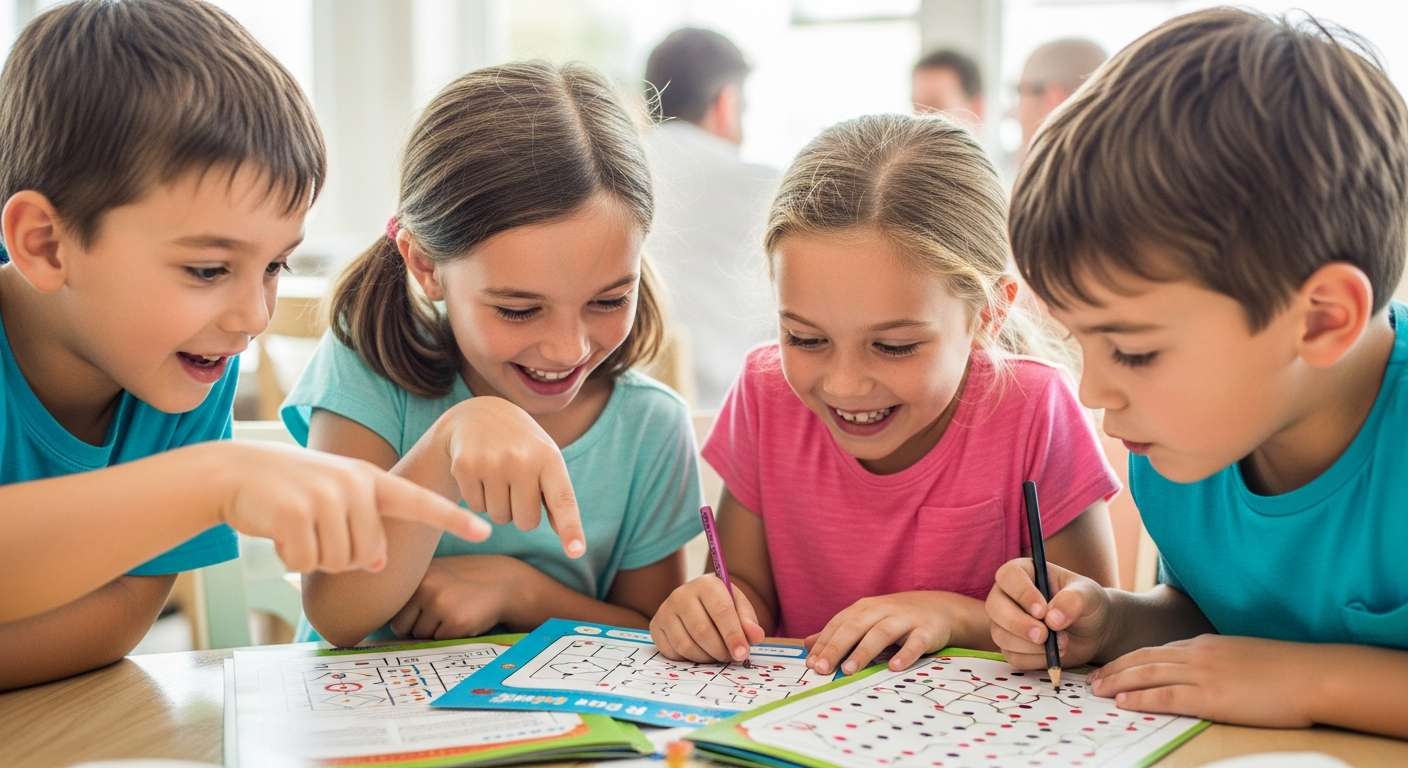
Table of Contents
- The Dining Out Dilemma: A Parent’s Reality
- Beyond the Crayons: Why Kids Menu Games are So Powerful
- Creative Kids Menu Game Ideas: Keeping Little Hands and Minds Busy
- Bringing Speech Blubs into the Restaurant Experience
- The Speech Blubs Advantage: Beyond the Tabletop
- Making it a Habit: Integrating Play into Everyday Life
- Choosing Your Speech Blubs Plan: Maximize Your Child's Potential
- Conclusion
- Frequently Asked Questions
The scene is familiar to many parents: you’re at a restaurant, eager for a relaxed meal, but within minutes, boredom sets in for your little ones. The initial excitement of crayons and a paper menu quickly fades, giving way to restlessness, wiggles, and the dreaded question, “Are we there yet?” even though you’re already seated. Eating out, which was once a simple pleasure, can transform into a test of patience, a hurried eat-and-go mission rather than the joyful family bonding experience you envisioned. But what if the humble kids’ menu and the items already on your table held the key to turning those challenging moments into opportunities for connection, learning, and genuine fun?
This post is designed to transform your family dining experiences. We're going to dive deep into a treasure trove of creative, engaging, and screen-free kids menu game ideas, using nothing but what’s typically found on a restaurant table. More than just keeping kids occupied, these games foster crucial developmental skills – from language and fine motor skills to problem-solving and social interaction. We’ll also explore how these playful moments can seamlessly connect with your child's overall communication journey, drawing parallels to the innovative tools we offer at Speech Blubs to further empower their voices. Get ready to reclaim the joy of dining out, armed with simple strategies that make every meal an adventure.

The Dining Out Dilemma: A Parent’s Reality
For many of us, the idea of a leisurely family dinner out is a beautiful dream. In reality, it often looks more like a race against the clock, trying to get food into little mouths before the inevitable surge of impatience and energy takes over. The wait for food, the expectation of sitting still, and the unfamiliar environment can all be overwhelming for children, leading to meltdowns, whining, and a general sense of chaos that leaves parents feeling exhausted rather than refreshed. We long for those moments of shared laughter and conversation around a table, but the fear of disrupting other diners or dealing with an unhappy child often limits our dining choices, or even discourages us from venturing out at all.
This isn’t about blaming children; it's about understanding their developmental needs. Young children have shorter attention spans, an innate need for movement, and are still developing self-regulation skills. A restaurant, with its inherent waiting periods and social expectations, can be a tough environment for them to navigate. We want to enjoy quality time together, but sometimes, the reality of managing little ones in a public setting overshadows the potential for connection. This is where clever, simple distractions and interactive games come into their own, providing an invaluable buffer that can make all the difference between a stressful outing and a memorable one.
Beyond the Crayons: Why Kids Menu Games are So Powerful
The traditional kids' menu often comes with a few crayons and a basic coloring page or maze. While these offer a momentary distraction, they rarely sustain a child's attention for long. The real power of kids menu game ideas lies in their versatility and their ability to engage multiple developmental domains simultaneously, often without requiring any extra equipment. These aren't just time-fillers; they are rich opportunities for growth.
Think about it:
- Language Development: Describing objects, asking questions, following instructions, telling stories, and even negotiating turns all build vocabulary and conversational skills.
- Fine Motor Skills: Holding crayons, drawing lines, folding paper, and manipulating small objects like sugar packets refine dexterity and hand-eye coordination.
- Cognitive Engagement: Memory games, puzzles, letter hunts, and strategy games like Tic-Tac-Toe stimulate problem-solving, critical thinking, and attention.
- Social-Emotional Learning: Taking turns, sharing, dealing with winning and losing, and engaging in collaborative play foster crucial social skills and emotional regulation.
- Family Bonding: Playing together creates shared experiences, laughter, and positive memories, strengthening family connections away from the distractions of home.
- Stress Reduction for Parents: When children are happily engaged, parents can relax, enjoy their meal, and have adult conversations, making the entire experience more pleasant for everyone.
At Speech Blubs, our mission is to empower children to "speak their minds and hearts," and we know that play is the most powerful vehicle for learning. These simple restaurant games align perfectly with our philosophy, turning everyday situations into active learning environments. They offer a "screen-free alternative" that encourages interaction and engagement, complementing the "smart screen time" experiences we provide through our app.

Creative Kids Menu Game Ideas: Keeping Little Hands and Minds Busy
Let's dive into some fantastic kids menu game ideas that leverage the power of everyday restaurant items. Remember, the key is adult participation and enthusiasm!
Pencil & Paper Puzzles (Using the Menu Itself)
The kids' menu, often printed on paper, is a blank canvas waiting for creativity. If there's no dedicated activity section, you can still use the blank spaces or even the back of the menu.
Tic-Tac-Toe
- How to Play: Ask your server for a couple of extra straws, or just use a crayon to draw a simple 3x3 grid on the menu. Use different colored sugar packets, crumpled pieces of napkin, or even coin-sized ripped paper as markers for 'X's and 'O's.
- Skills Developed: Strategy, turn-taking, fine motor control (manipulating markers).
- Speech Blubs Connection: While playing, you can model phrases like "My turn," "Your turn," "I win!" or "Good try!" For children who are working on expressing simple commands or social phrases, this provides a natural, low-pressure context.
Dots and Boxes (Capture the Squares)
- How to Play: Draw a grid of dots on the menu paper. Players take turns drawing a horizontal or vertical line connecting two adjacent dots. When a player completes a square, they put their initial inside it and get another turn. The player with the most squares at the end wins.
- Skills Developed: Strategic thinking, spatial reasoning, fine motor control, counting.
- Speech Blubs Connection: Count the squares together, practicing numbers and one-to-one correspondence. Discuss "sides," "corners," and "lines." For children building vocabulary, this game offers concrete visual cues for abstract concepts.
Word Search / Letter Hunt (ABC Spy)
- How to Play: If the menu has text, ask your child to find all the 'A's or 'P's. For older kids, you can create a simple word search by circling words on the menu and having them find those words. For younger kids, just calling out individual letters is effective. You can also look for words that start with specific sounds.
- Skills Developed: Letter recognition, phonological awareness, visual scanning, vocabulary.
- Speech Blubs Connection: This is a perfect real-world extension of early literacy skills. For a parent whose child is working on specific phonemes, they might point out a picture of "pizza" on the menu and then later, at home, reinforce that sound with the "First Words" section in Speech Blubs, where animated characters make the "P" sound for "Panda" or "Pig." Our app helps build these foundational sound-to-word connections.
Drawing Challenges
- How to Play: Give each child a drawing challenge: "Draw what you want to eat for dessert," "Draw a silly monster eating spaghetti," or "Draw your favorite animal." You can also play 'Pictionary' with menu items.
- Skills Developed: Creativity, imagination, fine motor skills, expressive language (describing their drawing).
- Speech Blubs Connection: If your child is captivated by the images of farm animals on a kids' menu, you can extend that interest later by exploring the "Animal Kingdom" section in Speech Blubs. Our unique video modeling feature allows them to watch and imitate their peers making sounds and words like "moo" or "baa," turning screen time into an active learning experience. This directly builds on their interest from the menu.
Origami Fortune Tellers
- How to Play: If you remember how to make these paper wonders, use the menu paper (or a blank sheet). Write colors on the outside, numbers inside, and simple fortunes or actions (e.g., "You will have good luck today," "Give someone a hug," "Make a silly face").
- Skills Developed: Fine motor skills, following instructions, social interaction, humor.
- Speech Blubs Connection: This game encourages asking and answering questions, as well as following multi-step directions. These are all crucial communication skills reinforced in Speech Blubs through various activities designed to build conversational fluency and listening comprehension.
Tabletop Treasures (Using Everyday Items)
Look around your table – sugar packets, straws, napkins, and even cutlery can become props for engaging kids menu game ideas.
I Spy
- How to Play: The classic game! "I spy with my little eye, something green" (pointing to a lettuce leaf in a salad). Or "I spy with my little eye, something that starts with the 'F' sound" (finding "fork"). You and your child take turns guessing.
- Skills Developed: Observation, descriptive language, vocabulary, inferencing.
- Speech Blubs Connection: This game is fantastic for building descriptive vocabulary and practicing identifying initial sounds. In Speech Blubs, we use vivid visuals and clear audio to help children connect words with objects and actions, similar to how "I Spy" encourages detailed observation. For more language-boosting fun, download Speech Blubs on the App Store or Google Play today!
Disappearing Objects
- How to Play: Arrange 3-5 small objects (sugar packets, salt shaker, spoon, napkin) in front of your child. Tell them to look carefully, then have them close their eyes. Remove one object and ask, "What's missing?"
- Skills Developed: Memory, observation, descriptive language.
- Speech Blubs Connection: Memory games enhance auditory and visual processing skills, which are fundamental to language acquisition. Activities within Speech Blubs are designed to improve recall and recognition of words and concepts, mirroring this game's benefits.
Guess Which Hand
- How to Play: Hide a small item (a coin, a piece of a napkin, a sugar packet) in one of your hands, making a fist with both. Have your child guess which hand it's in. Then let them hide it for you to guess.
- Skills Developed: Observation, critical thinking, turn-taking.
- Speech Blubs Connection: Simple question-and-answer exchanges ("Which hand?", "Is it this one?"), along with clear communication of intentions, are vital. Our app provides guided practice for asking and answering simple questions, building confidence in these basic conversational structures.
Sugar Packet Magic (The "Cups and Balls" Trick)
- How to Play: Take three identical sugar packets and a small coin or button. Show your child which packet the coin is under, then quickly mix them up while they watch. Ask them to point to the packet with the coin.
- Skills Developed: Visual tracking, attention, problem-solving.
- Speech Blubs Connection: This game strengthens sustained attention and focus, crucial skills for listening and processing spoken language. Children practicing their attention skills can find further engagement with the interactive features within the Speech Blubs app, which requires active participation rather than passive viewing.
Straw Wrapper Worms
- How to Play: Carefully scrunch up a straw wrapper into a small, tight "worm." Place it on the table and drip a tiny bit of water onto one end. Watch as it seemingly "grows" and wiggles!
- Skills Developed: Curiosity, observation, fine motor skills (scrunching), understanding cause and effect.
- Speech Blubs Connection: Engaging children's curiosity about the world around them encourages them to ask "why" and "how" questions, stimulating expressive language. For parents looking for scientifically-backed approaches to inspire curiosity and communication, explore the research behind Speech Blubs and our high MARS scale rating.
Conversation & Imagination Boosters (Screen-Free & Engaging)
Sometimes, the best kids menu game ideas don't require any props at all, just your voices and imaginations.
Story Starters
- How to Play: Use pictures from the menu (a smiling chef, a slice of pizza, a happy ice cream cone) as prompts. Start a story, "Once upon a time, there was a very friendly pizza who wanted to see the world..." and have your child add the next sentence.
- Skills Developed: Imagination, narrative skills, vocabulary, turn-taking in conversation.
- Speech Blubs Connection: Building narrative skills is central to complex communication. Our app helps children develop the vocabulary and sentence structures needed to tell their own stories, linking ideas and expressing sequences of events. This empowers them to truly "speak their minds and hearts."
"Would You Rather"
- How to Play: Create food-related "Would you rather" questions: "Would you rather eat broccoli or brussels sprouts?" "Would you rather have ice cream for breakfast or pizza for dessert?" Encourage them to explain their choice.
- Skills Developed: Expressive language, reasoning, critical thinking, making choices.
- Speech Blubs Connection: This game encourages comparative language, expressing preferences, and giving reasons—all important for sophisticated communication. Speech Blubs offers scenarios and prompts that help children articulate their thoughts and feelings more effectively.
Restaurant Bingo
- How to Play: On a napkin or the back of the menu, draw a simple bingo grid. Fill squares with common restaurant items (waiter, red napkin, ketchup bottle, salt shaker, person wearing a hat). Your child crosses off items as they spot them.
- Skills Developed: Observation, vocabulary, visual discrimination.
- Speech Blubs Connection: This game boosts vocabulary related to their environment. Our app uses real-life scenarios and video modeling to introduce new vocabulary in context, making learning relevant and engaging.
Bringing Speech Blubs into the Restaurant Experience
These tabletop and conversation games are fantastic for immediate engagement, but the learning doesn't have to stop when you leave the restaurant. At Speech Blubs, we believe in supporting your child's communication journey comprehensively, blending scientific principles with play. We know firsthand the challenges families face, as our company was born from the personal experiences of our founders, who all grew up with speech problems and created the tool they wished they had.
Here’s how Speech Blubs can seamlessly integrate and extend the learning from your "kids menu game ideas":
- For the Child Who Loves Animals on the Menu: If your child points excitedly to a picture of a cow or a chicken on the menu, you can continue that fascination later with Speech Blubs. Our "Animal Kingdom" section uses our unique video modeling methodology. Children learn by watching and imitating their peers making animal sounds and words. This active learning approach, where they see real children’s faces and mouths, is vastly more effective than passive screen time, transforming it into truly "smart screen time."
- For the Child Practicing Specific Sounds: A child working on their "D" sound might find a "duck" on the menu. After dinner, they can go to the "First Words" section in Speech Blubs, specifically the "D" sounds, and practice with our engaging video models, making the connection between the printed word, the sound, and the spoken word a fun and natural process.
- For the Child Who Needs Encouragement to Make Requests: Using the menu as a prompt, you can practice requesting ("I want water," "More bread"). Speech Blubs helps children build confidence in expressing their needs and desires by providing engaging practice with everyday phrases and expressions in contexts like "What do I say?" Our activities, like the "Asking Questions" section, reinforce the structure and confidence needed to communicate effectively, embodying our mission to empower children to speak their minds and hearts.
- For Parents Who Want to Track Progress and Get Expert Guidance: These games are wonderful, but sometimes parents need a clearer picture of their child’s communication development. Our quick 3-minute preliminary screener can provide you with a simple assessment and a next-steps plan, guiding you on how Speech Blubs can support your child's specific needs.
We are committed to providing an immediate, effective, and joyful solution for the 1 in 4 children who need speech support. Our methodology is backed by scientific principles, leveraging the power of mirror neurons through our peer-to-peer video modeling. This makes learning complex communication skills accessible and fun, creating powerful tools for family connection and a screen-free alternative to passive viewing.
The Speech Blubs Advantage: Beyond the Tabletop
While kids menu game ideas are excellent for immediate engagement, Speech Blubs offers a structured, engaging, and scientifically-backed approach to long-term speech and language development.
Our approach is unique:
- Video Modeling: Children learn by watching real children, not animated characters. This triggers mirror neurons in the brain, making imitation and learning more natural and effective.
- Active Participation: Our app is designed to be interactive. Children don't just watch; they participate, making sounds, repeating words, and engaging in activities that foster communication skills. This is "smart screen time" at its best, moving beyond passive consumption.
- Comprehensive Curriculum: From first sounds and words to complex sentences and social skills, Speech Blubs covers a wide range of speech and language milestones, adapted to various developmental stages.
- Parent Empowerment: We provide tools and resources for parents to actively participate in their child's learning journey, turning every interaction into a potential learning opportunity. Our app is a powerful supplement to a child's overall development plan and, when applicable, professional therapy.
- Joyful Learning: We believe that learning should be fun! Our activities are designed to be engaging, colorful, and playful, ensuring children love spending time with Speech Blubs.
We are proud of our methodology, which consistently places us in the top tier of speech apps worldwide according to the MARS scale. You can learn more about the science and research behind our approach here. See what other parents are saying about their child's success with Speech Blubs and how it has transformed their family life by reading our testimonials.
Making it a Habit: Integrating Play into Everyday Life
The beauty of these kids menu game ideas is their simplicity and adaptability. Making them a habit requires a little preparation and a lot of patience.
- Be Prepared: Always carry a small pouch with a few crayons, a pen, and perhaps a small notepad. Even if the restaurant provides these, having your own ensures you're never caught off guard.
- Model Enthusiasm: Your excitement for the games is contagious. If you're engaged, your child is more likely to be too.
- Keep it Flexible: Not every game will be a hit every time. Have a repertoire of ideas and be ready to switch if interest wanes.
- Embrace Imperfection: The goal isn't perfect behavior, but joyful engagement. There will still be wiggles and interruptions, and that’s okay. Focus on the positive interactions.
- Connect to Home Learning: Use these restaurant moments as springboards for further learning. If a game highlights a sound or word your child struggles with, remember that for a targeted practice session with Speech Blubs later.
Remember, every step in your child's communication journey, from imitating a sound at a restaurant to forming a full sentence with confidence, is a victory. We're here to support you in fostering a love for communication, building confidence, reducing frustration, and developing key foundational skills, creating countless joyful family learning moments along the way.
Choosing Your Speech Blubs Plan: Maximize Your Child's Potential
Ready to transform everyday moments into powerful speech and language learning opportunities? Speech Blubs is here to support your family every step of the way. We offer flexible plans to suit your needs, but one option stands out for its exceptional value and comprehensive benefits.
Here's how our plans compare:
- Monthly Plan: $14.99/month
- This plan provides access to our core speech therapy app.
- Yearly Plan: $59.99/year
- This is our best value, breaking down to just $4.99/month – you save a remarkable 66% compared to the monthly plan!
- The Yearly Plan isn't just more affordable; it includes exclusive, high-value features designed to give your child the most comprehensive support:
- 7-Day Free Trial: Try out the full Speech Blubs experience before committing.
- Extra Reading Blubs App: Gain access to our companion app, focused on early reading skills, at no additional cost. This provides holistic language and literacy development.
- Early Access to New Updates: Be among the first to experience our latest features and content.
- 24-Hour Support Response Time: Get priority assistance whenever you need it.
We highly recommend the Yearly plan to unlock the full suite of features and ensure your child benefits from a continuous, rich learning experience. It's the smart choice for dedicated parents looking for the most effective and value-packed solution.
Conclusion
Dining out with children doesn't have to be a source of stress. By embracing creative kids menu game ideas, you can transform moments of waiting into engaging opportunities for learning, bonding, and genuine fun. From simple paper puzzles to imaginative conversations, these activities not only keep little ones entertained but also nurture vital developmental skills – language, fine motor, cognitive, and social-emotional. They are a beautiful testament to how everyday items can spark extraordinary interactions.
These tabletop games perfectly complement the comprehensive and joyful learning experiences offered by Speech Blubs. We are passionate about empowering children to communicate effectively, and our app, built on the science of video modeling, extends this play-based learning from the restaurant table right into your home. We believe every child deserves the opportunity to speak their minds and hearts, and we're dedicated to providing the tools to make that possible.
Why wait to make family dining and your child's communication journey more joyful and productive? Start your 7-day free trial today by creating an account on our website. Or, if you prefer, you can download Speech Blubs directly on the App Store or Google Play. Remember to choose the Yearly Plan to unlock your free trial, access the extra Reading Blubs app, and receive all the exclusive benefits that provide the most comprehensive support for your child's speech and language development!
Frequently Asked Questions
Q1: What if my child isn't interested in the menu games?
A1: It's completely normal for children to have varying interests. Don't force a game if your child isn't engaged. Try having a variety of simple kids menu game ideas in your mental toolkit, and offer choices. Sometimes, switching from a drawing game to a conversation game like "Would You Rather" can reignite their interest. The key is to keep it light, fun, and follow their lead. Patience and flexibility are your best friends!
Q2: How can Speech Blubs help with speech development beyond restaurant games?
A2: While restaurant games are great for incidental learning, Speech Blubs provides a structured, comprehensive curriculum designed by speech therapists. Our app uses unique video modeling, where children learn by imitating their peers, to target specific sounds, words, sentences, and social skills. From building early vocabulary to practicing complex conversational structures, Speech Blubs offers engaging activities for various developmental stages, acting as a powerful supplement to your child's communication journey and a valuable tool for family connection.
Q3: Is "screen time" like Speech Blubs really beneficial for young children?
A3: We distinguish between passive screen time (like watching cartoons) and "smart screen time." Speech Blubs offers "smart screen time" by requiring active participation, imitation, and interaction. Our video modeling approach is backed by science, leveraging mirror neurons to make learning natural and effective. It's designed to be an engaging and educational tool that transforms screen time into a productive learning experience, fostering communication skills and building confidence, rather than just acting as a distraction.
Q4: How do I know which Speech Blubs plan is right for my family?
A4: We strongly recommend our Yearly Plan as it offers the best value and most comprehensive support. At just $59.99 per year (saving you 66% compared to the monthly plan), it includes a 7-day free trial, the bonus Reading Blubs app, early access to new features, and priority 24-hour support. The Monthly Plan ($14.99/month) only includes access to the core app. For the full experience and long-term benefits for your child's development, the Yearly Plan is the clear choice.
About the author