
Engaging Party Games for Kids: Boost Communication & Spark Joy
 By Speech Blubs Team•Jan 28, 2026•20 min.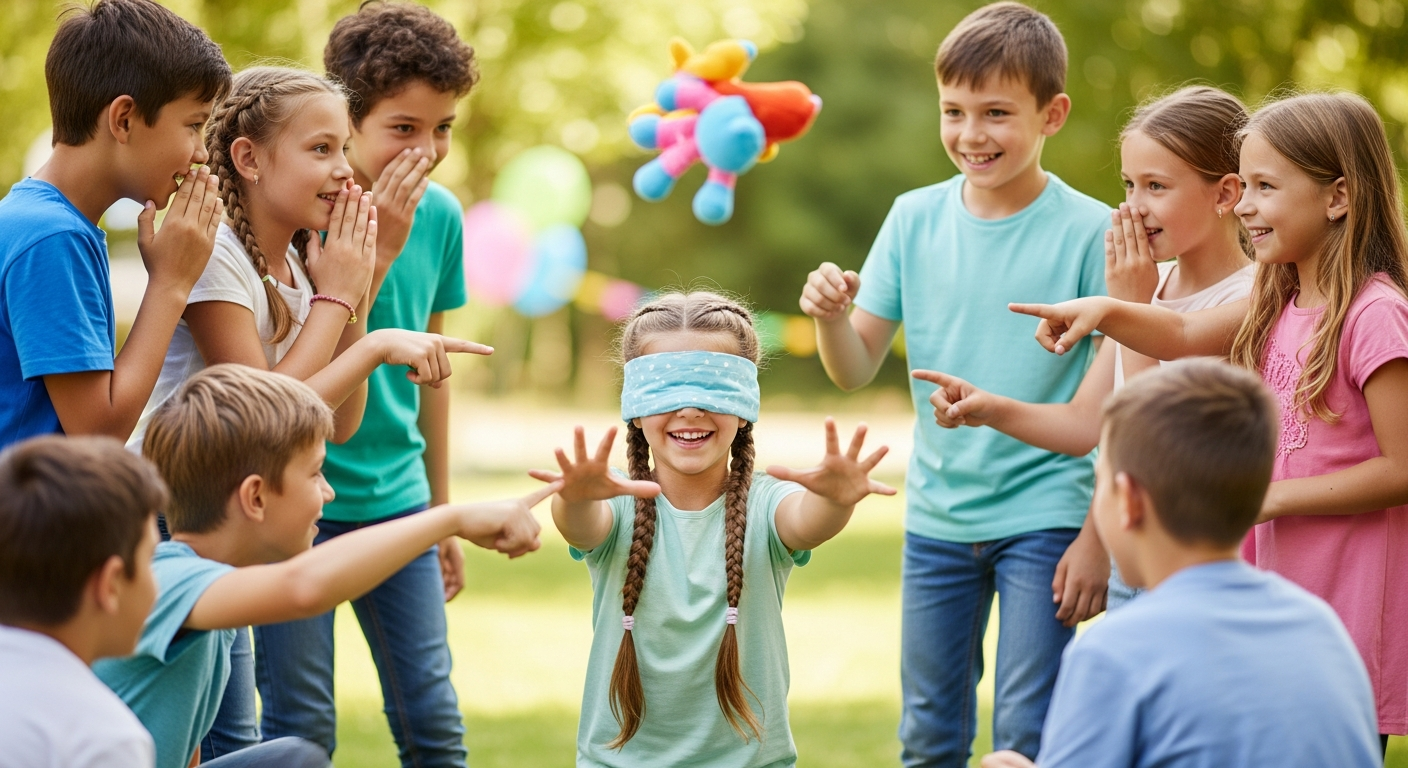
Table of Contents
- Introduction
- The Power of Play: How Party Games Boost Development
- High-Energy Active Games
- Quiet & Brainy Games
- Splashing Fun Water Games
- Creative & Unique Games
- Enhancing Communication in Every Game
- Conclusion: Play Your Way to Better Communication
- FAQ
Picture this: The decorations are up, the cake is ready, and a gaggle of excited children is about to burst through the door. As a parent, you want to create a magical, memorable experience – one filled with laughter, energy, and connection. But planning engaging activities that keep everyone entertained, happy, and even subtly learning, can feel like a daunting task. How do you move beyond passive entertainment and foster real interaction?
The secret lies in choosing the right party games. Far from just time-fillers, well-selected games are powerful tools for development, encouraging everything from physical coordination to critical thinking, and most importantly, boosting crucial communication skills. This post will dive into a treasure trove of fun and easy party game ideas for kids of all ages, offering practical tips to make your next celebration a roaring success. We believe that every moment is an opportunity for growth, and with these games, you’ll not only host an unforgettable party but also create a supportive environment where children can truly begin to speak their minds and hearts.

Introduction
Ever found yourself staring at a blank wall, wondering how to entertain a room full of energetic youngsters at a birthday party? You're not alone. The pressure to create a fun, memorable, and engaging experience can be immense. While sugary treats and colorful decorations play their part, it's often the games that truly make a party unforgettable. But what if those games could do more than just pass the time? What if they could actually help foster crucial developmental skills, including vital communication abilities?
This blog post is your ultimate guide to transforming ordinary gatherings into extraordinary adventures. We’ll explore a diverse collection of party games for kids, from high-energy outdoor romps to quiet, brain-teasing challenges, and exciting water-based fun. Each game description will not only provide clear instructions but also highlight its developmental benefits, with a special focus on how it encourages verbal interaction, listening, turn-taking, and expressive language. By the end of this article, you'll be equipped with a comprehensive toolkit of ideas to ensure your child's next party is not just fun, but also a meaningful step in their communication journey. Let's make every giggle and every shout a building block for confident self-expression!
The Power of Play: How Party Games Boost Development
Play is the universal language of childhood, and structured games are an incredible way to harness that power for developmental growth. Beyond the obvious fun, party games offer a rich environment for children to practice and refine a wide array of skills.
Physical and Motor Skill Development
Many games inherently involve movement, from running and jumping to throwing and balancing. These activities are vital for developing gross motor skills, coordination, and spatial awareness. Think of a child navigating an obstacle course or chasing a balloon – they’re not just playing; they’re building strength, agility, and a better understanding of their body in space. Fine motor skills, too, get a workout in games involving smaller manipulations, like sorting objects or building towers.

Cognitive and Problem-Solving Skills
Games often come with rules, challenges, and objectives that require children to think strategically. Memory games like Kim's Game, scavenger hunts, or even "Simon Says" demand focus, memory recall, and the ability to process information quickly. Problem-solving is at the core of many team-based games, where children must work together, strategize, and adapt to changing circumstances. These experiences lay foundational groundwork for academic success and critical thinking in everyday life.
Social and Emotional Learning
Perhaps one of the most significant benefits of party games is their contribution to social and emotional development. Children learn about:
- Turn-taking: A fundamental social skill, crucial for conversations and interactions.
- Cooperation: Working with others towards a common goal, sharing, and compromising.
- Sportsmanship: Learning to win graciously and lose with resilience, understanding that fun is more important than always being first.
- Empathy: Understanding the feelings of others, celebrating their successes, and offering comfort when needed.
- Self-regulation: Managing excitement, frustration, and impulse control, especially in competitive scenarios.
These interactions in a playful, low-stakes environment help children navigate complex social dynamics, building confidence and fostering positive relationships.
Communication Skills: Speaking Their Hearts and Minds
This is where party games truly shine as a powerful, natural catalyst for language and speech development. At Speech Blubs, our mission is to empower children to "speak their minds and hearts," and party games align perfectly with this philosophy. Our company was born from the personal experiences of our founders, who all grew up with speech problems and created the tool they wished they had – a joyful, effective way to develop communication skills. Games provide that "smart screen time" experience in a real-world setting, encouraging screen-free interaction and family connection.
Consider these communication benefits:
- Verbal Expression: Children use words to explain rules, ask questions, express excitement, negotiate, and describe actions. Games like Charades encourage non-verbal communication, while "I Spy" promotes descriptive language.
- Listening Comprehension: Following instructions, understanding cues, and listening to others' ideas are paramount in almost every game.
- Vocabulary Expansion: Encountering new words related to game actions, objects, and concepts naturally broadens a child's lexicon.
- Articulation Practice: In the excitement of play, children often vocalize sounds and words they might typically struggle with, reinforcing correct pronunciation in a fun, pressure-free context.
- Narrative Skills: Describing what happened during a game, retelling a funny moment, or explaining a strategy helps develop storytelling abilities.
For parents of children who need speech support, these moments are invaluable. Instead of passive viewing, games offer active participation, making communication a natural and joyful part of the experience. Much like our video modeling methodology, where children learn by watching and imitating their peers, many party games encourage imitation, observation, and direct interaction, building confidence and reducing communication frustration.
Unsure if your child could benefit from a little extra communication support? Take our quick 3-minute preliminary screener to get a simple assessment and a free 7-day trial. It involves just 9 simple questions and provides an assessment and next-steps plan. Take the Speech Blubs Screener Now!
High-Energy Active Games
These games are perfect for helping kids burn off some energy, especially at the start of a party. They promote gross motor skills, listening, and quick thinking.
1. Red Light, Green Light
- How to play: One person is the "stoplight" and stands at one end, facing away from the other players ("traffic") who line up at the opposite end. The stoplight calls out "Green Light!" and players move forward. When the stoplight suddenly yells "Red Light!" and turns around, all players must freeze. Anyone caught moving has to return to the starting line. The first person to tag the stoplight wins and becomes the new stoplight.
- Communication Benefit: Excellent for listening comprehension, understanding directives, and practicing self-regulation (the internal dialogue to "freeze!"). It also encourages clear vocalization from the "stoplight" player.
2. Capture the Flag
- How to play: Divide into two teams. Each team has a "flag" (a bandana, scarf, or even a toy) hidden in their territory. The goal is to steal the opposing team's flag and bring it back to your own base without being tagged. If tagged in the enemy's territory, you might be "frozen" until a teammate tags you free, or you might be out of the game for a round.
- Communication Benefit: Requires a lot of strategic communication – whispering plans, calling out enemy positions, and coordinating movements. It’s fantastic for developing teamwork and verbal strategizing.
3. Tug-of-War
- How to play: A classic group game. Two teams stand on opposite ends of a long, sturdy rope, with a marker (e.g., a scarf) tied to the middle of the rope and another two markers on the ground equidistant from the center. Each team pulls, trying to get the center marker past their designated ground marker.
- Communication Benefit: Encourages shouts of encouragement, coordinated pulling cues ("Pull! Pull!"), and understanding team dynamics. It’s a great way to vocalize effort and excitement.
4. Obstacle Course
- How to play: Design a course using household items or backyard equipment. Kids crawl under chairs, jump over cushions, weave around cones, or army-crawl through tunnels. Time each child to see who can complete it fastest, or simply let them enjoy the challenge.
- Communication Benefit: Following multi-step directions, describing actions ("I'm crawling!"), and cheering on peers. For a child learning sequencing, narrating the steps of the course can be very helpful.
5. Keep It Up (Balloon Game)
- How to play: The simplest games are often the most fun! Challenge a team of players to keep one or more balloons in the air for as long as possible without letting them touch the ground. Add a rule: no hands allowed, only heads or feet!
- Communication Benefit: Encourages shouts of "Mine!" or "Got it!" as children track the balloon. It fosters quick verbal responses and coordination.
6. Wheelbarrow Race
- How to play: Divide players into teams of two. One child holds another child's ankles, who then "walks" on their hands like a wheelbarrow. They race to a finish line.
- Communication Benefit: Partners must communicate about speed, direction, and when to stop or rest. It’s a great exercise in giving and following clear instructions.
7. Glow in the Dark Balloon Stomp
- How to play: Crack glow sticks and place one inside each balloon before inflating. Tie a balloon to each player's ankle. When the lights go out, the goal is to stomp and pop the balloons of other players while protecting your own. The last player with an intact balloon wins.
- Communication Benefit: Provides an exciting, sensory-rich environment where children use sounds to locate others, shout warnings, and express exhilaration.
Quiet & Brainy Games
Not every game needs to be a high-octane affair. These quieter games encourage listening, critical thinking, memory, and descriptive language, perfect for when it's time to wind down or focus minds.
1. Scavenger Hunt
- How to play: Hide a series of clues or objects around the party area. Children follow clues to find the next item, eventually leading to a treasure. This can be done individually or in teams. For a photo scavenger hunt, kids take pictures of items on a list.
- Communication Benefit: Reading and interpreting clues, describing what they're looking for, asking for help, and celebrating discoveries. Team hunts especially require group discussion and problem-solving language. Our Speech Blubs homepage has many articles with tips on how to plan engaging activities.
2. Simon Says
- How to play: A classic! One person is "Simon" and gives commands. Players only follow instructions that start with "Simon says." If Simon says, "Touch your nose," players touch their nose. If Simon simply says, "Jump," and a player jumps, they're out. The last player remaining wins.
- Communication Benefit: Superior for listening comprehension, understanding specific phrasing, and impulse control. Children must carefully process language before acting.
3. Charades
- How to play: Write various words or phrases on slips of paper (animals, actions, movie titles, party themes). Players take turns drawing a slip and acting out the word without speaking. The first person to guess correctly gets the next turn.
- Communication Benefit: Encourages non-verbal communication, descriptive guessing, and expanding vocabulary. It’s a fantastic way to link actions with words. For a child who struggles with expressive language, charades provides a low-pressure way to communicate ideas.
4. I Spy
- How to play: One person says, "I spy with my little eyes something..." and then describes an object they see (e.g., "something blue," "something soft," "something that starts with 'T'"). Other players guess what it is.
- Communication Benefit: Excellent for practicing descriptive language, expanding vocabulary related to attributes (color, texture, shape), and using initial sounds. For a child who might be a "late talker" or is working on specific sounds, it's a perfect low-pressure activity to practice words like 'green' or 'round'.
5. Kim's Game (Memory Game)
- How to play: Place a collection of small, everyday objects on a tray. Allow children to observe them for a minute. Cover the tray, then ask players to recall as many items as they can. For a harder version, remove one item after observation and ask what's missing.
- Communication Benefit: Enhances memory recall, vocabulary (naming objects), and descriptive language (explaining what they remember or what's missing). It's a great "quiet" game that requires concentration and focus.
6. Minute to Win It Games
- How to play: A series of quick, challenging games that can be completed in under a minute, often using inexpensive household items.
- Face the Cookie: Place a cookie on a player's forehead. Using only facial muscles, they must get it into their mouth.
- Stack Attack: Players must stack a certain number of items (e.g., plastic cups, candies) into a stable tower within a minute.
- Shamrock Shake (Junk in the Trunk): Tape an empty tissue box filled with ping-pong balls to a player's waist (like a tail). They must shake until all balls fall out.
- Don't Blow It: Using a straw, players blow a piece of flat candy (like a small paper cutout) from one point to another.
- Communication Benefit: These games are filled with anticipation, instruction following, and expressive reactions ("Oh no!", "Almost!"). They provide natural opportunities for encouragement, explanation, and celebrating small victories. They are also easily adaptable for various ages and developmental stages, just like our app, which features thousands of activities for children aged 1-8+. Our research shows that Speech Blubs ranks in the top tier of speech apps worldwide. You can learn more about the science behind our method here: Speech Blubs Research.
Splashing Fun Water Games
Perfect for outdoor parties on warm days, water games add an extra layer of excitement and sensory engagement.
1. Water Balloon Toss
- How to play: Partners stand a short distance apart and toss water balloons back and forth. After each successful catch, they take a step back, increasing the distance. The last pair with an unbroken balloon wins.
- Communication Benefit: Encourages clear calls for the ball, coordinating throws and catches, and expressing excitement or dismay. It’s a great way to practice spatial awareness vocabulary ("closer," "farther," "higher").
2. Sprinkler Tag
- How to play: Simply turn on a sprinkler! Designate one or two players as "it." The goal for "it" is to tag others while they run through the sprinkler's spray.
- Communication Benefit: Shouts of joy, warnings, and laughter fill the air. It’s a sensory-rich experience that prompts spontaneous vocalizations.
3. Marco Polo (Pool Party Game)
- How to play: One player closes their eyes (or wears a blindfold) and calls out "Marco!" Other players respond "Polo!" The "it" person tries to tag others by following their voices.
- Communication Benefit: Exceptional for auditory processing, vocalizing responses, and using spatial language ("left," "right," "closer"). It trains children to use and rely on sound cues.
4. Treasure Dig
- How to play: In a sandbox or large bin filled with sand (or even water for a twist), hide small waterproof toys, plastic animals, or "gems." Give children shovels or small digging tools to excavate their treasures.
- Communication Benefit: Sparks imaginative play, encourages descriptive language ("I found a shiny blue gem!"), and promotes sharing discoveries.
Creative & Unique Games
These games often involve a bit more setup but yield big rewards in terms of engagement and unique memories.
1. Saran Wrap Ball
- How to play: Wrap a large "prize" (e.g., a toy) in several layers of plastic wrap. Between layers, add smaller prizes like candies, stickers, or tiny toys. Players take turns unwrapping as quickly as possible while a timer or music plays. When the music stops or time runs out, whoever is holding the ball keeps whatever they've unwrapped from their current layer.
- Communication Benefit: Full of exclamations, negotiations, and discussions about the treasures found. It's a fun, suspenseful game that gets everyone talking.
2. Riddle Balloon Game
- How to play: Before inflating, place small slips of paper with riddles or answers inside balloons. Kids pop two balloons each, then work together to match riddles with their answers.
- Communication Benefit: Excellent for problem-solving, reading aloud, discussing possible solutions, and expanding vocabulary. It encourages cooperative communication.
3. Pass the Parcel
- How to play: Wrap a main prize in multiple layers of wrapping paper. Between layers, place small treats or trinkets. Children sit in a circle and pass the parcel around while music plays. When the music stops, the child holding the parcel unwraps one layer. The game continues until the final layer is unwrapped, and that child gets the main prize. Small treats can be given to everyone for participation.
- Communication Benefit: Teaches turn-taking, anticipation, and expressing excitement. It provides a structured, cooperative environment.
4. Donut on a String
- How to play: Hang donuts on strings at a height where children can reach them with their mouths. The challenge is to eat the entire donut without using hands!
- Communication Benefit: Leads to lots of giggles, encouragement, and humorous attempts at describing the messy, delicious struggle. It's a great lighthearted activity for all.
5. Piñata
- How to play: A classic for a reason! Hang a piñata filled with candies and small toys. Blindfolded children take turns trying to hit it with a stick until it breaks, releasing the goodies.
- Communication Benefit: Cheers, countdowns, and directional instructions ("Higher! Left!"). It's a high-energy activity that encourages loud, clear vocalizations and sharing the spoils.
Enhancing Communication in Every Game
No matter which games you choose, you can always enhance their communication benefits with a few simple strategies:
- Narrate and Describe: As children play, describe what they’re doing. "Look how fast Maya is running!" or "Leo found the blue car!" This models descriptive language.
- Ask Open-Ended Questions: Instead of "Did you have fun?" ask "What was your favorite part?" or "How did you solve that clue?" This encourages more detailed responses.
- Encourage Turn-Taking: Explicitly state whose turn it is and ensure everyone gets a chance to participate and speak.
- Model Clear Instructions: Use simple, concise language when explaining game rules. Break down complex instructions into smaller steps.
- Focus on the Process, Not Just the Outcome: Emphasize the fun of playing and trying, rather than just winning. This reduces pressure and fosters a love for communication.
Remember, at Speech Blubs, we believe in providing an immediate, effective, and joyful solution for the 1 in 4 children who need speech support. Our approach blends scientific principles with play, much like how these party games provide a rich, interactive environment. We offer screen-free alternatives to passive viewing and a powerful tool for family connection, using our unique "video modeling" methodology where children learn by watching and imitating their peers. This direct, imitative learning can be mirrored in how children learn communication through interactive play.
For instance, if you have a child who loves animals, our "Animal Kingdom" section offers a fun, motivating way to practice sounds like "moo" and "baa" by watching their peers. This direct imitation in the app can complement the imitative play encouraged in games like "Follow the Leader" or "Charades" at a party. The goal is always to build confidence, reduce frustration, develop key foundational skills, and create joyful family learning moments.
Ready to see how Speech Blubs can support your child's communication journey every day? Download Speech Blubs on the Apple App Store or Google Play Store to begin!
Conclusion: Play Your Way to Better Communication
Hosting a children's party is more than just an event; it's an opportunity to create cherished memories and support developmental growth. By thoughtfully selecting engaging party games, you can provide an environment rich in learning, laughter, and, most importantly, meaningful communication. From the boisterous energy of "Red Light, Green Light" to the focused observation of "I Spy" and the cooperative spirit of a scavenger hunt, each game offers unique pathways for children to practice listening, express themselves, and connect with their peers. These playful interactions are invaluable for building confidence, expanding vocabulary, and fostering a lifelong love for communication.
At Speech Blubs, we understand the profound impact that joyful, interactive experiences have on a child's ability to speak their minds and hearts. Our app is designed with the same spirit of fun and engagement, offering a "smart screen time" solution that complements the valuable, screen-free playtime you provide. We’re committed to supporting every child on their unique communication journey, transforming challenges into triumphs, one joyful sound at a time.
Don't miss out on empowering your child with the gift of confident communication. Ready to get started with a powerful supplement to their development? Create your account and begin your 7-day free trial today! We highly recommend choosing the yearly plan for the best value. Not only will you save 66% (making it just $4.99/month compared to $14.99/month), but it also unlocks exclusive features like the extra Reading Blubs app, early access to new updates, and 24-hour support response time. The monthly plan does not include these fantastic benefits.
Start your child's journey to clearer communication and discover the joy of speaking by signing up for your free trial and selecting the Yearly plan at Speech Blubs Account Creation or by downloading our app on the Apple App Store or Google Play Store today!
FAQ
Q1: How do party games specifically help with a child's speech and language development?
A1: Party games are fantastic for speech and language development because they create natural, motivating opportunities for communication. Children practice listening to and following instructions, using descriptive language to explain actions or objects (e.g., in "I Spy"), engaging in turn-taking conversations, and expressing emotions and needs verbally. The excitement of play often encourages more spontaneous vocalizations and attempts at new words or sounds, reinforcing good communication habits in a low-pressure environment.
Q2: What if my child is shy or reluctant to participate in group games?
A2: For shy children, start with games that allow for individual participation or smaller group interactions before moving to larger, more boisterous activities. Games like "I Spy" or a simple scavenger hunt can be less intimidating. Encourage their participation without pressure, emphasizing fun over winning. Adult involvement as a playful co-player can also help. Often, seeing others have fun will gradually draw them in. Remember that fostering a love for communication is a process, and every small step counts.
Q3: How do I choose the right party games for different age groups?
A3: When selecting games, consider the developmental stage of the majority of the children. For younger children (toddlers/preschoolers), opt for simple games with clear rules and lots of movement, like "Red Light, Green Light" or "Pop the Bubbles." For older children (school-age), introduce games that require more strategy, teamwork, or complex instructions, such as "Capture the Flag," "Charades," or "Minute to Win It" challenges. Always have a variety of options ready to adapt to the group's energy and interest levels.
Q4: Can Speech Blubs supplement the communication skills learned through party games?
A4: Absolutely! Party games provide wonderful real-world interaction, and Speech Blubs offers a focused, engaging, and scientifically-backed approach to reinforce and build upon those skills. While party games offer spontaneous communication, Speech Blubs provides structured "smart screen time" activities, utilizing video modeling to help children practice specific sounds, words, and conversational skills. It's a powerful supplement to a child's overall development plan, giving children the tools and confidence to communicate effectively in all social settings, including parties! Learn more about how we empower children at our Speech Blubs Homepage.
About the author