
Engaging Rainy Day Toddler Crafts for Home Fun
 By Speech Blubs Team•Feb 20, 2026•13 min.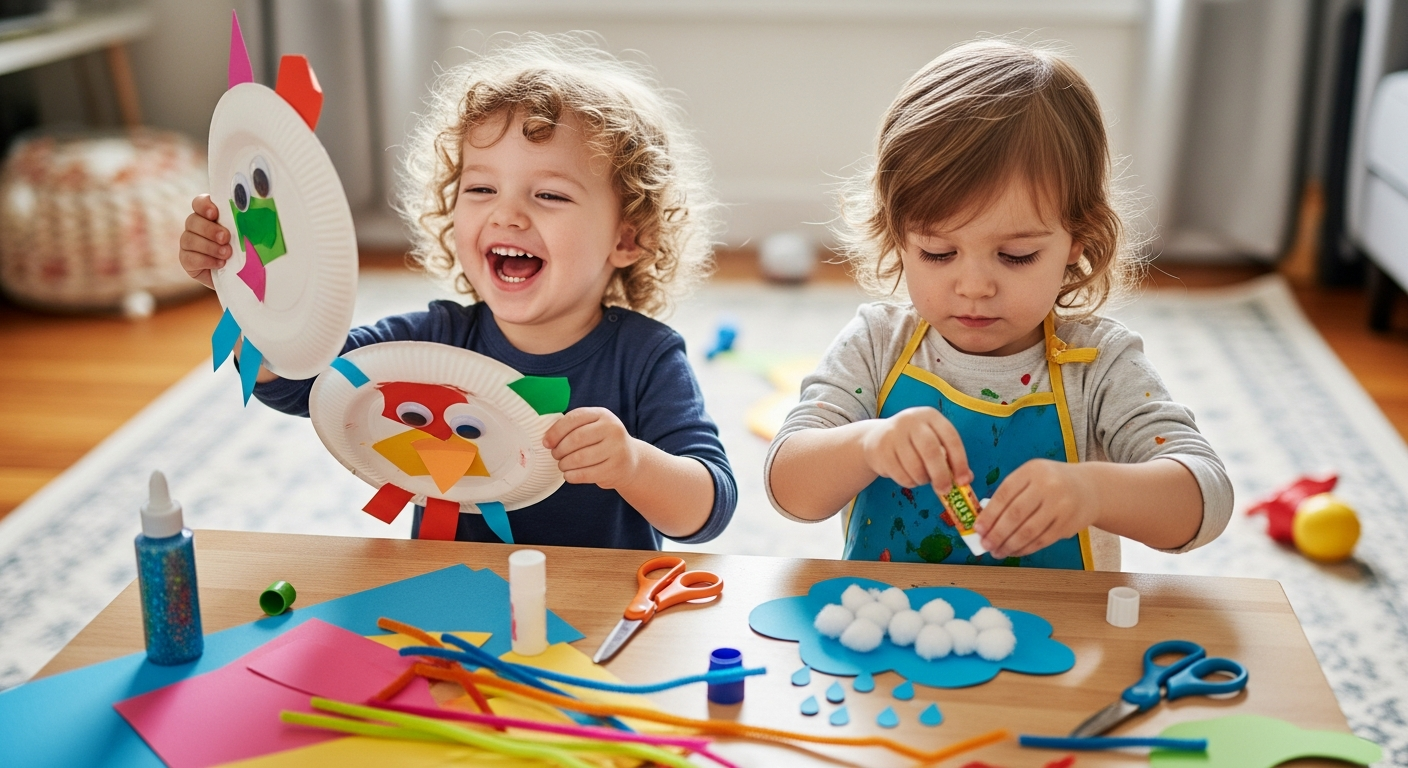
Table of Contents
- Introduction
- The Power of Creative Play on Rainy Days
- Setting Up Your Rainy Day Craft Station
- Sensory Rainy Day Crafts
- Fine Motor and Art-Based Crafts
- Integrating Speech Blubs into Your Crafty Day
- Practical Scenarios: Bringing Crafts to Life
- Building a "Rainy Day" Speech Kit
- Choosing the Right Plan for Your Family
- Why Process Over Product Matters
- Conclusion
- FAQ
Introduction
Have you ever watched the first raindrops hit the window and felt a tiny wave of panic, knowing your toddler’s trip to the playground is officially canceled? We have all been there. A rainy day with a cooped-up two-year-old can feel like a marathon with no finish line. However, at Speech Blubs, we believe these moments are hidden opportunities. When the clouds roll in, it is the perfect time to trade the swing set for the craft table and turn "stuck inside" into a morning of joyful connection and developmental growth.
The purpose of this post is to provide you with a treasure trove of rainy day toddler crafts that are not only easy to set up but also intentionally designed to boost your child’s communication and motor skills. We will explore sensory-rich activities, fine motor challenges, and ways to bridge the gap between digital learning and physical play. Our goal is to help you move past the frustration of a gray day and into a space of creative confidence.

At Speech Blubs, our mission is to empower children to speak their minds and hearts. We know that language development happens best when children are having fun, feeling safe, and interacting with their favorite people—you! By the end of this article, you will have a full toolkit of activities that foster a love for communication and turn every drizzle into a chance for a "smart screen time" breakthrough.
The Power of Creative Play on Rainy Days
When the weather keeps us indoors, our environment changes. The sounds are different, the light is dimmer, and the pace of the day often slows down. This is actually a wonderful thing for a child’s brain. Toddlers thrive on novelty, and a "craft day" provides a sensory experience that outdoor play often doesn’t.
Crafting is a multi-dimensional learning experience. When your child reaches for a blue crayon or squeezes a glue bottle, they aren't just making a mess; they are practicing bilateral coordination and hand strength. When they describe the "fluffy" cotton ball or the "wet" paint, they are building a robust vocabulary. We see these activities as the physical counterpart to what we do at Speech Blubs. Our app uses peer-led video modeling to encourage kids to imitate sounds and words, and crafting allows them to take those newfound communication skills and apply them to a tangible project.
Setting Up Your Rainy Day Craft Station
Before we dive into the specific rainy day toddler crafts, let’s talk about setup. The key to a stress-free crafting session is preparation. You don’t need a dedicated art studio; a kitchen table or even a cleared patch of floor will do.
- The "Messy" Mat: Keep an old shower curtain or a plastic tablecloth handy. This allows your toddler to explore without you worrying about the carpet.
- Accessibility: Place materials in low, open containers so your child can choose their "tools." This fosters independence and gives them the vocabulary of choice (e.g., "Do you want the red paper or the blue paper?").
- Safety First: Always use non-toxic, washable materials. Adult supervision is essential, especially when dealing with small items or safety scissors.
If you are looking for a way to assess where your child is currently at with their milestones before starting these activities, you can take our quick 3-minute preliminary screener. It involves 9 simple questions and provides an assessment and next-steps plan to help you tailor these crafts to your child’s specific needs.

Sensory Rainy Day Crafts
Sensory play is the foundation of early childhood learning. For toddlers, the world is understood through touch, sight, and sound. These crafts focus on the "feel" of a rainy day.
Fluffy Rain Clouds
This is a classic for a reason. It uses simple household items and targets fine motor "pincer" grasps.
- Materials: Paper plates, cotton balls, school glue, blue construction paper.
- The Process: Have your child glue cotton balls onto the paper plate until it looks like a big, puffy cloud. Then, help them cut out "raindrops" from the blue paper and tape them to the bottom of the plate using pieces of yarn.
- Language Boost: Use descriptive words like "soft," "sticky," "white," and "drip-drop." Ask your child, "Does the cloud feel fluffy?" This encourages them to use adjectives and engage in a back-and-forth dialogue.
Rain in a Bottle (Sensory Shakers)
If the sound of the rain is fascinating to your toddler, bring that sound inside.
- Materials: An empty plastic water bottle, dry rice or small beads, blue glitter, and blue food coloring (optional).
- The Process: Let your toddler help pour the rice into the bottle using a funnel. Add the glitter and water. Secure the cap with strong tape or hot glue (adults only).
- The Play: Shake the bottle slowly to hear the "patter" of the rain. This is a great way to practice verbs. "Shake, shake, shake!" or "Stop!"
For a parent whose 3-year-old "late talker" loves animals, you can even put small plastic ducks or frogs inside the bottle. As the child shakes the bottle, you can reference the "Animal Kingdom" section of our app to practice the "quack" or "ribbit" sounds he saw his peers making on the screen. To see how this method has worked for thousands of families, you can read our parent testimonials.
Fine Motor and Art-Based Crafts
As toddlers grow, they move from whole-hand grasping to more refined finger movements. These rainy day toddler crafts help bridge that gap.
The Painter’s Tape Masterpiece
This is perfect for toddlers who aren't quite ready for complex drawing but love to use color.
- Materials: Canvas or heavy paper, painter's tape, washable paint.
- The Process: Use the tape to create a "hidden" design or the child's initial on the paper. Let the toddler paint over the entire page—let them get messy! Once the paint is dry, peel off the tape to reveal the clean white lines underneath.
- Speech Connection: This activity is all about "discovering." Use phrases like "What’s under there?" and "Look! A letter!"
Paper Plate Umbrellas
- Materials: Half a paper plate, a pipe cleaner, markers, or stickers.
- The Process: Cut a paper plate in half. Let your toddler decorate the curved side with as many stickers and colors as they want. Poke a small hole in the bottom and hook a pipe cleaner through to act as the handle.
- The Goal: This helps with hand-eye coordination as they place stickers. It also provides a prop for imaginative play. You can "hide" under the umbrella together, which is a great time to practice "Where is [Child's Name]?" and "Peek-a-boo!"
Ready to see more ways to encourage these skills? Download Speech Blubs on the App Store to begin a journey of "smart screen time" that complements these hands-on activities.
Integrating Speech Blubs into Your Crafty Day
We know that many parents worry about screen time. However, at Speech Blubs, we advocate for "smart screen time"—an active, joyful, and shared experience rather than passive viewing. Our app was born from the personal experiences of our founders, who grew up with speech problems and wanted to create the tool they wished they had.
On a rainy day, Speech Blubs can serve as the inspiration for your crafts. Our unique approach uses video modeling, where children learn by watching and imitating their peers. If your child spends 10 minutes in the "Nature" section of the app watching a peer say "rain" or "cloud," their brain’s mirror neurons are firing. When you then transition to making a "Fluffy Rain Cloud" craft, you are reinforcing that neural pathway.
How to Co-Play with Speech Blubs:
- Watch Together: Sit with your child while they use the app.
- Imitate the Peers: When the child on the screen makes a sound, you make it too!
- Bridge to the Physical: After the session, say, "The boy in the app saw a big yellow sun. Should we make a yellow sun for our wall?"
Our method is backed by science, placing us in the top tier of speech apps worldwide. You can learn more about the science and research behind our video modeling methodology and how it helps 1 in 4 children who need speech support.
Practical Scenarios: Bringing Crafts to Life
Let’s look at a real-world scenario. Imagine a little girl named Mia. Mia is two and a half, and while she is starting to put two words together, she often gets frustrated when she can't communicate what she wants. It’s a Tuesday, it’s pouring rain, and Mia is starting to throw her toys.
Her dad decides to start a "Rainy Day Craft." He opens Speech Blubs to the "Yummy Time" section. They watch a peer name different fruits. Mia laughs at the funny filters. Then, Dad brings out some red and yellow play dough.
"Mia, let's make an apple like the boy did!" Dad says.
As they roll the dough, Mia says, "Apple!" Dad responds, "Yes, a big, red apple! Crunch, crunch!"
This interaction turns a potential meltdown into a moment of confidence-building. Mia isn't just "watching a screen"; she is engaging with a peer, her father, and a tactile material all at once. This is the essence of fostering a love for communication. You can start this same journey by downloading Speech Blubs on Google Play.
Building a "Rainy Day" Speech Kit
If you want to be prepared for the next storm, we recommend putting together a specific "Speech and Craft Box." Having these items ready to go will reduce your stress and make the transition to indoor play seamless.
- Visual Prompts: Printed pictures of common rainy day items (boots, umbrellas, puddles).
- Bubbles: Great for practicing "p" and "b" sounds ("Pop!," "Blow!").
- The Speech Blubs App: Ensure your subscription is active so you have access to over 1,500 activities.
- Basic Craft Supplies: Glue, construction paper, non-toxic markers, and play dough.
When you use these tools together, you aren't just passing the time. You are building foundational skills that will help your child "speak their minds and hearts" for years to come.
Choosing the Right Plan for Your Family
We want to be transparent and helpful as you decide how to integrate Speech Blubs into your routine. To build trust and provide the best experience for your child, we offer two primary plans.
Monthly Plan: $14.99 per month
This is a great "trial" option if you want to see how your child responds to the video modeling over a few weeks. However, please note that the monthly plan does not include the extra Reading Blubs app or the 7-day free trial.
Yearly Plan: $59.99 per year
The Yearly plan is our most popular choice and the clear best value. It breaks down to just $4.99 per month—a 66% savings compared to the monthly rate.
The Yearly plan includes:
- A 7-day free trial so you can explore everything risk-free.
- The Reading Blubs app, which helps transition your child from speech to early literacy.
- Early access to all new updates and content.
- Priority 24-hour support response time.
We encourage families to choose the Yearly plan to get the full suite of features and the most effective, long-term support for their child's development. You can create your account and begin your 7-day free trial today.
Why Process Over Product Matters
One of the most important things to remember when doing rainy day toddler crafts is that the "end result" does not matter. Your toddler’s rain cloud might look like a soggy grey blob. Their paper plate umbrella might be torn within five minutes. That is okay.
In the world of child development, the "process" is where the learning happens.
- The conversation you have while choosing colors.
- The laughter when a cotton ball gets stuck to a finger.
- The pride your child feels when they show you what they made.
At Speech Blubs, we avoid overpromising. We aren't going to tell you that a single craft or a week of using an app will have your child giving public speeches. Instead, we focus on the benefits of the journey: reducing frustration, building confidence, and creating those joyful family learning moments that stay with you long after the rain has stopped.
Conclusion
Rainy days don't have to be a source of stress. With a few simple rainy day toddler crafts and the support of Speech Blubs, you can turn a gloomy afternoon into a vibrant classroom of speech and discovery. Whether you are building a "Rain in a Bottle" or watching peers in the app model new sounds, you are providing your child with a powerful supplement to their overall development.
Remember, you are your child's best teacher and most important playmate. By engaging in adult co-play and utilizing "smart screen time," you are setting the stage for a lifetime of effective communication. We are honored to be a part of that journey with you.
Ready to transform your next rainy day? Start your 7-day free trial by downloading the Speech Blubs app today. Don’t forget to select the Yearly plan to unlock the best value, including the Reading Blubs app and early access to all our latest updates. Let's help your little one speak their mind and heart, one "drip-drop" at a time!
FAQ
What are the best rainy day toddler crafts for speech development?
The best crafts for speech are those that encourage "joint attention" and descriptive language. Activities like "Fluffy Rain Clouds" or "Sensory Shakers" are excellent because they allow you to use repetitive, simple words (e.g., "soft," "blue," "shake") while your child is physically engaged. Pairing these with the Speech Blubs app’s video modeling helps reinforce these sounds.
How can I make crafting less messy for a toddler?
Preparation is key! Use a "messy mat" (like an old shower curtain), choose washable and non-toxic supplies, and have a damp cloth nearby for quick clean-ups. You can also focus on "low-mess" crafts like tape art or sticker-based projects if you're in a space where you can't have a lot of spills.
Is screen time okay for toddlers on rainy days?
At Speech Blubs, we believe in "smart screen time." Instead of passive watching, we recommend interactive apps that encourage the child to participate, imitate, and speak. When used as a supplement to physical activities and with adult co-play, it becomes a powerful educational tool rather than just a distraction.
How does Speech Blubs help with late talkers?
Speech Blubs uses a peer-led video modeling methodology. When children see other children their age making sounds and words, it triggers mirror neurons in their brains, making them more likely to imitate the behavior. This approach is designed to build confidence, reduce frustration, and make the process of learning to speak a joyful, play-based experience.
About the author