
Engaging Toddler Writing Activities for Early Success
 By Speech Blubs Team•Feb 23, 2026•17 min.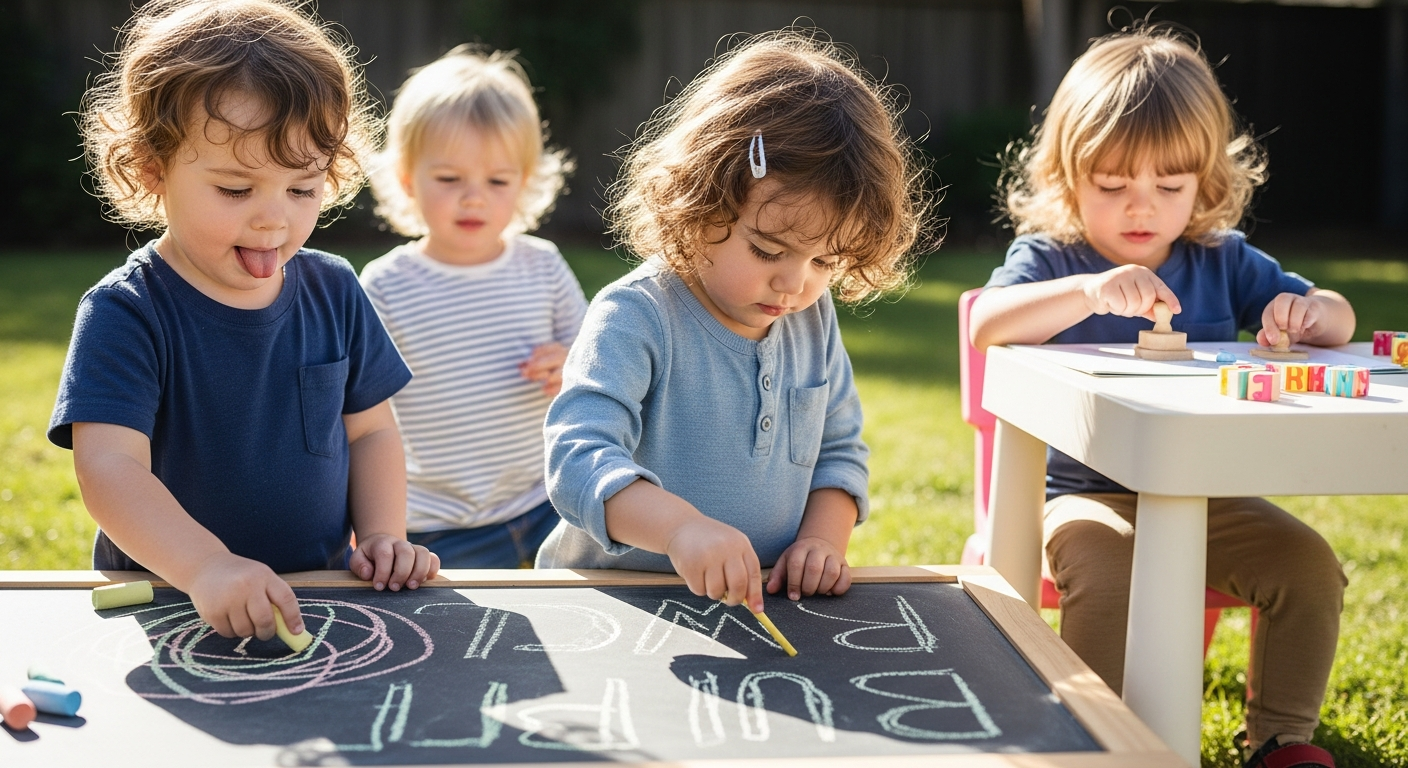
Table of Contents
- Introduction
- Why Writing Starts Long Before the Alphabet
- The Foundation: Pre-Writing Skills Every Toddler Needs
- Sensory Writing Activities: Making a Mark Without a Pencil
- Building Hand Strength: More Than Just Scribbling
- Vertical Writing: Why the Wall is Your Friend
- Using Technology as a Tool for Communication
- Engaging Toddler Writing Activities You Can Do at Home
- The Role of Family Connection in Learning
- Realistic Expectations: Fostering a Love for the Process
- Why Choose Speech Blubs for Your Child's Journey?
- Practical Scenario: From Frustration to Fun
- Summary of Key Takeaways
- Conclusion
- Frequently Asked Questions
Introduction
Have you ever walked into a room only to find your two-year-old proudly admiring a fresh, jagged "masterpiece" scrawled across your hallway wallpaper in bright red crayon? While your first instinct might be to reach for the scrub brush, that messy scribble is actually a monumental milestone. It is the beginning of your child’s journey toward communication, self-expression, and literacy. Many parents feel a sudden rush to buy alphabet workbooks the moment their child can hold a crayon, but the path to fluent writing is much more winding (and much more fun) than just tracing the letter "A" over and over.
In this guide, we are going to explore the world of toddler writing activities. We will look beyond the pencil and paper to understand the physical and cognitive foundations—like fine motor strength, hand-eye coordination, and spatial awareness—that make writing possible. You’ll discover how to transform everyday household items into powerful learning tools and how "smart screen time" can actually support these physical skills. Our mission at Speech Blubs is to empower children to speak their minds and hearts, and we believe that the journey to writing is a vital part of that communicative spark.

We will cover everything from sensory play and "mark making" to the specific physical exercises that prepare tiny hands for future school success. By the end of this article, you will have a toolkit of joyful, low-stress activities that foster a love for learning without the frustration of traditional "homework." Our goal isn't to turn your toddler into a novelist by next month; it’s about building the confidence and physical strength they need to express themselves clearly and joyfully.
Why Writing Starts Long Before the Alphabet
It is a common misconception that writing begins with letters. In reality, writing is a complex, whole-body process. Before a child can form a legible "B," they need a stable core to sit upright, strong shoulders to support their arms, and nimble fingers to grip a tool. This is why we often say that "play is the work of childhood."
Research shows that handwriting experience is critical for brain development. When a child physically forms a shape with their hand, it activates different neural pathways than simply tapping a screen or looking at a picture. This tactile experience helps the brain recognize letters more effectively when the child eventually starts to read. At Speech Blubs, we embrace this scientific connection between physical action and cognitive growth. Our founders, who all navigated speech challenges in their own childhoods, created our tools to be the "smart screen time" they wished they had—one that encourages active participation rather than passive scrolling.
When we talk about toddler writing activities, we are really talking about "pre-writing skills." These are the building blocks that prevent future frustration. If we force a child to hold a thin pencil before their hand muscles are ready, they may develop a "death grip" or poor habits that make writing painful or tiring later on. Instead, we focus on the journey: fostering a love for communication and building foundational skills through play.
The Foundation: Pre-Writing Skills Every Toddler Needs
Before your little one is ready for a notebook, they need to master several physical and mental "stepping stones." Think of these like the training an athlete does before a big game.

1. Fine Motor Control and Dexterity
Fine motor skills involve the coordination of small muscles in the hands and fingers. Your toddler needs these to perform the "pincer grasp"—using the thumb and index finger to pick up small objects. This is the same movement required to hold a pencil properly later in life.
2. Hand-Eye Coordination
This is the ability of the vision system to coordinate the information received through the eyes to control, guide, and direct the hands. Whether it’s popping bubbles or catching a ball, these actions teach the brain how to guide a tool across a page.
3. Spatial Awareness
Writing requires an understanding of "where" things are. A child needs to understand concepts like up, down, left, and right to know that a "d" has a belly on the left while a "b" has one on the right. Activities like building with blocks or solving puzzles are actually "writing" practice in disguise!
4. Visual Perception and Letter Recognition
Before they can write a letter, they must be able to see the difference between a circle and a square. We use "video modeling" in the Speech Blubs app to help children observe their peers performing sounds and shapes. This peer-to-peer imitation is a powerful way to build these recognition skills naturally.
Sensory Writing Activities: Making a Mark Without a Pencil
One of the best ways to engage a toddler is through sensory play. Engaging multiple senses—touch, sight, and even smell—makes the learning experience "stick" in their developing brains.
The Magic of Sand Trays
A simple tray filled with salt, flour, or colored sand is a fantastic writing tool. Invite your child to use their "magic pointer finger" to draw lines, circles, or zig-zags in the sand. This removes the pressure of "making a mistake" because a quick shake of the tray clears the canvas. For a child who might be hesitant to try new things, the low-stakes nature of a sand tray builds immense confidence.
Shaving Cream Fun
If you don't mind a little mess, spread some shaving cream on a plastic tray or right on the kitchen table. Let your toddler "paint" and scribble with their fingers. The smooth texture is highly motivating. You can even add a drop of food coloring to make it more visually stimulating. As they move their hands through the cream, they are strengthening their wrists and developing the muscle memory for fluid movements.
Squishy Sensory Bags
For a mess-free alternative, fill a resealable freezer bag with hair gel or a mix of flour and water with food coloring. Seal it tight (you can even tape it to the table for extra security). Your toddler can then "write" on the bag, seeing the gel move away to reveal the color beneath. This is perfect for practicing straight vertical and horizontal lines, which are the first "strokes" children usually master.
Parent Pro-Tip: Always follow your child's lead. If they want to draw "monsters" instead of lines, let them! The goal is "mark making"—the realization that their physical movement creates a visible result.
Building Hand Strength: More Than Just Scribbling
Writing is a physical workout for small hands. If a child's hands tire easily, they will eventually grow to dislike writing tasks. Here is how we can build that "hand stamina" through play.
Tweezers and Tongs
Squeezing a pair of kitchen tongs or child-safe tweezers is one of the best ways to strengthen the thumb and forefinger. You can set up a "transfer station" where your toddler moves pom-poms or large pasta shapes from one bowl to another. For a parent whose 3-year-old "late talker" loves animals, you might frame this as "feeding the birds" by moving "seeds" (pom-poms) into a toy nest. This ties into the same joyful approach we use in our video modeling methodology, where play and imitation drive development.
The Power of Playdough
Playdough is a staple for a reason. Rolling "snakes," pinching off small pieces, and squashing "pancakes" builds the intrinsic muscles of the hand. Once your child is comfortable, you can encourage them to form letters out of the "snakes." If they find this too difficult, you can draw a large letter on a piece of paper and have them lay the playdough on top of it. This provides a physical "guide" for their letter formation.
Clothespin Clipping
Opening a clothespin requires significant strength for a two- or three-year-old. You can turn this into a game by asking them to "clip the laundry" (scraps of fabric) onto a low string or the edge of a cardboard box. This repetitive squeezing motion is directly preparing them for the "tripod grasp" they will need for pencils later on.
Vertical Writing: Why the Wall is Your Friend
While we usually think of writing as something done sitting at a desk, vertical surfaces are actually better for young toddlers. Drawing on a wall-mounted chalkboard or a piece of paper taped to a door engages the shoulder and elbow.
When a child draws on a vertical surface, they have to work against gravity, which helps develop the stability in their upper body. It also encourages a better wrist position (slight extension), which is the ideal position for writing. If you find your toddler "hooking" their wrist when drawing on a table, try moving the paper to the wall. You might be surprised at how much more control they have!
Using Technology as a Tool for Communication
In a world full of passive cartoons, we believe in "smart screen time." At Speech Blubs, our app is designed to be a bridge to real-world interaction, not a replacement for it. We provide a powerful tool for family connection, encouraging parents to play alongside their children.
Our methodology is based on "video modeling," where children watch other children perform sounds and activities. This triggers "mirror neurons" in the brain, making the child more likely to imitate what they see. For a toddler working on pre-writing, seeing a peer joyfully engaged in a task can be the "spark" they need to try it themselves. If you are curious about your child's current development, you can take our quick 3-minute preliminary screener to get a simple assessment and see how our tools can support your journey.
Engaging Toddler Writing Activities You Can Do at Home
Here is a list of 10 easy-to-implement activities that focus on the different pillars of pre-writing.
- Sticker Paths: Draw a long, curvy line on a piece of paper and have your child place stickers all along the line. This builds hand-eye coordination and spatial awareness.
- Bubble Wrap Tracing: Write large letters on a sheet of bubble wrap. Have your child "trace" the letter by popping the bubbles. The tactile "pop" is a great reward!
- Water Painting: Give your child a cup of water and a paintbrush and let them "paint" on the driveway or sidewalk. The "disappearing" art is fascinating to toddlers and encourages large-scale arm movements.
- Paper Scrunching: Give your toddler old newspapers or scrap paper and encourage them to scrunch them into the tightest balls possible. This is incredible for hand strength.
- Dot Markers: Use "bingo daubers" or dot markers to fill in shapes or follow lines. This helps toddlers understand that "pressing" creates a mark.
- Salt Squeeze: Fill a plastic squeeze bottle (like an old ketchup bottle) with salt or sugar. Let your child "squeeze" lines and shapes onto a dark-colored tray.
- Lacing Cards: Use a hole punch on a piece of cardboard and let your child thread a shoelace through the holes. This is excellent for fine motor precision.
- Flashlight Tracing: In a dim room, use a flashlight to "draw" shapes on the wall and have your child follow the light with their own flashlight (or their finger).
- Cotton Swab Painting: Instead of a large brush, give your child a cotton swab. The small handle encourages a more precise grip.
- Magnetic Letter Roads: Tape a large letter to the table and have your child "drive" a small magnetic car along the "road" of the letter.
The Role of Family Connection in Learning
At the heart of every activity should be joy and connection. Our mission is to help children "speak their minds and hearts," and that starts with the safety and encouragement they feel from you. When you sit on the floor and roll playdough snakes together, you aren't just teaching them to write; you are building a bond.
We encourage "co-play." Don't just set the activity up and walk away; get your hands messy, too! Talk about what you are doing. "Look, I'm making a big, round circle. Can you make a circle, too?" This verbal labeling helps connect the physical action to the language, creating a holistic learning experience. You can see how this approach has helped thousands of families by reading our parent testimonials.
Realistic Expectations: Fostering a Love for the Process
It is important to remember that every child develops at their own pace. Approximately 1 in 4 children will need some form of speech or developmental support, and that is perfectly okay. Our founders created Speech Blubs because they were those children once. They wanted to provide an immediate, effective, and joyful solution that removes the "clinical" feel from learning.
Don't worry if your three-year-old isn't interested in tracing letters yet. Focus on the foundational skills. Are they getting better at using a spoon? Can they pull a sticker off a sheet? These are all "wins" on the road to writing. Our app serves as a powerful supplement to your child's development, but it works best when combined with these physical, real-world activities.
Our Promise: We don't promise that your child will be writing calligraphy in a month. We do promise to provide tools that make the process of learning to communicate—whether through speech or writing—a joyful, confidence-building experience for your whole family.
Why Choose Speech Blubs for Your Child's Journey?
When you choose to join the Speech Blubs family, you are getting more than just an app; you are getting a scientifically-backed tool designed by experts who care. We offer two clear paths for our members to ensure you get the best experience possible.
Transparent Pricing and Membership
We believe in being upfront about our value so you can make the best choice for your family.
- Monthly Plan: For $14.99 per month, you get full access to the Speech Blubs language therapy app.
- Yearly Plan (Best Value): For $59.99 per year (which is only $4.99 per month), you get the full suite of Speech Blubs features.
The Yearly Plan is our most popular choice because it includes:
- A 7-day free trial so you can explore the app risk-free.
- The Reading Blubs app, which perfectly complements the writing activities we've discussed today by focusing on early literacy.
- Early access to all our new updates and features.
- 24-hour support response time, because we know parenting doesn't stop for the weekend.
Choosing the Yearly plan ensures your child has a consistent, long-term tool to support their growth as they transition from "mark making" to early reading and writing. You can start your journey and create your account today to see the difference smart screen time can make.
Practical Scenario: From Frustration to Fun
Imagine Sarah, a mom of a 2.5-year-old named Leo. Leo is energetic but gets very frustrated when Sarah tries to get him to "draw." He often throws his crayons across the room. Instead of pushing the crayons, Sarah decides to try a vertical activity. She tapes a piece of bubble wrap to the fridge and draws a big "L" on it.
When Leo sees the bubble wrap, he is immediately curious. Sarah shows him how to pop the bubbles along the line of the "L." Leo laughs, his frustration vanishes, and he spends ten minutes "writing" his name with his fingers. By changing the sensory experience and the physical orientation, Sarah turned a moment of tension into a joyful learning win. This is the heart of what we do: finding the fun in the functional.
Summary of Key Takeaways
- Pre-writing is physical: Focus on core strength, shoulder stability, and fine motor dexterity before focusing on letters.
- Sensory play is key: Use sand, shaving cream, and playdough to make "mark making" a multi-sensory experience.
- Go Vertical: Taping paper to the wall helps toddlers develop better wrist and arm control.
- Hand strength matters: Activities like using tongs, squishing paper, and clipping clothespins build the muscles needed for a pencil grip.
- Smart screen time works: Tools like Speech Blubs use video modeling to encourage imitation and communication.
- Focus on the joy: The goal is to build confidence and a love for self-expression, not just "neat" handwriting.
Conclusion
The journey of a thousand miles begins with a single step—or in this case, a single scribble. By incorporating these toddler writing activities into your daily routine, you are doing so much more than teaching "skills." You are giving your child the tools to eventually share their thoughts, dreams, and stories with the world. Whether you are painting with water on the sidewalk or watching a peer on Speech Blubs, every moment of engagement is a brick in the foundation of their future success.
We invite you to join our community of parents who are dedicated to "smart," joyful learning. Our app is rated highly on the MARS scale for its educational quality, and our method is backed by the science of mirror neurons and peer imitation. We are here to support you every step of the way, providing a screen-free alternative to passive viewing and a way for your family to connect through play.
Ready to see your child's confidence soar? Download Speech Blubs on the App Store or Google Play Store today to begin. For the best value and access to our exclusive Reading Blubs app, be sure to select our Yearly Plan and start your 7-day free trial. Let’s help your little one speak—and eventually write—their mind and heart!
Frequently Asked Questions
1. At what age should my toddler start writing letters?
Most children aren't ready to form recognizable letters until they are 4 or 5 years old. However, the pre-writing journey begins as early as 12 to 18 months, when they first start to scribble. Focus on "mark making" and hand strength during the toddler years rather than perfect letter formation.
2. My child holds their crayon in a fist. Is this okay?
Yes! This is called a "palmar supinate grasp" and is a normal developmental stage for toddlers. As their hand and shoulder muscles get stronger, they will naturally move toward a "digital pronate grasp" and eventually the "tripod grasp" used by adults. You can encourage this progress by giving them smaller tools like broken crayon pieces or rock crayons.
3. How can I encourage a child who isn't interested in drawing?
Try to move away from paper and crayons. Many children who "hate drawing" love playing in a sand tray, squishing shaving cream, or using a flashlight to trace shapes on a wall. Find what motivates them—if they love cars, have them drive cars through a small amount of washable paint to make "tire tracks" on paper.
4. Does screen time hurt writing development?
Passive screen time (just watching cartoons) doesn't help physical development. However, "smart screen time" that encourages active participation, imitation, and sound-making—like Speech Blubs—can actually support the cognitive foundations of literacy. The key is to use technology as an interactive tool for family connection rather than a digital babysitter.
About the author