
Festive Christmas in July Toddler Crafts for Summer Fun
 By Speech Blubs Team•Feb 20, 2026•14 min.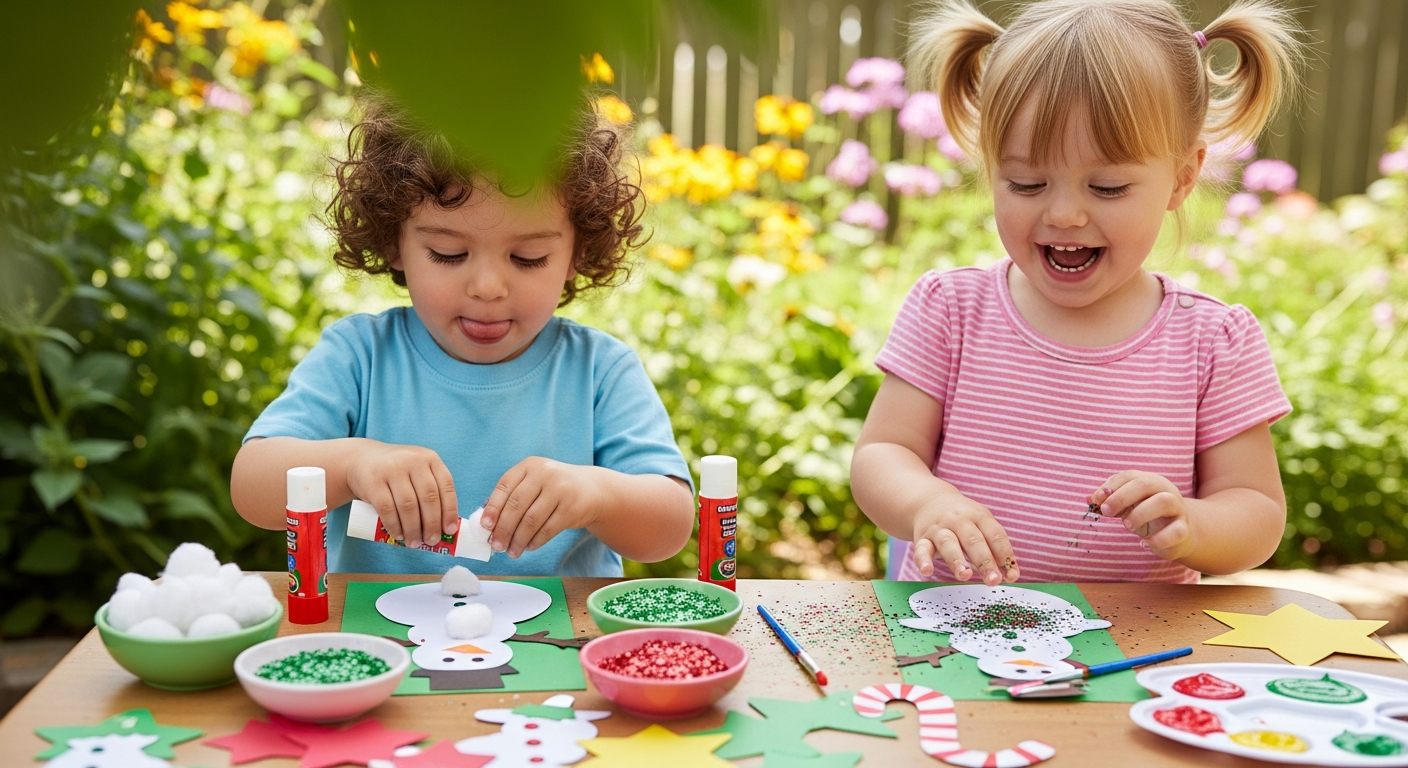
Table of Contents
- Introduction
- Why Celebrate Christmas in July with Your Toddler?
- The Science of "Smart Screen Time" and Peer Modeling
- Craft Idea 1: The Sand Snowman (Sensory & Speech)
- Craft Idea 2: Tropical Gingerbread Friends (Labeling Body Parts)
- Craft Idea 3: The Ice Cube "Ornament" Painting (Cause and Effect)
- Craft Idea 4: Handprint Palm Trees (Joint Attention)
- Setting Realistic Expectations for Your Child’s Progress
- Smart Screen Time: Why Speech Blubs is Different
- Maximizing Value: The Yearly Plan vs. Monthly Plan
- Tips for Success: Narrating Your Crafting Session
- Conclusion
- FAQ Section
Introduction
Have you ever found yourself staring at a pile of sand on a sweltering July afternoon, wishing it were a blanket of snow just so your toddler would stay engaged for more than five minutes? We’ve all been there. The "summer slump" is a real challenge for parents, where the heat makes outdoor play difficult and the routine starts to feel a bit stale. But what if we told you that you could bring the magic of the holiday season into the peak of summer to spark joy, creativity, and—most importantly—language development? Welcome to the wonderful world of Christmas in July toddler crafts.
At Speech Blubs, our mission is to empower every child to "speak their minds and hearts." We know that for many families, the journey to clear communication can feel like an uphill climb. Our company was born from the personal experiences of our founders, who all grew up with speech challenges themselves. They created the tool they wished they had as children—a way to turn "screen time" into "smart time." By blending scientific principles with the pure joy of play, we provide an immediate and effective solution for the 1 in 4 children who need speech support.

In this comprehensive guide, we are going to explore how festive crafting can be a powerful catalyst for your child's communication skills. We’ll dive into the science of why holiday themes resonate so well with toddlers, provide a curated list of easy-to-do Christmas in July crafts, and show you how to narrate these activities to boost your little one’s vocabulary. Whether you are dealing with a "late talker" or simply want to foster a love for learning, these activities are designed to create joyful family moments and build foundational skills.
Why Celebrate Christmas in July with Your Toddler?
The concept of Christmas in July might seem like a quirky marketing gimmick, but for a developing toddler, it is a goldmine of sensory and cognitive opportunities. Toddlers thrive on novelty. When we take the familiar imagery of Christmas—snowmen, trees, and bright colors—and place them in the unexpected context of summer, we pique their natural curiosity.
Breaking the Routine for Better Learning
Children are often most receptive to learning when their routine is gently disrupted by something exciting. A "Beach Snowman" or a "Tropical Gingerbread Man" isn't just a craft; it's a conversation starter. It forces the brain to make new connections. "Why is the snowman wearing sunglasses?" or "Where is the gingerbread man’s hula skirt?" These questions, even if your child isn't yet speaking in full sentences, encourage them to process complex ideas and seek out the labels for what they see.
Sensory Stimulation and Language
Speech development is deeply tied to sensory exploration. When a child touches the "crunchy" glitter, the "sticky" glue, or the "cold" ice used in summer-themed holiday crafts, they are building a sensory map of the world. At Speech Blubs, we emphasize that language is more than just sounds; it’s the ability to describe lived experiences. By engaging in these crafts, you are giving your child the "raw materials" for speech.
Reducing Frustration Through Joyful Play
For children with speech delays, frustration is a common hurdle. When a child can't express what they want, they might act out. Crafting provides a non-verbal outlet for expression. It’s an opportunity for "joint attention," where you and your child focus on the same task. This shared focus is the literal birthplace of communication. By making these moments joyful and low-pressure, you are building the confidence your child needs to try new sounds and words.

The Science of "Smart Screen Time" and Peer Modeling
Before we jump into the crafts, it’s important to understand how children learn to communicate. One of the core methodologies we use at Speech Blubs is "video modeling." This isn't passive viewing like watching a cartoon; it’s a scientifically-backed approach where children watch their peers perform specific mouth movements and sounds.
The Power of Mirror Neurons
When your toddler watches another child on a screen say a word or make a funny face, their "mirror neurons" fire. These are the same neurons that would fire if the child were performing the action themselves. This makes imitation—the highest form of learning for a toddler—much more likely.
We provide a screen-free alternative to the passive consumption of media. Our app serves as a "digital buddy" that encourages your child to participate. If you’re unsure where your child stands in their development, we recommend you take our quick 3-minute preliminary screener. It involves 9 simple questions and provides an assessment and a next-steps plan to help you support your child’s unique journey.
From Screen to Real Life
The goal of using an app like Speech Blubs is always to transition those skills into the real world. That is where our Christmas in July crafts come in. You can use the app to practice holiday-related sounds in the "Yummy Time" or "Animal Kingdom" sections, and then bring those sounds to life while you glue, paint, and create together.
Craft Idea 1: The Sand Snowman (Sensory & Speech)
This is a classic Christmas in July favorite. Instead of white, fluffy snow, we use the textures of the beach to create a winter icon.
What You’ll Need:
- Cardstock or heavy paper
- Sand (or light brown sandpaper)
- Glue sticks
- Googly eyes
- Small shells or buttons
- Orange paper for a "carrot" nose
How it Supports Speech: For a parent whose 3-year-old "late talker" loves sensory play, the Sand Snowman is a perfect motivator. As your child touches the sand, model the "S" sound. "Sss-sand! It’s sss-scratchy!" This focuses on sibilant sounds in a natural, fun way.
Steps:
- Draw three circles on the paper (top, middle, bottom).
- Have your child spread glue inside the circles. This works on fine motor "pincer" grasps.
- Pour the sand over the glue. Narrate the action: "Pour, pour, pour! More sand?"
- Shake off the excess. "All gone!"
- Add the shells as buttons. "One, two, three shells."
- Finish with sunglasses or a tiny sun hat to give it that July flair!
Craft Idea 2: Tropical Gingerbread Friends (Labeling Body Parts)
Gingerbread men are usually associated with ovens and cold kitchens, but these little guys are ready for a pool party.
What You’ll Need:
- Brown foam or cardstock cut into gingerbread shapes
- Colorful paper for "swim trunks" or "hula skirts"
- Flower stickers or tiny leis
- Markers
How it Supports Speech: This activity is fantastic for teaching body parts and clothing vocabulary. Our scientific research shows that children learn best when they can relate a concept to themselves.
Steps:
- Give your child the gingerbread shape. Ask, "Where are his eyes?"
- Encourage them to stick on the eyes. Use the "Pop" sound when they press them down.
- Help them "dress" the gingerbread person. "Put on the skirt. On his legs!"
- Add a flower to the head. "Up high! On his head."
- Practice the "Mmmm" sound for "Mmmm, gingerbread!" even though this one is made of paper.
Craft Idea 3: The Ice Cube "Ornament" Painting (Cause and Effect)
Nothing says summer like ice, and nothing says Christmas like ornaments. Let’s combine them for a cooling, artistic experience.
What You’ll Need:
- Ice cube tray
- Water and food coloring
- Popsicle sticks
- Large paper cut into a bauble or tree shape
How it Supports Speech: This craft introduces early science concepts and descriptive adjectives. You can talk about "cold," "wet," "melting," and "colors." If your child is using Speech Blubs, they might have already practiced color names in our "Color This" section. This is the perfect time to reinforce those words.
Steps:
- Freeze colored water in a tray with popsicle sticks sticking out (these are your "brushes").
- Once frozen, give your child a large paper "ornament."
- Let them "paint" with the melting ice.
- Narrate the change: "Look, the ice is melting! It’s turning into water."
- Ask choices: "Do you want Red ice or Blue ice?" This encourages "mand-ing" or requesting.
Craft Idea 4: Handprint Palm Trees (Joint Attention)
Instead of a traditional evergreen, let’s make a tropical Christmas tree using your child's handprints.
What You’ll Need:
- Green and brown washable paint
- Large paper
- Finger paints or small stickers for "ornaments"
How it Supports Speech: Handprint crafts require cooperation and "joint attention." You are working together on one masterpiece. This builds the social foundations of communication. For many parents, seeing their child's progress is the biggest reward. You can read testimonials from other parents who have used similar play-based strategies to see real-world success.
Steps:
- Paint your child’s arm brown and press it onto the paper to make the "trunk."
- Paint their palm green and press it at the top multiple times to create the palm leaves.
- Once dry, use fingers to "dot" on colorful Christmas lights.
- Practice the "L" sound for "Lights! Look at the lights!"
Setting Realistic Expectations for Your Child’s Progress
While these crafts are wonderful for development, we want to ensure you have a healthy perspective on your child’s growth. It is important to avoid the "guaranteed results" trap. Every child is unique and follows their own timeline.
Fostering a Love for Communication
The primary goal of these activities isn't to have a toddler giving public speeches by August. The goal is to foster a love for communication. We want your child to want to interact with you. When they point to a shell on their sand snowman and look at you for a reaction, that is a massive win. That is a communication milestone.
The Role of Professional Support
We frame our app and these activities as a powerful supplement to a child’s overall development plan. If your child is currently seeing a Speech-Language Pathologist (SLP), these crafts are excellent "homework" that feels like play. Always remember that adult co-play is the "secret sauce." The app and the crafts are tools, but you are the most important part of the equation.
Smart Screen Time: Why Speech Blubs is Different
In an era where parents are often told that all screen time is "bad," we want to offer a different perspective. Not all digital experiences are created equal. Passive viewing—where a child sits silently watching bright lights and fast-moving characters—can sometimes lead to "zombie mode."
Active Engagement
Speech Blubs is designed for active engagement. Our "smart screen time" experiences require the child to respond, imitate, and interact. We use a "wait and see" approach in our videos, giving the child space to try the sound themselves.
"Our mission is to provide an immediate, effective, and joyful solution for the 1 in 4 children who need speech support, blending scientific principles with play into one-of-a-kind 'smart screen time' experiences."
By choosing Speech Blubs, you are choosing a tool that was built by people who understand the struggle firsthand. We want to provide you with a screen-free alternative to the "noise" of the internet, focusing instead on meaningful family connection.
Maximizing Value: The Yearly Plan vs. Monthly Plan
We believe in being transparent about how you can best support your child while being mindful of your family budget. We offer two main ways to access the full suite of Speech Blubs features:
- Monthly Plan: $14.99 per month. This is a great way to test the waters if you're just starting out.
- Yearly Plan: $59.99 per year.
Why the Yearly Plan is the Best Choice
The Yearly plan is far and away the superior value for families committed to seeing progress over time. When you break it down, it costs just $4.99 per month—which is a 66% saving compared to the monthly rate.
Furthermore, the Yearly plan includes exclusive, high-value features that are not available on the monthly plan:
- A 7-Day Free Trial: You can explore everything we have to offer for a full week before committing.
- Reading Blubs App: You get full access to our companion app, Reading Blubs, which focuses on early literacy and phonics—the natural next step after speech.
- Priority Support: Enjoy a 24-hour support response time and early access to all new content updates.
To get the full suite of features and the best possible start for your child, we encourage you to sign up for the Yearly plan and start your free trial today.
Tips for Success: Narrating Your Crafting Session
To turn a simple craft into a speech therapy session, you need to "become the narrator." Here is how you can do it effectively:
- Parallel Talk: Describe what your child is doing as they do it. "You are rubbing the glue. Sticky, sticky glue!"
- Self-Talk: Describe what you are doing. "I am cutting the paper. Snip, snip, snip."
- Expansion: If your child says one word, give them back two. If they say "Tree," you say "Green tree!"
- The Power of the Pause: This is the hardest part. After you ask a question or model a sound, wait for 5 to 10 seconds. Give their little brain time to process and formulate a response.
Conclusion
Christmas in July toddler crafts are more than just a way to pass a hot afternoon; they are a bridge to better communication. By combining these hands-on, sensory experiences with the scientific power of Speech Blubs, you are giving your child a head start in "speaking their minds and hearts."
We’ve seen firsthand how a little bit of "smart screen time" paired with joyful family play can reduce frustration and build the confidence a child needs to navigate the world. Remember, the journey of a thousand words begins with a single "pop," "moo," or "snap."
Are you ready to turn this summer into a season of breakthrough? Download Speech Blubs on the App Store or get it on Google Play to begin. We highly recommend selecting the Yearly Plan during checkout to unlock your 7-day free trial, the Reading Blubs app, and the best long-term value for your family. Let’s make some holiday magic together!
FAQ Section
1. Is my toddler too young for Christmas in July crafts?
Not at all! Even 18-month-olds can participate in sensory-heavy crafts like the "Sand Snowman" or "Ice Painting." For younger toddlers, focus less on the final product and more on the textures, colors, and sounds. Always ensure all materials are non-toxic and provide constant supervision to prevent choking hazards.
2. How do these crafts actually help with my child's speech delay?
Crafts encourage "joint attention," "imitation," and "fine motor development," all of which are foundational for speech. By narrating the actions (e.g., "glue," "cut," "cold"), you are providing a rich linguistic environment. When these activities are paired with the video modeling in Speech Blubs, your child sees a word, hears a word, and then experiences the concept in real life.
3. What if my child isn't interested in crafting and just wants to play with the glue?
That’s perfectly fine! Playing with the glue is the activity. Use that interest to build language. "Oh, sticky fingers! Sticky, sticky!" Follow your child’s lead. If they want to dump all the sand in one spot, talk about a "mountain of sand." The goal is interaction, not a perfect Pinterest result.
4. How long should we spend on the app versus doing crafts?
We recommend "smart screen time" in short bursts—about 10 to 15 minutes a day. Use that time to practice specific sounds or themes (like colors or animals). Then, spend the next 20 to 30 minutes doing a related craft. This "blended learning" approach helps the child generalize what they learned on the screen into their physical world.
About the author