
Festive Fun: 25 Homemade Christmas Games for Kids
 By Speech Blubs Team•Dec 24, 2025•18 min.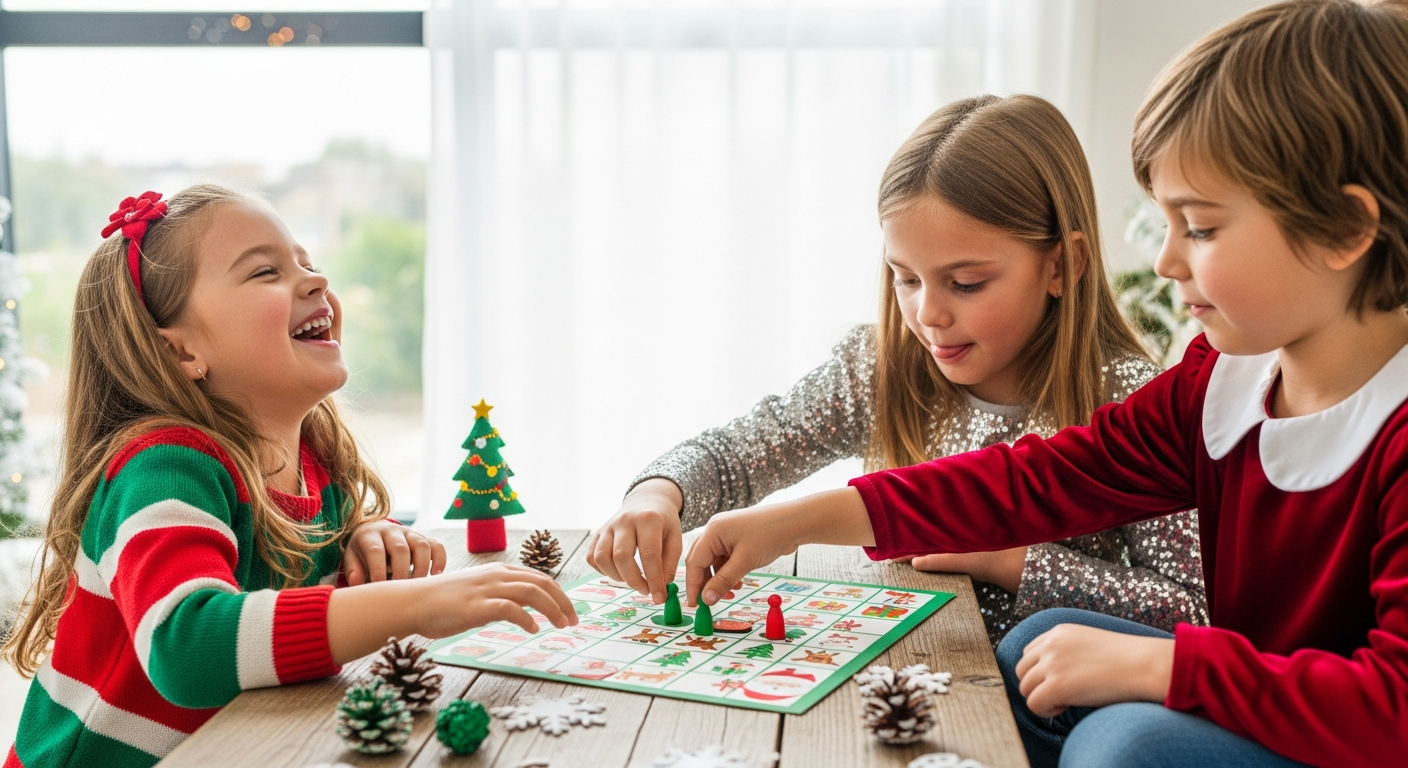
Table of Contents
- The Magic of Play: More Than Just Games
- Our Top 25 Homemade Christmas Games for Kids
- Integrating Speech Blubs into Your Holiday Routine
- Conclusion
- Frequently Asked Questions
The holiday season, with its twinkling lights and festive melodies, often brings a whirlwind of activity. Amidst the flurry of gift-wrapping and cookie-baking, how often do we truly pause to create meaningful, screen-free memories with our children? We often focus on elaborate gifts, but sometimes the greatest treasures are the shared moments of laughter and connection. This blog post dives into the magic of homemade Christmas games, offering a treasure trove of simple, engaging activities that promise laughter, connection, and a fantastic boost for your child's communication skills.
We’ll explore why these games are more than just fun, delve into specific activities perfect for various ages, and discover how playful interaction is a powerful catalyst for speech and language development, often alongside invaluable tools like Speech Blubs. By embracing the joy of simple, homemade Christmas games, families can not only forge unforgettable holiday memories but also nurture their children's ability to speak their minds and hearts, creating confident communicators for life.

The Magic of Play: More Than Just Games
Before we dive into the festive fun, let's understand why engaging in games, especially homemade ones, is so incredibly beneficial for children. Beyond the obvious joy and entertainment, these activities are powerhouses for development. They lay crucial groundwork for cognitive skills, social-emotional growth, and, most importantly for us at Speech Blubs, fundamental communication abilities.
At Speech Blubs, our mission is to empower children to speak their minds and hearts. Our company was born from a very personal place: our founders all grew up with speech problems and created the tool they wished they had. We understand the challenges and the immense joy that comes with every new word and clear sentence. This commitment drives us to blend scientific principles with play, creating one-of-a-kind "smart screen time" experiences that complement the rich, interactive learning that happens through games like the ones we’re about to share.
How Homemade Games Boost Speech and Language
Games provide a natural, low-pressure environment for children to practice and expand their communication skills. Think about it:
- Vocabulary Expansion: Every new game, object, or action introduces new words. "Gingerbread," "stack," "toss," "jingle," "unwrap" – the list is endless.
- Following Instructions: Games require listening and understanding multi-step directions, a critical skill for language comprehension.
- Turn-Taking and Social Cues: Learning to wait, share, and respond to others is vital for conversational skills.
- Expressing Wants and Needs: Children learn to ask for "more," "my turn," or express "I won!"
- Descriptive Language: Encouraging children to describe what they see, feel, or do during a game ("It's red and sticky!" "The tower is tall!") builds a richer vocabulary.
- Problem-Solving and Reasoning: Figuring out strategies, dealing with winning or losing, and adapting to rules all encourage verbal processing.
- Sound Production and Articulation: Many games involve making sounds or repeating phrases, which can help practice specific phonemes.
This isn't just theory; it's the foundation of effective communication development. And just like our app uses "video modeling" – where children learn by watching and imitating their peers – these games offer a similar, real-world opportunity for children to observe, mimic, and practice in a supportive, fun family setting.

If you're ever unsure about your child's communication development, we offer a quick 3-minute preliminary screener to provide an assessment and next-steps plan. It involves just 9 simple questions and can offer valuable insights.
Our Top 25 Homemade Christmas Games for Kids
Get ready to transform your living room into a hub of holiday cheer with these easy-to-set-up, incredibly fun games. Many require minimal supplies, often things you already have at home!
Active & Energetic Games
These games are perfect for burning off some holiday excitement and getting everyone moving!
1. Gingerbread Shuffle
- Supplies: Small gingerbread cookies (or crackers), one per player.
- How to Play: Each player places a gingerbread cookie on their forehead. On "Go!", players must get the cookie from their forehead to their mouth without using their hands. The first to succeed wins!
- Speech & Language Boost: Great for following a simple instruction, using body parts vocabulary ("forehead," "mouth"), and expressing excitement ("I did it!"). You can also encourage sounds of frustration or triumph.
2. Candy Cane Slide
- Supplies: A box of candy canes for each player.
- How to Play: Each player holds a candy cane in their mouth with the hook facing down. On "Go!", players have one minute to hook as many other candy canes onto the one in their mouth as possible. The player with the most hooked on wins.
- Speech & Language Boost: Encourages counting, practicing "more" and "less," and describing actions ("I'm hooking," "It fell!"). The focus on quiet concentration also highlights non-verbal communication and focus.
3. Tannenbaum Avalanche
- Supplies: Small, red plastic cups (or any small cups).
- How to Play: Each player gets a stack of cups. On "Go!", players have one minute to build the tallest Christmas tree possible by stacking the cups. The tallest tree wins. You can measure with a ruler or count rows.
- Speech & Language Boost: Excellent for spatial concepts ("tall," "taller," "top," "bottom"), counting, and using action verbs ("stack," "build," "fall"). Kids can narrate their building process.
4. Oh, Christmas Tree (Whipped Cream Edition)
- Supplies: One can of whipped cream and one paper plate per player.
- How to Play: Give each player a can of whipped cream and a plate. On "Go!", players must spray the whipped cream on the plate to form a Christmas tree. At the end of one minute, the player with the tallest or best-looking tree wins.
- Speech & Language Boost: Encourages descriptive language ("fluffy," "white," "tall"), expressing preferences ("Mine is better!"), and understanding comparisons. It's also a silly, sensory experience that can spark conversation.
5. Snowball Toss
- Supplies: Soft "snowballs" (crumpled white paper, cotton balls, or plush snowballs), buckets or baskets.
- How to Play: Set up buckets at different distances. Kids take turns tossing snowballs for points. Assign bonus points for harder targets.
- Speech & Language Boost: Counting, spatial awareness ("close," "far," "in," "out"), requesting ("My turn!"), and celebrating ("Yay! I made it!"). For younger children, focus on the action verb "toss."
6. Reindeer Antler Ring Toss
- Supplies: Inflatable reindeer antlers (or homemade cardboard antlers) and rings (could be hula hoops, pipe cleaner rings, or even cut-out cardboard rings).
- How to Play: One person wears the antlers while others toss rings, trying to hook them onto the antlers. Players take turns wearing the antlers.
- Speech & Language Boost: Great for asking questions ("Can I try?"), giving instructions ("Aim higher!"), counting, and using action words ("toss," "catch," "hook").
7. Santa Limbo
- Supplies: A string of Christmas lights or a broomstick, pillows for "Santa bellies."
- How to Play: Two adults hold the "limbo stick." Kids stuff a pillow under their shirt to be "Santa." Play holiday music and have them limbo under the stick. Lower it with each round.
- Speech & Language Boost: Encourages "how low," "go under," "belly," and sounds of exertion ("Oof!"). It’s a fantastic gross motor activity that naturally encourages expressive language through movement.
8. Ornament Spoon Race
- Supplies: Plastic ornaments, spoons.
- How to Play: Kids balance a plastic ornament on a spoon and race from a start to finish line. If it drops, they start over.
- Speech & Language Boost: Focuses on careful instructions, spatial words ("on top," "don't drop"), and self-talk ("Careful!"). This is excellent for developing focus and the language associated with fine motor control.
9. Present Stacking Challenge
- Supplies: Empty boxes wrapped in festive paper (various sizes).
- How to Play: Challenge kids to stack the boxes into the tallest "gift tower" in a set time (e.g., 60 seconds).
- Speech & Language Boost: Comparison words ("tall," "taller," "biggest," "smallest"), counting, problem-solving vocabulary ("balance," "strategy"), and expressing frustration or success.
Quiet & Creative Games
When you need a moment of calm or want to encourage imaginative play, these games are perfect.
10. Holiday Memory Game
- Supplies: Cardboard squares, holiday stickers (or printed holiday images), glue.
- How to Play: Create matching pairs of holiday-themed cards. Lay them face down and take turns flipping two over to find a match.
- Speech & Language Boost: Reinforces vocabulary ("Santa," "reindeer," "star"), memory skills, turn-taking, and descriptive language ("It's a bell! No, it's not a bell.").
11. Pin the Nose on Rudolph (or Star on the Tree)
- Supplies: Large drawing of Rudolph (or a Christmas tree), red sticky bows (or a paper star with tape), blindfold.
- How to Play: Blindfold players, spin them gently, and have them try to "pin" the nose or star in the correct spot.
- Speech & Language Boost: Excellent for following multi-step directions, giving positional words ("left," "right," "up," "down"), and expressing anticipation and laughter.
12. Christmas Movie Bingo
- Supplies: Printable Christmas movie bingo cards, markers (e.g., mini marshmallows, candy corn).
- How to Play: Watch a Christmas movie and mark off squares when characters, objects, or phrases appear. First to get Bingo wins.
- Speech & Language Boost: Promotes listening comprehension, identification of characters/objects, and using the word "Bingo!" It's a great way to engage with passive screen time more actively.
13. Christmas Charades
- Supplies: Slips of paper with holiday-themed words (movies, songs, characters).
- How to Play: Kids take turns acting out the words without speaking, while others guess.
- Speech & Language Boost: Encourages non-verbal communication, expressive vocabulary, asking questions ("Is it Frosty?"), and critical thinking.
14. Christmas Mad Libs
- Supplies: Printable Christmas Mad Libs pages.
- How to Play: Fill in the blanks with silly nouns, verbs, adjectives without knowing the story context. Read the funny stories aloud.
- Speech & Language Boost: Teaches parts of speech, expands vocabulary, and encourages creative thinking and storytelling, leading to lots of laughter!
15. Guess Who Christmas Game
- Supplies: Sticky notes, pen.
- How to Play: Write Christmas characters (Santa, Elf, Snowman) on sticky notes. Each player gets one on their forehead (without looking). Players ask "yes" or "no" questions to guess their character.
- Speech & Language Boost: Fantastic for asking targeted "yes/no" questions, deductive reasoning, and using descriptive adjectives related to characters.
16. Christmas Scent Game
- Supplies: Small, opaque containers, various Christmas scents (peppermint, pine needles, cinnamon stick, orange peel, vanilla extract on cotton balls).
- How to Play: Have players close their eyes and sniff each container, guessing the Christmas scent.
- Speech & Language Boost: Introduces sensory vocabulary ("sweet," "spicy," "fresh"), encourages descriptive language ("It smells like Christmas cookies!"), and practices identifying common holiday items.
17. Snowman Stack
- Supplies: Mini marshmallows.
- How to Play: Go around in a circle, each player adding one marshmallow to a growing "snowman" stack. See how tall it can get before it falls.
- Speech & Language Boost: Counting, "more," "fall down," "my turn," and expressing excitement or disappointment. It's simple, visual, and promotes cooperative play.
18. DIY Christmas Tree Bowling
- Supplies: Empty soda bottles (decorated as trees), a small ball.
- How to Play: Set up the "tree" bottles like bowling pins. Players roll the ball to knock them down.
- Speech & Language Boost: Counting pins, "hit," "roll," "knock down," and celebrating successes ("Strike!"). This offers a great way to practice simple action verbs and numbers.
Collaborative & Storytelling Games
These games foster teamwork and imaginative language use.
19. Family Christmas Mistletoe Kissing Toss Game
- Supplies: One bag of Hershey's Kisses (wrapped).
- How to Play: Divide into teams of two: one tosser, one catcher. Tosser unwraps a kiss and tosses it into their teammate's mouth. Most catches in one minute wins.
- Speech & Language Boost: Encourages teamwork, giving simple instructions ("Open your mouth!"), expressing surprise ("Yum!"), and counting. It's a silly game that breaks the ice and gets everyone talking.
20. Christmas Story Starters
- Supplies: None, or slips of paper with random Christmas words/phrases.
- How to Play: One person starts a Christmas story with one sentence. The next person adds a sentence, building on the story. Continue until the story has a fun ending.
- Speech & Language Boost: Promotes creative thinking, sequential storytelling, expanding sentences, and using descriptive language. This is fantastic for narrative skills and encourages imagination.
21. Holiday Photo Booth Challenge
- Supplies: Holiday props (Santa hats, reindeer antlers, tinsel, scarves).
- How to Play: Set up a fun backdrop and provide props. Challenge family members to take the most creative, funniest, or most festive photos.
- Speech & Language Boost: Encourages expressive language through posing, describing costumes, and laughing together. You can ask "What are you doing?" or "Tell me about your pose!"
22. Christmas Scavenger Hunt
- Supplies: A list of holiday-themed items to find around the house (e.g., "something red," "a twinkling light," "Santa's hat"), clues (optional).
- How to Play: Kids search the house for clues and treats. This can be as simple as a checklist or involve riddles for older kids.
- Speech & Language Boost: Great for following multi-step directions, positional words ("under," "behind," "next to"), asking for help, and naming objects.
23. Pass the Bow
- Supplies: A large Christmas bow or ornament.
- How to Play: Sit in a circle and pass the bow around as music plays. When the music stops, whoever is holding the bow is out. Last person remaining wins.
- Speech & Language Boost: Reinforces turn-taking, "my turn," "your turn," "stop," and responding to auditory cues. Simple yet effective for social communication.
24. Santa Says (Holiday Twist on Simon Says)
- Supplies: None.
- How to Play: One person is "Santa" and gives commands. Players only follow if "Santa Says" the command first.
- Speech & Language Boost: Builds listening comprehension, following directions, and identifying key words. It's a classic for a reason – highly engaging and great for focus.
25. Christmas Character Guess Who?
- Supplies: Pictures of various Christmas characters (Rudolph, Frosty, an Elf, Santa) or simply names written on cards.
- How to Play: Similar to the board game, but simplified. Each person thinks of a character. Others ask "yes" or "no" questions to narrow down the possibilities and guess who the character is.
- Speech & Language Boost: Focuses heavily on forming yes/no questions, using descriptive adjectives ("Does your character wear a hat?", "Is your character red?"), and logical reasoning.
Making Every Game a Language Opportunity
Every single game, whether it's a bustling scavenger hunt or a quiet memory match, can be turned into a powerful language lesson. Here's how to maximize the communication benefits:
- Model Language: Narrate your own actions and thoughts. "I'm looking for the red star. Where could it be? Oh, I see it now, it's under the chair!"
- Ask Open-Ended Questions: Instead of "Did you like that?", try "What was your favorite part?" or "How did you feel when the tower fell?"
- Describe Everything: Use vivid adjectives, verbs, and adverbs. "That ornament is so shiny!" "You carefully balanced that cup."
- Encourage Imitation: When a child says a sound or word, gently repeat it correctly. If they make an animal sound during a game, you can say, "Yes! The reindeer says 'gallop, gallop!'" This mirrors our "video modeling" approach, where children learn by observing and mimicking.
- Focus on the Process, Not Just Winning: Celebrate effort and participation. This reduces pressure and makes language practice more enjoyable.
- Connect to Speech Blubs: After an active game, transition to "smart screen time" with Speech Blubs. For a parent whose 3-year-old 'late talker' loves animals, the 'Animal Kingdom' section of our app offers a fun, motivating way to practice 'moo' and 'baa' sounds, reinforcing vocabulary learned during a Christmas animal game. It's a powerful tool for family connection, where you can sit together and engage with the app, turning screen time into an interactive learning experience. You can find out more about the scientific methodology behind our app, which consistently places us in the top tier of speech apps worldwide, by visiting our research page.
Integrating Speech Blubs into Your Holiday Routine
While homemade games are fantastic for face-to-face interaction, Speech Blubs provides a unique, scientifically-backed supplement to your child's communication journey. We offer an immediate, effective, and joyful solution for the 1 in 4 children who need speech support, blending scientific principles with play. Our app is designed to be a screen-free alternative to passive viewing (like cartoons), offering interactive experiences that encourage active participation.
Imagine playing a Christmas memory game and then opening Speech Blubs to reinforce vocabulary with our "Guess What" section, where children are prompted to describe objects and actions, building their descriptive language skills. Or after a lively game of "Santa Says," you can transition to our "Facial Gymnastics" section, which helps children strengthen their mouth muscles and practice specific speech sounds.
We believe in supporting families every step of the way. You can see what other parents are saying about their child's success with Speech Blubs by checking out our testimonials page.
Ready to Empower Your Child's Voice?
The holiday season is a wonderful time to connect and learn. By incorporating these fun, homemade games, you're not just creating memories; you're actively nurturing your child's ability to communicate. And when you're looking for that extra boost, Speech Blubs is here to help.
We offer flexible plans to fit your family's needs:
- Monthly Plan: For just $14.99 per month.
- Yearly Plan: Our most popular and best-value option at $59.99 per year, which breaks down to an incredible $4.99 per month. That's a 66% savings compared to the monthly plan!
The Yearly Plan isn't just cheaper; it also includes exclusive, high-value features:
- A 7-day free trial to experience the full benefits.
- Access to the extra Reading Blubs app, further supporting literacy development.
- Early access to new updates and features.
- A dedicated 24-hour support response time.
The Monthly plan does not include these valuable benefits, nor does it offer a free trial. We highly recommend choosing the Yearly plan to get the free trial and the full suite of features designed to support your child's communication journey.
Ready to get started? Download Speech Blubs on the App Store or Google Play to begin your 7-day free trial with the Yearly plan today. You can also create your account on our website to begin your free trial and unlock all the amazing features.
Conclusion
The holiday season is a precious time for making memories, and nothing quite solidifies those moments like shared laughter and engaging play. Homemade Christmas games offer a simple, budget-friendly way to foster family connection while simultaneously supercharging your child's communication skills. From the giggles of "Gingerbread Shuffle" to the collaborative fun of "Christmas Charades," each game is an opportunity for language development, social growth, and unforgettable festive moments.
Remember, the goal isn't perfection, but joyful participation. These activities, combined with dedicated support tools like Speech Blubs, create a powerful environment where children can thrive, building confidence, reducing frustration, and truly learning to "speak their minds and hearts."
Don't let this holiday season pass by without diving into these wonderful, enriching experiences. We encourage you to start your 7-day free trial today by downloading Speech Blubs on the App Store or Google Play, or by signing up on our website. Be sure to select the Yearly plan to gain access to the free trial, the Reading Blubs app, and all the exclusive features that offer the best value for your family's journey towards confident communication.
Frequently Asked Questions
Q1: How long should kids' Christmas party games last?
A1: It's best to keep individual games short and sweet, typically 10 to 15 minutes each, to maintain children's attention and energy levels. Rotating between active and quieter games can also help prevent meltdowns and keep the fun flowing.
Q2: Do I need to buy special prizes for Christmas games?
A2: Not at all! While small prizes like stickers, candy canes, or mini ornaments can add to the excitement, they aren't necessary. Often, the joy of playing, bragging rights, or silly photo opportunities are reward enough. The real prize is the shared family experience.
Q3: How can I adapt these games for children with different age ranges or developmental needs?
A3: Flexibility is key! For younger children, simplify rules, focus on participation over winning, and provide extra verbal modeling. For older kids, add challenges like timers, more complex instructions, or strategic elements. You can also pair older children with younger ones for a fun mentorship dynamic. For specific speech and language needs, focus on activities that target their particular goals, such as repetition for articulation or descriptive language for vocabulary building.
Q4: How can Speech Blubs supplement these homemade games?
A4: Speech Blubs offers "smart screen time" that complements physical play. After an active game, you can transition to the app to reinforce concepts, practice specific sounds, or expand vocabulary related to the game's theme. For example, if you played an animal-themed game, you could then use Speech Blubs' "Animal Kingdom" section. The app's video modeling technique, where children imitate their peers, works in tandem with the imitation and social learning that happens during family game time. It provides a structured, engaging way to continue language development in a fun, interactive environment.
About the author